
Difference: ProtocolsMediaRecipes (1 vs. 48)

Revision 482025-06-12 - AlexaMorton

 
META TOPICPARENT name="ProtocolsMediaRecipes"

Media Recipes

Added:
>
>
When making media, make sure the autoclave bin you're using contains water (DI or tap) at least half an inch deep to help prevent excess water loss from the media itself in the autoclave.
 

Liquid Media

Sterile Saline

Purpose: Used make dilutions of viable cells for plating or transfer to new media.

This saline concentration of 0.85% w/v (145 mM) is suitable for diluting E. coli before transferring to new media or plating on agar.

1L 5L Component
8.5 g 42.5 g NaCl

Add dH2O to final volume. Autoclave before use. Prepare large batches in 6 L flask and then aliquot out into bottles. It is not important to measure out exact volumes when dividing a large batch among bottles.

Included topic: ProtocolsRecipesSaline

LB: Lysogeny Broth / Luria-Bertani Medium (Miller)

Rich media used for routine culture of E. coli and other bacteria at high cell densities.

Add dH2O to desired volume in an appropriate flask. Combine the following, making sure the components completely dissolve before adding the next:

1L 6L Component
10 g 60 g Tryptone
5 g 30 g Yeast Extract
10 g 60 g NaCl

If mixing up large batches and aliquoting, be sure to add exact volumes to final media bottles so that they will be ready for addition of antibiotic to known concentrations. For 1L bottles, add 500 ml of LB to each. Each liter of LB makes 2 bottles. Autoclave.

This recipe is from Miller JH. (1992) A Short Course in Bacterial Genetics. CSHL Press. Handbook Unit 25.5.

Note: Be aware that (1) there are several other formulations that may be called LB but vary the amount of NaCl. Using the wrong one can cause large changes in growth. (2) LB was originally supposed to stand for "Lysogeny Broth" and you may also see it called "Luria Broth" (more about this).

Expected results: E. coli strains grow to 5×10⁹ cells/ml final density in LB.

Variant: 0.1×LB is made with 1 g Tryptone, 0.5 g Yeast Extract, and 10 g NaCl per liter. (It is 0.1× in the nutrients, but not the salt!)

Included topic: ProtocolsRecipesLysogenyBroth

DM: Davis-Mingioli

Growth medium used by the long-term E. coli evolution experiment.

0.5L 1L 4.5L 5L Component MW
2.67 g 5.34 g 24.03 g 26.7 g Potassium Phosphate (dibasic) K2HPO4 MW 174.18
1 g 2 g 9 g 10 g Potassium Phosphate (monobasic) KH2PO4 MW 136.07
0.5 g 1 g 4.5 g 5 g Ammonium Sulfate (NH4)2 SO4 MW 132.08
0.25 g 0.5 g 2.25 g 2.5 g Sodium Citrate (trisodium, dihydrate) Na3C6H5O7 (H2O)2 MW 294.10
Add dH2O to final volume and autoclave.

Note: 4.5 L of DM makes 8 bottles with 550 ml each.

Note: If using Potassium phosphate (dibasic) trihydrate (MW 228.22) use 7g per L

After autoclaving add the following stock solutions:

0.5L 550mL 1L 5L Component
0.5 ml 550 µl 1.0 ml 5 ml 10% (w/v) Magnesium Sulfate Heptahydrate MgSO4•7H2O (separately autoclaved stock)
0.5 ml 550 µl 1.0 ml 5 ml 0.2% (w/v) Thiamine (vitamin B1) (filter sterilized)

And supplement with a carbon source.

If preparing DM-glucose (MW 180.16 g/mol), add this volume of 10% glucose solution (separately autoclaved stock) to get the final concentration desired:

0.5L 550mL 1L 5L DMX [glucose] (w/v) [glucose] (mg/L) [glucose] (M)
125 µl 137.5 µl 250 µl 1.25 ml DM25 0.0025% 25 mg/L 139 µM
0.5 ml 0.55 ml 1 ml 5 ml DM100 0.010% 100 mg/L 694 µM
1.25 ml 1.375 ml 2.5 ml 12.5 ml DM250 0.025% 250 mg/L 1.39 µM
2.5 ml 2.75 ml 5 ml 25 ml DM500 0.05% 500 mg/L 2.78 mM
5 ml 5.5 ml 10 ml 50 ml DM1000 0.1% 1000 mg/L 5.55 mM
10 ml 11 ml 20 ml 100 ml DM2000 0.2% 2000 mg/L 11.1 mM

Remember: DMX = DM + X mg/L glucose. Glucose may no longer limit the final growth density above approximately DM1000.

Final composition
5.1 mM Sodium (Na+)
75.8 mM Potassium (K+)
15.2 mM Ammonium (NH4)
0.406 mM Magnesium (Mg2+)
8.41 mM Sulfate (SO42-)
45.3 mM Phosphate (PO43-)
1.70 mM Citrate
139 µM Glucose (in DM25)

Note: Recipe was corrected on 2026-04-22 to use MgSO4•7H2O.

Included topic: ProtocolsRecipesDavisMingioli

M9 Minimal Medium

1L Component
6 g Sodium phosphate dibasic (anhydrous), Na2HPO4
3 g Potassium phosphate monobasic, KH2PO4
0.5 g Sodium chloride, NaCl
1 g Ammonium chloride, NH4Cl
Add dH2O to 1 liter. Autoclave.

After media is autoclaved add the following sterile ingredients:

1L Component
1 ml 1M Magnesium sulfate, MgSO4
1 ml 0.1M Calcium chloride CaCl2
10 ml 10% (w/v) glucose (or other carbon source)

Final composition
93.0 mM Sodium (Na+)
22.1 mM Potassium (K+)
18.7 mM Ammonium (NH4)
1.0 mM Calcium (Ca2+)
0.1 mM Magnesium (Mg2+)
29.2 mM Chloride (Cl-
0.1 mM Sulfate (SO42-)
42.2 mM Phosphate (PO43-)

Included topic: ProtocolsRecipesM9Minimal

ABMS: Acinetobacter Minimal Succinate

Courtesy of the Averhoff lab, with modifications for available reagents.

To make standard ABMS, combine the following pre-sterilized ingredients at room temperature:

1L 5L Component
880 mL 4.4 L diH2O
20 mL 100 mL 1M Sodium Succinate
50 mL 250 mL 20× Mineral Solution
50 mL 250 mL 20× Phosphate Buffer

To make ABMS agar:

Per liter of media, add 16 g/L agar and 1 mL/L antifoam to diH2O, then autoclave in a 2 L flask. When water and agar are cool enough to touch, add component solutions. Optional: warm components at 55°C in a water bath before combining with agar to reduce the temperature difference when combined.

ABMS Component Recipes

SL9 (trace minerals)

1L Component
800 mL diH2O
12.8 g Nitrilotriacetic acid
2 g FeSO4•7H2O (note: first dissolve in 2M HCl)
104 mg CoCl2 (anhydrous)
122 mg MnCl2•4H2O
70 mg ZnCl2
36 mg Na2MoO4•2H2O
13 mg NiCl2

Add 1 mL of 10 mL 10× solution:

60 mg H3BO3
20 mg CuCl2•2H2O

To dissolve all components, adjust pH to ~7 or slightly higher using 1 M NaOH while you bring the volume to 1000 mL with diH2O. Note: this requires a lot of NaOH, so leave room when bringing up to volume.

Mineral Solution (20×)

500 mL Component
10 g NH4Cl
5.8 g MgSO4•7H2O
1 g KNO3
0.67 g CaCl2•2H2O †
20 mg (NH4)6Mo7O24•4H2O
10 mL SL 9

† Substitution: You may use 465.8 µL of a 1 M CaCl2 per 500 ml of stock solution for this component. The final concentration of Ca2+ in the 20× stock is 9.12 mM.

Bring to 500mL in a graduated cylinder with deionized water.

Phosphate Buffer (20×)

500mL Components
68 g KH2PO4
132.5 g Na2HPO4•H2O

Bring to 500 mL with diH2O; pH should be ~6.9-7.0 (you may add 400 mL diH2O first and bring pH up to 6.8 then complete volume to 500mL)

* Source: Averhoff lab

Included topic: ProtocolsRecipesABMS

R2A

R2A is a medium that can be used to grow a wide variety of soil microbes.

1L 5L Component
0.5 g 2.5 g Yeast Extract
0.5 g 2.5 g Proteose Peptone No. 3
0.5 g 2.5 g Casamino Acids
0.5 g 2.5 g Dextrose
0.5 g 2.5 g Soluble Starch
0.3 g 1.5 g Sodium Pyruvate
0.3 g 1.5 g Dipotassium Phosphate
0.05 g 0.25 g Magnesium Sulfate
Add dH2O to final volume and autoclave.

If making R2A solid media also add 15 g of agar and 1 ml of 5% antifoam per liter.

Included topic: ProtocolsRecipesR2A

RCV Medium

RCV is a complex media consisting of 3 different sub-components that must be prepared ahead of time if they are not already made.

Main recipe

1L Component
10 mL 10% (NH4)2 SO4
40 mL 10% DL-malate, pH 6.8
50 mL Super salts (see below)
15 mL 0.64 KPO4, pH 6.8 (see below)

add 3/4 H2O before adding the KPO4
adjust pH to 6.8 if needed
if making plates add 16 g Agar per L

0.64M KPO4, pH 6.8

500mL Component
20 g KH2PO4
30 g K2HPO4

Super salts

1L Component
40 mL 1.0% EDTA
20 mL 20% MgSO4 5H2O
20 mL 7.5% CaCl2 2H2O
20 mL Trace elements (see below)
48 mL 0.5% FeSO4 7H2O
20 mL 0.1% thiamine-HCl

Trace Elements

250mL Component
0.3975 g MnSO4H2O
0.7 g H3BO3 (Boric Acid)
0.01 g Cu(NO3)2 3H2O
0.06 g ZnSO4 7H2O
0.1875 g NaMoO4 2H2O (Sodium molybdate VI dihydrate)

Included topic: ProtocolsRecipesRCVMedium

SOB/SOC: Super Optimal Broth

For SOB:

200mL 250mL 1L Final [ ] Component
1 g 1.25 g 5 g 0.5% yeast extract
4 g 5 g 20 g 2.0% tryptone
0.12 g 0.125 g 0.5 g 10 mM NaCl
0.037 g* 0.042 g* 0.186 g 2 mM KCl
0.48 g 0.6 g 2.4 g 20 mM MgSO4 (anhydrous)

*Don't measure; it's just a pinch.

Adjust to pH 7.5 with 1M NaOH.

Note: 200 ml of SOC makes 25 two-dram vials of 8 ml each.

For 1 L: Add 800 ml of dH2O and dissolve components. Adjust to pH 7.5 prior to use with 1 M NaOH (approximately 25 ml). Add dH2O to a final volume 1 L.

Autoclave.

For SOC (=SOB+glucose)

Bulk scale: Make SOB, except add dH2O to a final volume of 960 ml instead of 1 L. Autoclave. When solution has cooled to 50°C (cool enough to touch with bare hands for a few seconds), add 40 ml of sterile 10% (w/v) glucose. (That's a final concentration of 0.4% glucose or about 20 mM.)

Smaller scale: To achieve a 20 mM concentration of glucose for a known final volume n of SOC, you can calculate the amount of 10% w/v glucose to be added as 0.036n. The amount of SOB to add is then 0.964n. Keep units constant, so if n is in µL, the final amounts will also be in µL and so on.

  • Note: If you have a known volume of SOB x and want to know how much 10% w/v glucose to add to make SOC containing 20 mM glucose, simply divide x/0.964 to get your final volume n and subtract x from n to get the volume of 10% w/v glucose to add.

Generally when making stocks of SOC it is advisable to make smaller volume aliquots rather than larger ones. SOC media is extremely rich and can contaminate easily particularly after glucose is added. Additionally, smaller volumes tend to be pulled from it repeatedly with pipettes, which increases the chances of contamination over time.

Note: Some recipes for SOB use 10 mM MgSO4 and 10 mM MgCl.

Containers for SOB/SOC

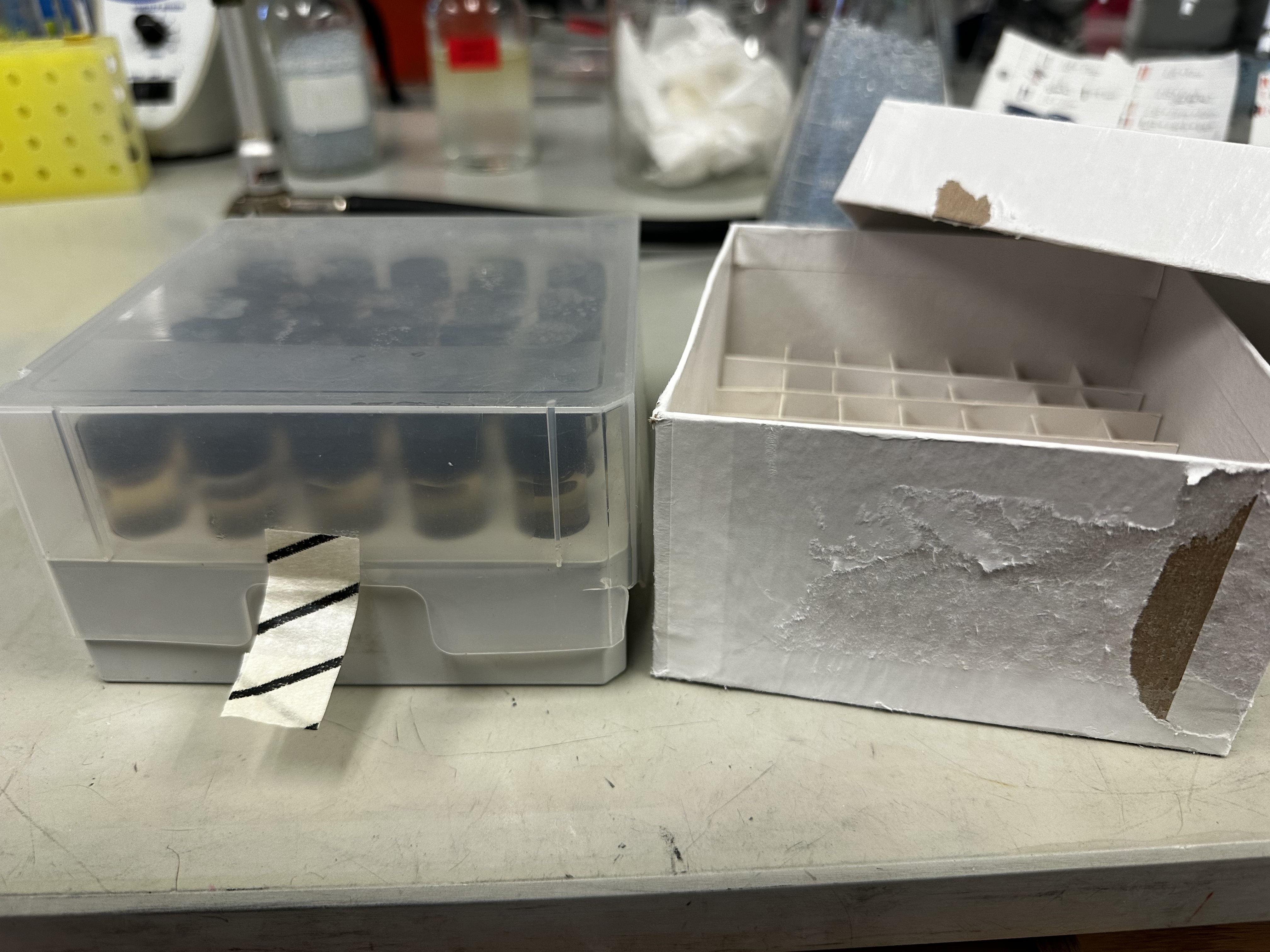
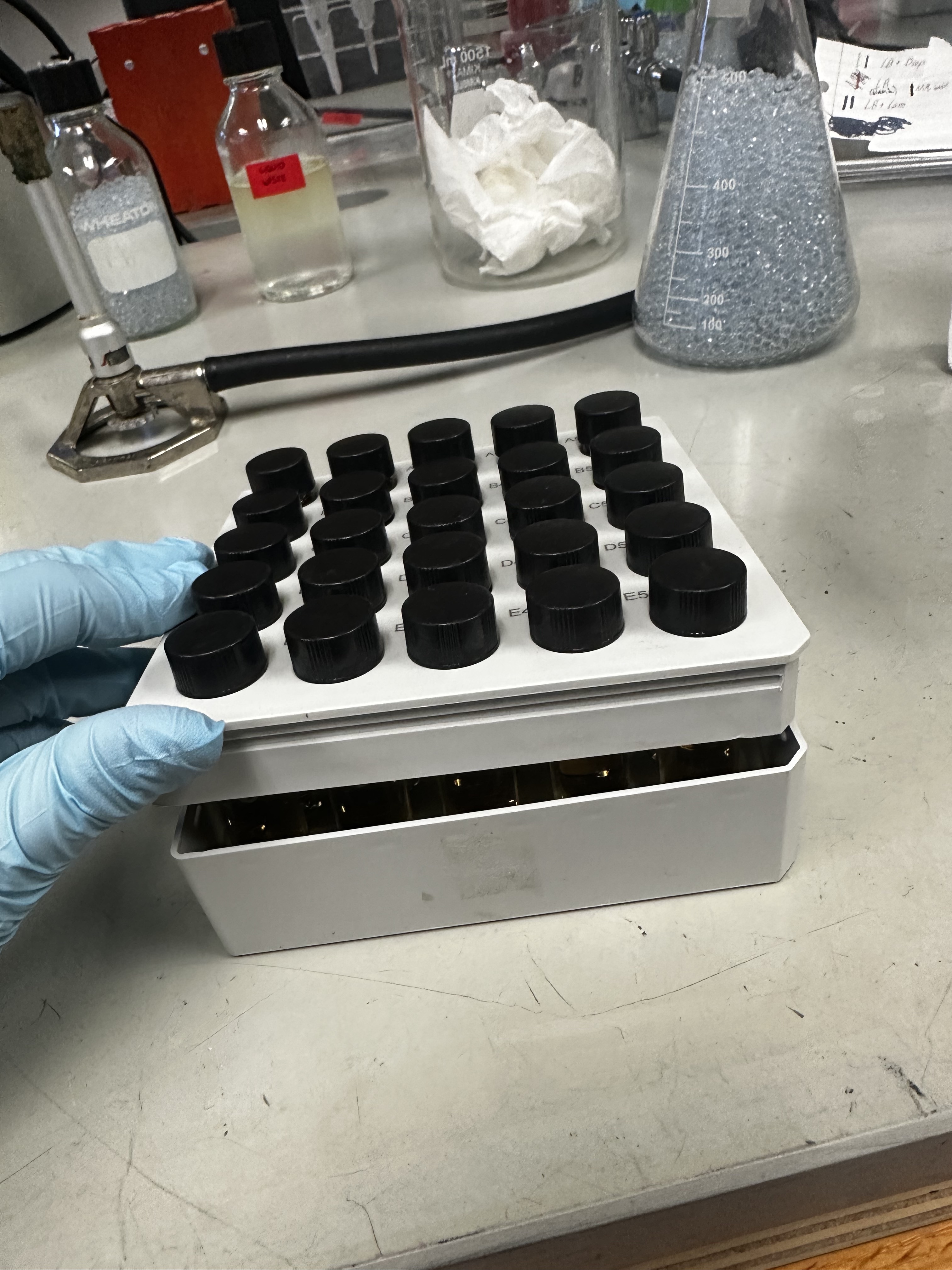
Autoclave the two-dram vials of SOC in the plastic container and store in the cardboard container when dry. Make sure lids are unscrewed prior to autoclaving and screwed shut afterward. The plastic container can have the rack popped out (see image on the right) after autoclaving to dry any water that accumulated at the bottom of the box and avoid the growth of mold and such.
Included topic: ProtocolsRecipesSOB

TGY Medium

1L 5L Component
5 g 25 g Pancreatic digest of casein
5 g 25 g Yeast Extract
1g 5 g Glucose
1 g 5 g K2HPO4
Add dH2O to final volume and autoclave.

Included topic:ProtocolsRecipesTGY

DR: Defined minimal media for D. radiodurans

250 ml 500 ml Component
50 ml 100 ml 5x M9 salts
250 ul 500 ul 5mM MnCl2
250 ul 500 ul 0.8M MgCl2
250 ul 500 ul 0.18 M CaCl2
2.5 ml 5 ml Syringe filtered Vitamins Mix
500 ul 1 ml Syringe filtered Amino Acid mix (see below)
Add dH2O to final volume.
Note: All components are either pre-sterilized or syringe filtered so the only things that need to be autoclaved are the receiving bottle and the added water.

To prepare the amino acids:

Amount Amino Acid
1 g L-Cys
0.5 g L-His
0.5 g L-Met
Dissolve these amino acids in 40 ml of dH2O

Included topic:ProtocolsRecipesDR

YPS Medium

1L 1.5L Component
3.0 g 4.5 g Yeast Extract
3.0 g 4.5 g Peptone
2.0 mL 3.0 mL 1 M Magnesium sulfate
2.0 mL 3.0 mL 1 M Calcium chloride
add water to final volume, adjust pH to 7.0 autoclave

Included topic:ProtocolsRecipesYPSMedium

1416: 4-hydroxybenzoic acid medium (for JJ-1b, Bacillus sp.)

1L 4L Component
4.25 g 17.0 g Potassium Phosphate (dibasic) K2HPO4 trihydrate
1.00 g 4.00 g Sodium Phosphate (monobasic) NaH2PO4 monohydrate
2.00 g 8.00 g Ammonium chloride NH4Cl
0.20 g 0.40 g Magnesium Sulfate MgSO4 heptahydrate
12.0 mg 48.0 mg Ferrous Sulfate FeSO4 heptahydrate
3.00 mg 12.0 mg Manganese Sulfate MnSO4 monohydrate
3.00 mg 12.0 mg Zinc Sulfate ZnSO4 heptahydrate
1.00 mg 4.00 mg Cobalt (II) Sulfate CoSO4
0.10 g 0.40 g Nitrilotriacetic acid *
1.00 g 4.00 g 4-Hydroxybenzoic acid *

* Dissolve these components in water made alkaline with concentrated NaOH before adding other components.

Adjust medium for final pH 7.2, +/- 0.2. Autoclave for at least 15 minutes.

If plates needed, add 15.0 g of agar per liter to the above recipe.

Included topic:ProtocolsRecipes1416,4-hydroxybenzoicacidmedium

YPD Medium

General media used for culturing Yeast. Adapted from Cold spring harbor

In 1 L bottle:

1L Component
20g Peptone
10 g Yeast Extract

  • Dissolve above in ~900 mL water.
  • Bring to 950 mL (final volume will be 1L after autoclaving)

In separate 500mL bottle, prepare 40% Glucose w/v

Autoclave separately. WARNING If glucose added before autoclaving, media will caramelize and be unusable.

  • Add 50 mL of 40% glucose solution to YPD media.

Included topic:ProtocolsRecipesYPDmedium

Czapek Broth (CB)

Combine in a flask:

500 mL 1 L Component
1.5 g 3 g sodium nitrate
0.5 g 1 g potassium phosphate dibasic
0.25 g 0.5 g potassium chloride
9 mg 18 mg ferrous sulfate heptahydrate
2.075 mL 4.15 mL 1 M sterile magnesium sulfate

  1. In a flask, combine sodium nitrate, potassium phosphate dibasic, potassium chloride, and ferrous sulfate heptahydrate in diH2O
    • If making 1 L of media, use 995.85 mL diH2O
    • If making 500 mL of media, use 497.925 mL diH2O
  2. Once reagents are combined and dissolved, measure pH and adjust until it reaches 7.5
  3. Once pH of 7.5 is achieved, autoclave the solution and allow to cool
  4. Once cooled, add 1 M magnesium sulfate

Source: Throne-Holst et. al 2007

Included topic:ProtocolsRecipesCzapekBroth

Solid Media

LB: Lysogeny Broth / Luria-Bertani (Miller) Agar

Add dH2O to full volume in an appropriately-sized flask. Combine the following, making sure each component fully dissolves before adding the next:

1L 6L Component
10 g 60 g Tryptone
5 g 30 g Yeast Extract
10 g 60 g NaCl
1 ml 6 ml 5% Antifoam*
16 g 48 g Agar*

ANTIFOAM: Open the bottle under sterile conditions (near a flame) only, and continue agitating after the addition of the 5% antifoam.

AGAR: Measure 8 grams of agar per 500 ml bottle and add to each individual bottle before aliquoting the LB. Autoclave to homogenize.

Each liter of LB Agar makes 2 bottles of 500 ml.

Notes and variations:

  • Common synonyms are Luria-Broth and Luria-Bertani medium.
  • This is the "Miller" formulation of LB with 10 g NaCl per liter (1% w/v). Another common formulation has only 5 g NaCl per liter (0.5% w/v)! They are NOT interchangeable.
  • If you are performing sacB counter-selection, you do not want to include NaCl in your agar. Use the above recipe, but swap out 5-10% w/v (50-100g per liter) sucrose in place of any NaCl. Sucrose can be directly combined with the other components and autoclaved (no need to filter sterilize it separately).
  • To make "soft" or "top" agar for phage studies, use only 7-8 g agar per liter.

Included topic: ProtocolsRecipesLysogenyBrothAgar

TA: Tetrazolium Sugar (TA, TM, TL, ...)

Combine in a 1 L flask:

500 mL Component
5 g Tryptone
500 mg Yeast Extract
2.5 g NaCl
8 g Agar
500 µL 5% Antifoam
Add dH2O to 433.33 mL.

Combine in a 125 ml flask:

500 mL Component
5 g Sugar (arabinose = TA, maltose = TM, lactose = TL)
Add dH2O to 66.67 mL.

Cover each flask with foil, and autoclave sugar and media separately. Total combined volume will be 500 mL.

Combine the autoclaved sugar and media solutions and add:

500 mL Component
500 µL 5% (w/v) Triphenyl Tetrazolium chloride (TTC), filter sterilized, stored at 4°C

Source: Lenski Lab Protocol

Included topic: ProtocolsRecipesTetrazoliumSugar

MG: Minimal Glucose agar, aka DM: Davis Mingioli agar

Note: When making these plates it is necessary to prepare and autoclave the 3 main parts (salts, agar, and sugar) separately. Compounds that inhibit growth are produced when agar and phosphate or phosphate and glucose are autoclaved together.

500 mL 1.0L Component
2.65 g 5.3 g Potassium Phosphate (dibasic) K2HPO4
1 g 2 g Potassium Phosphate (monobasic) KH2PO4
0.5 g 1 g Ammonium Sulfate (NH4)2 SO4
0.25 g 0.5 g Sodium Citrate (trisodium, dihydrate) Na3C6H5O7 (H2O)2
166.7 mL 333 mL dH2O

Separately, prepare the agar:

500 mL 1.0 L Component
8 g 16 g Agar
500 µL 1 mL Antifoam (5%)
166.7 mL 333 mL dH2O

Next, prepare the sugar solution. The final concentration is 0.4% w/v:

500 mL 1.0 L Component
2 g 4 g Glucose, arabinose, or other sugar
166.7 mL 333 mL dH2O
Autoclave the 3 parts separately for a 40 minute sterilization time.

After the 3 parts have been autoclaved, combine the contents of the three flasks together while they are still warm add the following stock solutions:

500 mL 1.0 L Component
500 µL 1.0 ml 10% MgSO4 (separately autoclaved stock)
500 µL 1.0 ml 0.2% Thiamine (vitamin B1) (filter sterilized stock refrigerated at 4ºC)

Source: Lenski Lab Protocol

Included topic: ProtocolsRecipesMinimalGlucose

MC: Minimal Citrate

Prepared the same as MG: Minimal Glucose with the following changes:

  • No glucose
  • 4.5 g/L Sodium Citrate (trisodium, dihydrate)

Included topic: ProtocolsRecipesMinimalCitrate

M9 Minimal Media Plates

As with DM and MG media, make sure to autoclave the agar and phosphate separately.

For 1 liter of media:

1L Component
6 g Sodium phosphate, Na2HPO4 (anhydrous)
3 g Potassium phosphate, KH2PO4
0.5 g Sodium chloride, NaCl
1 g Ammonium chloride, NH4Cl

Add dH2O to 500 mL

1L Component
16 g Agar
1 ml Antifoam

Add dH2O to 500 mL.

Autoclave media. Once the bottles are cooled to 55°C, mix the agar and M9 components.

Next, add the following sterile ingredients:

1L Component
1 ml 1M Magnesium sulfate, MgSO4
1 ml 0.1M Calcium chloride CaCl2
10 ml 10% (w/v) glucose (or other carbon source)

Included topic: ProtocolsRecipesM9

PA: Lac Papillation Agar

Make 10× Minimal A Salts.

10× Minimal A Salts
1L Component MW
80 g Potassium Phosphate (dibasic) K2HPO4 MW 174.18
45 g Potassium Phosphate (monobasic) KH2PO4 MW 136.07
10 g Ammonium Sulfate (NH4)2 SO4 MW 132.08
5 g Sodium Citrate (trisodium, dihydrate) Na3C6H5O7 (H2O)2 MW 294.10
to 1L dH2O  
Autoclave. Salt solution can be stored at room temperature.

Agar Solution
1L Component
15 g Agar
to 490 ml dH2O
Autoclave.

Sugar Solution
1L Component
2 g Glucose
to 400 ml dH2O
Autoclave.

After autoclaving, combine agar and sugar and add:

1L Component
100 ml 10× Minimal A Salts
6 ml 10% w/v (0.083M Mg2+) Magnesium Sulfate, anhydrous MgSO4 (autoclaved) MW 120.37
2.5 ml 0.2% w/v Thiamin (vitamin B1) (filter sterilized)
1 ml 500 mg/ml P-Gal (phenyl β-D-galactoside) (filter sterilized)
1 ml 40 mg/ml X-Gal (5-bromo-4-chloro-3-indolyl β-D-galactoside) (filter sterilized)

Note: The amounts added of some standard components (including agar) are slightly different for this recipe. Volumes have also been altered from the original Miller recipe to use the same stock solutions we have available for making DM plates. The final concentrations are 0.2% glucose, 0.05% P-Gal, and 0.004% X-Gal (w/v).

Sources:

  1. Nghiem, Y., Cabrera, M., Cupples, C.G., Miller, J.H. (1988) The mutY gene : A mutator locus in Escherichia coli that generates G•C→T•A transversions. Proc. Natl. Acad. Sci. U.S.A. 85:2709-2713.
  2. Miller J.H. (1972) Experiments in Molecular Genetics. Cold Spring Harbor Laboratory Press, Cold Spring Harbor, New York.

Included topic: ProtocolsPapillationAgar

TGY Medium

1.5L Component
7.5 g Pancreatic digest of casein
7.5 g Yeast Extract
1.5g Glucose
1.5 g K2HPO4
24g Agar
1.5mL Antifoam

Add dH2O to final volume and autoclave.

Included topic: ProtocolsTGYPlates

MOB: Mobility Media

This media is useful for enhancing the mobility of ADP1, which moves across the plate by "twitching".

1L Final [ ] Component
5 g 0.5% agarose
5 g 2.0% tryptone
2.5 g 10 mM NaCl

After pouring your gel, let it set overnight at room temperature. The next day, spot with 1µl of your overnight-grown culture, leave the plate to dry for 15 minutes at room temperature, wrap in Parafilm, invert, and incubate at 30°C. You should see spreading over the next 24 hours.

Included topic: ProtocolsMobilityMedia

Blood - Heart Infusion Agar

Heart Infusion Agar supplemented with sterile Sheep's Blood. Used for the cultivation of fastidious organisms (Bee gut microbiome species et al)

1L Component
44 g Heart Infusion Agar (HIA) (Difco brand)
50mL Sterile Sheep's Blood

Autoclave water and media (without blood) on a 20min liquid cycle. Transfer autoclaved media to hot water bath at 55 deg Celsius. Allow to equilibrate for 30mins to 1hr. Add 100mL blood (using PipetAid) and stir to mix (a stir bar isn't necessary, but do not shake). Smooth, small circles while the bottle is on a flat surface is sufficient to mix the blood and warm agar. Add necessary antibiotics and supplements (remember the volume is now 1100 mL, not 1 L) and pour into plates.

As with other agar, after autoclaving the HIA you can let it solidify at room temperature. After microwaving to dissolve, it still needs to be cooled before adding blood.

Included topic: ProtocolsRecipesBloodHeartInfusion

Stab Agar

Making agar stabs for storage and transport of bacterial strains.

1L Component
10 g Tryptone
5 g Yeast extract
10 g Sodium chloride
6 g Agar

Autoclave. Transfer to cryovials before media cools. Can store the vials at 4 C for a few months.

Included topic: ProtocolsRecipesStabAgar

META FILEATTACHMENT attachment="Media_Recipes.docx" attr="" comment="" date="1303834127" name="Media_Recipes.docx" path="Media Recipes.docx" size="15424" stream="Media Recipes.docx" tmpFilename="/usr/tmp/CGItemp19503" user="BrianRenda" version="1"
META FILEATTACHMENT attachment="Acinetobacter_Minimal_Succinate_Media_Recipe.docx" attr="" comment="Minimal Succinate Media for culturing Acinetobacter baylyi ADP1" date="1401826885" name="Acinetobacter_Minimal_Succinate_Media_Recipe.docx" path="Acinetobacter Minimal Succinate Media Recipe.docx" size="87008" stream="Acinetobacter Minimal Succinate Media Recipe.docx" tmpFilename="/usr/tmp/CGItemp40964" user="BrianRenda" version="1"

Revision 472024-10-16 - MeghnaVergis

 
META TOPICPARENT name="ProtocolsMediaRecipes"

Media Recipes

Liquid Media

Sterile Saline

Purpose: Used make dilutions of viable cells for plating or transfer to new media.

This saline concentration of 0.85% w/v (145 mM) is suitable for diluting E. coli before transferring to new media or plating on agar.

1L 5L Component
8.5 g 42.5 g NaCl

Add dH2O to final volume. Autoclave before use. Prepare large batches in 6 L flask and then aliquot out into bottles. It is not important to measure out exact volumes when dividing a large batch among bottles.

Included topic: ProtocolsRecipesSaline

LB: Lysogeny Broth / Luria-Bertani Medium (Miller)

Rich media used for routine culture of E. coli and other bacteria at high cell densities.

Add dH2O to desired volume in an appropriate flask. Combine the following, making sure the components completely dissolve before adding the next:

1L 6L Component
10 g 60 g Tryptone
5 g 30 g Yeast Extract
10 g 60 g NaCl

If mixing up large batches and aliquoting, be sure to add exact volumes to final media bottles so that they will be ready for addition of antibiotic to known concentrations. For 1L bottles, add 500 ml of LB to each. Each liter of LB makes 2 bottles. Autoclave.

This recipe is from Miller JH. (1992) A Short Course in Bacterial Genetics. CSHL Press. Handbook Unit 25.5.

Note: Be aware that (1) there are several other formulations that may be called LB but vary the amount of NaCl. Using the wrong one can cause large changes in growth. (2) LB was originally supposed to stand for "Lysogeny Broth" and you may also see it called "Luria Broth" (more about this).

Expected results: E. coli strains grow to 5×10⁹ cells/ml final density in LB.

Variant: 0.1×LB is made with 1 g Tryptone, 0.5 g Yeast Extract, and 10 g NaCl per liter. (It is 0.1× in the nutrients, but not the salt!)

Included topic: ProtocolsRecipesLysogenyBroth

DM: Davis-Mingioli

Growth medium used by the long-term E. coli evolution experiment.

0.5L 1L 4.5L 5L Component MW
2.67 g 5.34 g 24.03 g 26.7 g Potassium Phosphate (dibasic) K2HPO4 MW 174.18
1 g 2 g 9 g 10 g Potassium Phosphate (monobasic) KH2PO4 MW 136.07
0.5 g 1 g 4.5 g 5 g Ammonium Sulfate (NH4)2 SO4 MW 132.08
0.25 g 0.5 g 2.25 g 2.5 g Sodium Citrate (trisodium, dihydrate) Na3C6H5O7 (H2O)2 MW 294.10
Add dH2O to final volume and autoclave.

Note: 4.5 L of DM makes 8 bottles with 550 ml each.

Note: If using Potassium phosphate (dibasic) trihydrate (MW 228.22) use 7g per L

After autoclaving add the following stock solutions:

0.5L 550mL 1L 5L Component
0.5 ml 550 µl 1.0 ml 5 ml 10% (w/v) Magnesium Sulfate Heptahydrate MgSO4•7H2O (separately autoclaved stock)
0.5 ml 550 µl 1.0 ml 5 ml 0.2% (w/v) Thiamine (vitamin B1) (filter sterilized)

And supplement with a carbon source.

If preparing DM-glucose (MW 180.16 g/mol), add this volume of 10% glucose solution (separately autoclaved stock) to get the final concentration desired:

0.5L 550mL 1L 5L DMX [glucose] (w/v) [glucose] (mg/L) [glucose] (M)
125 µl 137.5 µl 250 µl 1.25 ml DM25 0.0025% 25 mg/L 139 µM
0.5 ml 0.55 ml 1 ml 5 ml DM100 0.010% 100 mg/L 694 µM
1.25 ml 1.375 ml 2.5 ml 12.5 ml DM250 0.025% 250 mg/L 1.39 µM
2.5 ml 2.75 ml 5 ml 25 ml DM500 0.05% 500 mg/L 2.78 mM
5 ml 5.5 ml 10 ml 50 ml DM1000 0.1% 1000 mg/L 5.55 mM
10 ml 11 ml 20 ml 100 ml DM2000 0.2% 2000 mg/L 11.1 mM

Remember: DMX = DM + X mg/L glucose. Glucose may no longer limit the final growth density above approximately DM1000.

Final composition
5.1 mM Sodium (Na+)
75.8 mM Potassium (K+)
15.2 mM Ammonium (NH4)
0.406 mM Magnesium (Mg2+)
8.41 mM Sulfate (SO42-)
45.3 mM Phosphate (PO43-)
1.70 mM Citrate
139 µM Glucose (in DM25)

Note: Recipe was corrected on 2026-04-22 to use MgSO4•7H2O.

Included topic: ProtocolsRecipesDavisMingioli

M9 Minimal Medium

1L Component
6 g Sodium phosphate dibasic (anhydrous), Na2HPO4
3 g Potassium phosphate monobasic, KH2PO4
0.5 g Sodium chloride, NaCl
1 g Ammonium chloride, NH4Cl
Add dH2O to 1 liter. Autoclave.

After media is autoclaved add the following sterile ingredients:

1L Component
1 ml 1M Magnesium sulfate, MgSO4
1 ml 0.1M Calcium chloride CaCl2
10 ml 10% (w/v) glucose (or other carbon source)

Final composition
93.0 mM Sodium (Na+)
22.1 mM Potassium (K+)
18.7 mM Ammonium (NH4)
1.0 mM Calcium (Ca2+)
0.1 mM Magnesium (Mg2+)
29.2 mM Chloride (Cl-
0.1 mM Sulfate (SO42-)
42.2 mM Phosphate (PO43-)

Included topic: ProtocolsRecipesM9Minimal

ABMS: Acinetobacter Minimal Succinate

Courtesy of the Averhoff lab, with modifications for available reagents.

To make standard ABMS, combine the following pre-sterilized ingredients at room temperature:

1L 5L Component
880 mL 4.4 L diH2O
20 mL 100 mL 1M Sodium Succinate
50 mL 250 mL 20× Mineral Solution
50 mL 250 mL 20× Phosphate Buffer

To make ABMS agar:

Per liter of media, add 16 g/L agar and 1 mL/L antifoam to diH2O, then autoclave in a 2 L flask. When water and agar are cool enough to touch, add component solutions. Optional: warm components at 55°C in a water bath before combining with agar to reduce the temperature difference when combined.

ABMS Component Recipes

SL9 (trace minerals)

1L Component
800 mL diH2O
12.8 g Nitrilotriacetic acid
2 g FeSO4•7H2O (note: first dissolve in 2M HCl)
104 mg CoCl2 (anhydrous)
122 mg MnCl2•4H2O
70 mg ZnCl2
36 mg Na2MoO4•2H2O
13 mg NiCl2

Add 1 mL of 10 mL 10× solution:

60 mg H3BO3
20 mg CuCl2•2H2O

To dissolve all components, adjust pH to ~7 or slightly higher using 1 M NaOH while you bring the volume to 1000 mL with diH2O. Note: this requires a lot of NaOH, so leave room when bringing up to volume.

Mineral Solution (20×)

500 mL Component
10 g NH4Cl
5.8 g MgSO4•7H2O
1 g KNO3
0.67 g CaCl2•2H2O †
20 mg (NH4)6Mo7O24•4H2O
10 mL SL 9

† Substitution: You may use 465.8 µL of a 1 M CaCl2 per 500 ml of stock solution for this component. The final concentration of Ca2+ in the 20× stock is 9.12 mM.

Bring to 500mL in a graduated cylinder with deionized water.

Phosphate Buffer (20×)

500mL Components
68 g KH2PO4
132.5 g Na2HPO4•H2O

Bring to 500 mL with diH2O; pH should be ~6.9-7.0 (you may add 400 mL diH2O first and bring pH up to 6.8 then complete volume to 500mL)

* Source: Averhoff lab

Included topic: ProtocolsRecipesABMS

R2A

R2A is a medium that can be used to grow a wide variety of soil microbes.

1L 5L Component
0.5 g 2.5 g Yeast Extract
0.5 g 2.5 g Proteose Peptone No. 3
0.5 g 2.5 g Casamino Acids
0.5 g 2.5 g Dextrose
0.5 g 2.5 g Soluble Starch
0.3 g 1.5 g Sodium Pyruvate
0.3 g 1.5 g Dipotassium Phosphate
0.05 g 0.25 g Magnesium Sulfate
Add dH2O to final volume and autoclave.

If making R2A solid media also add 15 g of agar and 1 ml of 5% antifoam per liter.

Included topic: ProtocolsRecipesR2A

RCV Medium

RCV is a complex media consisting of 3 different sub-components that must be prepared ahead of time if they are not already made.

Main recipe

1L Component
10 mL 10% (NH4)2 SO4
40 mL 10% DL-malate, pH 6.8
50 mL Super salts (see below)
15 mL 0.64 KPO4, pH 6.8 (see below)

add 3/4 H2O before adding the KPO4
adjust pH to 6.8 if needed
if making plates add 16 g Agar per L

0.64M KPO4, pH 6.8

500mL Component
20 g KH2PO4
30 g K2HPO4

Super salts

1L Component
40 mL 1.0% EDTA
20 mL 20% MgSO4 5H2O
20 mL 7.5% CaCl2 2H2O
20 mL Trace elements (see below)
48 mL 0.5% FeSO4 7H2O
20 mL 0.1% thiamine-HCl

Trace Elements

250mL Component
0.3975 g MnSO4H2O
0.7 g H3BO3 (Boric Acid)
0.01 g Cu(NO3)2 3H2O
0.06 g ZnSO4 7H2O
0.1875 g NaMoO4 2H2O (Sodium molybdate VI dihydrate)

Included topic: ProtocolsRecipesRCVMedium

SOB/SOC: Super Optimal Broth

For SOB:

200mL 250mL 1L Final [ ] Component
1 g 1.25 g 5 g 0.5% yeast extract
4 g 5 g 20 g 2.0% tryptone
0.12 g 0.125 g 0.5 g 10 mM NaCl
0.037 g* 0.042 g* 0.186 g 2 mM KCl
0.48 g 0.6 g 2.4 g 20 mM MgSO4 (anhydrous)

*Don't measure; it's just a pinch.

Adjust to pH 7.5 with 1M NaOH.

Note: 200 ml of SOC makes 25 two-dram vials of 8 ml each.

For 1 L: Add 800 ml of dH2O and dissolve components. Adjust to pH 7.5 prior to use with 1 M NaOH (approximately 25 ml). Add dH2O to a final volume 1 L.

Autoclave.

For SOC (=SOB+glucose)

Bulk scale: Make SOB, except add dH2O to a final volume of 960 ml instead of 1 L. Autoclave. When solution has cooled to 50°C (cool enough to touch with bare hands for a few seconds), add 40 ml of sterile 10% (w/v) glucose. (That's a final concentration of 0.4% glucose or about 20 mM.)

Smaller scale: To achieve a 20 mM concentration of glucose for a known final volume n of SOC, you can calculate the amount of 10% w/v glucose to be added as 0.036n. The amount of SOB to add is then 0.964n. Keep units constant, so if n is in µL, the final amounts will also be in µL and so on.

  • Note: If you have a known volume of SOB x and want to know how much 10% w/v glucose to add to make SOC containing 20 mM glucose, simply divide x/0.964 to get your final volume n and subtract x from n to get the volume of 10% w/v glucose to add.

Generally when making stocks of SOC it is advisable to make smaller volume aliquots rather than larger ones. SOC media is extremely rich and can contaminate easily particularly after glucose is added. Additionally, smaller volumes tend to be pulled from it repeatedly with pipettes, which increases the chances of contamination over time.

Note: Some recipes for SOB use 10 mM MgSO4 and 10 mM MgCl.

Containers for SOB/SOC

Autoclave the two-dram vials of SOC in the plastic container and store in the cardboard container when dry. Make sure lids are unscrewed prior to autoclaving and screwed shut afterward. The plastic container can have the rack popped out (see image on the right) after autoclaving to dry any water that accumulated at the bottom of the box and avoid the growth of mold and such.

Included topic: ProtocolsRecipesSOB

TGY Medium

1L 5L Component
5 g 25 g Pancreatic digest of casein
5 g 25 g Yeast Extract
1g 5 g Glucose
1 g 5 g K2HPO4
Add dH2O to final volume and autoclave.

Included topic:ProtocolsRecipesTGY

DR: Defined minimal media for D. radiodurans

250 ml 500 ml Component
50 ml 100 ml 5x M9 salts
250 ul 500 ul 5mM MnCl2
250 ul 500 ul 0.8M MgCl2
250 ul 500 ul 0.18 M CaCl2
2.5 ml 5 ml Syringe filtered Vitamins Mix
500 ul 1 ml Syringe filtered Amino Acid mix (see below)
Add dH2O to final volume.
Note: All components are either pre-sterilized or syringe filtered so the only things that need to be autoclaved are the receiving bottle and the added water.

To prepare the amino acids:

Amount Amino Acid
1 g L-Cys
0.5 g L-His
0.5 g L-Met
Dissolve these amino acids in 40 ml of dH2O

Included topic:ProtocolsRecipesDR

YPS Medium

1L 1.5L Component
3.0 g 4.5 g Yeast Extract
3.0 g 4.5 g Peptone
2.0 mL 3.0 mL 1 M Magnesium sulfate
2.0 mL 3.0 mL 1 M Calcium chloride
add water to final volume, adjust pH to 7.0 autoclave

Included topic:ProtocolsRecipesYPSMedium

1416: 4-hydroxybenzoic acid medium (for JJ-1b, Bacillus sp.)

1L 4L Component
4.25 g 17.0 g Potassium Phosphate (dibasic) K2HPO4 trihydrate
1.00 g 4.00 g Sodium Phosphate (monobasic) NaH2PO4 monohydrate
2.00 g 8.00 g Ammonium chloride NH4Cl
0.20 g 0.40 g Magnesium Sulfate MgSO4 heptahydrate
12.0 mg 48.0 mg Ferrous Sulfate FeSO4 heptahydrate
3.00 mg 12.0 mg Manganese Sulfate MnSO4 monohydrate
3.00 mg 12.0 mg Zinc Sulfate ZnSO4 heptahydrate
1.00 mg 4.00 mg Cobalt (II) Sulfate CoSO4
0.10 g 0.40 g Nitrilotriacetic acid *
1.00 g 4.00 g 4-Hydroxybenzoic acid *

* Dissolve these components in water made alkaline with concentrated NaOH before adding other components.

Adjust medium for final pH 7.2, +/- 0.2. Autoclave for at least 15 minutes.

If plates needed, add 15.0 g of agar per liter to the above recipe.

Included topic:ProtocolsRecipes1416,4-hydroxybenzoicacidmedium

YPD Medium

General media used for culturing Yeast. Adapted from Cold spring harbor

In 1 L bottle:

1L Component
20g Peptone
10 g Yeast Extract

  • Dissolve above in ~900 mL water.
  • Bring to 950 mL (final volume will be 1L after autoclaving)

In separate 500mL bottle, prepare 40% Glucose w/v

Autoclave separately. WARNING If glucose added before autoclaving, media will caramelize and be unusable.

  • Add 50 mL of 40% glucose solution to YPD media.

Included topic:ProtocolsRecipesYPDmedium

Czapek Broth (CB)

Combine in a flask:

500 mL 1 L Component
1.5 g 3 g sodium nitrate
0.5 g 1 g potassium phosphate dibasic
0.25 g 0.5 g potassium chloride
9 mg 18 mg ferrous sulfate heptahydrate
2.075 mL 4.15 mL 1 M sterile magnesium sulfate

  1. In a flask, combine sodium nitrate, potassium phosphate dibasic, potassium chloride, and ferrous sulfate heptahydrate in diH2O
    • If making 1 L of media, use 995.85 mL diH2O
    • If making 500 mL of media, use 497.925 mL diH2O
  2. Once reagents are combined and dissolved, measure pH and adjust until it reaches 7.5
  3. Once pH of 7.5 is achieved, autoclave the solution and allow to cool
  4. Once cooled, add 1 M magnesium sulfate

Source: Throne-Holst et. al 2007

Included topic:ProtocolsRecipesCzapekBroth

Solid Media

LB: Lysogeny Broth / Luria-Bertani (Miller) Agar

Add dH2O to full volume in an appropriately-sized flask. Combine the following, making sure each component fully dissolves before adding the next:

1L 6L Component
10 g 60 g Tryptone
5 g 30 g Yeast Extract
10 g 60 g NaCl
1 ml 6 ml 5% Antifoam*
16 g 48 g Agar*

ANTIFOAM: Open the bottle under sterile conditions (near a flame) only, and continue agitating after the addition of the 5% antifoam.

AGAR: Measure 8 grams of agar per 500 ml bottle and add to each individual bottle before aliquoting the LB. Autoclave to homogenize.

Each liter of LB Agar makes 2 bottles of 500 ml.

Notes and variations:

  • Common synonyms are Luria-Broth and Luria-Bertani medium.
  • This is the "Miller" formulation of LB with 10 g NaCl per liter (1% w/v). Another common formulation has only 5 g NaCl per liter (0.5% w/v)! They are NOT interchangeable.
  • If you are performing sacB counter-selection, you do not want to include NaCl in your agar. Use the above recipe, but swap out 5-10% w/v (50-100g per liter) sucrose in place of any NaCl. Sucrose can be directly combined with the other components and autoclaved (no need to filter sterilize it separately).
  • To make "soft" or "top" agar for phage studies, use only 7-8 g agar per liter.

Included topic: ProtocolsRecipesLysogenyBrothAgar

TA: Tetrazolium Sugar (TA, TM, TL, ...)

Combine in a 1 L flask:

500 mL Component
5 g Tryptone
500 mg Yeast Extract
2.5 g NaCl
8 g Agar
500 µL 5% Antifoam
Add dH2O to 433.33 mL.

Combine in a 125 ml flask:

500 mL Component
5 g Sugar (arabinose = TA, maltose = TM, lactose = TL)
Add dH2O to 66.67 mL.

Cover each flask with foil, and autoclave sugar and media separately. Total combined volume will be 500 mL.

Combine the autoclaved sugar and media solutions and add:

500 mL Component
500 µL 5% (w/v) Triphenyl Tetrazolium chloride (TTC), filter sterilized, stored at 4°C

Source: Lenski Lab Protocol

Included topic: ProtocolsRecipesTetrazoliumSugar

MG: Minimal Glucose agar, aka DM: Davis Mingioli agar

Note: When making these plates it is necessary to prepare and autoclave the 3 main parts (salts, agar, and sugar) separately. Compounds that inhibit growth are produced when agar and phosphate or phosphate and glucose are autoclaved together.

500 mL 1.0L Component
2.65 g 5.3 g Potassium Phosphate (dibasic) K2HPO4
1 g 2 g Potassium Phosphate (monobasic) KH2PO4
0.5 g 1 g Ammonium Sulfate (NH4)2 SO4
0.25 g 0.5 g Sodium Citrate (trisodium, dihydrate) Na3C6H5O7 (H2O)2
166.7 mL 333 mL dH2O

Separately, prepare the agar:

500 mL 1.0 L Component
8 g 16 g Agar
500 µL 1 mL Antifoam (5%)
166.7 mL 333 mL dH2O

Next, prepare the sugar solution. The final concentration is 0.4% w/v:

500 mL 1.0 L Component
2 g 4 g Glucose, arabinose, or other sugar
166.7 mL 333 mL dH2O
Autoclave the 3 parts separately for a 40 minute sterilization time.

After the 3 parts have been autoclaved, combine the contents of the three flasks together while they are still warm add the following stock solutions:

500 mL 1.0 L Component
500 µL 1.0 ml 10% MgSO4 (separately autoclaved stock)
500 µL 1.0 ml 0.2% Thiamine (vitamin B1) (filter sterilized stock refrigerated at 4ºC)

Source: Lenski Lab Protocol

Included topic: ProtocolsRecipesMinimalGlucose

MC: Minimal Citrate

Prepared the same as MG: Minimal Glucose with the following changes:

  • No glucose
  • 4.5 g/L Sodium Citrate (trisodium, dihydrate)

Included topic: ProtocolsRecipesMinimalCitrate

M9 Minimal Media Plates

As with DM and MG media, make sure to autoclave the agar and phosphate separately.

For 1 liter of media:

1L Component
6 g Sodium phosphate, Na2HPO4 (anhydrous)
3 g Potassium phosphate, KH2PO4
0.5 g Sodium chloride, NaCl
1 g Ammonium chloride, NH4Cl

Add dH2O to 500 mL

1L Component
16 g Agar
1 ml Antifoam

Add dH2O to 500 mL.

Autoclave media. Once the bottles are cooled to 55°C, mix the agar and M9 components.

Next, add the following sterile ingredients:

1L Component
1 ml 1M Magnesium sulfate, MgSO4
1 ml 0.1M Calcium chloride CaCl2
10 ml 10% (w/v) glucose (or other carbon source)

Included topic: ProtocolsRecipesM9

PA: Lac Papillation Agar

Make 10× Minimal A Salts.

10× Minimal A Salts
1L Component MW
80 g Potassium Phosphate (dibasic) K2HPO4 MW 174.18
45 g Potassium Phosphate (monobasic) KH2PO4 MW 136.07
10 g Ammonium Sulfate (NH4)2 SO4 MW 132.08
5 g Sodium Citrate (trisodium, dihydrate) Na3C6H5O7 (H2O)2 MW 294.10
to 1L dH2O  
Autoclave. Salt solution can be stored at room temperature.

Agar Solution
1L Component
15 g Agar
to 490 ml dH2O
Autoclave.

Sugar Solution
1L Component
2 g Glucose
to 400 ml dH2O
Autoclave.

After autoclaving, combine agar and sugar and add:

1L Component
100 ml 10× Minimal A Salts
6 ml 10% w/v (0.083M Mg2+) Magnesium Sulfate, anhydrous MgSO4 (autoclaved) MW 120.37
2.5 ml 0.2% w/v Thiamin (vitamin B1) (filter sterilized)
1 ml 500 mg/ml P-Gal (phenyl β-D-galactoside) (filter sterilized)
1 ml 40 mg/ml X-Gal (5-bromo-4-chloro-3-indolyl β-D-galactoside) (filter sterilized)

Note: The amounts added of some standard components (including agar) are slightly different for this recipe. Volumes have also been altered from the original Miller recipe to use the same stock solutions we have available for making DM plates. The final concentrations are 0.2% glucose, 0.05% P-Gal, and 0.004% X-Gal (w/v).

Sources:

  1. Nghiem, Y., Cabrera, M., Cupples, C.G., Miller, J.H. (1988) The mutY gene : A mutator locus in Escherichia coli that generates G•C→T•A transversions. Proc. Natl. Acad. Sci. U.S.A. 85:2709-2713.
  2. Miller J.H. (1972) Experiments in Molecular Genetics. Cold Spring Harbor Laboratory Press, Cold Spring Harbor, New York.

Included topic: ProtocolsPapillationAgar

TGY Medium

1.5L Component
7.5 g Pancreatic digest of casein
7.5 g Yeast Extract
1.5g Glucose
1.5 g K2HPO4
24g Agar
1.5mL Antifoam

Add dH2O to final volume and autoclave.

Included topic: ProtocolsTGYPlates

MOB: Mobility Media

This media is useful for enhancing the mobility of ADP1, which moves across the plate by "twitching".

1L Final [ ] Component
5 g 0.5% agarose
5 g 2.0% tryptone
2.5 g 10 mM NaCl

After pouring your gel, let it set overnight at room temperature. The next day, spot with 1µl of your overnight-grown culture, leave the plate to dry for 15 minutes at room temperature, wrap in Parafilm, invert, and incubate at 30°C. You should see spreading over the next 24 hours.

Included topic: ProtocolsMobilityMedia

Blood - Heart Infusion Agar

Heart Infusion Agar supplemented with sterile Sheep's Blood. Used for the cultivation of fastidious organisms (Bee gut microbiome species et al)

1L Component
44 g Heart Infusion Agar (HIA) (Difco brand)
50mL Sterile Sheep's Blood

Autoclave water and media (without blood) on a 20min liquid cycle. Transfer autoclaved media to hot water bath at 55 deg Celsius. Allow to equilibrate for 30mins to 1hr. Add 100mL blood (using PipetAid) and stir to mix (a stir bar isn't necessary, but do not shake). Smooth, small circles while the bottle is on a flat surface is sufficient to mix the blood and warm agar. Add necessary antibiotics and supplements (remember the volume is now 1100 mL, not 1 L) and pour into plates.

As with other agar, after autoclaving the HIA you can let it solidify at room temperature. After microwaving to dissolve, it still needs to be cooled before adding blood.

Included topic: ProtocolsRecipesBloodHeartInfusion

Stab Agar

Making agar stabs for storage and transport of bacterial strains.

1L Component
10 g Tryptone
5 g Yeast extract
10 g Sodium chloride
6 g Agar

Autoclave. Transfer to cryovials before media cools. Can store the vials at 4 C for a few months.

Included topic: ProtocolsRecipesStabAgar

META FILEATTACHMENT attachment="Media_Recipes.docx" attr="" comment="" date="1303834127" name="Media_Recipes.docx" path="Media Recipes.docx" size="15424" stream="Media Recipes.docx" tmpFilename="/usr/tmp/CGItemp19503" user="BrianRenda" version="1"
META FILEATTACHMENT attachment="Acinetobacter_Minimal_Succinate_Media_Recipe.docx" attr="" comment="Minimal Succinate Media for culturing Acinetobacter baylyi ADP1" date="1401826885" name="Acinetobacter_Minimal_Succinate_Media_Recipe.docx" path="Acinetobacter Minimal Succinate Media Recipe.docx" size="87008" stream="Acinetobacter Minimal Succinate Media Recipe.docx" tmpFilename="/usr/tmp/CGItemp40964" user="BrianRenda" version="1"

Revision 462024-07-09 - MeghnaVergis

 
META TOPICPARENT name="ProtocolsMediaRecipes"

Media Recipes

Liquid Media

Sterile Saline

Purpose: Used make dilutions of viable cells for plating or transfer to new media.

This saline concentration of 0.85% w/v (145 mM) is suitable for diluting E. coli before transferring to new media or plating on agar.

1L 5L Component
8.5 g 42.5 g NaCl

Add dH2O to final volume. Autoclave before use. Prepare large batches in 6 L flask and then aliquot out into bottles. It is not important to measure out exact volumes when dividing a large batch among bottles.

Included topic: ProtocolsRecipesSaline

LB: Lysogeny Broth / Luria-Bertani Medium (Miller)

Rich media used for routine culture of E. coli and other bacteria at high cell densities.

Add dH2O to desired volume in an appropriate flask. Combine the following, making sure the components completely dissolve before adding the next:

1L 6L Component
10 g 60 g Tryptone
5 g 30 g Yeast Extract
10 g 60 g NaCl

If mixing up large batches and aliquoting, be sure to add exact volumes to final media bottles so that they will be ready for addition of antibiotic to known concentrations. For 1L bottles, add 500 ml of LB to each. Each liter of LB makes 2 bottles. Autoclave.

This recipe is from Miller JH. (1992) A Short Course in Bacterial Genetics. CSHL Press. Handbook Unit 25.5.

Note: Be aware that (1) there are several other formulations that may be called LB but vary the amount of NaCl. Using the wrong one can cause large changes in growth. (2) LB was originally supposed to stand for "Lysogeny Broth" and you may also see it called "Luria Broth" (more about this).

Expected results: E. coli strains grow to 5×10⁹ cells/ml final density in LB.

Variant: 0.1×LB is made with 1 g Tryptone, 0.5 g Yeast Extract, and 10 g NaCl per liter. (It is 0.1× in the nutrients, but not the salt!)

Included topic: ProtocolsRecipesLysogenyBroth

DM: Davis-Mingioli

Growth medium used by the long-term E. coli evolution experiment.

0.5L 1L 4.5L 5L Component MW
2.67 g 5.34 g 24.03 g 26.7 g Potassium Phosphate (dibasic) K2HPO4 MW 174.18
1 g 2 g 9 g 10 g Potassium Phosphate (monobasic) KH2PO4 MW 136.07
0.5 g 1 g 4.5 g 5 g Ammonium Sulfate (NH4)2 SO4 MW 132.08
0.25 g 0.5 g 2.25 g 2.5 g Sodium Citrate (trisodium, dihydrate) Na3C6H5O7 (H2O)2 MW 294.10
Add dH2O to final volume and autoclave.

Note: 4.5 L of DM makes 8 bottles with 550 ml each.

Note: If using Potassium phosphate (dibasic) trihydrate (MW 228.22) use 7g per L

After autoclaving add the following stock solutions:

0.5L 550mL 1L 5L Component
0.5 ml 550 µl 1.0 ml 5 ml 10% (w/v) Magnesium Sulfate Heptahydrate MgSO4•7H2O (separately autoclaved stock)
0.5 ml 550 µl 1.0 ml 5 ml 0.2% (w/v) Thiamine (vitamin B1) (filter sterilized)

And supplement with a carbon source.

If preparing DM-glucose (MW 180.16 g/mol), add this volume of 10% glucose solution (separately autoclaved stock) to get the final concentration desired:

0.5L 550mL 1L 5L DMX [glucose] (w/v) [glucose] (mg/L) [glucose] (M)
125 µl 137.5 µl 250 µl 1.25 ml DM25 0.0025% 25 mg/L 139 µM
0.5 ml 0.55 ml 1 ml 5 ml DM100 0.010% 100 mg/L 694 µM
1.25 ml 1.375 ml 2.5 ml 12.5 ml DM250 0.025% 250 mg/L 1.39 µM
2.5 ml 2.75 ml 5 ml 25 ml DM500 0.05% 500 mg/L 2.78 mM
5 ml 5.5 ml 10 ml 50 ml DM1000 0.1% 1000 mg/L 5.55 mM
10 ml 11 ml 20 ml 100 ml DM2000 0.2% 2000 mg/L 11.1 mM

Remember: DMX = DM + X mg/L glucose. Glucose may no longer limit the final growth density above approximately DM1000.

Final composition
5.1 mM Sodium (Na+)
75.8 mM Potassium (K+)
15.2 mM Ammonium (NH4)
0.406 mM Magnesium (Mg2+)
8.41 mM Sulfate (SO42-)
45.3 mM Phosphate (PO43-)
1.70 mM Citrate
139 µM Glucose (in DM25)

Note: Recipe was corrected on 2026-04-22 to use MgSO4•7H2O.

Included topic: ProtocolsRecipesDavisMingioli

M9 Minimal Medium

1L Component
6 g Sodium phosphate dibasic (anhydrous), Na2HPO4
3 g Potassium phosphate monobasic, KH2PO4
0.5 g Sodium chloride, NaCl
1 g Ammonium chloride, NH4Cl
Add dH2O to 1 liter. Autoclave.

After media is autoclaved add the following sterile ingredients:

1L Component
1 ml 1M Magnesium sulfate, MgSO4
1 ml 0.1M Calcium chloride CaCl2
10 ml 10% (w/v) glucose (or other carbon source)

Final composition
93.0 mM Sodium (Na+)
22.1 mM Potassium (K+)
18.7 mM Ammonium (NH4)
1.0 mM Calcium (Ca2+)
0.1 mM Magnesium (Mg2+)
29.2 mM Chloride (Cl-
0.1 mM Sulfate (SO42-)
42.2 mM Phosphate (PO43-)

Included topic: ProtocolsRecipesM9Minimal

ABMS: Acinetobacter Minimal Succinate

Courtesy of the Averhoff lab, with modifications for available reagents.

To make standard ABMS, combine the following pre-sterilized ingredients at room temperature:

1L 5L Component
880 mL 4.4 L diH2O
20 mL 100 mL 1M Sodium Succinate
50 mL 250 mL 20× Mineral Solution
50 mL 250 mL 20× Phosphate Buffer

To make ABMS agar:

Per liter of media, add 16 g/L agar and 1 mL/L antifoam to diH2O, then autoclave in a 2 L flask. When water and agar are cool enough to touch, add component solutions. Optional: warm components at 55°C in a water bath before combining with agar to reduce the temperature difference when combined.

ABMS Component Recipes

SL9 (trace minerals)

1L Component
800 mL diH2O
12.8 g Nitrilotriacetic acid
2 g FeSO4•7H2O (note: first dissolve in 2M HCl)
104 mg CoCl2 (anhydrous)
122 mg MnCl2•4H2O
70 mg ZnCl2
36 mg Na2MoO4•2H2O
13 mg NiCl2

Add 1 mL of 10 mL 10× solution:

60 mg H3BO3
20 mg CuCl2•2H2O

To dissolve all components, adjust pH to ~7 or slightly higher using 1 M NaOH while you bring the volume to 1000 mL with diH2O. Note: this requires a lot of NaOH, so leave room when bringing up to volume.

Mineral Solution (20×)

500 mL Component
10 g NH4Cl
5.8 g MgSO4•7H2O
1 g KNO3
0.67 g CaCl2•2H2O †
20 mg (NH4)6Mo7O24•4H2O
10 mL SL 9

† Substitution: You may use 465.8 µL of a 1 M CaCl2 per 500 ml of stock solution for this component. The final concentration of Ca2+ in the 20× stock is 9.12 mM.

Bring to 500mL in a graduated cylinder with deionized water.

Phosphate Buffer (20×)

500mL Components
68 g KH2PO4
132.5 g Na2HPO4•H2O

Bring to 500 mL with diH2O; pH should be ~6.9-7.0 (you may add 400 mL diH2O first and bring pH up to 6.8 then complete volume to 500mL)

* Source: Averhoff lab

Included topic: ProtocolsRecipesABMS

R2A

R2A is a medium that can be used to grow a wide variety of soil microbes.

1L 5L Component
0.5 g 2.5 g Yeast Extract
0.5 g 2.5 g Proteose Peptone No. 3
0.5 g 2.5 g Casamino Acids
0.5 g 2.5 g Dextrose
0.5 g 2.5 g Soluble Starch
0.3 g 1.5 g Sodium Pyruvate
0.3 g 1.5 g Dipotassium Phosphate
0.05 g 0.25 g Magnesium Sulfate
Add dH2O to final volume and autoclave.

If making R2A solid media also add 15 g of agar and 1 ml of 5% antifoam per liter.

Included topic: ProtocolsRecipesR2A

RCV Medium

RCV is a complex media consisting of 3 different sub-components that must be prepared ahead of time if they are not already made.

Main recipe

1L Component
10 mL 10% (NH4)2 SO4
40 mL 10% DL-malate, pH 6.8
50 mL Super salts (see below)
15 mL 0.64 KPO4, pH 6.8 (see below)

add 3/4 H2O before adding the KPO4
adjust pH to 6.8 if needed
if making plates add 16 g Agar per L

0.64M KPO4, pH 6.8

500mL Component
20 g KH2PO4
30 g K2HPO4

Super salts

1L Component
40 mL 1.0% EDTA
20 mL 20% MgSO4 5H2O
20 mL 7.5% CaCl2 2H2O
20 mL Trace elements (see below)
48 mL 0.5% FeSO4 7H2O
20 mL 0.1% thiamine-HCl

Trace Elements

250mL Component
0.3975 g MnSO4H2O
0.7 g H3BO3 (Boric Acid)
0.01 g Cu(NO3)2 3H2O
0.06 g ZnSO4 7H2O
0.1875 g NaMoO4 2H2O (Sodium molybdate VI dihydrate)

Included topic: ProtocolsRecipesRCVMedium

SOB/SOC: Super Optimal Broth

For SOB:

200mL 250mL 1L Final [ ] Component
1 g 1.25 g 5 g 0.5% yeast extract
4 g 5 g 20 g 2.0% tryptone
0.12 g 0.125 g 0.5 g 10 mM NaCl
0.037 g* 0.042 g* 0.186 g 2 mM KCl
0.48 g 0.6 g 2.4 g 20 mM MgSO4 (anhydrous)

*Don't measure; it's just a pinch.

Adjust to pH 7.5 with 1M NaOH.

Note: 200 ml of SOC makes 25 two-dram vials of 8 ml each.

For 1 L: Add 800 ml of dH2O and dissolve components. Adjust to pH 7.5 prior to use with 1 M NaOH (approximately 25 ml). Add dH2O to a final volume 1 L.

Autoclave.

For SOC (=SOB+glucose)

Bulk scale: Make SOB, except add dH2O to a final volume of 960 ml instead of 1 L. Autoclave. When solution has cooled to 50°C (cool enough to touch with bare hands for a few seconds), add 40 ml of sterile 10% (w/v) glucose. (That's a final concentration of 0.4% glucose or about 20 mM.)

Smaller scale: To achieve a 20 mM concentration of glucose for a known final volume n of SOC, you can calculate the amount of 10% w/v glucose to be added as 0.036n. The amount of SOB to add is then 0.964n. Keep units constant, so if n is in µL, the final amounts will also be in µL and so on.

  • Note: If you have a known volume of SOB x and want to know how much 10% w/v glucose to add to make SOC containing 20 mM glucose, simply divide x/0.964 to get your final volume n and subtract x from n to get the volume of 10% w/v glucose to add.

Generally when making stocks of SOC it is advisable to make smaller volume aliquots rather than larger ones. SOC media is extremely rich and can contaminate easily particularly after glucose is added. Additionally, smaller volumes tend to be pulled from it repeatedly with pipettes, which increases the chances of contamination over time.

Note: Some recipes for SOB use 10 mM MgSO4 and 10 mM MgCl.

Containers for SOB/SOC

Autoclave the two-dram vials of SOC in the plastic container and store in the cardboard container when dry. Make sure lids are unscrewed prior to autoclaving and screwed shut afterward. The plastic container can have the rack popped out (see image on the right) after autoclaving to dry any water that accumulated at the bottom of the box and avoid the growth of mold and such.

Included topic: ProtocolsRecipesSOB

TGY Medium

1L 5L Component
5 g 25 g Pancreatic digest of casein
5 g 25 g Yeast Extract
1g 5 g Glucose
1 g 5 g K2HPO4
Add dH2O to final volume and autoclave.

Included topic:ProtocolsRecipesTGY

DR: Defined minimal media for D. radiodurans

250 ml 500 ml Component
50 ml 100 ml 5x M9 salts
250 ul 500 ul 5mM MnCl2
250 ul 500 ul 0.8M MgCl2
250 ul 500 ul 0.18 M CaCl2
2.5 ml 5 ml Syringe filtered Vitamins Mix
500 ul 1 ml Syringe filtered Amino Acid mix (see below)
Add dH2O to final volume.
Note: All components are either pre-sterilized or syringe filtered so the only things that need to be autoclaved are the receiving bottle and the added water.

To prepare the amino acids:

Amount Amino Acid
1 g L-Cys
0.5 g L-His
0.5 g L-Met
Dissolve these amino acids in 40 ml of dH2O

Included topic:ProtocolsRecipesDR

YPS Medium

1L 1.5L Component
3.0 g 4.5 g Yeast Extract
3.0 g 4.5 g Peptone
2.0 mL 3.0 mL 1 M Magnesium sulfate
2.0 mL 3.0 mL 1 M Calcium chloride
add water to final volume, adjust pH to 7.0 autoclave

Included topic:ProtocolsRecipesYPSMedium

1416: 4-hydroxybenzoic acid medium (for JJ-1b, Bacillus sp.)

1L 4L Component
4.25 g 17.0 g Potassium Phosphate (dibasic) K2HPO4 trihydrate
1.00 g 4.00 g Sodium Phosphate (monobasic) NaH2PO4 monohydrate
2.00 g 8.00 g Ammonium chloride NH4Cl
0.20 g 0.40 g Magnesium Sulfate MgSO4 heptahydrate
12.0 mg 48.0 mg Ferrous Sulfate FeSO4 heptahydrate
3.00 mg 12.0 mg Manganese Sulfate MnSO4 monohydrate
3.00 mg 12.0 mg Zinc Sulfate ZnSO4 heptahydrate
1.00 mg 4.00 mg Cobalt (II) Sulfate CoSO4
0.10 g 0.40 g Nitrilotriacetic acid *
1.00 g 4.00 g 4-Hydroxybenzoic acid *

* Dissolve these components in water made alkaline with concentrated NaOH before adding other components.

Adjust medium for final pH 7.2, +/- 0.2. Autoclave for at least 15 minutes.

If plates needed, add 15.0 g of agar per liter to the above recipe.

Included topic:ProtocolsRecipes1416,4-hydroxybenzoicacidmedium

YPD Medium

General media used for culturing Yeast. Adapted from Cold spring harbor

In 1 L bottle:

1L Component
20g Peptone
10 g Yeast Extract

  • Dissolve above in ~900 mL water.
  • Bring to 950 mL (final volume will be 1L after autoclaving)

In separate 500mL bottle, prepare 40% Glucose w/v

Autoclave separately. WARNING If glucose added before autoclaving, media will caramelize and be unusable.

  • Add 50 mL of 40% glucose solution to YPD media.

Included topic:ProtocolsRecipesYPDmedium

Added:
>
>

Czapek Broth (CB)

Combine in a flask:

500 mL 1 L Component
1.5 g 3 g sodium nitrate
0.5 g 1 g potassium phosphate dibasic
0.25 g 0.5 g potassium chloride
9 mg 18 mg ferrous sulfate heptahydrate
2.075 mL 4.15 mL 1 M sterile magnesium sulfate

  1. In a flask, combine sodium nitrate, potassium phosphate dibasic, potassium chloride, and ferrous sulfate heptahydrate in diH2O
    • If making 1 L of media, use 995.85 mL diH2O
    • If making 500 mL of media, use 497.925 mL diH2O
  2. Once reagents are combined and dissolved, measure pH and adjust until it reaches 7.5
  3. Once pH of 7.5 is achieved, autoclave the solution and allow to cool
  4. Once cooled, add 1 M magnesium sulfate

Source: Throne-Holst et. al 2007

Included topic:ProtocolsRecipesCzapekBroth


Solid Media

LB: Lysogeny Broth / Luria-Bertani (Miller) Agar

Add dH2O to full volume in an appropriately-sized flask. Combine the following, making sure each component fully dissolves before adding the next:

1L 6L Component
10 g 60 g Tryptone
5 g 30 g Yeast Extract
10 g 60 g NaCl
1 ml 6 ml 5% Antifoam*
16 g 48 g Agar*

ANTIFOAM: Open the bottle under sterile conditions (near a flame) only, and continue agitating after the addition of the 5% antifoam.

AGAR: Measure 8 grams of agar per 500 ml bottle and add to each individual bottle before aliquoting the LB. Autoclave to homogenize.

Each liter of LB Agar makes 2 bottles of 500 ml.

Notes and variations:

  • Common synonyms are Luria-Broth and Luria-Bertani medium.
  • This is the "Miller" formulation of LB with 10 g NaCl per liter (1% w/v). Another common formulation has only 5 g NaCl per liter (0.5% w/v)! They are NOT interchangeable.
  • If you are performing sacB counter-selection, you do not want to include NaCl in your agar. Use the above recipe, but swap out 5-10% w/v (50-100g per liter) sucrose in place of any NaCl. Sucrose can be directly combined with the other components and autoclaved (no need to filter sterilize it separately).
  • To make "soft" or "top" agar for phage studies, use only 7-8 g agar per liter.

Included topic: ProtocolsRecipesLysogenyBrothAgar

TA: Tetrazolium Sugar (TA, TM, TL, ...)

Combine in a 1 L flask:

500 mL Component
5 g Tryptone
500 mg Yeast Extract
2.5 g NaCl
8 g Agar
500 µL 5% Antifoam
Add dH2O to 433.33 mL.

Combine in a 125 ml flask:

500 mL Component
5 g Sugar (arabinose = TA, maltose = TM, lactose = TL)
Add dH2O to 66.67 mL.

Cover each flask with foil, and autoclave sugar and media separately. Total combined volume will be 500 mL.

Combine the autoclaved sugar and media solutions and add:

500 mL Component
500 µL 5% (w/v) Triphenyl Tetrazolium chloride (TTC), filter sterilized, stored at 4°C

Source: Lenski Lab Protocol

Included topic: ProtocolsRecipesTetrazoliumSugar

MG: Minimal Glucose agar, aka DM: Davis Mingioli agar

Note: When making these plates it is necessary to prepare and autoclave the 3 main parts (salts, agar, and sugar) separately. Compounds that inhibit growth are produced when agar and phosphate or phosphate and glucose are autoclaved together.

500 mL 1.0L Component
2.65 g 5.3 g Potassium Phosphate (dibasic) K2HPO4
1 g 2 g Potassium Phosphate (monobasic) KH2PO4
0.5 g 1 g Ammonium Sulfate (NH4)2 SO4
0.25 g 0.5 g Sodium Citrate (trisodium, dihydrate) Na3C6H5O7 (H2O)2
166.7 mL 333 mL dH2O

Separately, prepare the agar:

500 mL 1.0 L Component
8 g 16 g Agar
500 µL 1 mL Antifoam (5%)
166.7 mL 333 mL dH2O

Next, prepare the sugar solution. The final concentration is 0.4% w/v:

500 mL 1.0 L Component
2 g 4 g Glucose, arabinose, or other sugar
166.7 mL 333 mL dH2O
Autoclave the 3 parts separately for a 40 minute sterilization time.

After the 3 parts have been autoclaved, combine the contents of the three flasks together while they are still warm add the following stock solutions:

500 mL 1.0 L Component
500 µL 1.0 ml 10% MgSO4 (separately autoclaved stock)
500 µL 1.0 ml 0.2% Thiamine (vitamin B1) (filter sterilized stock refrigerated at 4ºC)

Source: Lenski Lab Protocol

Included topic: ProtocolsRecipesMinimalGlucose

MC: Minimal Citrate

Prepared the same as MG: Minimal Glucose with the following changes:

  • No glucose
  • 4.5 g/L Sodium Citrate (trisodium, dihydrate)

Included topic: ProtocolsRecipesMinimalCitrate

M9 Minimal Media Plates

As with DM and MG media, make sure to autoclave the agar and phosphate separately.

For 1 liter of media:

1L Component
6 g Sodium phosphate, Na2HPO4 (anhydrous)
3 g Potassium phosphate, KH2PO4
0.5 g Sodium chloride, NaCl
1 g Ammonium chloride, NH4Cl

Add dH2O to 500 mL

1L Component
16 g Agar
1 ml Antifoam

Add dH2O to 500 mL.

Autoclave media. Once the bottles are cooled to 55°C, mix the agar and M9 components.

Next, add the following sterile ingredients:

1L Component
1 ml 1M Magnesium sulfate, MgSO4
1 ml 0.1M Calcium chloride CaCl2
10 ml 10% (w/v) glucose (or other carbon source)

Included topic: ProtocolsRecipesM9

PA: Lac Papillation Agar

Make 10× Minimal A Salts.

10× Minimal A Salts
1L Component MW
80 g Potassium Phosphate (dibasic) K2HPO4 MW 174.18
45 g Potassium Phosphate (monobasic) KH2PO4 MW 136.07
10 g Ammonium Sulfate (NH4)2 SO4 MW 132.08
5 g Sodium Citrate (trisodium, dihydrate) Na3C6H5O7 (H2O)2 MW 294.10
to 1L dH2O  
Autoclave. Salt solution can be stored at room temperature.

Agar Solution
1L Component
15 g Agar
to 490 ml dH2O
Autoclave.

Sugar Solution
1L Component
2 g Glucose
to 400 ml dH2O
Autoclave.

After autoclaving, combine agar and sugar and add:

1L Component
100 ml 10× Minimal A Salts
6 ml 10% w/v (0.083M Mg2+) Magnesium Sulfate, anhydrous MgSO4 (autoclaved) MW 120.37
2.5 ml 0.2% w/v Thiamin (vitamin B1) (filter sterilized)
1 ml 500 mg/ml P-Gal (phenyl β-D-galactoside) (filter sterilized)
1 ml 40 mg/ml X-Gal (5-bromo-4-chloro-3-indolyl β-D-galactoside) (filter sterilized)

Note: The amounts added of some standard components (including agar) are slightly different for this recipe. Volumes have also been altered from the original Miller recipe to use the same stock solutions we have available for making DM plates. The final concentrations are 0.2% glucose, 0.05% P-Gal, and 0.004% X-Gal (w/v).

Sources:

  1. Nghiem, Y., Cabrera, M., Cupples, C.G., Miller, J.H. (1988) The mutY gene : A mutator locus in Escherichia coli that generates G•C→T•A transversions. Proc. Natl. Acad. Sci. U.S.A. 85:2709-2713.
  2. Miller J.H. (1972) Experiments in Molecular Genetics. Cold Spring Harbor Laboratory Press, Cold Spring Harbor, New York.

Included topic: ProtocolsPapillationAgar

TGY Medium

1.5L Component
7.5 g Pancreatic digest of casein
7.5 g Yeast Extract
1.5g Glucose
1.5 g K2HPO4
24g Agar
1.5mL Antifoam

Add dH2O to final volume and autoclave.

Included topic: ProtocolsTGYPlates

MOB: Mobility Media

This media is useful for enhancing the mobility of ADP1, which moves across the plate by "twitching".

1L Final [ ] Component
5 g 0.5% agarose
5 g 2.0% tryptone
2.5 g 10 mM NaCl

After pouring your gel, let it set overnight at room temperature. The next day, spot with 1µl of your overnight-grown culture, leave the plate to dry for 15 minutes at room temperature, wrap in Parafilm, invert, and incubate at 30°C. You should see spreading over the next 24 hours.

Included topic: ProtocolsMobilityMedia

Blood - Heart Infusion Agar

Heart Infusion Agar supplemented with sterile Sheep's Blood. Used for the cultivation of fastidious organisms (Bee gut microbiome species et al)

1L Component
44 g Heart Infusion Agar (HIA) (Difco brand)
50mL Sterile Sheep's Blood

Autoclave water and media (without blood) on a 20min liquid cycle. Transfer autoclaved media to hot water bath at 55 deg Celsius. Allow to equilibrate for 30mins to 1hr. Add 100mL blood (using PipetAid) and stir to mix (a stir bar isn't necessary, but do not shake). Smooth, small circles while the bottle is on a flat surface is sufficient to mix the blood and warm agar. Add necessary antibiotics and supplements (remember the volume is now 1100 mL, not 1 L) and pour into plates.

As with other agar, after autoclaving the HIA you can let it solidify at room temperature. After microwaving to dissolve, it still needs to be cooled before adding blood.

Included topic: ProtocolsRecipesBloodHeartInfusion

Stab Agar

Making agar stabs for storage and transport of bacterial strains.

1L Component
10 g Tryptone
5 g Yeast extract
10 g Sodium chloride
6 g Agar

Autoclave. Transfer to cryovials before media cools. Can store the vials at 4 C for a few months.

Included topic: ProtocolsRecipesStabAgar

META FILEATTACHMENT attachment="Media_Recipes.docx" attr="" comment="" date="1303834127" name="Media_Recipes.docx" path="Media Recipes.docx" size="15424" stream="Media Recipes.docx" tmpFilename="/usr/tmp/CGItemp19503" user="BrianRenda" version="1"
META FILEATTACHMENT attachment="Acinetobacter_Minimal_Succinate_Media_Recipe.docx" attr="" comment="Minimal Succinate Media for culturing Acinetobacter baylyi ADP1" date="1401826885" name="Acinetobacter_Minimal_Succinate_Media_Recipe.docx" path="Acinetobacter Minimal Succinate Media Recipe.docx" size="87008" stream="Acinetobacter Minimal Succinate Media Recipe.docx" tmpFilename="/usr/tmp/CGItemp40964" user="BrianRenda" version="1"

Revision 452022-06-01 - JeffreyBarrick

 
META TOPICPARENT name="ProtocolsMediaRecipes"

Media Recipes

Liquid Media

Sterile Saline

Purpose: Used make dilutions of viable cells for plating or transfer to new media.

This saline concentration of 0.85% w/v (145 mM) is suitable for diluting E. coli before transferring to new media or plating on agar.

1L 5L Component
8.5 g 42.5 g NaCl

Add dH2O to final volume. Autoclave before use. Prepare large batches in 6 L flask and then aliquot out into bottles. It is not important to measure out exact volumes when dividing a large batch among bottles.

Included topic: ProtocolsRecipesSaline

LB: Lysogeny Broth / Luria-Bertani Medium (Miller)

Rich media used for routine culture of E. coli and other bacteria at high cell densities.

Add dH2O to desired volume in an appropriate flask. Combine the following, making sure the components completely dissolve before adding the next:

1L 6L Component
10 g 60 g Tryptone
5 g 30 g Yeast Extract
10 g 60 g NaCl

If mixing up large batches and aliquoting, be sure to add exact volumes to final media bottles so that they will be ready for addition of antibiotic to known concentrations. For 1L bottles, add 500 ml of LB to each. Each liter of LB makes 2 bottles. Autoclave.

This recipe is from Miller JH. (1992) A Short Course in Bacterial Genetics. CSHL Press. Handbook Unit 25.5.

Note: Be aware that (1) there are several other formulations that may be called LB but vary the amount of NaCl. Using the wrong one can cause large changes in growth. (2) LB was originally supposed to stand for "Lysogeny Broth" and you may also see it called "Luria Broth" (more about this).

Expected results: E. coli strains grow to 5×10⁹ cells/ml final density in LB.

Variant: 0.1×LB is made with 1 g Tryptone, 0.5 g Yeast Extract, and 10 g NaCl per liter. (It is 0.1× in the nutrients, but not the salt!)

Included topic: ProtocolsRecipesLysogenyBroth

DM: Davis-Mingioli

Growth medium used by the long-term E. coli evolution experiment.

0.5L 1L 4.5L 5L Component MW
2.67 g 5.34 g 24.03 g 26.7 g Potassium Phosphate (dibasic) K2HPO4 MW 174.18
1 g 2 g 9 g 10 g Potassium Phosphate (monobasic) KH2PO4 MW 136.07
0.5 g 1 g 4.5 g 5 g Ammonium Sulfate (NH4)2 SO4 MW 132.08
0.25 g 0.5 g 2.25 g 2.5 g Sodium Citrate (trisodium, dihydrate) Na3C6H5O7 (H2O)2 MW 294.10
Add dH2O to final volume and autoclave.

Note: 4.5 L of DM makes 8 bottles with 550 ml each.

Note: If using Potassium phosphate (dibasic) trihydrate (MW 228.22) use 7g per L

After autoclaving add the following stock solutions:

0.5L 550mL 1L 5L Component
0.5 ml 550 µl 1.0 ml 5 ml 10% (w/v) Magnesium Sulfate Heptahydrate MgSO4•7H2O (separately autoclaved stock)
0.5 ml 550 µl 1.0 ml 5 ml 0.2% (w/v) Thiamine (vitamin B1) (filter sterilized)

And supplement with a carbon source.

If preparing DM-glucose (MW 180.16 g/mol), add this volume of 10% glucose solution (separately autoclaved stock) to get the final concentration desired:

0.5L 550mL 1L 5L DMX [glucose] (w/v) [glucose] (mg/L) [glucose] (M)
125 µl 137.5 µl 250 µl 1.25 ml DM25 0.0025% 25 mg/L 139 µM
0.5 ml 0.55 ml 1 ml 5 ml DM100 0.010% 100 mg/L 694 µM
1.25 ml 1.375 ml 2.5 ml 12.5 ml DM250 0.025% 250 mg/L 1.39 µM
2.5 ml 2.75 ml 5 ml 25 ml DM500 0.05% 500 mg/L 2.78 mM
5 ml 5.5 ml 10 ml 50 ml DM1000 0.1% 1000 mg/L 5.55 mM
10 ml 11 ml 20 ml 100 ml DM2000 0.2% 2000 mg/L 11.1 mM

Remember: DMX = DM + X mg/L glucose. Glucose may no longer limit the final growth density above approximately DM1000.

Final composition
5.1 mM Sodium (Na+)
75.8 mM Potassium (K+)
15.2 mM Ammonium (NH4)
0.406 mM Magnesium (Mg2+)
8.41 mM Sulfate (SO42-)
45.3 mM Phosphate (PO43-)
1.70 mM Citrate
139 µM Glucose (in DM25)

Note: Recipe was corrected on 2026-04-22 to use MgSO4•7H2O.

Included topic: ProtocolsRecipesDavisMingioli

Deleted:
<
<
Warning: Can't find topic Lab.ProtocolsRecipesNZYBroth

Included topic: ProtocolsRecipesNZY+Broth


M9 Minimal Medium

1L Component
6 g Sodium phosphate dibasic (anhydrous), Na2HPO4
3 g Potassium phosphate monobasic, KH2PO4
0.5 g Sodium chloride, NaCl
1 g Ammonium chloride, NH4Cl
Add dH2O to 1 liter. Autoclave.

After media is autoclaved add the following sterile ingredients:

1L Component
1 ml 1M Magnesium sulfate, MgSO4
1 ml 0.1M Calcium chloride CaCl2
10 ml 10% (w/v) glucose (or other carbon source)

Final composition
93.0 mM Sodium (Na+)
22.1 mM Potassium (K+)
18.7 mM Ammonium (NH4)
1.0 mM Calcium (Ca2+)
0.1 mM Magnesium (Mg2+)
29.2 mM Chloride (Cl-
0.1 mM Sulfate (SO42-)
42.2 mM Phosphate (PO43-)

Included topic: ProtocolsRecipesM9Minimal

ABMS: Acinetobacter Minimal Succinate

Courtesy of the Averhoff lab, with modifications for available reagents.

To make standard ABMS, combine the following pre-sterilized ingredients at room temperature:

1L 5L Component
880 mL 4.4 L diH2O
20 mL 100 mL 1M Sodium Succinate
50 mL 250 mL 20× Mineral Solution
50 mL 250 mL 20× Phosphate Buffer

To make ABMS agar:

Per liter of media, add 16 g/L agar and 1 mL/L antifoam to diH2O, then autoclave in a 2 L flask. When water and agar are cool enough to touch, add component solutions. Optional: warm components at 55°C in a water bath before combining with agar to reduce the temperature difference when combined.

ABMS Component Recipes

SL9 (trace minerals)

1L Component
800 mL diH2O
12.8 g Nitrilotriacetic acid
2 g FeSO4•7H2O (note: first dissolve in 2M HCl)
104 mg CoCl2 (anhydrous)
122 mg MnCl2•4H2O
70 mg ZnCl2
36 mg Na2MoO4•2H2O
13 mg NiCl2

Add 1 mL of 10 mL 10× solution:

60 mg H3BO3
20 mg CuCl2•2H2O

To dissolve all components, adjust pH to ~7 or slightly higher using 1 M NaOH while you bring the volume to 1000 mL with diH2O. Note: this requires a lot of NaOH, so leave room when bringing up to volume.

Mineral Solution (20×)

500 mL Component
10 g NH4Cl
5.8 g MgSO4•7H2O
1 g KNO3
0.67 g CaCl2•2H2O †
20 mg (NH4)6Mo7O24•4H2O
10 mL SL 9

† Substitution: You may use 465.8 µL of a 1 M CaCl2 per 500 ml of stock solution for this component. The final concentration of Ca2+ in the 20× stock is 9.12 mM.

Bring to 500mL in a graduated cylinder with deionized water.

Phosphate Buffer (20×)

500mL Components
68 g KH2PO4
132.5 g Na2HPO4•H2O

Bring to 500 mL with diH2O; pH should be ~6.9-7.0 (you may add 400 mL diH2O first and bring pH up to 6.8 then complete volume to 500mL)

* Source: Averhoff lab

Included topic: ProtocolsRecipesABMS

R2A

R2A is a medium that can be used to grow a wide variety of soil microbes.

1L 5L Component
0.5 g 2.5 g Yeast Extract
0.5 g 2.5 g Proteose Peptone No. 3
0.5 g 2.5 g Casamino Acids
0.5 g 2.5 g Dextrose
0.5 g 2.5 g Soluble Starch
0.3 g 1.5 g Sodium Pyruvate
0.3 g 1.5 g Dipotassium Phosphate
0.05 g 0.25 g Magnesium Sulfate
Add dH2O to final volume and autoclave.

If making R2A solid media also add 15 g of agar and 1 ml of 5% antifoam per liter.

Included topic: ProtocolsRecipesR2A

RCV Medium

RCV is a complex media consisting of 3 different sub-components that must be prepared ahead of time if they are not already made.

Main recipe

1L Component
10 mL 10% (NH4)2 SO4
40 mL 10% DL-malate, pH 6.8
50 mL Super salts (see below)
15 mL 0.64 KPO4, pH 6.8 (see below)

add 3/4 H2O before adding the KPO4
adjust pH to 6.8 if needed
if making plates add 16 g Agar per L

0.64M KPO4, pH 6.8

500mL Component
20 g KH2PO4
30 g K2HPO4

Super salts

1L Component
40 mL 1.0% EDTA
20 mL 20% MgSO4 5H2O
20 mL 7.5% CaCl2 2H2O
20 mL Trace elements (see below)
48 mL 0.5% FeSO4 7H2O
20 mL 0.1% thiamine-HCl

Trace Elements

250mL Component
0.3975 g MnSO4H2O
0.7 g H3BO3 (Boric Acid)
0.01 g Cu(NO3)2 3H2O
0.06 g ZnSO4 7H2O
0.1875 g NaMoO4 2H2O (Sodium molybdate VI dihydrate)

Included topic: ProtocolsRecipesRCVMedium

SOB/SOC: Super Optimal Broth

For SOB:

200mL 250mL 1L Final [ ] Component
1 g 1.25 g 5 g 0.5% yeast extract
4 g 5 g 20 g 2.0% tryptone
0.12 g 0.125 g 0.5 g 10 mM NaCl
0.037 g* 0.042 g* 0.186 g 2 mM KCl
0.48 g 0.6 g 2.4 g 20 mM MgSO4 (anhydrous)

*Don't measure; it's just a pinch.

Adjust to pH 7.5 with 1M NaOH.

Note: 200 ml of SOC makes 25 two-dram vials of 8 ml each.

For 1 L: Add 800 ml of dH2O and dissolve components. Adjust to pH 7.5 prior to use with 1 M NaOH (approximately 25 ml). Add dH2O to a final volume 1 L.

Autoclave.

For SOC (=SOB+glucose)

Bulk scale: Make SOB, except add dH2O to a final volume of 960 ml instead of 1 L. Autoclave. When solution has cooled to 50°C (cool enough to touch with bare hands for a few seconds), add 40 ml of sterile 10% (w/v) glucose. (That's a final concentration of 0.4% glucose or about 20 mM.)

Smaller scale: To achieve a 20 mM concentration of glucose for a known final volume n of SOC, you can calculate the amount of 10% w/v glucose to be added as 0.036n. The amount of SOB to add is then 0.964n. Keep units constant, so if n is in µL, the final amounts will also be in µL and so on.

  • Note: If you have a known volume of SOB x and want to know how much 10% w/v glucose to add to make SOC containing 20 mM glucose, simply divide x/0.964 to get your final volume n and subtract x from n to get the volume of 10% w/v glucose to add.

Generally when making stocks of SOC it is advisable to make smaller volume aliquots rather than larger ones. SOC media is extremely rich and can contaminate easily particularly after glucose is added. Additionally, smaller volumes tend to be pulled from it repeatedly with pipettes, which increases the chances of contamination over time.

Note: Some recipes for SOB use 10 mM MgSO4 and 10 mM MgCl.

Containers for SOB/SOC

Autoclave the two-dram vials of SOC in the plastic container and store in the cardboard container when dry. Make sure lids are unscrewed prior to autoclaving and screwed shut afterward. The plastic container can have the rack popped out (see image on the right) after autoclaving to dry any water that accumulated at the bottom of the box and avoid the growth of mold and such.

Included topic: ProtocolsRecipesSOB

TGY Medium

1L 5L Component
5 g 25 g Pancreatic digest of casein
5 g 25 g Yeast Extract
1g 5 g Glucose
1 g 5 g K2HPO4
Add dH2O to final volume and autoclave.

Included topic:ProtocolsRecipesTGY

DR: Defined minimal media for D. radiodurans

250 ml 500 ml Component
50 ml 100 ml 5x M9 salts
250 ul 500 ul 5mM MnCl2
250 ul 500 ul 0.8M MgCl2
250 ul 500 ul 0.18 M CaCl2
2.5 ml 5 ml Syringe filtered Vitamins Mix
500 ul 1 ml Syringe filtered Amino Acid mix (see below)
Add dH2O to final volume.
Note: All components are either pre-sterilized or syringe filtered so the only things that need to be autoclaved are the receiving bottle and the added water.

To prepare the amino acids:

Amount Amino Acid
1 g L-Cys
0.5 g L-His
0.5 g L-Met
Dissolve these amino acids in 40 ml of dH2O

Included topic:ProtocolsRecipesDR

YPS Medium

1L 1.5L Component
3.0 g 4.5 g Yeast Extract
3.0 g 4.5 g Peptone
2.0 mL 3.0 mL 1 M Magnesium sulfate
2.0 mL 3.0 mL 1 M Calcium chloride
add water to final volume, adjust pH to 7.0 autoclave

Included topic:ProtocolsRecipesYPSMedium

1416: 4-hydroxybenzoic acid medium (for JJ-1b, Bacillus sp.)

1L 4L Component
4.25 g 17.0 g Potassium Phosphate (dibasic) K2HPO4 trihydrate
1.00 g 4.00 g Sodium Phosphate (monobasic) NaH2PO4 monohydrate
2.00 g 8.00 g Ammonium chloride NH4Cl
0.20 g 0.40 g Magnesium Sulfate MgSO4 heptahydrate
12.0 mg 48.0 mg Ferrous Sulfate FeSO4 heptahydrate
3.00 mg 12.0 mg Manganese Sulfate MnSO4 monohydrate
3.00 mg 12.0 mg Zinc Sulfate ZnSO4 heptahydrate
1.00 mg 4.00 mg Cobalt (II) Sulfate CoSO4
0.10 g 0.40 g Nitrilotriacetic acid *
1.00 g 4.00 g 4-Hydroxybenzoic acid *

* Dissolve these components in water made alkaline with concentrated NaOH before adding other components.

Adjust medium for final pH 7.2, +/- 0.2. Autoclave for at least 15 minutes.

If plates needed, add 15.0 g of agar per liter to the above recipe.

Included topic:ProtocolsRecipes1416,4-hydroxybenzoicacidmedium

YPD Medium

General media used for culturing Yeast. Adapted from Cold spring harbor

In 1 L bottle:

1L Component
20g Peptone
10 g Yeast Extract

  • Dissolve above in ~900 mL water.
  • Bring to 950 mL (final volume will be 1L after autoclaving)

In separate 500mL bottle, prepare 40% Glucose w/v

Autoclave separately. WARNING If glucose added before autoclaving, media will caramelize and be unusable.

  • Add 50 mL of 40% glucose solution to YPD media.

Included topic:ProtocolsRecipesYPDmedium

Solid Media

LB: Lysogeny Broth / Luria-Bertani (Miller) Agar

Add dH2O to full volume in an appropriately-sized flask. Combine the following, making sure each component fully dissolves before adding the next:

1L 6L Component
10 g 60 g Tryptone
5 g 30 g Yeast Extract
10 g 60 g NaCl
1 ml 6 ml 5% Antifoam*
16 g 48 g Agar*

ANTIFOAM: Open the bottle under sterile conditions (near a flame) only, and continue agitating after the addition of the 5% antifoam.

AGAR: Measure 8 grams of agar per 500 ml bottle and add to each individual bottle before aliquoting the LB. Autoclave to homogenize.

Each liter of LB Agar makes 2 bottles of 500 ml.

Notes and variations:

  • Common synonyms are Luria-Broth and Luria-Bertani medium.
  • This is the "Miller" formulation of LB with 10 g NaCl per liter (1% w/v). Another common formulation has only 5 g NaCl per liter (0.5% w/v)! They are NOT interchangeable.
  • If you are performing sacB counter-selection, you do not want to include NaCl in your agar. Use the above recipe, but swap out 5-10% w/v (50-100g per liter) sucrose in place of any NaCl. Sucrose can be directly combined with the other components and autoclaved (no need to filter sterilize it separately).
  • To make "soft" or "top" agar for phage studies, use only 7-8 g agar per liter.

Included topic: ProtocolsRecipesLysogenyBrothAgar

TA: Tetrazolium Sugar (TA, TM, TL, ...)

Combine in a 1 L flask:

500 mL Component
5 g Tryptone
500 mg Yeast Extract
2.5 g NaCl
8 g Agar
500 µL 5% Antifoam
Add dH2O to 433.33 mL.

Combine in a 125 ml flask:

500 mL Component
5 g Sugar (arabinose = TA, maltose = TM, lactose = TL)
Add dH2O to 66.67 mL.

Cover each flask with foil, and autoclave sugar and media separately. Total combined volume will be 500 mL.

Combine the autoclaved sugar and media solutions and add:

500 mL Component
500 µL 5% (w/v) Triphenyl Tetrazolium chloride (TTC), filter sterilized, stored at 4°C

Source: Lenski Lab Protocol

Included topic: ProtocolsRecipesTetrazoliumSugar

MG: Minimal Glucose agar, aka DM: Davis Mingioli agar

Note: When making these plates it is necessary to prepare and autoclave the 3 main parts (salts, agar, and sugar) separately. Compounds that inhibit growth are produced when agar and phosphate or phosphate and glucose are autoclaved together.

500 mL 1.0L Component
2.65 g 5.3 g Potassium Phosphate (dibasic) K2HPO4
1 g 2 g Potassium Phosphate (monobasic) KH2PO4
0.5 g 1 g Ammonium Sulfate (NH4)2 SO4
0.25 g 0.5 g Sodium Citrate (trisodium, dihydrate) Na3C6H5O7 (H2O)2
166.7 mL 333 mL dH2O

Separately, prepare the agar:

500 mL 1.0 L Component
8 g 16 g Agar
500 µL 1 mL Antifoam (5%)
166.7 mL 333 mL dH2O

Next, prepare the sugar solution. The final concentration is 0.4% w/v:

500 mL 1.0 L Component
2 g 4 g Glucose, arabinose, or other sugar
166.7 mL 333 mL dH2O
Autoclave the 3 parts separately for a 40 minute sterilization time.

After the 3 parts have been autoclaved, combine the contents of the three flasks together while they are still warm add the following stock solutions:

500 mL 1.0 L Component
500 µL 1.0 ml 10% MgSO4 (separately autoclaved stock)
500 µL 1.0 ml 0.2% Thiamine (vitamin B1) (filter sterilized stock refrigerated at 4ºC)

Source: Lenski Lab Protocol

Included topic: ProtocolsRecipesMinimalGlucose

MC: Minimal Citrate

Prepared the same as MG: Minimal Glucose with the following changes:

  • No glucose
  • 4.5 g/L Sodium Citrate (trisodium, dihydrate)

Included topic: ProtocolsRecipesMinimalCitrate

M9 Minimal Media Plates

As with DM and MG media, make sure to autoclave the agar and phosphate separately.

For 1 liter of media:

1L Component
6 g Sodium phosphate, Na2HPO4 (anhydrous)
3 g Potassium phosphate, KH2PO4
0.5 g Sodium chloride, NaCl
1 g Ammonium chloride, NH4Cl

Add dH2O to 500 mL

1L Component
16 g Agar
1 ml Antifoam

Add dH2O to 500 mL.

Autoclave media. Once the bottles are cooled to 55°C, mix the agar and M9 components.

Next, add the following sterile ingredients:

1L Component
1 ml 1M Magnesium sulfate, MgSO4
1 ml 0.1M Calcium chloride CaCl2
10 ml 10% (w/v) glucose (or other carbon source)

Included topic: ProtocolsRecipesM9

PA: Lac Papillation Agar

Make 10× Minimal A Salts.

10× Minimal A Salts
1L Component MW
80 g Potassium Phosphate (dibasic) K2HPO4 MW 174.18
45 g Potassium Phosphate (monobasic) KH2PO4 MW 136.07
10 g Ammonium Sulfate (NH4)2 SO4 MW 132.08
5 g Sodium Citrate (trisodium, dihydrate) Na3C6H5O7 (H2O)2 MW 294.10
to 1L dH2O  
Autoclave. Salt solution can be stored at room temperature.

Agar Solution
1L Component
15 g Agar
to 490 ml dH2O
Autoclave.

Sugar Solution
1L Component
2 g Glucose
to 400 ml dH2O
Autoclave.

After autoclaving, combine agar and sugar and add:

1L Component
100 ml 10× Minimal A Salts
6 ml 10% w/v (0.083M Mg2+) Magnesium Sulfate, anhydrous MgSO4 (autoclaved) MW 120.37
2.5 ml 0.2% w/v Thiamin (vitamin B1) (filter sterilized)
1 ml 500 mg/ml P-Gal (phenyl β-D-galactoside) (filter sterilized)
1 ml 40 mg/ml X-Gal (5-bromo-4-chloro-3-indolyl β-D-galactoside) (filter sterilized)

Note: The amounts added of some standard components (including agar) are slightly different for this recipe. Volumes have also been altered from the original Miller recipe to use the same stock solutions we have available for making DM plates. The final concentrations are 0.2% glucose, 0.05% P-Gal, and 0.004% X-Gal (w/v).

Sources:

  1. Nghiem, Y., Cabrera, M., Cupples, C.G., Miller, J.H. (1988) The mutY gene : A mutator locus in Escherichia coli that generates G•C→T•A transversions. Proc. Natl. Acad. Sci. U.S.A. 85:2709-2713.
  2. Miller J.H. (1972) Experiments in Molecular Genetics. Cold Spring Harbor Laboratory Press, Cold Spring Harbor, New York.

Included topic: ProtocolsPapillationAgar

TGY Medium

1.5L Component
7.5 g Pancreatic digest of casein
7.5 g Yeast Extract
1.5g Glucose
1.5 g K2HPO4
24g Agar
1.5mL Antifoam

Add dH2O to final volume and autoclave.

Included topic: ProtocolsTGYPlates

MOB: Mobility Media

This media is useful for enhancing the mobility of ADP1, which moves across the plate by "twitching".

1L Final [ ] Component
5 g 0.5% agarose
5 g 2.0% tryptone
2.5 g 10 mM NaCl

After pouring your gel, let it set overnight at room temperature. The next day, spot with 1µl of your overnight-grown culture, leave the plate to dry for 15 minutes at room temperature, wrap in Parafilm, invert, and incubate at 30°C. You should see spreading over the next 24 hours.

Included topic: ProtocolsMobilityMedia

Blood - Heart Infusion Agar

Heart Infusion Agar supplemented with sterile Sheep's Blood. Used for the cultivation of fastidious organisms (Bee gut microbiome species et al)

1L Component
44 g Heart Infusion Agar (HIA) (Difco brand)
50mL Sterile Sheep's Blood

Autoclave water and media (without blood) on a 20min liquid cycle. Transfer autoclaved media to hot water bath at 55 deg Celsius. Allow to equilibrate for 30mins to 1hr. Add 100mL blood (using PipetAid) and stir to mix (a stir bar isn't necessary, but do not shake). Smooth, small circles while the bottle is on a flat surface is sufficient to mix the blood and warm agar. Add necessary antibiotics and supplements (remember the volume is now 1100 mL, not 1 L) and pour into plates.

As with other agar, after autoclaving the HIA you can let it solidify at room temperature. After microwaving to dissolve, it still needs to be cooled before adding blood.

Included topic: ProtocolsRecipesBloodHeartInfusion

Stab Agar

Making agar stabs for storage and transport of bacterial strains.

1L Component
10 g Tryptone
5 g Yeast extract
10 g Sodium chloride
6 g Agar

Autoclave. Transfer to cryovials before media cools. Can store the vials at 4 C for a few months.

Included topic: ProtocolsRecipesStabAgar

Deleted:
<
<
Warning: Can't find topic Lab.ProtocolsRecipesYPDplates

Included topic:ProtocolsRecipesYPDplates

 
META FILEATTACHMENT attachment="Media_Recipes.docx" attr="" comment="" date="1303834127" name="Media_Recipes.docx" path="Media Recipes.docx" size="15424" stream="Media Recipes.docx" tmpFilename="/usr/tmp/CGItemp19503" user="BrianRenda" version="1"
META FILEATTACHMENT attachment="Acinetobacter_Minimal_Succinate_Media_Recipe.docx" attr="" comment="Minimal Succinate Media for culturing Acinetobacter baylyi ADP1" date="1401826885" name="Acinetobacter_Minimal_Succinate_Media_Recipe.docx" path="Acinetobacter Minimal Succinate Media Recipe.docx" size="87008" stream="Acinetobacter Minimal Succinate Media Recipe.docx" tmpFilename="/usr/tmp/CGItemp40964" user="BrianRenda" version="1"

Revision 442021-04-19 - DanielDeatherage

 
META TOPICPARENT name="ProtocolsMediaRecipes"

Media Recipes

Liquid Media

Sterile Saline

Purpose: Used make dilutions of viable cells for plating or transfer to new media.

This saline concentration of 0.85% w/v (145 mM) is suitable for diluting E. coli before transferring to new media or plating on agar.

1L 5L Component
8.5 g 42.5 g NaCl

Add dH2O to final volume. Autoclave before use. Prepare large batches in 6 L flask and then aliquot out into bottles. It is not important to measure out exact volumes when dividing a large batch among bottles.

Included topic: ProtocolsRecipesSaline

LB: Lysogeny Broth / Luria-Bertani Medium (Miller)

Rich media used for routine culture of E. coli and other bacteria at high cell densities.

Add dH2O to desired volume in an appropriate flask. Combine the following, making sure the components completely dissolve before adding the next:

1L 6L Component
10 g 60 g Tryptone
5 g 30 g Yeast Extract
10 g 60 g NaCl

If mixing up large batches and aliquoting, be sure to add exact volumes to final media bottles so that they will be ready for addition of antibiotic to known concentrations. For 1L bottles, add 500 ml of LB to each. Each liter of LB makes 2 bottles. Autoclave.

This recipe is from Miller JH. (1992) A Short Course in Bacterial Genetics. CSHL Press. Handbook Unit 25.5.

Note: Be aware that (1) there are several other formulations that may be called LB but vary the amount of NaCl. Using the wrong one can cause large changes in growth. (2) LB was originally supposed to stand for "Lysogeny Broth" and you may also see it called "Luria Broth" (more about this).

Expected results: E. coli strains grow to 5×10⁹ cells/ml final density in LB.

Variant: 0.1×LB is made with 1 g Tryptone, 0.5 g Yeast Extract, and 10 g NaCl per liter. (It is 0.1× in the nutrients, but not the salt!)

Included topic: ProtocolsRecipesLysogenyBroth

DM: Davis-Mingioli

Growth medium used by the long-term E. coli evolution experiment.

0.5L 1L 4.5L 5L Component MW
2.67 g 5.34 g 24.03 g 26.7 g Potassium Phosphate (dibasic) K2HPO4 MW 174.18
1 g 2 g 9 g 10 g Potassium Phosphate (monobasic) KH2PO4 MW 136.07
0.5 g 1 g 4.5 g 5 g Ammonium Sulfate (NH4)2 SO4 MW 132.08
0.25 g 0.5 g 2.25 g 2.5 g Sodium Citrate (trisodium, dihydrate) Na3C6H5O7 (H2O)2 MW 294.10
Add dH2O to final volume and autoclave.

Note: 4.5 L of DM makes 8 bottles with 550 ml each.

Note: If using Potassium phosphate (dibasic) trihydrate (MW 228.22) use 7g per L

After autoclaving add the following stock solutions:

0.5L 550mL 1L 5L Component
0.5 ml 550 µl 1.0 ml 5 ml 10% (w/v) Magnesium Sulfate Heptahydrate MgSO4•7H2O (separately autoclaved stock)
0.5 ml 550 µl 1.0 ml 5 ml 0.2% (w/v) Thiamine (vitamin B1) (filter sterilized)

And supplement with a carbon source.

If preparing DM-glucose (MW 180.16 g/mol), add this volume of 10% glucose solution (separately autoclaved stock) to get the final concentration desired:

0.5L 550mL 1L 5L DMX [glucose] (w/v) [glucose] (mg/L) [glucose] (M)
125 µl 137.5 µl 250 µl 1.25 ml DM25 0.0025% 25 mg/L 139 µM
0.5 ml 0.55 ml 1 ml 5 ml DM100 0.010% 100 mg/L 694 µM
1.25 ml 1.375 ml 2.5 ml 12.5 ml DM250 0.025% 250 mg/L 1.39 µM
2.5 ml 2.75 ml 5 ml 25 ml DM500 0.05% 500 mg/L 2.78 mM
5 ml 5.5 ml 10 ml 50 ml DM1000 0.1% 1000 mg/L 5.55 mM
10 ml 11 ml 20 ml 100 ml DM2000 0.2% 2000 mg/L 11.1 mM

Remember: DMX = DM + X mg/L glucose. Glucose may no longer limit the final growth density above approximately DM1000.

Final composition
5.1 mM Sodium (Na+)
75.8 mM Potassium (K+)
15.2 mM Ammonium (NH4)
0.406 mM Magnesium (Mg2+)
8.41 mM Sulfate (SO42-)
45.3 mM Phosphate (PO43-)
1.70 mM Citrate
139 µM Glucose (in DM25)

Note: Recipe was corrected on 2026-04-22 to use MgSO4•7H2O.

Included topic: ProtocolsRecipesDavisMingioli

Warning: Can't find topic Lab.ProtocolsRecipesNZYBroth

Included topic: ProtocolsRecipesNZY+Broth

M9 Minimal Medium

1L Component
6 g Sodium phosphate dibasic (anhydrous), Na2HPO4
3 g Potassium phosphate monobasic, KH2PO4
0.5 g Sodium chloride, NaCl
1 g Ammonium chloride, NH4Cl
Add dH2O to 1 liter. Autoclave.

After media is autoclaved add the following sterile ingredients:

1L Component
1 ml 1M Magnesium sulfate, MgSO4
1 ml 0.1M Calcium chloride CaCl2
10 ml 10% (w/v) glucose (or other carbon source)

Final composition
93.0 mM Sodium (Na+)
22.1 mM Potassium (K+)
18.7 mM Ammonium (NH4)
1.0 mM Calcium (Ca2+)
0.1 mM Magnesium (Mg2+)
29.2 mM Chloride (Cl-
0.1 mM Sulfate (SO42-)
42.2 mM Phosphate (PO43-)

Included topic: ProtocolsRecipesM9Minimal

ABMS: Acinetobacter Minimal Succinate

Courtesy of the Averhoff lab, with modifications for available reagents.

To make standard ABMS, combine the following pre-sterilized ingredients at room temperature:

1L 5L Component
880 mL 4.4 L diH2O
20 mL 100 mL 1M Sodium Succinate
50 mL 250 mL 20× Mineral Solution
50 mL 250 mL 20× Phosphate Buffer

To make ABMS agar:

Per liter of media, add 16 g/L agar and 1 mL/L antifoam to diH2O, then autoclave in a 2 L flask. When water and agar are cool enough to touch, add component solutions. Optional: warm components at 55°C in a water bath before combining with agar to reduce the temperature difference when combined.

ABMS Component Recipes

SL9 (trace minerals)

1L Component
800 mL diH2O
12.8 g Nitrilotriacetic acid
2 g FeSO4•7H2O (note: first dissolve in 2M HCl)
104 mg CoCl2 (anhydrous)
122 mg MnCl2•4H2O
70 mg ZnCl2
36 mg Na2MoO4•2H2O
13 mg NiCl2

Add 1 mL of 10 mL 10× solution:

60 mg H3BO3
20 mg CuCl2•2H2O

To dissolve all components, adjust pH to ~7 or slightly higher using 1 M NaOH while you bring the volume to 1000 mL with diH2O. Note: this requires a lot of NaOH, so leave room when bringing up to volume.

Mineral Solution (20×)

500 mL Component
10 g NH4Cl
5.8 g MgSO4•7H2O
1 g KNO3
0.67 g CaCl2•2H2O †
20 mg (NH4)6Mo7O24•4H2O
10 mL SL 9

† Substitution: You may use 465.8 µL of a 1 M CaCl2 per 500 ml of stock solution for this component. The final concentration of Ca2+ in the 20× stock is 9.12 mM.

Bring to 500mL in a graduated cylinder with deionized water.

Phosphate Buffer (20×)

500mL Components
68 g KH2PO4
132.5 g Na2HPO4•H2O

Bring to 500 mL with diH2O; pH should be ~6.9-7.0 (you may add 400 mL diH2O first and bring pH up to 6.8 then complete volume to 500mL)

* Source: Averhoff lab

Included topic: ProtocolsRecipesABMS

R2A

R2A is a medium that can be used to grow a wide variety of soil microbes.

1L 5L Component
0.5 g 2.5 g Yeast Extract
0.5 g 2.5 g Proteose Peptone No. 3
0.5 g 2.5 g Casamino Acids
0.5 g 2.5 g Dextrose
0.5 g 2.5 g Soluble Starch
0.3 g 1.5 g Sodium Pyruvate
0.3 g 1.5 g Dipotassium Phosphate
0.05 g 0.25 g Magnesium Sulfate
Add dH2O to final volume and autoclave.

If making R2A solid media also add 15 g of agar and 1 ml of 5% antifoam per liter.

Included topic: ProtocolsRecipesR2A

RCV Medium

RCV is a complex media consisting of 3 different sub-components that must be prepared ahead of time if they are not already made.

Main recipe

1L Component
10 mL 10% (NH4)2 SO4
40 mL 10% DL-malate, pH 6.8
50 mL Super salts (see below)
15 mL 0.64 KPO4, pH 6.8 (see below)

add 3/4 H2O before adding the KPO4
adjust pH to 6.8 if needed
if making plates add 16 g Agar per L

0.64M KPO4, pH 6.8

500mL Component
20 g KH2PO4
30 g K2HPO4

Super salts

1L Component
40 mL 1.0% EDTA
20 mL 20% MgSO4 5H2O
20 mL 7.5% CaCl2 2H2O
20 mL Trace elements (see below)
48 mL 0.5% FeSO4 7H2O
20 mL 0.1% thiamine-HCl

Trace Elements

250mL Component
0.3975 g MnSO4H2O
0.7 g H3BO3 (Boric Acid)
0.01 g Cu(NO3)2 3H2O
0.06 g ZnSO4 7H2O
0.1875 g NaMoO4 2H2O (Sodium molybdate VI dihydrate)

Included topic: ProtocolsRecipesRCVMedium

SOB/SOC: Super Optimal Broth

For SOB:

200mL 250mL 1L Final [ ] Component
1 g 1.25 g 5 g 0.5% yeast extract
4 g 5 g 20 g 2.0% tryptone
0.12 g 0.125 g 0.5 g 10 mM NaCl
0.037 g* 0.042 g* 0.186 g 2 mM KCl
0.48 g 0.6 g 2.4 g 20 mM MgSO4 (anhydrous)

*Don't measure; it's just a pinch.

Adjust to pH 7.5 with 1M NaOH.

Note: 200 ml of SOC makes 25 two-dram vials of 8 ml each.

For 1 L: Add 800 ml of dH2O and dissolve components. Adjust to pH 7.5 prior to use with 1 M NaOH (approximately 25 ml). Add dH2O to a final volume 1 L.

Autoclave.

For SOC (=SOB+glucose)

Bulk scale: Make SOB, except add dH2O to a final volume of 960 ml instead of 1 L. Autoclave. When solution has cooled to 50°C (cool enough to touch with bare hands for a few seconds), add 40 ml of sterile 10% (w/v) glucose. (That's a final concentration of 0.4% glucose or about 20 mM.)

Smaller scale: To achieve a 20 mM concentration of glucose for a known final volume n of SOC, you can calculate the amount of 10% w/v glucose to be added as 0.036n. The amount of SOB to add is then 0.964n. Keep units constant, so if n is in µL, the final amounts will also be in µL and so on.

  • Note: If you have a known volume of SOB x and want to know how much 10% w/v glucose to add to make SOC containing 20 mM glucose, simply divide x/0.964 to get your final volume n and subtract x from n to get the volume of 10% w/v glucose to add.

Generally when making stocks of SOC it is advisable to make smaller volume aliquots rather than larger ones. SOC media is extremely rich and can contaminate easily particularly after glucose is added. Additionally, smaller volumes tend to be pulled from it repeatedly with pipettes, which increases the chances of contamination over time.

Note: Some recipes for SOB use 10 mM MgSO4 and 10 mM MgCl.

Containers for SOB/SOC

Autoclave the two-dram vials of SOC in the plastic container and store in the cardboard container when dry. Make sure lids are unscrewed prior to autoclaving and screwed shut afterward. The plastic container can have the rack popped out (see image on the right) after autoclaving to dry any water that accumulated at the bottom of the box and avoid the growth of mold and such.

Included topic: ProtocolsRecipesSOB

TGY Medium

1L 5L Component
5 g 25 g Pancreatic digest of casein
5 g 25 g Yeast Extract
1g 5 g Glucose
1 g 5 g K2HPO4
Add dH2O to final volume and autoclave.

Included topic:ProtocolsRecipesTGY

DR: Defined minimal media for D. radiodurans

250 ml 500 ml Component
50 ml 100 ml 5x M9 salts
250 ul 500 ul 5mM MnCl2
250 ul 500 ul 0.8M MgCl2
250 ul 500 ul 0.18 M CaCl2
2.5 ml 5 ml Syringe filtered Vitamins Mix
500 ul 1 ml Syringe filtered Amino Acid mix (see below)
Add dH2O to final volume.
Note: All components are either pre-sterilized or syringe filtered so the only things that need to be autoclaved are the receiving bottle and the added water.

To prepare the amino acids:

Amount Amino Acid
1 g L-Cys
0.5 g L-His
0.5 g L-Met
Dissolve these amino acids in 40 ml of dH2O

Included topic:ProtocolsRecipesDR

YPS Medium

1L 1.5L Component
3.0 g 4.5 g Yeast Extract
3.0 g 4.5 g Peptone
2.0 mL 3.0 mL 1 M Magnesium sulfate
2.0 mL 3.0 mL 1 M Calcium chloride
add water to final volume, adjust pH to 7.0 autoclave

Included topic:ProtocolsRecipesYPSMedium

1416: 4-hydroxybenzoic acid medium (for JJ-1b, Bacillus sp.)

1L 4L Component
4.25 g 17.0 g Potassium Phosphate (dibasic) K2HPO4 trihydrate
1.00 g 4.00 g Sodium Phosphate (monobasic) NaH2PO4 monohydrate
2.00 g 8.00 g Ammonium chloride NH4Cl
0.20 g 0.40 g Magnesium Sulfate MgSO4 heptahydrate
12.0 mg 48.0 mg Ferrous Sulfate FeSO4 heptahydrate
3.00 mg 12.0 mg Manganese Sulfate MnSO4 monohydrate
3.00 mg 12.0 mg Zinc Sulfate ZnSO4 heptahydrate
1.00 mg 4.00 mg Cobalt (II) Sulfate CoSO4
0.10 g 0.40 g Nitrilotriacetic acid *
1.00 g 4.00 g 4-Hydroxybenzoic acid *

* Dissolve these components in water made alkaline with concentrated NaOH before adding other components.

Adjust medium for final pH 7.2, +/- 0.2. Autoclave for at least 15 minutes.

If plates needed, add 15.0 g of agar per liter to the above recipe.

Included topic:ProtocolsRecipes1416,4-hydroxybenzoicacidmedium

Added:
>
>

YPD Medium

General media used for culturing Yeast. Adapted from Cold spring harbor

In 1 L bottle:

1L Component
20g Peptone
10 g Yeast Extract

  • Dissolve above in ~900 mL water.
  • Bring to 950 mL (final volume will be 1L after autoclaving)

In separate 500mL bottle, prepare 40% Glucose w/v

Autoclave separately. WARNING If glucose added before autoclaving, media will caramelize and be unusable.

  • Add 50 mL of 40% glucose solution to YPD media.

Included topic:ProtocolsRecipesYPDmedium


Solid Media

LB: Lysogeny Broth / Luria-Bertani (Miller) Agar

Add dH2O to full volume in an appropriately-sized flask. Combine the following, making sure each component fully dissolves before adding the next:

1L 6L Component
10 g 60 g Tryptone
5 g 30 g Yeast Extract
10 g 60 g NaCl
1 ml 6 ml 5% Antifoam*
16 g 48 g Agar*

ANTIFOAM: Open the bottle under sterile conditions (near a flame) only, and continue agitating after the addition of the 5% antifoam.

AGAR: Measure 8 grams of agar per 500 ml bottle and add to each individual bottle before aliquoting the LB. Autoclave to homogenize.

Each liter of LB Agar makes 2 bottles of 500 ml.

Notes and variations:

  • Common synonyms are Luria-Broth and Luria-Bertani medium.
  • This is the "Miller" formulation of LB with 10 g NaCl per liter (1% w/v). Another common formulation has only 5 g NaCl per liter (0.5% w/v)! They are NOT interchangeable.
  • If you are performing sacB counter-selection, you do not want to include NaCl in your agar. Use the above recipe, but swap out 5-10% w/v (50-100g per liter) sucrose in place of any NaCl. Sucrose can be directly combined with the other components and autoclaved (no need to filter sterilize it separately).
  • To make "soft" or "top" agar for phage studies, use only 7-8 g agar per liter.

Included topic: ProtocolsRecipesLysogenyBrothAgar

TA: Tetrazolium Sugar (TA, TM, TL, ...)

Combine in a 1 L flask:

500 mL Component
5 g Tryptone
500 mg Yeast Extract
2.5 g NaCl
8 g Agar
500 µL 5% Antifoam
Add dH2O to 433.33 mL.

Combine in a 125 ml flask:

500 mL Component
5 g Sugar (arabinose = TA, maltose = TM, lactose = TL)
Add dH2O to 66.67 mL.

Cover each flask with foil, and autoclave sugar and media separately. Total combined volume will be 500 mL.

Combine the autoclaved sugar and media solutions and add:

500 mL Component
500 µL 5% (w/v) Triphenyl Tetrazolium chloride (TTC), filter sterilized, stored at 4°C

Source: Lenski Lab Protocol

Included topic: ProtocolsRecipesTetrazoliumSugar

MG: Minimal Glucose agar, aka DM: Davis Mingioli agar

Note: When making these plates it is necessary to prepare and autoclave the 3 main parts (salts, agar, and sugar) separately. Compounds that inhibit growth are produced when agar and phosphate or phosphate and glucose are autoclaved together.

500 mL 1.0L Component
2.65 g 5.3 g Potassium Phosphate (dibasic) K2HPO4
1 g 2 g Potassium Phosphate (monobasic) KH2PO4
0.5 g 1 g Ammonium Sulfate (NH4)2 SO4
0.25 g 0.5 g Sodium Citrate (trisodium, dihydrate) Na3C6H5O7 (H2O)2
166.7 mL 333 mL dH2O

Separately, prepare the agar:

500 mL 1.0 L Component
8 g 16 g Agar
500 µL 1 mL Antifoam (5%)
166.7 mL 333 mL dH2O

Next, prepare the sugar solution. The final concentration is 0.4% w/v:

500 mL 1.0 L Component
2 g 4 g Glucose, arabinose, or other sugar
166.7 mL 333 mL dH2O
Autoclave the 3 parts separately for a 40 minute sterilization time.

After the 3 parts have been autoclaved, combine the contents of the three flasks together while they are still warm add the following stock solutions:

500 mL 1.0 L Component
500 µL 1.0 ml 10% MgSO4 (separately autoclaved stock)
500 µL 1.0 ml 0.2% Thiamine (vitamin B1) (filter sterilized stock refrigerated at 4ºC)

Source: Lenski Lab Protocol

Included topic: ProtocolsRecipesMinimalGlucose

MC: Minimal Citrate

Prepared the same as MG: Minimal Glucose with the following changes:

  • No glucose
  • 4.5 g/L Sodium Citrate (trisodium, dihydrate)

Included topic: ProtocolsRecipesMinimalCitrate

M9 Minimal Media Plates

As with DM and MG media, make sure to autoclave the agar and phosphate separately.

For 1 liter of media:

1L Component
6 g Sodium phosphate, Na2HPO4 (anhydrous)
3 g Potassium phosphate, KH2PO4
0.5 g Sodium chloride, NaCl
1 g Ammonium chloride, NH4Cl

Add dH2O to 500 mL

1L Component
16 g Agar
1 ml Antifoam

Add dH2O to 500 mL.

Autoclave media. Once the bottles are cooled to 55°C, mix the agar and M9 components.

Next, add the following sterile ingredients:

1L Component
1 ml 1M Magnesium sulfate, MgSO4
1 ml 0.1M Calcium chloride CaCl2
10 ml 10% (w/v) glucose (or other carbon source)

Included topic: ProtocolsRecipesM9

PA: Lac Papillation Agar

Make 10× Minimal A Salts.

10× Minimal A Salts
1L Component MW
80 g Potassium Phosphate (dibasic) K2HPO4 MW 174.18
45 g Potassium Phosphate (monobasic) KH2PO4 MW 136.07
10 g Ammonium Sulfate (NH4)2 SO4 MW 132.08
5 g Sodium Citrate (trisodium, dihydrate) Na3C6H5O7 (H2O)2 MW 294.10
to 1L dH2O  
Autoclave. Salt solution can be stored at room temperature.

Agar Solution
1L Component
15 g Agar
to 490 ml dH2O
Autoclave.

Sugar Solution
1L Component
2 g Glucose
to 400 ml dH2O
Autoclave.

After autoclaving, combine agar and sugar and add:

1L Component
100 ml 10× Minimal A Salts
6 ml 10% w/v (0.083M Mg2+) Magnesium Sulfate, anhydrous MgSO4 (autoclaved) MW 120.37
2.5 ml 0.2% w/v Thiamin (vitamin B1) (filter sterilized)
1 ml 500 mg/ml P-Gal (phenyl β-D-galactoside) (filter sterilized)
1 ml 40 mg/ml X-Gal (5-bromo-4-chloro-3-indolyl β-D-galactoside) (filter sterilized)

Note: The amounts added of some standard components (including agar) are slightly different for this recipe. Volumes have also been altered from the original Miller recipe to use the same stock solutions we have available for making DM plates. The final concentrations are 0.2% glucose, 0.05% P-Gal, and 0.004% X-Gal (w/v).

Sources:

  1. Nghiem, Y., Cabrera, M., Cupples, C.G., Miller, J.H. (1988) The mutY gene : A mutator locus in Escherichia coli that generates G•C→T•A transversions. Proc. Natl. Acad. Sci. U.S.A. 85:2709-2713.
  2. Miller J.H. (1972) Experiments in Molecular Genetics. Cold Spring Harbor Laboratory Press, Cold Spring Harbor, New York.

Included topic: ProtocolsPapillationAgar

TGY Medium

1.5L Component
7.5 g Pancreatic digest of casein
7.5 g Yeast Extract
1.5g Glucose
1.5 g K2HPO4
24g Agar
1.5mL Antifoam

Add dH2O to final volume and autoclave.

Included topic: ProtocolsTGYPlates

MOB: Mobility Media

This media is useful for enhancing the mobility of ADP1, which moves across the plate by "twitching".

1L Final [ ] Component
5 g 0.5% agarose
5 g 2.0% tryptone
2.5 g 10 mM NaCl

After pouring your gel, let it set overnight at room temperature. The next day, spot with 1µl of your overnight-grown culture, leave the plate to dry for 15 minutes at room temperature, wrap in Parafilm, invert, and incubate at 30°C. You should see spreading over the next 24 hours.

Included topic: ProtocolsMobilityMedia

Blood - Heart Infusion Agar

Heart Infusion Agar supplemented with sterile Sheep's Blood. Used for the cultivation of fastidious organisms (Bee gut microbiome species et al)

1L Component
44 g Heart Infusion Agar (HIA) (Difco brand)
50mL Sterile Sheep's Blood

Autoclave water and media (without blood) on a 20min liquid cycle. Transfer autoclaved media to hot water bath at 55 deg Celsius. Allow to equilibrate for 30mins to 1hr. Add 100mL blood (using PipetAid) and stir to mix (a stir bar isn't necessary, but do not shake). Smooth, small circles while the bottle is on a flat surface is sufficient to mix the blood and warm agar. Add necessary antibiotics and supplements (remember the volume is now 1100 mL, not 1 L) and pour into plates.

As with other agar, after autoclaving the HIA you can let it solidify at room temperature. After microwaving to dissolve, it still needs to be cooled before adding blood.

Included topic: ProtocolsRecipesBloodHeartInfusion

Stab Agar

Making agar stabs for storage and transport of bacterial strains.

1L Component
10 g Tryptone
5 g Yeast extract
10 g Sodium chloride
6 g Agar

Autoclave. Transfer to cryovials before media cools. Can store the vials at 4 C for a few months.

Included topic: ProtocolsRecipesStabAgar

Added:
>
>
Warning: Can't find topic Lab.ProtocolsRecipesYPDplates

Included topic:ProtocolsRecipesYPDplates

 
META FILEATTACHMENT attachment="Media_Recipes.docx" attr="" comment="" date="1303834127" name="Media_Recipes.docx" path="Media Recipes.docx" size="15424" stream="Media Recipes.docx" tmpFilename="/usr/tmp/CGItemp19503" user="BrianRenda" version="1"
META FILEATTACHMENT attachment="Acinetobacter_Minimal_Succinate_Media_Recipe.docx" attr="" comment="Minimal Succinate Media for culturing Acinetobacter baylyi ADP1" date="1401826885" name="Acinetobacter_Minimal_Succinate_Media_Recipe.docx" path="Acinetobacter Minimal Succinate Media Recipe.docx" size="87008" stream="Acinetobacter Minimal Succinate Media Recipe.docx" tmpFilename="/usr/tmp/CGItemp40964" user="BrianRenda" version="1"

Revision 432020-02-14 - JeffreyBarrick

 
META TOPICPARENT name="ProtocolsMediaRecipes"

Media Recipes

Liquid Media

Sterile Saline

Purpose: Used make dilutions of viable cells for plating or transfer to new media.

This saline concentration of 0.85% w/v (145 mM) is suitable for diluting E. coli before transferring to new media or plating on agar.

1L 5L Component
8.5 g 42.5 g NaCl

Add dH2O to final volume. Autoclave before use. Prepare large batches in 6 L flask and then aliquot out into bottles. It is not important to measure out exact volumes when dividing a large batch among bottles.

Included topic: ProtocolsRecipesSaline

LB: Lysogeny Broth / Luria-Bertani Medium (Miller)

Rich media used for routine culture of E. coli and other bacteria at high cell densities.

Add dH2O to desired volume in an appropriate flask. Combine the following, making sure the components completely dissolve before adding the next:

1L 6L Component
10 g 60 g Tryptone
5 g 30 g Yeast Extract
10 g 60 g NaCl

If mixing up large batches and aliquoting, be sure to add exact volumes to final media bottles so that they will be ready for addition of antibiotic to known concentrations. For 1L bottles, add 500 ml of LB to each. Each liter of LB makes 2 bottles. Autoclave.

This recipe is from Miller JH. (1992) A Short Course in Bacterial Genetics. CSHL Press. Handbook Unit 25.5.

Note: Be aware that (1) there are several other formulations that may be called LB but vary the amount of NaCl. Using the wrong one can cause large changes in growth. (2) LB was originally supposed to stand for "Lysogeny Broth" and you may also see it called "Luria Broth" (more about this).

Expected results: E. coli strains grow to 5×10⁹ cells/ml final density in LB.

Variant: 0.1×LB is made with 1 g Tryptone, 0.5 g Yeast Extract, and 10 g NaCl per liter. (It is 0.1× in the nutrients, but not the salt!)

Included topic: ProtocolsRecipesLysogenyBroth

DM: Davis-Mingioli

Growth medium used by the long-term E. coli evolution experiment.

0.5L 1L 4.5L 5L Component MW
2.67 g 5.34 g 24.03 g 26.7 g Potassium Phosphate (dibasic) K2HPO4 MW 174.18
1 g 2 g 9 g 10 g Potassium Phosphate (monobasic) KH2PO4 MW 136.07
0.5 g 1 g 4.5 g 5 g Ammonium Sulfate (NH4)2 SO4 MW 132.08
0.25 g 0.5 g 2.25 g 2.5 g Sodium Citrate (trisodium, dihydrate) Na3C6H5O7 (H2O)2 MW 294.10
Add dH2O to final volume and autoclave.

Note: 4.5 L of DM makes 8 bottles with 550 ml each.

Note: If using Potassium phosphate (dibasic) trihydrate (MW 228.22) use 7g per L

After autoclaving add the following stock solutions:

0.5L 550mL 1L 5L Component
0.5 ml 550 µl 1.0 ml 5 ml 10% (w/v) Magnesium Sulfate Heptahydrate MgSO4•7H2O (separately autoclaved stock)
0.5 ml 550 µl 1.0 ml 5 ml 0.2% (w/v) Thiamine (vitamin B1) (filter sterilized)

And supplement with a carbon source.

If preparing DM-glucose (MW 180.16 g/mol), add this volume of 10% glucose solution (separately autoclaved stock) to get the final concentration desired:

0.5L 550mL 1L 5L DMX [glucose] (w/v) [glucose] (mg/L) [glucose] (M)
125 µl 137.5 µl 250 µl 1.25 ml DM25 0.0025% 25 mg/L 139 µM
0.5 ml 0.55 ml 1 ml 5 ml DM100 0.010% 100 mg/L 694 µM
1.25 ml 1.375 ml 2.5 ml 12.5 ml DM250 0.025% 250 mg/L 1.39 µM
2.5 ml 2.75 ml 5 ml 25 ml DM500 0.05% 500 mg/L 2.78 mM
5 ml 5.5 ml 10 ml 50 ml DM1000 0.1% 1000 mg/L 5.55 mM
10 ml 11 ml 20 ml 100 ml DM2000 0.2% 2000 mg/L 11.1 mM

Remember: DMX = DM + X mg/L glucose. Glucose may no longer limit the final growth density above approximately DM1000.

Final composition
5.1 mM Sodium (Na+)
75.8 mM Potassium (K+)
15.2 mM Ammonium (NH4)
0.406 mM Magnesium (Mg2+)
8.41 mM Sulfate (SO42-)
45.3 mM Phosphate (PO43-)
1.70 mM Citrate
139 µM Glucose (in DM25)

Note: Recipe was corrected on 2026-04-22 to use MgSO4•7H2O.

Included topic: ProtocolsRecipesDavisMingioli

Warning: Can't find topic Lab.ProtocolsRecipesNZYBroth

Included topic: ProtocolsRecipesNZY+Broth

M9 Minimal Medium

1L Component
6 g Sodium phosphate dibasic (anhydrous), Na2HPO4
3 g Potassium phosphate monobasic, KH2PO4
0.5 g Sodium chloride, NaCl
1 g Ammonium chloride, NH4Cl
Add dH2O to 1 liter. Autoclave.

After media is autoclaved add the following sterile ingredients:

1L Component
1 ml 1M Magnesium sulfate, MgSO4
1 ml 0.1M Calcium chloride CaCl2
10 ml 10% (w/v) glucose (or other carbon source)

Final composition
93.0 mM Sodium (Na+)
22.1 mM Potassium (K+)
18.7 mM Ammonium (NH4)
1.0 mM Calcium (Ca2+)
0.1 mM Magnesium (Mg2+)
29.2 mM Chloride (Cl-
0.1 mM Sulfate (SO42-)
42.2 mM Phosphate (PO43-)

Included topic: ProtocolsRecipesM9Minimal

ABMS: Acinetobacter Minimal Succinate

Courtesy of the Averhoff lab, with modifications for available reagents.

To make standard ABMS, combine the following pre-sterilized ingredients at room temperature:

1L 5L Component
880 mL 4.4 L diH2O
20 mL 100 mL 1M Sodium Succinate
50 mL 250 mL 20× Mineral Solution
50 mL 250 mL 20× Phosphate Buffer

To make ABMS agar:

Per liter of media, add 16 g/L agar and 1 mL/L antifoam to diH2O, then autoclave in a 2 L flask. When water and agar are cool enough to touch, add component solutions. Optional: warm components at 55°C in a water bath before combining with agar to reduce the temperature difference when combined.

ABMS Component Recipes

SL9 (trace minerals)

1L Component
800 mL diH2O
12.8 g Nitrilotriacetic acid
2 g FeSO4•7H2O (note: first dissolve in 2M HCl)
104 mg CoCl2 (anhydrous)
122 mg MnCl2•4H2O
70 mg ZnCl2
36 mg Na2MoO4•2H2O
13 mg NiCl2

Add 1 mL of 10 mL 10× solution:

60 mg H3BO3
20 mg CuCl2•2H2O

To dissolve all components, adjust pH to ~7 or slightly higher using 1 M NaOH while you bring the volume to 1000 mL with diH2O. Note: this requires a lot of NaOH, so leave room when bringing up to volume.

Mineral Solution (20×)

500 mL Component
10 g NH4Cl
5.8 g MgSO4•7H2O
1 g KNO3
0.67 g CaCl2•2H2O †
20 mg (NH4)6Mo7O24•4H2O
10 mL SL 9

† Substitution: You may use 465.8 µL of a 1 M CaCl2 per 500 ml of stock solution for this component. The final concentration of Ca2+ in the 20× stock is 9.12 mM.

Bring to 500mL in a graduated cylinder with deionized water.

Phosphate Buffer (20×)

500mL Components
68 g KH2PO4
132.5 g Na2HPO4•H2O

Bring to 500 mL with diH2O; pH should be ~6.9-7.0 (you may add 400 mL diH2O first and bring pH up to 6.8 then complete volume to 500mL)

* Source: Averhoff lab

Included topic: ProtocolsRecipesABMS

R2A

R2A is a medium that can be used to grow a wide variety of soil microbes.

1L 5L Component
0.5 g 2.5 g Yeast Extract
0.5 g 2.5 g Proteose Peptone No. 3
0.5 g 2.5 g Casamino Acids
0.5 g 2.5 g Dextrose
0.5 g 2.5 g Soluble Starch
0.3 g 1.5 g Sodium Pyruvate
0.3 g 1.5 g Dipotassium Phosphate
0.05 g 0.25 g Magnesium Sulfate
Add dH2O to final volume and autoclave.

If making R2A solid media also add 15 g of agar and 1 ml of 5% antifoam per liter.

Included topic: ProtocolsRecipesR2A

RCV Medium

RCV is a complex media consisting of 3 different sub-components that must be prepared ahead of time if they are not already made.

Main recipe

1L Component
10 mL 10% (NH4)2 SO4
40 mL 10% DL-malate, pH 6.8
50 mL Super salts (see below)
15 mL 0.64 KPO4, pH 6.8 (see below)

add 3/4 H2O before adding the KPO4
adjust pH to 6.8 if needed
if making plates add 16 g Agar per L

0.64M KPO4, pH 6.8

500mL Component
20 g KH2PO4
30 g K2HPO4

Super salts

1L Component
40 mL 1.0% EDTA
20 mL 20% MgSO4 5H2O
20 mL 7.5% CaCl2 2H2O
20 mL Trace elements (see below)
48 mL 0.5% FeSO4 7H2O
20 mL 0.1% thiamine-HCl

Trace Elements

250mL Component
0.3975 g MnSO4H2O
0.7 g H3BO3 (Boric Acid)
0.01 g Cu(NO3)2 3H2O
0.06 g ZnSO4 7H2O
0.1875 g NaMoO4 2H2O (Sodium molybdate VI dihydrate)

Included topic: ProtocolsRecipesRCVMedium

SOB/SOC: Super Optimal Broth

For SOB:

200mL 250mL 1L Final [ ] Component
1 g 1.25 g 5 g 0.5% yeast extract
4 g 5 g 20 g 2.0% tryptone
0.12 g 0.125 g 0.5 g 10 mM NaCl
0.037 g* 0.042 g* 0.186 g 2 mM KCl
0.48 g 0.6 g 2.4 g 20 mM MgSO4 (anhydrous)

*Don't measure; it's just a pinch.

Adjust to pH 7.5 with 1M NaOH.

Note: 200 ml of SOC makes 25 two-dram vials of 8 ml each.

For 1 L: Add 800 ml of dH2O and dissolve components. Adjust to pH 7.5 prior to use with 1 M NaOH (approximately 25 ml). Add dH2O to a final volume 1 L.

Autoclave.

For SOC (=SOB+glucose)

Bulk scale: Make SOB, except add dH2O to a final volume of 960 ml instead of 1 L. Autoclave. When solution has cooled to 50°C (cool enough to touch with bare hands for a few seconds), add 40 ml of sterile 10% (w/v) glucose. (That's a final concentration of 0.4% glucose or about 20 mM.)

Smaller scale: To achieve a 20 mM concentration of glucose for a known final volume n of SOC, you can calculate the amount of 10% w/v glucose to be added as 0.036n. The amount of SOB to add is then 0.964n. Keep units constant, so if n is in µL, the final amounts will also be in µL and so on.

  • Note: If you have a known volume of SOB x and want to know how much 10% w/v glucose to add to make SOC containing 20 mM glucose, simply divide x/0.964 to get your final volume n and subtract x from n to get the volume of 10% w/v glucose to add.

Generally when making stocks of SOC it is advisable to make smaller volume aliquots rather than larger ones. SOC media is extremely rich and can contaminate easily particularly after glucose is added. Additionally, smaller volumes tend to be pulled from it repeatedly with pipettes, which increases the chances of contamination over time.

Note: Some recipes for SOB use 10 mM MgSO4 and 10 mM MgCl.

Containers for SOB/SOC

Autoclave the two-dram vials of SOC in the plastic container and store in the cardboard container when dry. Make sure lids are unscrewed prior to autoclaving and screwed shut afterward. The plastic container can have the rack popped out (see image on the right) after autoclaving to dry any water that accumulated at the bottom of the box and avoid the growth of mold and such.

Included topic: ProtocolsRecipesSOB

TGY Medium

1L 5L Component
5 g 25 g Pancreatic digest of casein
5 g 25 g Yeast Extract
1g 5 g Glucose
1 g 5 g K2HPO4
Add dH2O to final volume and autoclave.

Included topic:ProtocolsRecipesTGY

DR: Defined minimal media for D. radiodurans

250 ml 500 ml Component
50 ml 100 ml 5x M9 salts
250 ul 500 ul 5mM MnCl2
250 ul 500 ul 0.8M MgCl2
250 ul 500 ul 0.18 M CaCl2
2.5 ml 5 ml Syringe filtered Vitamins Mix
500 ul 1 ml Syringe filtered Amino Acid mix (see below)
Add dH2O to final volume.
Note: All components are either pre-sterilized or syringe filtered so the only things that need to be autoclaved are the receiving bottle and the added water.

To prepare the amino acids:

Amount Amino Acid
1 g L-Cys
0.5 g L-His
0.5 g L-Met
Dissolve these amino acids in 40 ml of dH2O

Included topic:ProtocolsRecipesDR

YPS Medium

1L 1.5L Component
3.0 g 4.5 g Yeast Extract
3.0 g 4.5 g Peptone
2.0 mL 3.0 mL 1 M Magnesium sulfate
2.0 mL 3.0 mL 1 M Calcium chloride
add water to final volume, adjust pH to 7.0 autoclave

Included topic:ProtocolsRecipesYPSMedium

1416: 4-hydroxybenzoic acid medium (for JJ-1b, Bacillus sp.)

1L 4L Component
4.25 g 17.0 g Potassium Phosphate (dibasic) K2HPO4 trihydrate
1.00 g 4.00 g Sodium Phosphate (monobasic) NaH2PO4 monohydrate
2.00 g 8.00 g Ammonium chloride NH4Cl
0.20 g 0.40 g Magnesium Sulfate MgSO4 heptahydrate
12.0 mg 48.0 mg Ferrous Sulfate FeSO4 heptahydrate
3.00 mg 12.0 mg Manganese Sulfate MnSO4 monohydrate
3.00 mg 12.0 mg Zinc Sulfate ZnSO4 heptahydrate
1.00 mg 4.00 mg Cobalt (II) Sulfate CoSO4
0.10 g 0.40 g Nitrilotriacetic acid *
1.00 g 4.00 g 4-Hydroxybenzoic acid *

* Dissolve these components in water made alkaline with concentrated NaOH before adding other components.

Adjust medium for final pH 7.2, +/- 0.2. Autoclave for at least 15 minutes.

If plates needed, add 15.0 g of agar per liter to the above recipe.

Included topic:ProtocolsRecipes1416,4-hydroxybenzoicacidmedium

Solid Media

LB: Lysogeny Broth / Luria-Bertani (Miller) Agar

Add dH2O to full volume in an appropriately-sized flask. Combine the following, making sure each component fully dissolves before adding the next:

1L 6L Component
10 g 60 g Tryptone
5 g 30 g Yeast Extract
10 g 60 g NaCl
1 ml 6 ml 5% Antifoam*
16 g 48 g Agar*

ANTIFOAM: Open the bottle under sterile conditions (near a flame) only, and continue agitating after the addition of the 5% antifoam.

AGAR: Measure 8 grams of agar per 500 ml bottle and add to each individual bottle before aliquoting the LB. Autoclave to homogenize.

Each liter of LB Agar makes 2 bottles of 500 ml.

Notes and variations:

  • Common synonyms are Luria-Broth and Luria-Bertani medium.
  • This is the "Miller" formulation of LB with 10 g NaCl per liter (1% w/v). Another common formulation has only 5 g NaCl per liter (0.5% w/v)! They are NOT interchangeable.
  • If you are performing sacB counter-selection, you do not want to include NaCl in your agar. Use the above recipe, but swap out 5-10% w/v (50-100g per liter) sucrose in place of any NaCl. Sucrose can be directly combined with the other components and autoclaved (no need to filter sterilize it separately).
  • To make "soft" or "top" agar for phage studies, use only 7-8 g agar per liter.

Included topic: ProtocolsRecipesLysogenyBrothAgar

TA: Tetrazolium Sugar (TA, TM, TL, ...)

Combine in a 1 L flask:

500 mL Component
5 g Tryptone
500 mg Yeast Extract
2.5 g NaCl
8 g Agar
500 µL 5% Antifoam
Add dH2O to 433.33 mL.

Combine in a 125 ml flask:

500 mL Component
5 g Sugar (arabinose = TA, maltose = TM, lactose = TL)
Add dH2O to 66.67 mL.

Cover each flask with foil, and autoclave sugar and media separately. Total combined volume will be 500 mL.

Combine the autoclaved sugar and media solutions and add:

500 mL Component
500 µL 5% (w/v) Triphenyl Tetrazolium chloride (TTC), filter sterilized, stored at 4°C

Source: Lenski Lab Protocol

Included topic: ProtocolsRecipesTetrazoliumSugar

MG: Minimal Glucose agar, aka DM: Davis Mingioli agar

Note: When making these plates it is necessary to prepare and autoclave the 3 main parts (salts, agar, and sugar) separately. Compounds that inhibit growth are produced when agar and phosphate or phosphate and glucose are autoclaved together.

500 mL 1.0L Component
2.65 g 5.3 g Potassium Phosphate (dibasic) K2HPO4
1 g 2 g Potassium Phosphate (monobasic) KH2PO4
0.5 g 1 g Ammonium Sulfate (NH4)2 SO4
0.25 g 0.5 g Sodium Citrate (trisodium, dihydrate) Na3C6H5O7 (H2O)2
166.7 mL 333 mL dH2O

Separately, prepare the agar:

500 mL 1.0 L Component
8 g 16 g Agar
500 µL 1 mL Antifoam (5%)
166.7 mL 333 mL dH2O

Next, prepare the sugar solution. The final concentration is 0.4% w/v:

500 mL 1.0 L Component
2 g 4 g Glucose, arabinose, or other sugar
166.7 mL 333 mL dH2O
Autoclave the 3 parts separately for a 40 minute sterilization time.

After the 3 parts have been autoclaved, combine the contents of the three flasks together while they are still warm add the following stock solutions:

500 mL 1.0 L Component
500 µL 1.0 ml 10% MgSO4 (separately autoclaved stock)
500 µL 1.0 ml 0.2% Thiamine (vitamin B1) (filter sterilized stock refrigerated at 4ºC)

Source: Lenski Lab Protocol

Included topic: ProtocolsRecipesMinimalGlucose

MC: Minimal Citrate

Prepared the same as MG: Minimal Glucose with the following changes:

  • No glucose
  • 4.5 g/L Sodium Citrate (trisodium, dihydrate)

Included topic: ProtocolsRecipesMinimalCitrate

M9 Minimal Media Plates

As with DM and MG media, make sure to autoclave the agar and phosphate separately.

For 1 liter of media:

1L Component
6 g Sodium phosphate, Na2HPO4 (anhydrous)
3 g Potassium phosphate, KH2PO4
0.5 g Sodium chloride, NaCl
1 g Ammonium chloride, NH4Cl

Add dH2O to 500 mL

1L Component
16 g Agar
1 ml Antifoam

Add dH2O to 500 mL.

Autoclave media. Once the bottles are cooled to 55°C, mix the agar and M9 components.

Next, add the following sterile ingredients:

1L Component
1 ml 1M Magnesium sulfate, MgSO4
1 ml 0.1M Calcium chloride CaCl2
10 ml 10% (w/v) glucose (or other carbon source)

Included topic: ProtocolsRecipesM9

PA: Lac Papillation Agar

Make 10× Minimal A Salts.

10× Minimal A Salts
1L Component MW
80 g Potassium Phosphate (dibasic) K2HPO4 MW 174.18
45 g Potassium Phosphate (monobasic) KH2PO4 MW 136.07
10 g Ammonium Sulfate (NH4)2 SO4 MW 132.08
5 g Sodium Citrate (trisodium, dihydrate) Na3C6H5O7 (H2O)2 MW 294.10
to 1L dH2O  
Autoclave. Salt solution can be stored at room temperature.

Agar Solution
1L Component
15 g Agar
to 490 ml dH2O
Autoclave.

Sugar Solution
1L Component
2 g Glucose
to 400 ml dH2O
Autoclave.

After autoclaving, combine agar and sugar and add:

1L Component
100 ml 10× Minimal A Salts
6 ml 10% w/v (0.083M Mg2+) Magnesium Sulfate, anhydrous MgSO4 (autoclaved) MW 120.37
2.5 ml 0.2% w/v Thiamin (vitamin B1) (filter sterilized)
1 ml 500 mg/ml P-Gal (phenyl β-D-galactoside) (filter sterilized)
1 ml 40 mg/ml X-Gal (5-bromo-4-chloro-3-indolyl β-D-galactoside) (filter sterilized)

Note: The amounts added of some standard components (including agar) are slightly different for this recipe. Volumes have also been altered from the original Miller recipe to use the same stock solutions we have available for making DM plates. The final concentrations are 0.2% glucose, 0.05% P-Gal, and 0.004% X-Gal (w/v).

Sources:

  1. Nghiem, Y., Cabrera, M., Cupples, C.G., Miller, J.H. (1988) The mutY gene : A mutator locus in Escherichia coli that generates G•C→T•A transversions. Proc. Natl. Acad. Sci. U.S.A. 85:2709-2713.
  2. Miller J.H. (1972) Experiments in Molecular Genetics. Cold Spring Harbor Laboratory Press, Cold Spring Harbor, New York.

Included topic: ProtocolsPapillationAgar

TGY Medium

1.5L Component
7.5 g Pancreatic digest of casein
7.5 g Yeast Extract
1.5g Glucose
1.5 g K2HPO4
24g Agar
1.5mL Antifoam

Add dH2O to final volume and autoclave.

Included topic: ProtocolsTGYPlates

MOB: Mobility Media

This media is useful for enhancing the mobility of ADP1, which moves across the plate by "twitching".

1L Final [ ] Component
5 g 0.5% agarose
5 g 2.0% tryptone
2.5 g 10 mM NaCl

After pouring your gel, let it set overnight at room temperature. The next day, spot with 1µl of your overnight-grown culture, leave the plate to dry for 15 minutes at room temperature, wrap in Parafilm, invert, and incubate at 30°C. You should see spreading over the next 24 hours.

Included topic: ProtocolsMobilityMedia

Blood - Heart Infusion Agar

Heart Infusion Agar supplemented with sterile Sheep's Blood. Used for the cultivation of fastidious organisms (Bee gut microbiome species et al)

1L Component
44 g Heart Infusion Agar (HIA) (Difco brand)
50mL Sterile Sheep's Blood

Autoclave water and media (without blood) on a 20min liquid cycle. Transfer autoclaved media to hot water bath at 55 deg Celsius. Allow to equilibrate for 30mins to 1hr. Add 100mL blood (using PipetAid) and stir to mix (a stir bar isn't necessary, but do not shake). Smooth, small circles while the bottle is on a flat surface is sufficient to mix the blood and warm agar. Add necessary antibiotics and supplements (remember the volume is now 1100 mL, not 1 L) and pour into plates.

As with other agar, after autoclaving the HIA you can let it solidify at room temperature. After microwaving to dissolve, it still needs to be cooled before adding blood.

Included topic: ProtocolsRecipesBloodHeartInfusion

Stab Agar

Making agar stabs for storage and transport of bacterial strains.

1L Component
10 g Tryptone
5 g Yeast extract
10 g Sodium chloride
6 g Agar

Autoclave. Transfer to cryovials before media cools. Can store the vials at 4 C for a few months.

Included topic: ProtocolsRecipesStabAgar

META FILEATTACHMENT attachment="Media_Recipes.docx" attr="" comment="" date="1303834127" name="Media_Recipes.docx" path="Media Recipes.docx" size="15424" stream="Media Recipes.docx" tmpFilename="/usr/tmp/CGItemp19503" user="BrianRenda" version="1"
META FILEATTACHMENT attachment="Acinetobacter_Minimal_Succinate_Media_Recipe.docx" attr="" comment="Minimal Succinate Media for culturing Acinetobacter baylyi ADP1" date="1401826885" name="Acinetobacter_Minimal_Succinate_Media_Recipe.docx" path="Acinetobacter Minimal Succinate Media Recipe.docx" size="87008" stream="Acinetobacter Minimal Succinate Media Recipe.docx" tmpFilename="/usr/tmp/CGItemp40964" user="BrianRenda" version="1"

Revision 422018-12-10 - JeffreyBarrick

 
META TOPICPARENT name="ProtocolsMediaRecipes"

Media Recipes

Liquid Media

Sterile Saline

Purpose: Used make dilutions of viable cells for plating or transfer to new media.

This saline concentration of 0.85% w/v (145 mM) is suitable for diluting E. coli before transferring to new media or plating on agar.

1L 5L Component
8.5 g 42.5 g NaCl

Add dH2O to final volume. Autoclave before use. Prepare large batches in 6 L flask and then aliquot out into bottles. It is not important to measure out exact volumes when dividing a large batch among bottles.

Included topic: ProtocolsRecipesSaline

LB: Lysogeny Broth / Luria-Bertani Medium (Miller)

Rich media used for routine culture of E. coli and other bacteria at high cell densities.

Add dH2O to desired volume in an appropriate flask. Combine the following, making sure the components completely dissolve before adding the next:

1L 6L Component
10 g 60 g Tryptone
5 g 30 g Yeast Extract
10 g 60 g NaCl

If mixing up large batches and aliquoting, be sure to add exact volumes to final media bottles so that they will be ready for addition of antibiotic to known concentrations. For 1L bottles, add 500 ml of LB to each. Each liter of LB makes 2 bottles. Autoclave.

This recipe is from Miller JH. (1992) A Short Course in Bacterial Genetics. CSHL Press. Handbook Unit 25.5.

Note: Be aware that (1) there are several other formulations that may be called LB but vary the amount of NaCl. Using the wrong one can cause large changes in growth. (2) LB was originally supposed to stand for "Lysogeny Broth" and you may also see it called "Luria Broth" (more about this).

Expected results: E. coli strains grow to 5×10⁹ cells/ml final density in LB.

Variant: 0.1×LB is made with 1 g Tryptone, 0.5 g Yeast Extract, and 10 g NaCl per liter. (It is 0.1× in the nutrients, but not the salt!)

Included topic: ProtocolsRecipesLysogenyBroth

DM: Davis-Mingioli

Growth medium used by the long-term E. coli evolution experiment.

0.5L 1L 4.5L 5L Component MW
2.67 g 5.34 g 24.03 g 26.7 g Potassium Phosphate (dibasic) K2HPO4 MW 174.18
1 g 2 g 9 g 10 g Potassium Phosphate (monobasic) KH2PO4 MW 136.07
0.5 g 1 g 4.5 g 5 g Ammonium Sulfate (NH4)2 SO4 MW 132.08
0.25 g 0.5 g 2.25 g 2.5 g Sodium Citrate (trisodium, dihydrate) Na3C6H5O7 (H2O)2 MW 294.10
Add dH2O to final volume and autoclave.

Note: 4.5 L of DM makes 8 bottles with 550 ml each.

Note: If using Potassium phosphate (dibasic) trihydrate (MW 228.22) use 7g per L

After autoclaving add the following stock solutions:

0.5L 550mL 1L 5L Component
0.5 ml 550 µl 1.0 ml 5 ml 10% (w/v) Magnesium Sulfate Heptahydrate MgSO4•7H2O (separately autoclaved stock)
0.5 ml 550 µl 1.0 ml 5 ml 0.2% (w/v) Thiamine (vitamin B1) (filter sterilized)

And supplement with a carbon source.

If preparing DM-glucose (MW 180.16 g/mol), add this volume of 10% glucose solution (separately autoclaved stock) to get the final concentration desired:

0.5L 550mL 1L 5L DMX [glucose] (w/v) [glucose] (mg/L) [glucose] (M)
125 µl 137.5 µl 250 µl 1.25 ml DM25 0.0025% 25 mg/L 139 µM
0.5 ml 0.55 ml 1 ml 5 ml DM100 0.010% 100 mg/L 694 µM
1.25 ml 1.375 ml 2.5 ml 12.5 ml DM250 0.025% 250 mg/L 1.39 µM
2.5 ml 2.75 ml 5 ml 25 ml DM500 0.05% 500 mg/L 2.78 mM
5 ml 5.5 ml 10 ml 50 ml DM1000 0.1% 1000 mg/L 5.55 mM
10 ml 11 ml 20 ml 100 ml DM2000 0.2% 2000 mg/L 11.1 mM

Remember: DMX = DM + X mg/L glucose. Glucose may no longer limit the final growth density above approximately DM1000.

Final composition
5.1 mM Sodium (Na+)
75.8 mM Potassium (K+)
15.2 mM Ammonium (NH4)
0.406 mM Magnesium (Mg2+)
8.41 mM Sulfate (SO42-)
45.3 mM Phosphate (PO43-)
1.70 mM Citrate
139 µM Glucose (in DM25)

Note: Recipe was corrected on 2026-04-22 to use MgSO4•7H2O.

Included topic: ProtocolsRecipesDavisMingioli

Warning: Can't find topic Lab.ProtocolsRecipesNZYBroth

Included topic: ProtocolsRecipesNZY+Broth

M9 Minimal Medium

1L Component
6 g Sodium phosphate dibasic (anhydrous), Na2HPO4
3 g Potassium phosphate monobasic, KH2PO4
0.5 g Sodium chloride, NaCl
1 g Ammonium chloride, NH4Cl
Add dH2O to 1 liter. Autoclave.

After media is autoclaved add the following sterile ingredients:

1L Component
1 ml 1M Magnesium sulfate, MgSO4
1 ml 0.1M Calcium chloride CaCl2
10 ml 10% (w/v) glucose (or other carbon source)

Final composition
93.0 mM Sodium (Na+)
22.1 mM Potassium (K+)
18.7 mM Ammonium (NH4)
1.0 mM Calcium (Ca2+)
0.1 mM Magnesium (Mg2+)
29.2 mM Chloride (Cl-
0.1 mM Sulfate (SO42-)
42.2 mM Phosphate (PO43-)

Included topic: ProtocolsRecipesM9Minimal

ABMS: Acinetobacter Minimal Succinate

Courtesy of the Averhoff lab, with modifications for available reagents.

To make standard ABMS, combine the following pre-sterilized ingredients at room temperature:

1L 5L Component
880 mL 4.4 L diH2O
20 mL 100 mL 1M Sodium Succinate
50 mL 250 mL 20× Mineral Solution
50 mL 250 mL 20× Phosphate Buffer

To make ABMS agar:

Per liter of media, add 16 g/L agar and 1 mL/L antifoam to diH2O, then autoclave in a 2 L flask. When water and agar are cool enough to touch, add component solutions. Optional: warm components at 55°C in a water bath before combining with agar to reduce the temperature difference when combined.

ABMS Component Recipes

SL9 (trace minerals)

1L Component
800 mL diH2O
12.8 g Nitrilotriacetic acid
2 g FeSO4•7H2O (note: first dissolve in 2M HCl)
104 mg CoCl2 (anhydrous)
122 mg MnCl2•4H2O
70 mg ZnCl2
36 mg Na2MoO4•2H2O
13 mg NiCl2

Add 1 mL of 10 mL 10× solution:

60 mg H3BO3
20 mg CuCl2•2H2O

To dissolve all components, adjust pH to ~7 or slightly higher using 1 M NaOH while you bring the volume to 1000 mL with diH2O. Note: this requires a lot of NaOH, so leave room when bringing up to volume.

Mineral Solution (20×)

500 mL Component
10 g NH4Cl
5.8 g MgSO4•7H2O
1 g KNO3
0.67 g CaCl2•2H2O †
20 mg (NH4)6Mo7O24•4H2O
10 mL SL 9

† Substitution: You may use 465.8 µL of a 1 M CaCl2 per 500 ml of stock solution for this component. The final concentration of Ca2+ in the 20× stock is 9.12 mM.

Bring to 500mL in a graduated cylinder with deionized water.

Phosphate Buffer (20×)

500mL Components
68 g KH2PO4
132.5 g Na2HPO4•H2O

Bring to 500 mL with diH2O; pH should be ~6.9-7.0 (you may add 400 mL diH2O first and bring pH up to 6.8 then complete volume to 500mL)

* Source: Averhoff lab

Included topic: ProtocolsRecipesABMS

R2A

R2A is a medium that can be used to grow a wide variety of soil microbes.

1L 5L Component
0.5 g 2.5 g Yeast Extract
0.5 g 2.5 g Proteose Peptone No. 3
0.5 g 2.5 g Casamino Acids
0.5 g 2.5 g Dextrose
0.5 g 2.5 g Soluble Starch
0.3 g 1.5 g Sodium Pyruvate
0.3 g 1.5 g Dipotassium Phosphate
0.05 g 0.25 g Magnesium Sulfate
Add dH2O to final volume and autoclave.

If making R2A solid media also add 15 g of agar and 1 ml of 5% antifoam per liter.

Included topic: ProtocolsRecipesR2A

RCV Medium

RCV is a complex media consisting of 3 different sub-components that must be prepared ahead of time if they are not already made.

Main recipe

1L Component
10 mL 10% (NH4)2 SO4
40 mL 10% DL-malate, pH 6.8
50 mL Super salts (see below)
15 mL 0.64 KPO4, pH 6.8 (see below)

add 3/4 H2O before adding the KPO4
adjust pH to 6.8 if needed
if making plates add 16 g Agar per L

0.64M KPO4, pH 6.8

500mL Component
20 g KH2PO4
30 g K2HPO4

Super salts

1L Component
40 mL 1.0% EDTA
20 mL 20% MgSO4 5H2O
20 mL 7.5% CaCl2 2H2O
20 mL Trace elements (see below)
48 mL 0.5% FeSO4 7H2O
20 mL 0.1% thiamine-HCl

Trace Elements

250mL Component
0.3975 g MnSO4H2O
0.7 g H3BO3 (Boric Acid)
0.01 g Cu(NO3)2 3H2O
0.06 g ZnSO4 7H2O
0.1875 g NaMoO4 2H2O (Sodium molybdate VI dihydrate)

Included topic: ProtocolsRecipesRCVMedium

SOB/SOC: Super Optimal Broth

For SOB:

200mL 250mL 1L Final [ ] Component
1 g 1.25 g 5 g 0.5% yeast extract
4 g 5 g 20 g 2.0% tryptone
0.12 g 0.125 g 0.5 g 10 mM NaCl
0.037 g* 0.042 g* 0.186 g 2 mM KCl
0.48 g 0.6 g 2.4 g 20 mM MgSO4 (anhydrous)

*Don't measure; it's just a pinch.

Adjust to pH 7.5 with 1M NaOH.

Note: 200 ml of SOC makes 25 two-dram vials of 8 ml each.

For 1 L: Add 800 ml of dH2O and dissolve components. Adjust to pH 7.5 prior to use with 1 M NaOH (approximately 25 ml). Add dH2O to a final volume 1 L.

Autoclave.

For SOC (=SOB+glucose)

Bulk scale: Make SOB, except add dH2O to a final volume of 960 ml instead of 1 L. Autoclave. When solution has cooled to 50°C (cool enough to touch with bare hands for a few seconds), add 40 ml of sterile 10% (w/v) glucose. (That's a final concentration of 0.4% glucose or about 20 mM.)

Smaller scale: To achieve a 20 mM concentration of glucose for a known final volume n of SOC, you can calculate the amount of 10% w/v glucose to be added as 0.036n. The amount of SOB to add is then 0.964n. Keep units constant, so if n is in µL, the final amounts will also be in µL and so on.

  • Note: If you have a known volume of SOB x and want to know how much 10% w/v glucose to add to make SOC containing 20 mM glucose, simply divide x/0.964 to get your final volume n and subtract x from n to get the volume of 10% w/v glucose to add.

Generally when making stocks of SOC it is advisable to make smaller volume aliquots rather than larger ones. SOC media is extremely rich and can contaminate easily particularly after glucose is added. Additionally, smaller volumes tend to be pulled from it repeatedly with pipettes, which increases the chances of contamination over time.

Note: Some recipes for SOB use 10 mM MgSO4 and 10 mM MgCl.

Containers for SOB/SOC

Autoclave the two-dram vials of SOC in the plastic container and store in the cardboard container when dry. Make sure lids are unscrewed prior to autoclaving and screwed shut afterward. The plastic container can have the rack popped out (see image on the right) after autoclaving to dry any water that accumulated at the bottom of the box and avoid the growth of mold and such.

Included topic: ProtocolsRecipesSOB

Deleted:
<
<
Warning: Can't find topic Lab.ProtocolsRecipesSOC

Included topic: ProtocolsRecipesSOC


TGY Medium

1L 5L Component
5 g 25 g Pancreatic digest of casein
5 g 25 g Yeast Extract
1g 5 g Glucose
1 g 5 g K2HPO4
Add dH2O to final volume and autoclave.

Included topic:ProtocolsRecipesTGY

DR: Defined minimal media for D. radiodurans

250 ml 500 ml Component
50 ml 100 ml 5x M9 salts
250 ul 500 ul 5mM MnCl2
250 ul 500 ul 0.8M MgCl2
250 ul 500 ul 0.18 M CaCl2
2.5 ml 5 ml Syringe filtered Vitamins Mix
500 ul 1 ml Syringe filtered Amino Acid mix (see below)
Add dH2O to final volume.
Note: All components are either pre-sterilized or syringe filtered so the only things that need to be autoclaved are the receiving bottle and the added water.

To prepare the amino acids:

Amount Amino Acid
1 g L-Cys
0.5 g L-His
0.5 g L-Met
Dissolve these amino acids in 40 ml of dH2O

Included topic:ProtocolsRecipesDR

YPS Medium

1L 1.5L Component
3.0 g 4.5 g Yeast Extract
3.0 g 4.5 g Peptone
2.0 mL 3.0 mL 1 M Magnesium sulfate
2.0 mL 3.0 mL 1 M Calcium chloride
add water to final volume, adjust pH to 7.0 autoclave

Included topic:ProtocolsRecipesYPSMedium

1416: 4-hydroxybenzoic acid medium (for JJ-1b, Bacillus sp.)

1L 4L Component
4.25 g 17.0 g Potassium Phosphate (dibasic) K2HPO4 trihydrate
1.00 g 4.00 g Sodium Phosphate (monobasic) NaH2PO4 monohydrate
2.00 g 8.00 g Ammonium chloride NH4Cl
0.20 g 0.40 g Magnesium Sulfate MgSO4 heptahydrate
12.0 mg 48.0 mg Ferrous Sulfate FeSO4 heptahydrate
3.00 mg 12.0 mg Manganese Sulfate MnSO4 monohydrate
3.00 mg 12.0 mg Zinc Sulfate ZnSO4 heptahydrate
1.00 mg 4.00 mg Cobalt (II) Sulfate CoSO4
0.10 g 0.40 g Nitrilotriacetic acid *
1.00 g 4.00 g 4-Hydroxybenzoic acid *

* Dissolve these components in water made alkaline with concentrated NaOH before adding other components.

Adjust medium for final pH 7.2, +/- 0.2. Autoclave for at least 15 minutes.

If plates needed, add 15.0 g of agar per liter to the above recipe.

Included topic:ProtocolsRecipes1416,4-hydroxybenzoicacidmedium

Solid Media

LB: Lysogeny Broth / Luria-Bertani (Miller) Agar

Add dH2O to full volume in an appropriately-sized flask. Combine the following, making sure each component fully dissolves before adding the next:

1L 6L Component
10 g 60 g Tryptone
5 g 30 g Yeast Extract
10 g 60 g NaCl
1 ml 6 ml 5% Antifoam*
16 g 48 g Agar*

ANTIFOAM: Open the bottle under sterile conditions (near a flame) only, and continue agitating after the addition of the 5% antifoam.

AGAR: Measure 8 grams of agar per 500 ml bottle and add to each individual bottle before aliquoting the LB. Autoclave to homogenize.

Each liter of LB Agar makes 2 bottles of 500 ml.

Notes and variations:

  • Common synonyms are Luria-Broth and Luria-Bertani medium.
  • This is the "Miller" formulation of LB with 10 g NaCl per liter (1% w/v). Another common formulation has only 5 g NaCl per liter (0.5% w/v)! They are NOT interchangeable.
  • If you are performing sacB counter-selection, you do not want to include NaCl in your agar. Use the above recipe, but swap out 5-10% w/v (50-100g per liter) sucrose in place of any NaCl. Sucrose can be directly combined with the other components and autoclaved (no need to filter sterilize it separately).
  • To make "soft" or "top" agar for phage studies, use only 7-8 g agar per liter.

Included topic: ProtocolsRecipesLysogenyBrothAgar

TA: Tetrazolium Sugar (TA, TM, TL, ...)

Combine in a 1 L flask:

500 mL Component
5 g Tryptone
500 mg Yeast Extract
2.5 g NaCl
8 g Agar
500 µL 5% Antifoam
Add dH2O to 433.33 mL.

Combine in a 125 ml flask:

500 mL Component
5 g Sugar (arabinose = TA, maltose = TM, lactose = TL)
Add dH2O to 66.67 mL.

Cover each flask with foil, and autoclave sugar and media separately. Total combined volume will be 500 mL.

Combine the autoclaved sugar and media solutions and add:

500 mL Component
500 µL 5% (w/v) Triphenyl Tetrazolium chloride (TTC), filter sterilized, stored at 4°C

Source: Lenski Lab Protocol

Included topic: ProtocolsRecipesTetrazoliumSugar

MG: Minimal Glucose agar, aka DM: Davis Mingioli agar

Note: When making these plates it is necessary to prepare and autoclave the 3 main parts (salts, agar, and sugar) separately. Compounds that inhibit growth are produced when agar and phosphate or phosphate and glucose are autoclaved together.

500 mL 1.0L Component
2.65 g 5.3 g Potassium Phosphate (dibasic) K2HPO4
1 g 2 g Potassium Phosphate (monobasic) KH2PO4
0.5 g 1 g Ammonium Sulfate (NH4)2 SO4
0.25 g 0.5 g Sodium Citrate (trisodium, dihydrate) Na3C6H5O7 (H2O)2
166.7 mL 333 mL dH2O

Separately, prepare the agar:

500 mL 1.0 L Component
8 g 16 g Agar
500 µL 1 mL Antifoam (5%)
166.7 mL 333 mL dH2O

Next, prepare the sugar solution. The final concentration is 0.4% w/v:

500 mL 1.0 L Component
2 g 4 g Glucose, arabinose, or other sugar
166.7 mL 333 mL dH2O
Autoclave the 3 parts separately for a 40 minute sterilization time.

After the 3 parts have been autoclaved, combine the contents of the three flasks together while they are still warm add the following stock solutions:

500 mL 1.0 L Component
500 µL 1.0 ml 10% MgSO4 (separately autoclaved stock)
500 µL 1.0 ml 0.2% Thiamine (vitamin B1) (filter sterilized stock refrigerated at 4ºC)

Source: Lenski Lab Protocol

Included topic: ProtocolsRecipesMinimalGlucose

MC: Minimal Citrate

Prepared the same as MG: Minimal Glucose with the following changes:

  • No glucose
  • 4.5 g/L Sodium Citrate (trisodium, dihydrate)

Included topic: ProtocolsRecipesMinimalCitrate

M9 Minimal Media Plates

As with DM and MG media, make sure to autoclave the agar and phosphate separately.

For 1 liter of media:

1L Component
6 g Sodium phosphate, Na2HPO4 (anhydrous)
3 g Potassium phosphate, KH2PO4
0.5 g Sodium chloride, NaCl
1 g Ammonium chloride, NH4Cl

Add dH2O to 500 mL

1L Component
16 g Agar
1 ml Antifoam

Add dH2O to 500 mL.

Autoclave media. Once the bottles are cooled to 55°C, mix the agar and M9 components.

Next, add the following sterile ingredients:

1L Component
1 ml 1M Magnesium sulfate, MgSO4
1 ml 0.1M Calcium chloride CaCl2
10 ml 10% (w/v) glucose (or other carbon source)

Included topic: ProtocolsRecipesM9

Deleted:
<
<
Warning: Can't find topic Lab.ProtocolsRecipesSOBplates

Included topic: ProtocolsRecipesSOBplates


PA: Lac Papillation Agar

Make 10× Minimal A Salts.

10× Minimal A Salts
1L Component MW
80 g Potassium Phosphate (dibasic) K2HPO4 MW 174.18
45 g Potassium Phosphate (monobasic) KH2PO4 MW 136.07
10 g Ammonium Sulfate (NH4)2 SO4 MW 132.08
5 g Sodium Citrate (trisodium, dihydrate) Na3C6H5O7 (H2O)2 MW 294.10
to 1L dH2O  
Autoclave. Salt solution can be stored at room temperature.

Agar Solution
1L Component
15 g Agar
to 490 ml dH2O
Autoclave.

Sugar Solution
1L Component
2 g Glucose
to 400 ml dH2O
Autoclave.

After autoclaving, combine agar and sugar and add:

1L Component
100 ml 10× Minimal A Salts
6 ml 10% w/v (0.083M Mg2+) Magnesium Sulfate, anhydrous MgSO4 (autoclaved) MW 120.37
2.5 ml 0.2% w/v Thiamin (vitamin B1) (filter sterilized)
1 ml 500 mg/ml P-Gal (phenyl β-D-galactoside) (filter sterilized)
1 ml 40 mg/ml X-Gal (5-bromo-4-chloro-3-indolyl β-D-galactoside) (filter sterilized)

Note: The amounts added of some standard components (including agar) are slightly different for this recipe. Volumes have also been altered from the original Miller recipe to use the same stock solutions we have available for making DM plates. The final concentrations are 0.2% glucose, 0.05% P-Gal, and 0.004% X-Gal (w/v).

Sources:

  1. Nghiem, Y., Cabrera, M., Cupples, C.G., Miller, J.H. (1988) The mutY gene : A mutator locus in Escherichia coli that generates G•C→T•A transversions. Proc. Natl. Acad. Sci. U.S.A. 85:2709-2713.
  2. Miller J.H. (1972) Experiments in Molecular Genetics. Cold Spring Harbor Laboratory Press, Cold Spring Harbor, New York.

Included topic: ProtocolsPapillationAgar

TGY Medium

1.5L Component
7.5 g Pancreatic digest of casein
7.5 g Yeast Extract
1.5g Glucose
1.5 g K2HPO4
24g Agar
1.5mL Antifoam

Add dH2O to final volume and autoclave.

Included topic: ProtocolsTGYPlates

MOB: Mobility Media

This media is useful for enhancing the mobility of ADP1, which moves across the plate by "twitching".

1L Final [ ] Component
5 g 0.5% agarose
5 g 2.0% tryptone
2.5 g 10 mM NaCl

After pouring your gel, let it set overnight at room temperature. The next day, spot with 1µl of your overnight-grown culture, leave the plate to dry for 15 minutes at room temperature, wrap in Parafilm, invert, and incubate at 30°C. You should see spreading over the next 24 hours.

Included topic: ProtocolsMobilityMedia

Blood - Heart Infusion Agar

Heart Infusion Agar supplemented with sterile Sheep's Blood. Used for the cultivation of fastidious organisms (Bee gut microbiome species et al)

1L Component
44 g Heart Infusion Agar (HIA) (Difco brand)
50mL Sterile Sheep's Blood

Autoclave water and media (without blood) on a 20min liquid cycle. Transfer autoclaved media to hot water bath at 55 deg Celsius. Allow to equilibrate for 30mins to 1hr. Add 100mL blood (using PipetAid) and stir to mix (a stir bar isn't necessary, but do not shake). Smooth, small circles while the bottle is on a flat surface is sufficient to mix the blood and warm agar. Add necessary antibiotics and supplements (remember the volume is now 1100 mL, not 1 L) and pour into plates.

As with other agar, after autoclaving the HIA you can let it solidify at room temperature. After microwaving to dissolve, it still needs to be cooled before adding blood.

Included topic: ProtocolsRecipesBloodHeartInfusion

Stab Agar

Making agar stabs for storage and transport of bacterial strains.

1L Component
10 g Tryptone
5 g Yeast extract
10 g Sodium chloride
6 g Agar

Autoclave. Transfer to cryovials before media cools. Can store the vials at 4 C for a few months.

Included topic: ProtocolsRecipesStabAgar

META FILEATTACHMENT attachment="Media_Recipes.docx" attr="" comment="" date="1303834127" name="Media_Recipes.docx" path="Media Recipes.docx" size="15424" stream="Media Recipes.docx" tmpFilename="/usr/tmp/CGItemp19503" user="BrianRenda" version="1"
META FILEATTACHMENT attachment="Acinetobacter_Minimal_Succinate_Media_Recipe.docx" attr="" comment="Minimal Succinate Media for culturing Acinetobacter baylyi ADP1" date="1401826885" name="Acinetobacter_Minimal_Succinate_Media_Recipe.docx" path="Acinetobacter Minimal Succinate Media Recipe.docx" size="87008" stream="Acinetobacter Minimal Succinate Media Recipe.docx" tmpFilename="/usr/tmp/CGItemp40964" user="BrianRenda" version="1"

Revision 412018-03-26 - DaciaLeon

 
META TOPICPARENT name="ProtocolsMediaRecipes"
Changed:
<
<

Media Recipes

>
>

Media Recipes


Liquid Media

Sterile Saline

Purpose: Used make dilutions of viable cells for plating or transfer to new media.

This saline concentration of 0.85% w/v (145 mM) is suitable for diluting E. coli before transferring to new media or plating on agar.

1L 5L Component
8.5 g 42.5 g NaCl

Add dH2O to final volume. Autoclave before use. Prepare large batches in 6 L flask and then aliquot out into bottles. It is not important to measure out exact volumes when dividing a large batch among bottles.

Included topic: ProtocolsRecipesSaline

LB: Lysogeny Broth / Luria-Bertani Medium (Miller)

Rich media used for routine culture of E. coli and other bacteria at high cell densities.

Add dH2O to desired volume in an appropriate flask. Combine the following, making sure the components completely dissolve before adding the next:

1L 6L Component
10 g 60 g Tryptone
5 g 30 g Yeast Extract
10 g 60 g NaCl

If mixing up large batches and aliquoting, be sure to add exact volumes to final media bottles so that they will be ready for addition of antibiotic to known concentrations. For 1L bottles, add 500 ml of LB to each. Each liter of LB makes 2 bottles. Autoclave.

This recipe is from Miller JH. (1992) A Short Course in Bacterial Genetics. CSHL Press. Handbook Unit 25.5.

Note: Be aware that (1) there are several other formulations that may be called LB but vary the amount of NaCl. Using the wrong one can cause large changes in growth. (2) LB was originally supposed to stand for "Lysogeny Broth" and you may also see it called "Luria Broth" (more about this).

Expected results: E. coli strains grow to 5×10⁹ cells/ml final density in LB.

Variant: 0.1×LB is made with 1 g Tryptone, 0.5 g Yeast Extract, and 10 g NaCl per liter. (It is 0.1× in the nutrients, but not the salt!)

Included topic: ProtocolsRecipesLysogenyBroth

DM: Davis-Mingioli

Growth medium used by the long-term E. coli evolution experiment.

0.5L 1L 4.5L 5L Component MW
2.67 g 5.34 g 24.03 g 26.7 g Potassium Phosphate (dibasic) K2HPO4 MW 174.18
1 g 2 g 9 g 10 g Potassium Phosphate (monobasic) KH2PO4 MW 136.07
0.5 g 1 g 4.5 g 5 g Ammonium Sulfate (NH4)2 SO4 MW 132.08
0.25 g 0.5 g 2.25 g 2.5 g Sodium Citrate (trisodium, dihydrate) Na3C6H5O7 (H2O)2 MW 294.10
Add dH2O to final volume and autoclave.

Note: 4.5 L of DM makes 8 bottles with 550 ml each.

Note: If using Potassium phosphate (dibasic) trihydrate (MW 228.22) use 7g per L

After autoclaving add the following stock solutions:

0.5L 550mL 1L 5L Component
0.5 ml 550 µl 1.0 ml 5 ml 10% (w/v) Magnesium Sulfate Heptahydrate MgSO4•7H2O (separately autoclaved stock)
0.5 ml 550 µl 1.0 ml 5 ml 0.2% (w/v) Thiamine (vitamin B1) (filter sterilized)

And supplement with a carbon source.

If preparing DM-glucose (MW 180.16 g/mol), add this volume of 10% glucose solution (separately autoclaved stock) to get the final concentration desired:

0.5L 550mL 1L 5L DMX [glucose] (w/v) [glucose] (mg/L) [glucose] (M)
125 µl 137.5 µl 250 µl 1.25 ml DM25 0.0025% 25 mg/L 139 µM
0.5 ml 0.55 ml 1 ml 5 ml DM100 0.010% 100 mg/L 694 µM
1.25 ml 1.375 ml 2.5 ml 12.5 ml DM250 0.025% 250 mg/L 1.39 µM
2.5 ml 2.75 ml 5 ml 25 ml DM500 0.05% 500 mg/L 2.78 mM
5 ml 5.5 ml 10 ml 50 ml DM1000 0.1% 1000 mg/L 5.55 mM
10 ml 11 ml 20 ml 100 ml DM2000 0.2% 2000 mg/L 11.1 mM

Remember: DMX = DM + X mg/L glucose. Glucose may no longer limit the final growth density above approximately DM1000.

Final composition
5.1 mM Sodium (Na+)
75.8 mM Potassium (K+)
15.2 mM Ammonium (NH4)
0.406 mM Magnesium (Mg2+)
8.41 mM Sulfate (SO42-)
45.3 mM Phosphate (PO43-)
1.70 mM Citrate
139 µM Glucose (in DM25)

Note: Recipe was corrected on 2026-04-22 to use MgSO4•7H2O.

Included topic: ProtocolsRecipesDavisMingioli

Warning: Can't find topic Lab.ProtocolsRecipesNZYBroth

Included topic: ProtocolsRecipesNZY+Broth

M9 Minimal Medium

1L Component
6 g Sodium phosphate dibasic (anhydrous), Na2HPO4
3 g Potassium phosphate monobasic, KH2PO4
0.5 g Sodium chloride, NaCl
1 g Ammonium chloride, NH4Cl
Add dH2O to 1 liter. Autoclave.

After media is autoclaved add the following sterile ingredients:

1L Component
1 ml 1M Magnesium sulfate, MgSO4
1 ml 0.1M Calcium chloride CaCl2
10 ml 10% (w/v) glucose (or other carbon source)

Final composition
93.0 mM Sodium (Na+)
22.1 mM Potassium (K+)
18.7 mM Ammonium (NH4)
1.0 mM Calcium (Ca2+)
0.1 mM Magnesium (Mg2+)
29.2 mM Chloride (Cl-
0.1 mM Sulfate (SO42-)
42.2 mM Phosphate (PO43-)

Included topic: ProtocolsRecipesM9Minimal

ABMS: Acinetobacter Minimal Succinate

Courtesy of the Averhoff lab, with modifications for available reagents.

To make standard ABMS, combine the following pre-sterilized ingredients at room temperature:

1L 5L Component
880 mL 4.4 L diH2O
20 mL 100 mL 1M Sodium Succinate
50 mL 250 mL 20× Mineral Solution
50 mL 250 mL 20× Phosphate Buffer

To make ABMS agar:

Per liter of media, add 16 g/L agar and 1 mL/L antifoam to diH2O, then autoclave in a 2 L flask. When water and agar are cool enough to touch, add component solutions. Optional: warm components at 55°C in a water bath before combining with agar to reduce the temperature difference when combined.

ABMS Component Recipes

SL9 (trace minerals)

1L Component
800 mL diH2O
12.8 g Nitrilotriacetic acid
2 g FeSO4•7H2O (note: first dissolve in 2M HCl)
104 mg CoCl2 (anhydrous)
122 mg MnCl2•4H2O
70 mg ZnCl2
36 mg Na2MoO4•2H2O
13 mg NiCl2

Add 1 mL of 10 mL 10× solution:

60 mg H3BO3
20 mg CuCl2•2H2O

To dissolve all components, adjust pH to ~7 or slightly higher using 1 M NaOH while you bring the volume to 1000 mL with diH2O. Note: this requires a lot of NaOH, so leave room when bringing up to volume.

Mineral Solution (20×)

500 mL Component
10 g NH4Cl
5.8 g MgSO4•7H2O
1 g KNO3
0.67 g CaCl2•2H2O †
20 mg (NH4)6Mo7O24•4H2O
10 mL SL 9

† Substitution: You may use 465.8 µL of a 1 M CaCl2 per 500 ml of stock solution for this component. The final concentration of Ca2+ in the 20× stock is 9.12 mM.

Bring to 500mL in a graduated cylinder with deionized water.

Phosphate Buffer (20×)

500mL Components
68 g KH2PO4
132.5 g Na2HPO4•H2O

Bring to 500 mL with diH2O; pH should be ~6.9-7.0 (you may add 400 mL diH2O first and bring pH up to 6.8 then complete volume to 500mL)

* Source: Averhoff lab

Included topic: ProtocolsRecipesABMS

R2A

R2A is a medium that can be used to grow a wide variety of soil microbes.

1L 5L Component
0.5 g 2.5 g Yeast Extract
0.5 g 2.5 g Proteose Peptone No. 3
0.5 g 2.5 g Casamino Acids
0.5 g 2.5 g Dextrose
0.5 g 2.5 g Soluble Starch
0.3 g 1.5 g Sodium Pyruvate
0.3 g 1.5 g Dipotassium Phosphate
0.05 g 0.25 g Magnesium Sulfate
Add dH2O to final volume and autoclave.

If making R2A solid media also add 15 g of agar and 1 ml of 5% antifoam per liter.

Included topic: ProtocolsRecipesR2A

RCV Medium

RCV is a complex media consisting of 3 different sub-components that must be prepared ahead of time if they are not already made.

Main recipe

1L Component
10 mL 10% (NH4)2 SO4
40 mL 10% DL-malate, pH 6.8
50 mL Super salts (see below)
15 mL 0.64 KPO4, pH 6.8 (see below)

add 3/4 H2O before adding the KPO4
adjust pH to 6.8 if needed
if making plates add 16 g Agar per L

0.64M KPO4, pH 6.8

500mL Component
20 g KH2PO4
30 g K2HPO4

Super salts

1L Component
40 mL 1.0% EDTA
20 mL 20% MgSO4 5H2O
20 mL 7.5% CaCl2 2H2O
20 mL Trace elements (see below)
48 mL 0.5% FeSO4 7H2O
20 mL 0.1% thiamine-HCl

Trace Elements

250mL Component
0.3975 g MnSO4H2O
0.7 g H3BO3 (Boric Acid)
0.01 g Cu(NO3)2 3H2O
0.06 g ZnSO4 7H2O
0.1875 g NaMoO4 2H2O (Sodium molybdate VI dihydrate)
Changed:
<
<
Included topic: ProtocolsRecipesRCVMedium
>
>
Included topic: ProtocolsRecipesRCVMedium
 

SOB/SOC: Super Optimal Broth

For SOB:

200mL 250mL 1L Final [ ] Component
1 g 1.25 g 5 g 0.5% yeast extract
4 g 5 g 20 g 2.0% tryptone
0.12 g 0.125 g 0.5 g 10 mM NaCl
0.037 g* 0.042 g* 0.186 g 2 mM KCl
0.48 g 0.6 g 2.4 g 20 mM MgSO4 (anhydrous)

*Don't measure; it's just a pinch.

Adjust to pH 7.5 with 1M NaOH.

Note: 200 ml of SOC makes 25 two-dram vials of 8 ml each.

For 1 L: Add 800 ml of dH2O and dissolve components. Adjust to pH 7.5 prior to use with 1 M NaOH (approximately 25 ml). Add dH2O to a final volume 1 L.

Autoclave.

For SOC (=SOB+glucose)

Bulk scale: Make SOB, except add dH2O to a final volume of 960 ml instead of 1 L. Autoclave. When solution has cooled to 50°C (cool enough to touch with bare hands for a few seconds), add 40 ml of sterile 10% (w/v) glucose. (That's a final concentration of 0.4% glucose or about 20 mM.)

Smaller scale: To achieve a 20 mM concentration of glucose for a known final volume n of SOC, you can calculate the amount of 10% w/v glucose to be added as 0.036n. The amount of SOB to add is then 0.964n. Keep units constant, so if n is in µL, the final amounts will also be in µL and so on.

  • Note: If you have a known volume of SOB x and want to know how much 10% w/v glucose to add to make SOC containing 20 mM glucose, simply divide x/0.964 to get your final volume n and subtract x from n to get the volume of 10% w/v glucose to add.

Generally when making stocks of SOC it is advisable to make smaller volume aliquots rather than larger ones. SOC media is extremely rich and can contaminate easily particularly after glucose is added. Additionally, smaller volumes tend to be pulled from it repeatedly with pipettes, which increases the chances of contamination over time.

Note: Some recipes for SOB use 10 mM MgSO4 and 10 mM MgCl.

Containers for SOB/SOC

Autoclave the two-dram vials of SOC in the plastic container and store in the cardboard container when dry. Make sure lids are unscrewed prior to autoclaving and screwed shut afterward. The plastic container can have the rack popped out (see image on the right) after autoclaving to dry any water that accumulated at the bottom of the box and avoid the growth of mold and such.

Changed:
<
<
Included topic: ProtocolsRecipesSOB
>
>
Included topic: ProtocolsRecipesSOB
  Warning: Can't find topic Lab.ProtocolsRecipesSOC

Included topic: ProtocolsRecipesSOC

TGY Medium

1L 5L Component
5 g 25 g Pancreatic digest of casein
5 g 25 g Yeast Extract
1g 5 g Glucose
1 g 5 g K2HPO4
Add dH2O to final volume and autoclave.

Included topic:ProtocolsRecipesTGY

DR: Defined minimal media for D. radiodurans

250 ml 500 ml Component
50 ml 100 ml 5x M9 salts
250 ul 500 ul 5mM MnCl2
250 ul 500 ul 0.8M MgCl2
250 ul 500 ul 0.18 M CaCl2
2.5 ml 5 ml Syringe filtered Vitamins Mix
500 ul 1 ml Syringe filtered Amino Acid mix (see below)
Add dH2O to final volume.
Note: All components are either pre-sterilized or syringe filtered so the only things that need to be autoclaved are the receiving bottle and the added water.

To prepare the amino acids:

Amount Amino Acid
1 g L-Cys
0.5 g L-His
0.5 g L-Met
Dissolve these amino acids in 40 ml of dH2O

Included topic:ProtocolsRecipesDR

YPS Medium

1L 1.5L Component
3.0 g 4.5 g Yeast Extract
3.0 g 4.5 g Peptone
2.0 mL 3.0 mL 1 M Magnesium sulfate
2.0 mL 3.0 mL 1 M Calcium chloride
add water to final volume, adjust pH to 7.0 autoclave

Included topic:ProtocolsRecipesYPSMedium

1416: 4-hydroxybenzoic acid medium (for JJ-1b, Bacillus sp.)

1L 4L Component
4.25 g 17.0 g Potassium Phosphate (dibasic) K2HPO4 trihydrate
1.00 g 4.00 g Sodium Phosphate (monobasic) NaH2PO4 monohydrate
2.00 g 8.00 g Ammonium chloride NH4Cl
0.20 g 0.40 g Magnesium Sulfate MgSO4 heptahydrate
12.0 mg 48.0 mg Ferrous Sulfate FeSO4 heptahydrate
3.00 mg 12.0 mg Manganese Sulfate MnSO4 monohydrate
3.00 mg 12.0 mg Zinc Sulfate ZnSO4 heptahydrate
1.00 mg 4.00 mg Cobalt (II) Sulfate CoSO4
0.10 g 0.40 g Nitrilotriacetic acid *
1.00 g 4.00 g 4-Hydroxybenzoic acid *

* Dissolve these components in water made alkaline with concentrated NaOH before adding other components.

Adjust medium for final pH 7.2, +/- 0.2. Autoclave for at least 15 minutes.

If plates needed, add 15.0 g of agar per liter to the above recipe.

Included topic:ProtocolsRecipes1416,4-hydroxybenzoicacidmedium

Solid Media

LB: Lysogeny Broth / Luria-Bertani (Miller) Agar

Add dH2O to full volume in an appropriately-sized flask. Combine the following, making sure each component fully dissolves before adding the next:

1L 6L Component
10 g 60 g Tryptone
5 g 30 g Yeast Extract
10 g 60 g NaCl
1 ml 6 ml 5% Antifoam*
16 g 48 g Agar*

ANTIFOAM: Open the bottle under sterile conditions (near a flame) only, and continue agitating after the addition of the 5% antifoam.

AGAR: Measure 8 grams of agar per 500 ml bottle and add to each individual bottle before aliquoting the LB. Autoclave to homogenize.

Each liter of LB Agar makes 2 bottles of 500 ml.

Notes and variations:

  • Common synonyms are Luria-Broth and Luria-Bertani medium.
  • This is the "Miller" formulation of LB with 10 g NaCl per liter (1% w/v). Another common formulation has only 5 g NaCl per liter (0.5% w/v)! They are NOT interchangeable.
  • If you are performing sacB counter-selection, you do not want to include NaCl in your agar. Use the above recipe, but swap out 5-10% w/v (50-100g per liter) sucrose in place of any NaCl. Sucrose can be directly combined with the other components and autoclaved (no need to filter sterilize it separately).
  • To make "soft" or "top" agar for phage studies, use only 7-8 g agar per liter.

Included topic: ProtocolsRecipesLysogenyBrothAgar

TA: Tetrazolium Sugar (TA, TM, TL, ...)

Combine in a 1 L flask:

500 mL Component
5 g Tryptone
500 mg Yeast Extract
2.5 g NaCl
8 g Agar
500 µL 5% Antifoam
Add dH2O to 433.33 mL.

Combine in a 125 ml flask:

500 mL Component
5 g Sugar (arabinose = TA, maltose = TM, lactose = TL)
Add dH2O to 66.67 mL.

Cover each flask with foil, and autoclave sugar and media separately. Total combined volume will be 500 mL.

Combine the autoclaved sugar and media solutions and add:

500 mL Component
500 µL 5% (w/v) Triphenyl Tetrazolium chloride (TTC), filter sterilized, stored at 4°C

Source: Lenski Lab Protocol

Included topic: ProtocolsRecipesTetrazoliumSugar

MG: Minimal Glucose agar, aka DM: Davis Mingioli agar

Note: When making these plates it is necessary to prepare and autoclave the 3 main parts (salts, agar, and sugar) separately. Compounds that inhibit growth are produced when agar and phosphate or phosphate and glucose are autoclaved together.

500 mL 1.0L Component
2.65 g 5.3 g Potassium Phosphate (dibasic) K2HPO4
1 g 2 g Potassium Phosphate (monobasic) KH2PO4
0.5 g 1 g Ammonium Sulfate (NH4)2 SO4
0.25 g 0.5 g Sodium Citrate (trisodium, dihydrate) Na3C6H5O7 (H2O)2
166.7 mL 333 mL dH2O

Separately, prepare the agar:

500 mL 1.0 L Component
8 g 16 g Agar
500 µL 1 mL Antifoam (5%)
166.7 mL 333 mL dH2O

Next, prepare the sugar solution. The final concentration is 0.4% w/v:

500 mL 1.0 L Component
2 g 4 g Glucose, arabinose, or other sugar
166.7 mL 333 mL dH2O
Autoclave the 3 parts separately for a 40 minute sterilization time.

After the 3 parts have been autoclaved, combine the contents of the three flasks together while they are still warm add the following stock solutions:

500 mL 1.0 L Component
500 µL 1.0 ml 10% MgSO4 (separately autoclaved stock)
500 µL 1.0 ml 0.2% Thiamine (vitamin B1) (filter sterilized stock refrigerated at 4ºC)

Source: Lenski Lab Protocol

Included topic: ProtocolsRecipesMinimalGlucose

MC: Minimal Citrate

Prepared the same as MG: Minimal Glucose with the following changes:

  • No glucose
  • 4.5 g/L Sodium Citrate (trisodium, dihydrate)

Included topic: ProtocolsRecipesMinimalCitrate

M9 Minimal Media Plates

As with DM and MG media, make sure to autoclave the agar and phosphate separately.

For 1 liter of media:

1L Component
6 g Sodium phosphate, Na2HPO4 (anhydrous)
3 g Potassium phosphate, KH2PO4
0.5 g Sodium chloride, NaCl
1 g Ammonium chloride, NH4Cl

Add dH2O to 500 mL

1L Component
16 g Agar
1 ml Antifoam

Add dH2O to 500 mL.

Autoclave media. Once the bottles are cooled to 55°C, mix the agar and M9 components.

Next, add the following sterile ingredients:

1L Component
1 ml 1M Magnesium sulfate, MgSO4
1 ml 0.1M Calcium chloride CaCl2
10 ml 10% (w/v) glucose (or other carbon source)
Changed:
<
<
Included topic: ProtocolsRecipesM9
>
>
Included topic: ProtocolsRecipesM9
  Warning: Can't find topic Lab.ProtocolsRecipesSOBplates

Included topic: ProtocolsRecipesSOBplates

PA: Lac Papillation Agar

Make 10× Minimal A Salts.

10× Minimal A Salts
1L Component MW
80 g Potassium Phosphate (dibasic) K2HPO4 MW 174.18
45 g Potassium Phosphate (monobasic) KH2PO4 MW 136.07
10 g Ammonium Sulfate (NH4)2 SO4 MW 132.08
5 g Sodium Citrate (trisodium, dihydrate) Na3C6H5O7 (H2O)2 MW 294.10
to 1L dH2O  
Autoclave. Salt solution can be stored at room temperature.

Agar Solution
1L Component
15 g Agar
to 490 ml dH2O
Autoclave.

Sugar Solution
1L Component
2 g Glucose
to 400 ml dH2O
Autoclave.

After autoclaving, combine agar and sugar and add:

1L Component
100 ml 10× Minimal A Salts
6 ml 10% w/v (0.083M Mg2+) Magnesium Sulfate, anhydrous MgSO4 (autoclaved) MW 120.37
2.5 ml 0.2% w/v Thiamin (vitamin B1) (filter sterilized)
1 ml 500 mg/ml P-Gal (phenyl β-D-galactoside) (filter sterilized)
1 ml 40 mg/ml X-Gal (5-bromo-4-chloro-3-indolyl β-D-galactoside) (filter sterilized)

Note: The amounts added of some standard components (including agar) are slightly different for this recipe. Volumes have also been altered from the original Miller recipe to use the same stock solutions we have available for making DM plates. The final concentrations are 0.2% glucose, 0.05% P-Gal, and 0.004% X-Gal (w/v).

Sources:

  1. Nghiem, Y., Cabrera, M., Cupples, C.G., Miller, J.H. (1988) The mutY gene : A mutator locus in Escherichia coli that generates G•C→T•A transversions. Proc. Natl. Acad. Sci. U.S.A. 85:2709-2713.
  2. Miller J.H. (1972) Experiments in Molecular Genetics. Cold Spring Harbor Laboratory Press, Cold Spring Harbor, New York.

Included topic: ProtocolsPapillationAgar

TGY Medium

1.5L Component
7.5 g Pancreatic digest of casein
7.5 g Yeast Extract
1.5g Glucose
1.5 g K2HPO4
24g Agar
1.5mL Antifoam

Add dH2O to final volume and autoclave.

Included topic: ProtocolsTGYPlates

MOB: Mobility Media

This media is useful for enhancing the mobility of ADP1, which moves across the plate by "twitching".

1L Final [ ] Component
5 g 0.5% agarose
5 g 2.0% tryptone
2.5 g 10 mM NaCl

After pouring your gel, let it set overnight at room temperature. The next day, spot with 1µl of your overnight-grown culture, leave the plate to dry for 15 minutes at room temperature, wrap in Parafilm, invert, and incubate at 30°C. You should see spreading over the next 24 hours.

Included topic: ProtocolsMobilityMedia

Blood - Heart Infusion Agar

Heart Infusion Agar supplemented with sterile Sheep's Blood. Used for the cultivation of fastidious organisms (Bee gut microbiome species et al)

1L Component
44 g Heart Infusion Agar (HIA) (Difco brand)
50mL Sterile Sheep's Blood

Autoclave water and media (without blood) on a 20min liquid cycle. Transfer autoclaved media to hot water bath at 55 deg Celsius. Allow to equilibrate for 30mins to 1hr. Add 100mL blood (using PipetAid) and stir to mix (a stir bar isn't necessary, but do not shake). Smooth, small circles while the bottle is on a flat surface is sufficient to mix the blood and warm agar. Add necessary antibiotics and supplements (remember the volume is now 1100 mL, not 1 L) and pour into plates.

As with other agar, after autoclaving the HIA you can let it solidify at room temperature. After microwaving to dissolve, it still needs to be cooled before adding blood.

Included topic: ProtocolsRecipesBloodHeartInfusion

Stab Agar

Making agar stabs for storage and transport of bacterial strains.

1L Component
10 g Tryptone
5 g Yeast extract
10 g Sodium chloride
6 g Agar

Autoclave. Transfer to cryovials before media cools. Can store the vials at 4 C for a few months.

Changed:
<
<
Included topic: ProtocolsRecipesStabAgar
>
>
Included topic: ProtocolsRecipesStabAgar
Deleted:
<
<
 
META FILEATTACHMENT attachment="Media_Recipes.docx" attr="" comment="" date="1303834127" name="Media_Recipes.docx" path="Media Recipes.docx" size="15424" stream="Media Recipes.docx" tmpFilename="/usr/tmp/CGItemp19503" user="BrianRenda" version="1"
META FILEATTACHMENT attachment="Acinetobacter_Minimal_Succinate_Media_Recipe.docx" attr="" comment="Minimal Succinate Media for culturing Acinetobacter baylyi ADP1" date="1401826885" name="Acinetobacter_Minimal_Succinate_Media_Recipe.docx" path="Acinetobacter Minimal Succinate Media Recipe.docx" size="87008" stream="Acinetobacter Minimal Succinate Media Recipe.docx" tmpFilename="/usr/tmp/CGItemp40964" user="BrianRenda" version="1"

Revision 402016-12-15 - SeanLeonard

 
META TOPICPARENT name="ProtocolsMediaRecipes"

Media Recipes

Liquid Media

Sterile Saline

Purpose: Used make dilutions of viable cells for plating or transfer to new media.

This saline concentration of 0.85% w/v (145 mM) is suitable for diluting E. coli before transferring to new media or plating on agar.

1L 5L Component
8.5 g 42.5 g NaCl

Add dH2O to final volume. Autoclave before use. Prepare large batches in 6 L flask and then aliquot out into bottles. It is not important to measure out exact volumes when dividing a large batch among bottles.

Included topic: ProtocolsRecipesSaline

LB: Lysogeny Broth / Luria-Bertani Medium (Miller)

Rich media used for routine culture of E. coli and other bacteria at high cell densities.

Add dH2O to desired volume in an appropriate flask. Combine the following, making sure the components completely dissolve before adding the next:

1L 6L Component
10 g 60 g Tryptone
5 g 30 g Yeast Extract
10 g 60 g NaCl

If mixing up large batches and aliquoting, be sure to add exact volumes to final media bottles so that they will be ready for addition of antibiotic to known concentrations. For 1L bottles, add 500 ml of LB to each. Each liter of LB makes 2 bottles. Autoclave.

This recipe is from Miller JH. (1992) A Short Course in Bacterial Genetics. CSHL Press. Handbook Unit 25.5.

Note: Be aware that (1) there are several other formulations that may be called LB but vary the amount of NaCl. Using the wrong one can cause large changes in growth. (2) LB was originally supposed to stand for "Lysogeny Broth" and you may also see it called "Luria Broth" (more about this).

Expected results: E. coli strains grow to 5×10⁹ cells/ml final density in LB.

Variant: 0.1×LB is made with 1 g Tryptone, 0.5 g Yeast Extract, and 10 g NaCl per liter. (It is 0.1× in the nutrients, but not the salt!)

Included topic: ProtocolsRecipesLysogenyBroth

DM: Davis-Mingioli

Growth medium used by the long-term E. coli evolution experiment.

0.5L 1L 4.5L 5L Component MW
2.67 g 5.34 g 24.03 g 26.7 g Potassium Phosphate (dibasic) K2HPO4 MW 174.18
1 g 2 g 9 g 10 g Potassium Phosphate (monobasic) KH2PO4 MW 136.07
0.5 g 1 g 4.5 g 5 g Ammonium Sulfate (NH4)2 SO4 MW 132.08
0.25 g 0.5 g 2.25 g 2.5 g Sodium Citrate (trisodium, dihydrate) Na3C6H5O7 (H2O)2 MW 294.10
Add dH2O to final volume and autoclave.

Note: 4.5 L of DM makes 8 bottles with 550 ml each.

Note: If using Potassium phosphate (dibasic) trihydrate (MW 228.22) use 7g per L

After autoclaving add the following stock solutions:

0.5L 550mL 1L 5L Component
0.5 ml 550 µl 1.0 ml 5 ml 10% (w/v) Magnesium Sulfate Heptahydrate MgSO4•7H2O (separately autoclaved stock)
0.5 ml 550 µl 1.0 ml 5 ml 0.2% (w/v) Thiamine (vitamin B1) (filter sterilized)

And supplement with a carbon source.

If preparing DM-glucose (MW 180.16 g/mol), add this volume of 10% glucose solution (separately autoclaved stock) to get the final concentration desired:

0.5L 550mL 1L 5L DMX [glucose] (w/v) [glucose] (mg/L) [glucose] (M)
125 µl 137.5 µl 250 µl 1.25 ml DM25 0.0025% 25 mg/L 139 µM
0.5 ml 0.55 ml 1 ml 5 ml DM100 0.010% 100 mg/L 694 µM
1.25 ml 1.375 ml 2.5 ml 12.5 ml DM250 0.025% 250 mg/L 1.39 µM
2.5 ml 2.75 ml 5 ml 25 ml DM500 0.05% 500 mg/L 2.78 mM
5 ml 5.5 ml 10 ml 50 ml DM1000 0.1% 1000 mg/L 5.55 mM
10 ml 11 ml 20 ml 100 ml DM2000 0.2% 2000 mg/L 11.1 mM

Remember: DMX = DM + X mg/L glucose. Glucose may no longer limit the final growth density above approximately DM1000.

Final composition
5.1 mM Sodium (Na+)
75.8 mM Potassium (K+)
15.2 mM Ammonium (NH4)
0.406 mM Magnesium (Mg2+)
8.41 mM Sulfate (SO42-)
45.3 mM Phosphate (PO43-)
1.70 mM Citrate
139 µM Glucose (in DM25)

Note: Recipe was corrected on 2026-04-22 to use MgSO4•7H2O.

Included topic: ProtocolsRecipesDavisMingioli

Warning: Can't find topic Lab.ProtocolsRecipesNZYBroth

Included topic: ProtocolsRecipesNZY+Broth

M9 Minimal Medium

1L Component
6 g Sodium phosphate dibasic (anhydrous), Na2HPO4
3 g Potassium phosphate monobasic, KH2PO4
0.5 g Sodium chloride, NaCl
1 g Ammonium chloride, NH4Cl
Add dH2O to 1 liter. Autoclave.

After media is autoclaved add the following sterile ingredients:

1L Component
1 ml 1M Magnesium sulfate, MgSO4
1 ml 0.1M Calcium chloride CaCl2
10 ml 10% (w/v) glucose (or other carbon source)

Final composition
93.0 mM Sodium (Na+)
22.1 mM Potassium (K+)
18.7 mM Ammonium (NH4)
1.0 mM Calcium (Ca2+)
0.1 mM Magnesium (Mg2+)
29.2 mM Chloride (Cl-
0.1 mM Sulfate (SO42-)
42.2 mM Phosphate (PO43-)

Included topic: ProtocolsRecipesM9Minimal

ABMS: Acinetobacter Minimal Succinate

Courtesy of the Averhoff lab, with modifications for available reagents.

To make standard ABMS, combine the following pre-sterilized ingredients at room temperature:

1L 5L Component
880 mL 4.4 L diH2O
20 mL 100 mL 1M Sodium Succinate
50 mL 250 mL 20× Mineral Solution
50 mL 250 mL 20× Phosphate Buffer

To make ABMS agar:

Per liter of media, add 16 g/L agar and 1 mL/L antifoam to diH2O, then autoclave in a 2 L flask. When water and agar are cool enough to touch, add component solutions. Optional: warm components at 55°C in a water bath before combining with agar to reduce the temperature difference when combined.

ABMS Component Recipes

SL9 (trace minerals)

1L Component
800 mL diH2O
12.8 g Nitrilotriacetic acid
2 g FeSO4•7H2O (note: first dissolve in 2M HCl)
104 mg CoCl2 (anhydrous)
122 mg MnCl2•4H2O
70 mg ZnCl2
36 mg Na2MoO4•2H2O
13 mg NiCl2

Add 1 mL of 10 mL 10× solution:

60 mg H3BO3
20 mg CuCl2•2H2O

To dissolve all components, adjust pH to ~7 or slightly higher using 1 M NaOH while you bring the volume to 1000 mL with diH2O. Note: this requires a lot of NaOH, so leave room when bringing up to volume.

Mineral Solution (20×)

500 mL Component
10 g NH4Cl
5.8 g MgSO4•7H2O
1 g KNO3
0.67 g CaCl2•2H2O †
20 mg (NH4)6Mo7O24•4H2O
10 mL SL 9

† Substitution: You may use 465.8 µL of a 1 M CaCl2 per 500 ml of stock solution for this component. The final concentration of Ca2+ in the 20× stock is 9.12 mM.

Bring to 500mL in a graduated cylinder with deionized water.

Phosphate Buffer (20×)

500mL Components
68 g KH2PO4
132.5 g Na2HPO4•H2O

Bring to 500 mL with diH2O; pH should be ~6.9-7.0 (you may add 400 mL diH2O first and bring pH up to 6.8 then complete volume to 500mL)

* Source: Averhoff lab

Included topic: ProtocolsRecipesABMS

R2A

R2A is a medium that can be used to grow a wide variety of soil microbes.

1L 5L Component
0.5 g 2.5 g Yeast Extract
0.5 g 2.5 g Proteose Peptone No. 3
0.5 g 2.5 g Casamino Acids
0.5 g 2.5 g Dextrose
0.5 g 2.5 g Soluble Starch
0.3 g 1.5 g Sodium Pyruvate
0.3 g 1.5 g Dipotassium Phosphate
0.05 g 0.25 g Magnesium Sulfate
Add dH2O to final volume and autoclave.

If making R2A solid media also add 15 g of agar and 1 ml of 5% antifoam per liter.

Included topic: ProtocolsRecipesR2A

RCV Medium

RCV is a complex media consisting of 3 different sub-components that must be prepared ahead of time if they are not already made.

Main recipe

1L Component
10 mL 10% (NH4)2 SO4
40 mL 10% DL-malate, pH 6.8
50 mL Super salts (see below)
15 mL 0.64 KPO4, pH 6.8 (see below)

add 3/4 H2O before adding the KPO4
adjust pH to 6.8 if needed
if making plates add 16 g Agar per L

0.64M KPO4, pH 6.8

500mL Component
20 g KH2PO4
30 g K2HPO4

Super salts

1L Component
40 mL 1.0% EDTA
20 mL 20% MgSO4 5H2O
20 mL 7.5% CaCl2 2H2O
20 mL Trace elements (see below)
48 mL 0.5% FeSO4 7H2O
20 mL 0.1% thiamine-HCl

Trace Elements

250mL Component
0.3975 g MnSO4H2O
0.7 g H3BO3 (Boric Acid)
0.01 g Cu(NO3)2 3H2O
0.06 g ZnSO4 7H2O
0.1875 g NaMoO4 2H2O (Sodium molybdate VI dihydrate)

Included topic: ProtocolsRecipesRCVMedium

SOB/SOC: Super Optimal Broth

For SOB:

200mL 250mL 1L Final [ ] Component
1 g 1.25 g 5 g 0.5% yeast extract
4 g 5 g 20 g 2.0% tryptone
0.12 g 0.125 g 0.5 g 10 mM NaCl
0.037 g* 0.042 g* 0.186 g 2 mM KCl
0.48 g 0.6 g 2.4 g 20 mM MgSO4 (anhydrous)

*Don't measure; it's just a pinch.

Adjust to pH 7.5 with 1M NaOH.

Note: 200 ml of SOC makes 25 two-dram vials of 8 ml each.

For 1 L: Add 800 ml of dH2O and dissolve components. Adjust to pH 7.5 prior to use with 1 M NaOH (approximately 25 ml). Add dH2O to a final volume 1 L.

Autoclave.

For SOC (=SOB+glucose)

Bulk scale: Make SOB, except add dH2O to a final volume of 960 ml instead of 1 L. Autoclave. When solution has cooled to 50°C (cool enough to touch with bare hands for a few seconds), add 40 ml of sterile 10% (w/v) glucose. (That's a final concentration of 0.4% glucose or about 20 mM.)

Smaller scale: To achieve a 20 mM concentration of glucose for a known final volume n of SOC, you can calculate the amount of 10% w/v glucose to be added as 0.036n. The amount of SOB to add is then 0.964n. Keep units constant, so if n is in µL, the final amounts will also be in µL and so on.

  • Note: If you have a known volume of SOB x and want to know how much 10% w/v glucose to add to make SOC containing 20 mM glucose, simply divide x/0.964 to get your final volume n and subtract x from n to get the volume of 10% w/v glucose to add.

Generally when making stocks of SOC it is advisable to make smaller volume aliquots rather than larger ones. SOC media is extremely rich and can contaminate easily particularly after glucose is added. Additionally, smaller volumes tend to be pulled from it repeatedly with pipettes, which increases the chances of contamination over time.

Note: Some recipes for SOB use 10 mM MgSO4 and 10 mM MgCl.

Containers for SOB/SOC

Autoclave the two-dram vials of SOC in the plastic container and store in the cardboard container when dry. Make sure lids are unscrewed prior to autoclaving and screwed shut afterward. The plastic container can have the rack popped out (see image on the right) after autoclaving to dry any water that accumulated at the bottom of the box and avoid the growth of mold and such.

Included topic: ProtocolsRecipesSOB

Warning: Can't find topic Lab.ProtocolsRecipesSOC

Included topic: ProtocolsRecipesSOC

TGY Medium

1L 5L Component
5 g 25 g Pancreatic digest of casein
5 g 25 g Yeast Extract
1g 5 g Glucose
1 g 5 g K2HPO4
Add dH2O to final volume and autoclave.

Included topic:ProtocolsRecipesTGY

DR: Defined minimal media for D. radiodurans

250 ml 500 ml Component
50 ml 100 ml 5x M9 salts
250 ul 500 ul 5mM MnCl2
250 ul 500 ul 0.8M MgCl2
250 ul 500 ul 0.18 M CaCl2
2.5 ml 5 ml Syringe filtered Vitamins Mix
500 ul 1 ml Syringe filtered Amino Acid mix (see below)
Add dH2O to final volume.
Note: All components are either pre-sterilized or syringe filtered so the only things that need to be autoclaved are the receiving bottle and the added water.

To prepare the amino acids:

Amount Amino Acid
1 g L-Cys
0.5 g L-His
0.5 g L-Met
Dissolve these amino acids in 40 ml of dH2O

Included topic:ProtocolsRecipesDR

YPS Medium

1L 1.5L Component
3.0 g 4.5 g Yeast Extract
3.0 g 4.5 g Peptone
2.0 mL 3.0 mL 1 M Magnesium sulfate
2.0 mL 3.0 mL 1 M Calcium chloride
add water to final volume, adjust pH to 7.0 autoclave

Included topic:ProtocolsRecipesYPSMedium

1416: 4-hydroxybenzoic acid medium (for JJ-1b, Bacillus sp.)

1L 4L Component
4.25 g 17.0 g Potassium Phosphate (dibasic) K2HPO4 trihydrate
1.00 g 4.00 g Sodium Phosphate (monobasic) NaH2PO4 monohydrate
2.00 g 8.00 g Ammonium chloride NH4Cl
0.20 g 0.40 g Magnesium Sulfate MgSO4 heptahydrate
12.0 mg 48.0 mg Ferrous Sulfate FeSO4 heptahydrate
3.00 mg 12.0 mg Manganese Sulfate MnSO4 monohydrate
3.00 mg 12.0 mg Zinc Sulfate ZnSO4 heptahydrate
1.00 mg 4.00 mg Cobalt (II) Sulfate CoSO4
0.10 g 0.40 g Nitrilotriacetic acid *
1.00 g 4.00 g 4-Hydroxybenzoic acid *

* Dissolve these components in water made alkaline with concentrated NaOH before adding other components.

Adjust medium for final pH 7.2, +/- 0.2. Autoclave for at least 15 minutes.

If plates needed, add 15.0 g of agar per liter to the above recipe.

Included topic:ProtocolsRecipes1416,4-hydroxybenzoicacidmedium

Solid Media

LB: Lysogeny Broth / Luria-Bertani (Miller) Agar

Add dH2O to full volume in an appropriately-sized flask. Combine the following, making sure each component fully dissolves before adding the next:

1L 6L Component
10 g 60 g Tryptone
5 g 30 g Yeast Extract
10 g 60 g NaCl
1 ml 6 ml 5% Antifoam*
16 g 48 g Agar*

ANTIFOAM: Open the bottle under sterile conditions (near a flame) only, and continue agitating after the addition of the 5% antifoam.

AGAR: Measure 8 grams of agar per 500 ml bottle and add to each individual bottle before aliquoting the LB. Autoclave to homogenize.

Each liter of LB Agar makes 2 bottles of 500 ml.

Notes and variations:

  • Common synonyms are Luria-Broth and Luria-Bertani medium.
  • This is the "Miller" formulation of LB with 10 g NaCl per liter (1% w/v). Another common formulation has only 5 g NaCl per liter (0.5% w/v)! They are NOT interchangeable.
  • If you are performing sacB counter-selection, you do not want to include NaCl in your agar. Use the above recipe, but swap out 5-10% w/v (50-100g per liter) sucrose in place of any NaCl. Sucrose can be directly combined with the other components and autoclaved (no need to filter sterilize it separately).
  • To make "soft" or "top" agar for phage studies, use only 7-8 g agar per liter.

Included topic: ProtocolsRecipesLysogenyBrothAgar

TA: Tetrazolium Sugar (TA, TM, TL, ...)

Combine in a 1 L flask:

500 mL Component
5 g Tryptone
500 mg Yeast Extract
2.5 g NaCl
8 g Agar
500 µL 5% Antifoam
Add dH2O to 433.33 mL.

Combine in a 125 ml flask:

500 mL Component
5 g Sugar (arabinose = TA, maltose = TM, lactose = TL)
Add dH2O to 66.67 mL.

Cover each flask with foil, and autoclave sugar and media separately. Total combined volume will be 500 mL.

Combine the autoclaved sugar and media solutions and add:

500 mL Component
500 µL 5% (w/v) Triphenyl Tetrazolium chloride (TTC), filter sterilized, stored at 4°C

Source: Lenski Lab Protocol

Included topic: ProtocolsRecipesTetrazoliumSugar

MG: Minimal Glucose agar, aka DM: Davis Mingioli agar

Note: When making these plates it is necessary to prepare and autoclave the 3 main parts (salts, agar, and sugar) separately. Compounds that inhibit growth are produced when agar and phosphate or phosphate and glucose are autoclaved together.

500 mL 1.0L Component
2.65 g 5.3 g Potassium Phosphate (dibasic) K2HPO4
1 g 2 g Potassium Phosphate (monobasic) KH2PO4
0.5 g 1 g Ammonium Sulfate (NH4)2 SO4
0.25 g 0.5 g Sodium Citrate (trisodium, dihydrate) Na3C6H5O7 (H2O)2
166.7 mL 333 mL dH2O

Separately, prepare the agar:

500 mL 1.0 L Component
8 g 16 g Agar
500 µL 1 mL Antifoam (5%)
166.7 mL 333 mL dH2O

Next, prepare the sugar solution. The final concentration is 0.4% w/v:

500 mL 1.0 L Component
2 g 4 g Glucose, arabinose, or other sugar
166.7 mL 333 mL dH2O
Autoclave the 3 parts separately for a 40 minute sterilization time.

After the 3 parts have been autoclaved, combine the contents of the three flasks together while they are still warm add the following stock solutions:

500 mL 1.0 L Component
500 µL 1.0 ml 10% MgSO4 (separately autoclaved stock)
500 µL 1.0 ml 0.2% Thiamine (vitamin B1) (filter sterilized stock refrigerated at 4ºC)

Source: Lenski Lab Protocol

Included topic: ProtocolsRecipesMinimalGlucose

MC: Minimal Citrate

Prepared the same as MG: Minimal Glucose with the following changes:

  • No glucose
  • 4.5 g/L Sodium Citrate (trisodium, dihydrate)

Included topic: ProtocolsRecipesMinimalCitrate

M9 Minimal Media Plates

As with DM and MG media, make sure to autoclave the agar and phosphate separately.

For 1 liter of media:

1L Component
6 g Sodium phosphate, Na2HPO4 (anhydrous)
3 g Potassium phosphate, KH2PO4
0.5 g Sodium chloride, NaCl
1 g Ammonium chloride, NH4Cl

Add dH2O to 500 mL

1L Component
16 g Agar
1 ml Antifoam

Add dH2O to 500 mL.

Autoclave media. Once the bottles are cooled to 55°C, mix the agar and M9 components.

Next, add the following sterile ingredients:

1L Component
1 ml 1M Magnesium sulfate, MgSO4
1 ml 0.1M Calcium chloride CaCl2
10 ml 10% (w/v) glucose (or other carbon source)

Included topic: ProtocolsRecipesM9

Warning: Can't find topic Lab.ProtocolsRecipesSOBplates

Included topic: ProtocolsRecipesSOBplates

PA: Lac Papillation Agar

Make 10× Minimal A Salts.

10× Minimal A Salts
1L Component MW
80 g Potassium Phosphate (dibasic) K2HPO4 MW 174.18
45 g Potassium Phosphate (monobasic) KH2PO4 MW 136.07
10 g Ammonium Sulfate (NH4)2 SO4 MW 132.08
5 g Sodium Citrate (trisodium, dihydrate) Na3C6H5O7 (H2O)2 MW 294.10
to 1L dH2O  
Autoclave. Salt solution can be stored at room temperature.

Agar Solution
1L Component
15 g Agar
to 490 ml dH2O
Autoclave.

Sugar Solution
1L Component
2 g Glucose
to 400 ml dH2O
Autoclave.

After autoclaving, combine agar and sugar and add:

1L Component
100 ml 10× Minimal A Salts
6 ml 10% w/v (0.083M Mg2+) Magnesium Sulfate, anhydrous MgSO4 (autoclaved) MW 120.37
2.5 ml 0.2% w/v Thiamin (vitamin B1) (filter sterilized)
1 ml 500 mg/ml P-Gal (phenyl β-D-galactoside) (filter sterilized)
1 ml 40 mg/ml X-Gal (5-bromo-4-chloro-3-indolyl β-D-galactoside) (filter sterilized)

Note: The amounts added of some standard components (including agar) are slightly different for this recipe. Volumes have also been altered from the original Miller recipe to use the same stock solutions we have available for making DM plates. The final concentrations are 0.2% glucose, 0.05% P-Gal, and 0.004% X-Gal (w/v).

Sources:

  1. Nghiem, Y., Cabrera, M., Cupples, C.G., Miller, J.H. (1988) The mutY gene : A mutator locus in Escherichia coli that generates G•C→T•A transversions. Proc. Natl. Acad. Sci. U.S.A. 85:2709-2713.
  2. Miller J.H. (1972) Experiments in Molecular Genetics. Cold Spring Harbor Laboratory Press, Cold Spring Harbor, New York.

Included topic: ProtocolsPapillationAgar

TGY Medium

1.5L Component
7.5 g Pancreatic digest of casein
7.5 g Yeast Extract
1.5g Glucose
1.5 g K2HPO4
24g Agar
1.5mL Antifoam

Add dH2O to final volume and autoclave.

Included topic: ProtocolsTGYPlates

MOB: Mobility Media

This media is useful for enhancing the mobility of ADP1, which moves across the plate by "twitching".

1L Final [ ] Component
5 g 0.5% agarose
5 g 2.0% tryptone
2.5 g 10 mM NaCl

After pouring your gel, let it set overnight at room temperature. The next day, spot with 1µl of your overnight-grown culture, leave the plate to dry for 15 minutes at room temperature, wrap in Parafilm, invert, and incubate at 30°C. You should see spreading over the next 24 hours.

Included topic: ProtocolsMobilityMedia

Added:
>
>

Blood - Heart Infusion Agar

Heart Infusion Agar supplemented with sterile Sheep's Blood. Used for the cultivation of fastidious organisms (Bee gut microbiome species et al)

1L Component
44 g Heart Infusion Agar (HIA) (Difco brand)
50mL Sterile Sheep's Blood

Autoclave water and media (without blood) on a 20min liquid cycle. Transfer autoclaved media to hot water bath at 55 deg Celsius. Allow to equilibrate for 30mins to 1hr. Add 100mL blood (using PipetAid) and stir to mix (a stir bar isn't necessary, but do not shake). Smooth, small circles while the bottle is on a flat surface is sufficient to mix the blood and warm agar. Add necessary antibiotics and supplements (remember the volume is now 1100 mL, not 1 L) and pour into plates.

As with other agar, after autoclaving the HIA you can let it solidify at room temperature. After microwaving to dissolve, it still needs to be cooled before adding blood.

Included topic: ProtocolsRecipesBloodHeartInfusion


Stab Agar

Making agar stabs for storage and transport of bacterial strains.

1L Component
10 g Tryptone
5 g Yeast extract
10 g Sodium chloride
6 g Agar

Autoclave. Transfer to cryovials before media cools. Can store the vials at 4 C for a few months.

Included topic: ProtocolsRecipesStabAgar

Added:
>
>
 
META FILEATTACHMENT attachment="Media_Recipes.docx" attr="" comment="" date="1303834127" name="Media_Recipes.docx" path="Media Recipes.docx" size="15424" stream="Media Recipes.docx" tmpFilename="/usr/tmp/CGItemp19503" user="BrianRenda" version="1"
META FILEATTACHMENT attachment="Acinetobacter_Minimal_Succinate_Media_Recipe.docx" attr="" comment="Minimal Succinate Media for culturing Acinetobacter baylyi ADP1" date="1401826885" name="Acinetobacter_Minimal_Succinate_Media_Recipe.docx" path="Acinetobacter Minimal Succinate Media Recipe.docx" size="87008" stream="Acinetobacter Minimal Succinate Media Recipe.docx" tmpFilename="/usr/tmp/CGItemp40964" user="BrianRenda" version="1"

Revision 392016-12-15 - JuliePerreau

 
META TOPICPARENT name="ProtocolsMediaRecipes"

Media Recipes

Liquid Media

Sterile Saline

Purpose: Used make dilutions of viable cells for plating or transfer to new media.

This saline concentration of 0.85% w/v (145 mM) is suitable for diluting E. coli before transferring to new media or plating on agar.

1L 5L Component
8.5 g 42.5 g NaCl

Add dH2O to final volume. Autoclave before use. Prepare large batches in 6 L flask and then aliquot out into bottles. It is not important to measure out exact volumes when dividing a large batch among bottles.

Included topic: ProtocolsRecipesSaline

LB: Lysogeny Broth / Luria-Bertani Medium (Miller)

Rich media used for routine culture of E. coli and other bacteria at high cell densities.

Add dH2O to desired volume in an appropriate flask. Combine the following, making sure the components completely dissolve before adding the next:

1L 6L Component
10 g 60 g Tryptone
5 g 30 g Yeast Extract
10 g 60 g NaCl

If mixing up large batches and aliquoting, be sure to add exact volumes to final media bottles so that they will be ready for addition of antibiotic to known concentrations. For 1L bottles, add 500 ml of LB to each. Each liter of LB makes 2 bottles. Autoclave.

This recipe is from Miller JH. (1992) A Short Course in Bacterial Genetics. CSHL Press. Handbook Unit 25.5.

Note: Be aware that (1) there are several other formulations that may be called LB but vary the amount of NaCl. Using the wrong one can cause large changes in growth. (2) LB was originally supposed to stand for "Lysogeny Broth" and you may also see it called "Luria Broth" (more about this).

Expected results: E. coli strains grow to 5×10⁹ cells/ml final density in LB.

Variant: 0.1×LB is made with 1 g Tryptone, 0.5 g Yeast Extract, and 10 g NaCl per liter. (It is 0.1× in the nutrients, but not the salt!)

Included topic: ProtocolsRecipesLysogenyBroth

DM: Davis-Mingioli

Growth medium used by the long-term E. coli evolution experiment.

0.5L 1L 4.5L 5L Component MW
2.67 g 5.34 g 24.03 g 26.7 g Potassium Phosphate (dibasic) K2HPO4 MW 174.18
1 g 2 g 9 g 10 g Potassium Phosphate (monobasic) KH2PO4 MW 136.07
0.5 g 1 g 4.5 g 5 g Ammonium Sulfate (NH4)2 SO4 MW 132.08
0.25 g 0.5 g 2.25 g 2.5 g Sodium Citrate (trisodium, dihydrate) Na3C6H5O7 (H2O)2 MW 294.10
Add dH2O to final volume and autoclave.

Note: 4.5 L of DM makes 8 bottles with 550 ml each.

Note: If using Potassium phosphate (dibasic) trihydrate (MW 228.22) use 7g per L

After autoclaving add the following stock solutions:

0.5L 550mL 1L 5L Component
0.5 ml 550 µl 1.0 ml 5 ml 10% (w/v) Magnesium Sulfate Heptahydrate MgSO4•7H2O (separately autoclaved stock)
0.5 ml 550 µl 1.0 ml 5 ml 0.2% (w/v) Thiamine (vitamin B1) (filter sterilized)

And supplement with a carbon source.

If preparing DM-glucose (MW 180.16 g/mol), add this volume of 10% glucose solution (separately autoclaved stock) to get the final concentration desired:

0.5L 550mL 1L 5L DMX [glucose] (w/v) [glucose] (mg/L) [glucose] (M)
125 µl 137.5 µl 250 µl 1.25 ml DM25 0.0025% 25 mg/L 139 µM
0.5 ml 0.55 ml 1 ml 5 ml DM100 0.010% 100 mg/L 694 µM
1.25 ml 1.375 ml 2.5 ml 12.5 ml DM250 0.025% 250 mg/L 1.39 µM
2.5 ml 2.75 ml 5 ml 25 ml DM500 0.05% 500 mg/L 2.78 mM
5 ml 5.5 ml 10 ml 50 ml DM1000 0.1% 1000 mg/L 5.55 mM
10 ml 11 ml 20 ml 100 ml DM2000 0.2% 2000 mg/L 11.1 mM

Remember: DMX = DM + X mg/L glucose. Glucose may no longer limit the final growth density above approximately DM1000.

Final composition
5.1 mM Sodium (Na+)
75.8 mM Potassium (K+)
15.2 mM Ammonium (NH4)
0.406 mM Magnesium (Mg2+)
8.41 mM Sulfate (SO42-)
45.3 mM Phosphate (PO43-)
1.70 mM Citrate
139 µM Glucose (in DM25)

Note: Recipe was corrected on 2026-04-22 to use MgSO4•7H2O.

Included topic: ProtocolsRecipesDavisMingioli

Warning: Can't find topic Lab.ProtocolsRecipesNZYBroth

Included topic: ProtocolsRecipesNZY+Broth

M9 Minimal Medium

1L Component
6 g Sodium phosphate dibasic (anhydrous), Na2HPO4
3 g Potassium phosphate monobasic, KH2PO4
0.5 g Sodium chloride, NaCl
1 g Ammonium chloride, NH4Cl
Add dH2O to 1 liter. Autoclave.

After media is autoclaved add the following sterile ingredients:

1L Component
1 ml 1M Magnesium sulfate, MgSO4
1 ml 0.1M Calcium chloride CaCl2
10 ml 10% (w/v) glucose (or other carbon source)

Final composition
93.0 mM Sodium (Na+)
22.1 mM Potassium (K+)
18.7 mM Ammonium (NH4)
1.0 mM Calcium (Ca2+)
0.1 mM Magnesium (Mg2+)
29.2 mM Chloride (Cl-
0.1 mM Sulfate (SO42-)
42.2 mM Phosphate (PO43-)

Included topic: ProtocolsRecipesM9Minimal

ABMS: Acinetobacter Minimal Succinate

Courtesy of the Averhoff lab, with modifications for available reagents.

To make standard ABMS, combine the following pre-sterilized ingredients at room temperature:

1L 5L Component
880 mL 4.4 L diH2O
20 mL 100 mL 1M Sodium Succinate
50 mL 250 mL 20× Mineral Solution
50 mL 250 mL 20× Phosphate Buffer

To make ABMS agar:

Per liter of media, add 16 g/L agar and 1 mL/L antifoam to diH2O, then autoclave in a 2 L flask. When water and agar are cool enough to touch, add component solutions. Optional: warm components at 55°C in a water bath before combining with agar to reduce the temperature difference when combined.

ABMS Component Recipes

SL9 (trace minerals)

1L Component
800 mL diH2O
12.8 g Nitrilotriacetic acid
2 g FeSO4•7H2O (note: first dissolve in 2M HCl)
104 mg CoCl2 (anhydrous)
122 mg MnCl2•4H2O
70 mg ZnCl2
36 mg Na2MoO4•2H2O
13 mg NiCl2

Add 1 mL of 10 mL 10× solution:

60 mg H3BO3
20 mg CuCl2•2H2O

To dissolve all components, adjust pH to ~7 or slightly higher using 1 M NaOH while you bring the volume to 1000 mL with diH2O. Note: this requires a lot of NaOH, so leave room when bringing up to volume.

Mineral Solution (20×)

500 mL Component
10 g NH4Cl
5.8 g MgSO4•7H2O
1 g KNO3
0.67 g CaCl2•2H2O †
20 mg (NH4)6Mo7O24•4H2O
10 mL SL 9

† Substitution: You may use 465.8 µL of a 1 M CaCl2 per 500 ml of stock solution for this component. The final concentration of Ca2+ in the 20× stock is 9.12 mM.

Bring to 500mL in a graduated cylinder with deionized water.

Phosphate Buffer (20×)

500mL Components
68 g KH2PO4
132.5 g Na2HPO4•H2O

Bring to 500 mL with diH2O; pH should be ~6.9-7.0 (you may add 400 mL diH2O first and bring pH up to 6.8 then complete volume to 500mL)

* Source: Averhoff lab

Included topic: ProtocolsRecipesABMS

R2A

R2A is a medium that can be used to grow a wide variety of soil microbes.

1L 5L Component
0.5 g 2.5 g Yeast Extract
0.5 g 2.5 g Proteose Peptone No. 3
0.5 g 2.5 g Casamino Acids
0.5 g 2.5 g Dextrose
0.5 g 2.5 g Soluble Starch
0.3 g 1.5 g Sodium Pyruvate
0.3 g 1.5 g Dipotassium Phosphate
0.05 g 0.25 g Magnesium Sulfate
Add dH2O to final volume and autoclave.

If making R2A solid media also add 15 g of agar and 1 ml of 5% antifoam per liter.

Included topic: ProtocolsRecipesR2A

RCV Medium

RCV is a complex media consisting of 3 different sub-components that must be prepared ahead of time if they are not already made.

Main recipe

1L Component
10 mL 10% (NH4)2 SO4
40 mL 10% DL-malate, pH 6.8
50 mL Super salts (see below)
15 mL 0.64 KPO4, pH 6.8 (see below)

add 3/4 H2O before adding the KPO4
adjust pH to 6.8 if needed
if making plates add 16 g Agar per L

0.64M KPO4, pH 6.8

500mL Component
20 g KH2PO4
30 g K2HPO4

Super salts

1L Component
40 mL 1.0% EDTA
20 mL 20% MgSO4 5H2O
20 mL 7.5% CaCl2 2H2O
20 mL Trace elements (see below)
48 mL 0.5% FeSO4 7H2O
20 mL 0.1% thiamine-HCl

Trace Elements

250mL Component
0.3975 g MnSO4H2O
0.7 g H3BO3 (Boric Acid)
0.01 g Cu(NO3)2 3H2O
0.06 g ZnSO4 7H2O
0.1875 g NaMoO4 2H2O (Sodium molybdate VI dihydrate)

Included topic: ProtocolsRecipesRCVMedium

SOB/SOC: Super Optimal Broth

For SOB:

200mL 250mL 1L Final [ ] Component
1 g 1.25 g 5 g 0.5% yeast extract
4 g 5 g 20 g 2.0% tryptone
0.12 g 0.125 g 0.5 g 10 mM NaCl
0.037 g* 0.042 g* 0.186 g 2 mM KCl
0.48 g 0.6 g 2.4 g 20 mM MgSO4 (anhydrous)

*Don't measure; it's just a pinch.

Adjust to pH 7.5 with 1M NaOH.

Note: 200 ml of SOC makes 25 two-dram vials of 8 ml each.

For 1 L: Add 800 ml of dH2O and dissolve components. Adjust to pH 7.5 prior to use with 1 M NaOH (approximately 25 ml). Add dH2O to a final volume 1 L.

Autoclave.

For SOC (=SOB+glucose)

Bulk scale: Make SOB, except add dH2O to a final volume of 960 ml instead of 1 L. Autoclave. When solution has cooled to 50°C (cool enough to touch with bare hands for a few seconds), add 40 ml of sterile 10% (w/v) glucose. (That's a final concentration of 0.4% glucose or about 20 mM.)

Smaller scale: To achieve a 20 mM concentration of glucose for a known final volume n of SOC, you can calculate the amount of 10% w/v glucose to be added as 0.036n. The amount of SOB to add is then 0.964n. Keep units constant, so if n is in µL, the final amounts will also be in µL and so on.

  • Note: If you have a known volume of SOB x and want to know how much 10% w/v glucose to add to make SOC containing 20 mM glucose, simply divide x/0.964 to get your final volume n and subtract x from n to get the volume of 10% w/v glucose to add.

Generally when making stocks of SOC it is advisable to make smaller volume aliquots rather than larger ones. SOC media is extremely rich and can contaminate easily particularly after glucose is added. Additionally, smaller volumes tend to be pulled from it repeatedly with pipettes, which increases the chances of contamination over time.

Note: Some recipes for SOB use 10 mM MgSO4 and 10 mM MgCl.

Containers for SOB/SOC

Autoclave the two-dram vials of SOC in the plastic container and store in the cardboard container when dry. Make sure lids are unscrewed prior to autoclaving and screwed shut afterward. The plastic container can have the rack popped out (see image on the right) after autoclaving to dry any water that accumulated at the bottom of the box and avoid the growth of mold and such.

Included topic: ProtocolsRecipesSOB

Warning: Can't find topic Lab.ProtocolsRecipesSOC

Included topic: ProtocolsRecipesSOC

TGY Medium

1L 5L Component
5 g 25 g Pancreatic digest of casein
5 g 25 g Yeast Extract
1g 5 g Glucose
1 g 5 g K2HPO4
Add dH2O to final volume and autoclave.

Included topic:ProtocolsRecipesTGY

DR: Defined minimal media for D. radiodurans

250 ml 500 ml Component
50 ml 100 ml 5x M9 salts
250 ul 500 ul 5mM MnCl2
250 ul 500 ul 0.8M MgCl2
250 ul 500 ul 0.18 M CaCl2
2.5 ml 5 ml Syringe filtered Vitamins Mix
500 ul 1 ml Syringe filtered Amino Acid mix (see below)
Add dH2O to final volume.
Note: All components are either pre-sterilized or syringe filtered so the only things that need to be autoclaved are the receiving bottle and the added water.

To prepare the amino acids:

Amount Amino Acid
1 g L-Cys
0.5 g L-His
0.5 g L-Met
Dissolve these amino acids in 40 ml of dH2O

Included topic:ProtocolsRecipesDR

YPS Medium

1L 1.5L Component
3.0 g 4.5 g Yeast Extract
3.0 g 4.5 g Peptone
2.0 mL 3.0 mL 1 M Magnesium sulfate
2.0 mL 3.0 mL 1 M Calcium chloride
add water to final volume, adjust pH to 7.0 autoclave

Included topic:ProtocolsRecipesYPSMedium

1416: 4-hydroxybenzoic acid medium (for JJ-1b, Bacillus sp.)

1L 4L Component
4.25 g 17.0 g Potassium Phosphate (dibasic) K2HPO4 trihydrate
1.00 g 4.00 g Sodium Phosphate (monobasic) NaH2PO4 monohydrate
2.00 g 8.00 g Ammonium chloride NH4Cl
0.20 g 0.40 g Magnesium Sulfate MgSO4 heptahydrate
12.0 mg 48.0 mg Ferrous Sulfate FeSO4 heptahydrate
3.00 mg 12.0 mg Manganese Sulfate MnSO4 monohydrate
3.00 mg 12.0 mg Zinc Sulfate ZnSO4 heptahydrate
1.00 mg 4.00 mg Cobalt (II) Sulfate CoSO4
0.10 g 0.40 g Nitrilotriacetic acid *
1.00 g 4.00 g 4-Hydroxybenzoic acid *

* Dissolve these components in water made alkaline with concentrated NaOH before adding other components.

Adjust medium for final pH 7.2, +/- 0.2. Autoclave for at least 15 minutes.

If plates needed, add 15.0 g of agar per liter to the above recipe.

Included topic:ProtocolsRecipes1416,4-hydroxybenzoicacidmedium

Solid Media

LB: Lysogeny Broth / Luria-Bertani (Miller) Agar

Add dH2O to full volume in an appropriately-sized flask. Combine the following, making sure each component fully dissolves before adding the next:

1L 6L Component
10 g 60 g Tryptone
5 g 30 g Yeast Extract
10 g 60 g NaCl
1 ml 6 ml 5% Antifoam*
16 g 48 g Agar*

ANTIFOAM: Open the bottle under sterile conditions (near a flame) only, and continue agitating after the addition of the 5% antifoam.

AGAR: Measure 8 grams of agar per 500 ml bottle and add to each individual bottle before aliquoting the LB. Autoclave to homogenize.

Each liter of LB Agar makes 2 bottles of 500 ml.

Notes and variations:

  • Common synonyms are Luria-Broth and Luria-Bertani medium.
  • This is the "Miller" formulation of LB with 10 g NaCl per liter (1% w/v). Another common formulation has only 5 g NaCl per liter (0.5% w/v)! They are NOT interchangeable.
  • If you are performing sacB counter-selection, you do not want to include NaCl in your agar. Use the above recipe, but swap out 5-10% w/v (50-100g per liter) sucrose in place of any NaCl. Sucrose can be directly combined with the other components and autoclaved (no need to filter sterilize it separately).
  • To make "soft" or "top" agar for phage studies, use only 7-8 g agar per liter.

Included topic: ProtocolsRecipesLysogenyBrothAgar

TA: Tetrazolium Sugar (TA, TM, TL, ...)

Combine in a 1 L flask:

500 mL Component
5 g Tryptone
500 mg Yeast Extract
2.5 g NaCl
8 g Agar
500 µL 5% Antifoam
Add dH2O to 433.33 mL.

Combine in a 125 ml flask:

500 mL Component
5 g Sugar (arabinose = TA, maltose = TM, lactose = TL)
Add dH2O to 66.67 mL.

Cover each flask with foil, and autoclave sugar and media separately. Total combined volume will be 500 mL.

Combine the autoclaved sugar and media solutions and add:

500 mL Component
500 µL 5% (w/v) Triphenyl Tetrazolium chloride (TTC), filter sterilized, stored at 4°C

Source: Lenski Lab Protocol

Included topic: ProtocolsRecipesTetrazoliumSugar

MG: Minimal Glucose agar, aka DM: Davis Mingioli agar

Note: When making these plates it is necessary to prepare and autoclave the 3 main parts (salts, agar, and sugar) separately. Compounds that inhibit growth are produced when agar and phosphate or phosphate and glucose are autoclaved together.

500 mL 1.0L Component
2.65 g 5.3 g Potassium Phosphate (dibasic) K2HPO4
1 g 2 g Potassium Phosphate (monobasic) KH2PO4
0.5 g 1 g Ammonium Sulfate (NH4)2 SO4
0.25 g 0.5 g Sodium Citrate (trisodium, dihydrate) Na3C6H5O7 (H2O)2
166.7 mL 333 mL dH2O

Separately, prepare the agar:

500 mL 1.0 L Component
8 g 16 g Agar
500 µL 1 mL Antifoam (5%)
166.7 mL 333 mL dH2O

Next, prepare the sugar solution. The final concentration is 0.4% w/v:

500 mL 1.0 L Component
2 g 4 g Glucose, arabinose, or other sugar
166.7 mL 333 mL dH2O
Autoclave the 3 parts separately for a 40 minute sterilization time.

After the 3 parts have been autoclaved, combine the contents of the three flasks together while they are still warm add the following stock solutions:

500 mL 1.0 L Component
500 µL 1.0 ml 10% MgSO4 (separately autoclaved stock)
500 µL 1.0 ml 0.2% Thiamine (vitamin B1) (filter sterilized stock refrigerated at 4ºC)

Source: Lenski Lab Protocol

Included topic: ProtocolsRecipesMinimalGlucose

MC: Minimal Citrate

Prepared the same as MG: Minimal Glucose with the following changes:

  • No glucose
  • 4.5 g/L Sodium Citrate (trisodium, dihydrate)

Included topic: ProtocolsRecipesMinimalCitrate

M9 Minimal Media Plates

As with DM and MG media, make sure to autoclave the agar and phosphate separately.

For 1 liter of media:

1L Component
6 g Sodium phosphate, Na2HPO4 (anhydrous)
3 g Potassium phosphate, KH2PO4
0.5 g Sodium chloride, NaCl
1 g Ammonium chloride, NH4Cl

Add dH2O to 500 mL

1L Component
16 g Agar
1 ml Antifoam

Add dH2O to 500 mL.

Autoclave media. Once the bottles are cooled to 55°C, mix the agar and M9 components.

Next, add the following sterile ingredients:

1L Component
1 ml 1M Magnesium sulfate, MgSO4
1 ml 0.1M Calcium chloride CaCl2
10 ml 10% (w/v) glucose (or other carbon source)

Included topic: ProtocolsRecipesM9

Warning: Can't find topic Lab.ProtocolsRecipesSOBplates

Included topic: ProtocolsRecipesSOBplates

PA: Lac Papillation Agar

Make 10× Minimal A Salts.

10× Minimal A Salts
1L Component MW
80 g Potassium Phosphate (dibasic) K2HPO4 MW 174.18
45 g Potassium Phosphate (monobasic) KH2PO4 MW 136.07
10 g Ammonium Sulfate (NH4)2 SO4 MW 132.08
5 g Sodium Citrate (trisodium, dihydrate) Na3C6H5O7 (H2O)2 MW 294.10
to 1L dH2O  
Autoclave. Salt solution can be stored at room temperature.

Agar Solution
1L Component
15 g Agar
to 490 ml dH2O
Autoclave.

Sugar Solution
1L Component
2 g Glucose
to 400 ml dH2O
Autoclave.

After autoclaving, combine agar and sugar and add:

1L Component
100 ml 10× Minimal A Salts
6 ml 10% w/v (0.083M Mg2+) Magnesium Sulfate, anhydrous MgSO4 (autoclaved) MW 120.37
2.5 ml 0.2% w/v Thiamin (vitamin B1) (filter sterilized)
1 ml 500 mg/ml P-Gal (phenyl β-D-galactoside) (filter sterilized)
1 ml 40 mg/ml X-Gal (5-bromo-4-chloro-3-indolyl β-D-galactoside) (filter sterilized)

Note: The amounts added of some standard components (including agar) are slightly different for this recipe. Volumes have also been altered from the original Miller recipe to use the same stock solutions we have available for making DM plates. The final concentrations are 0.2% glucose, 0.05% P-Gal, and 0.004% X-Gal (w/v).

Sources:

  1. Nghiem, Y., Cabrera, M., Cupples, C.G., Miller, J.H. (1988) The mutY gene : A mutator locus in Escherichia coli that generates G•C→T•A transversions. Proc. Natl. Acad. Sci. U.S.A. 85:2709-2713.
  2. Miller J.H. (1972) Experiments in Molecular Genetics. Cold Spring Harbor Laboratory Press, Cold Spring Harbor, New York.

Included topic: ProtocolsPapillationAgar

TGY Medium

1.5L Component
7.5 g Pancreatic digest of casein
7.5 g Yeast Extract
1.5g Glucose
1.5 g K2HPO4
24g Agar
1.5mL Antifoam

Add dH2O to final volume and autoclave.

Included topic: ProtocolsTGYPlates

Added:
>
>

MOB: Mobility Media

This media is useful for enhancing the mobility of ADP1, which moves across the plate by "twitching".

1L Final [ ] Component
5 g 0.5% agarose
5 g 2.0% tryptone
2.5 g 10 mM NaCl

After pouring your gel, let it set overnight at room temperature. The next day, spot with 1µl of your overnight-grown culture, leave the plate to dry for 15 minutes at room temperature, wrap in Parafilm, invert, and incubate at 30°C. You should see spreading over the next 24 hours.

Included topic: ProtocolsMobilityMedia


Stab Agar

Making agar stabs for storage and transport of bacterial strains.

1L Component
10 g Tryptone
5 g Yeast extract
10 g Sodium chloride
6 g Agar

Autoclave. Transfer to cryovials before media cools. Can store the vials at 4 C for a few months.

Included topic: ProtocolsRecipesStabAgar

META FILEATTACHMENT attachment="Media_Recipes.docx" attr="" comment="" date="1303834127" name="Media_Recipes.docx" path="Media Recipes.docx" size="15424" stream="Media Recipes.docx" tmpFilename="/usr/tmp/CGItemp19503" user="BrianRenda" version="1"
META FILEATTACHMENT attachment="Acinetobacter_Minimal_Succinate_Media_Recipe.docx" attr="" comment="Minimal Succinate Media for culturing Acinetobacter baylyi ADP1" date="1401826885" name="Acinetobacter_Minimal_Succinate_Media_Recipe.docx" path="Acinetobacter Minimal Succinate Media Recipe.docx" size="87008" stream="Acinetobacter Minimal Succinate Media Recipe.docx" tmpFilename="/usr/tmp/CGItemp40964" user="BrianRenda" version="1"

Revision 382016-07-20 - JeffreyBarrick

 
META TOPICPARENT name="ProtocolsMediaRecipes"

Media Recipes

Liquid Media

Sterile Saline

Purpose: Used make dilutions of viable cells for plating or transfer to new media.

This saline concentration of 0.85% w/v (145 mM) is suitable for diluting E. coli before transferring to new media or plating on agar.

1L 5L Component
8.5 g 42.5 g NaCl

Add dH2O to final volume. Autoclave before use. Prepare large batches in 6 L flask and then aliquot out into bottles. It is not important to measure out exact volumes when dividing a large batch among bottles.

Included topic: ProtocolsRecipesSaline

LB: Lysogeny Broth / Luria-Bertani Medium (Miller)

Rich media used for routine culture of E. coli and other bacteria at high cell densities.

Add dH2O to desired volume in an appropriate flask. Combine the following, making sure the components completely dissolve before adding the next:

1L 6L Component
10 g 60 g Tryptone
5 g 30 g Yeast Extract
10 g 60 g NaCl

If mixing up large batches and aliquoting, be sure to add exact volumes to final media bottles so that they will be ready for addition of antibiotic to known concentrations. For 1L bottles, add 500 ml of LB to each. Each liter of LB makes 2 bottles. Autoclave.

This recipe is from Miller JH. (1992) A Short Course in Bacterial Genetics. CSHL Press. Handbook Unit 25.5.

Note: Be aware that (1) there are several other formulations that may be called LB but vary the amount of NaCl. Using the wrong one can cause large changes in growth. (2) LB was originally supposed to stand for "Lysogeny Broth" and you may also see it called "Luria Broth" (more about this).

Expected results: E. coli strains grow to 5×10⁹ cells/ml final density in LB.

Variant: 0.1×LB is made with 1 g Tryptone, 0.5 g Yeast Extract, and 10 g NaCl per liter. (It is 0.1× in the nutrients, but not the salt!)

Included topic: ProtocolsRecipesLysogenyBroth

DM: Davis-Mingioli

Growth medium used by the long-term E. coli evolution experiment.

0.5L 1L 4.5L 5L Component MW
2.67 g 5.34 g 24.03 g 26.7 g Potassium Phosphate (dibasic) K2HPO4 MW 174.18
1 g 2 g 9 g 10 g Potassium Phosphate (monobasic) KH2PO4 MW 136.07
0.5 g 1 g 4.5 g 5 g Ammonium Sulfate (NH4)2 SO4 MW 132.08
0.25 g 0.5 g 2.25 g 2.5 g Sodium Citrate (trisodium, dihydrate) Na3C6H5O7 (H2O)2 MW 294.10
Add dH2O to final volume and autoclave.

Note: 4.5 L of DM makes 8 bottles with 550 ml each.

Note: If using Potassium phosphate (dibasic) trihydrate (MW 228.22) use 7g per L

After autoclaving add the following stock solutions:

0.5L 550mL 1L 5L Component
0.5 ml 550 µl 1.0 ml 5 ml 10% (w/v) Magnesium Sulfate Heptahydrate MgSO4•7H2O (separately autoclaved stock)
0.5 ml 550 µl 1.0 ml 5 ml 0.2% (w/v) Thiamine (vitamin B1) (filter sterilized)

And supplement with a carbon source.

If preparing DM-glucose (MW 180.16 g/mol), add this volume of 10% glucose solution (separately autoclaved stock) to get the final concentration desired:

0.5L 550mL 1L 5L DMX [glucose] (w/v) [glucose] (mg/L) [glucose] (M)
125 µl 137.5 µl 250 µl 1.25 ml DM25 0.0025% 25 mg/L 139 µM
0.5 ml 0.55 ml 1 ml 5 ml DM100 0.010% 100 mg/L 694 µM
1.25 ml 1.375 ml 2.5 ml 12.5 ml DM250 0.025% 250 mg/L 1.39 µM
2.5 ml 2.75 ml 5 ml 25 ml DM500 0.05% 500 mg/L 2.78 mM
5 ml 5.5 ml 10 ml 50 ml DM1000 0.1% 1000 mg/L 5.55 mM
10 ml 11 ml 20 ml 100 ml DM2000 0.2% 2000 mg/L 11.1 mM

Remember: DMX = DM + X mg/L glucose. Glucose may no longer limit the final growth density above approximately DM1000.

Final composition
5.1 mM Sodium (Na+)
75.8 mM Potassium (K+)
15.2 mM Ammonium (NH4)
0.406 mM Magnesium (Mg2+)
8.41 mM Sulfate (SO42-)
45.3 mM Phosphate (PO43-)
1.70 mM Citrate
139 µM Glucose (in DM25)

Note: Recipe was corrected on 2026-04-22 to use MgSO4•7H2O.

Included topic: ProtocolsRecipesDavisMingioli

Warning: Can't find topic Lab.ProtocolsRecipesNZYBroth

Included topic: ProtocolsRecipesNZY+Broth

M9 Minimal Medium

1L Component
6 g Sodium phosphate dibasic (anhydrous), Na2HPO4
3 g Potassium phosphate monobasic, KH2PO4
0.5 g Sodium chloride, NaCl
1 g Ammonium chloride, NH4Cl
Add dH2O to 1 liter. Autoclave.

After media is autoclaved add the following sterile ingredients:

1L Component
1 ml 1M Magnesium sulfate, MgSO4
1 ml 0.1M Calcium chloride CaCl2
10 ml 10% (w/v) glucose (or other carbon source)

Final composition
93.0 mM Sodium (Na+)
22.1 mM Potassium (K+)
18.7 mM Ammonium (NH4)
1.0 mM Calcium (Ca2+)
0.1 mM Magnesium (Mg2+)
29.2 mM Chloride (Cl-
0.1 mM Sulfate (SO42-)
42.2 mM Phosphate (PO43-)

Included topic: ProtocolsRecipesM9Minimal

Added:
>
>

ABMS: Acinetobacter Minimal Succinate

Courtesy of the Averhoff lab, with modifications for available reagents.

To make standard ABMS, combine the following pre-sterilized ingredients at room temperature:

1L 5L Component
880 mL 4.4 L diH2O
20 mL 100 mL 1M Sodium Succinate
50 mL 250 mL 20× Mineral Solution
50 mL 250 mL 20× Phosphate Buffer

To make ABMS agar:

Per liter of media, add 16 g/L agar and 1 mL/L antifoam to diH2O, then autoclave in a 2 L flask. When water and agar are cool enough to touch, add component solutions. Optional: warm components at 55°C in a water bath before combining with agar to reduce the temperature difference when combined.

ABMS Component Recipes

SL9 (trace minerals)

1L Component
800 mL diH2O
12.8 g Nitrilotriacetic acid
2 g FeSO4•7H2O (note: first dissolve in 2M HCl)
104 mg CoCl2 (anhydrous)
122 mg MnCl2•4H2O
70 mg ZnCl2
36 mg Na2MoO4•2H2O
13 mg NiCl2

Add 1 mL of 10 mL 10× solution:

60 mg H3BO3
20 mg CuCl2•2H2O

To dissolve all components, adjust pH to ~7 or slightly higher using 1 M NaOH while you bring the volume to 1000 mL with diH2O. Note: this requires a lot of NaOH, so leave room when bringing up to volume.

Mineral Solution (20×)

500 mL Component
10 g NH4Cl
5.8 g MgSO4•7H2O
1 g KNO3
0.67 g CaCl2•2H2O †
20 mg (NH4)6Mo7O24•4H2O
10 mL SL 9

† Substitution: You may use 465.8 µL of a 1 M CaCl2 per 500 ml of stock solution for this component. The final concentration of Ca2+ in the 20× stock is 9.12 mM.

Bring to 500mL in a graduated cylinder with deionized water.

Phosphate Buffer (20×)

500mL Components
68 g KH2PO4
132.5 g Na2HPO4•H2O

Bring to 500 mL with diH2O; pH should be ~6.9-7.0 (you may add 400 mL diH2O first and bring pH up to 6.8 then complete volume to 500mL)

* Source: Averhoff lab

Included topic: ProtocolsRecipesABMS


R2A

R2A is a medium that can be used to grow a wide variety of soil microbes.

1L 5L Component
0.5 g 2.5 g Yeast Extract
0.5 g 2.5 g Proteose Peptone No. 3
0.5 g 2.5 g Casamino Acids
0.5 g 2.5 g Dextrose
0.5 g 2.5 g Soluble Starch
0.3 g 1.5 g Sodium Pyruvate
0.3 g 1.5 g Dipotassium Phosphate
0.05 g 0.25 g Magnesium Sulfate
Add dH2O to final volume and autoclave.

If making R2A solid media also add 15 g of agar and 1 ml of 5% antifoam per liter.

Included topic: ProtocolsRecipesR2A

RCV Medium

RCV is a complex media consisting of 3 different sub-components that must be prepared ahead of time if they are not already made.

Main recipe

1L Component
10 mL 10% (NH4)2 SO4
40 mL 10% DL-malate, pH 6.8
50 mL Super salts (see below)
15 mL 0.64 KPO4, pH 6.8 (see below)

add 3/4 H2O before adding the KPO4
adjust pH to 6.8 if needed
if making plates add 16 g Agar per L

0.64M KPO4, pH 6.8

500mL Component
20 g KH2PO4
30 g K2HPO4

Super salts

1L Component
40 mL 1.0% EDTA
20 mL 20% MgSO4 5H2O
20 mL 7.5% CaCl2 2H2O
20 mL Trace elements (see below)
48 mL 0.5% FeSO4 7H2O
20 mL 0.1% thiamine-HCl

Trace Elements

250mL Component
0.3975 g MnSO4H2O
0.7 g H3BO3 (Boric Acid)
0.01 g Cu(NO3)2 3H2O
0.06 g ZnSO4 7H2O
0.1875 g NaMoO4 2H2O (Sodium molybdate VI dihydrate)

Included topic: ProtocolsRecipesRCVMedium

SOB/SOC: Super Optimal Broth

For SOB:

200mL 250mL 1L Final [ ] Component
1 g 1.25 g 5 g 0.5% yeast extract
4 g 5 g 20 g 2.0% tryptone
0.12 g 0.125 g 0.5 g 10 mM NaCl
0.037 g* 0.042 g* 0.186 g 2 mM KCl
0.48 g 0.6 g 2.4 g 20 mM MgSO4 (anhydrous)

*Don't measure; it's just a pinch.

Adjust to pH 7.5 with 1M NaOH.

Note: 200 ml of SOC makes 25 two-dram vials of 8 ml each.

For 1 L: Add 800 ml of dH2O and dissolve components. Adjust to pH 7.5 prior to use with 1 M NaOH (approximately 25 ml). Add dH2O to a final volume 1 L.

Autoclave.

For SOC (=SOB+glucose)

Bulk scale: Make SOB, except add dH2O to a final volume of 960 ml instead of 1 L. Autoclave. When solution has cooled to 50°C (cool enough to touch with bare hands for a few seconds), add 40 ml of sterile 10% (w/v) glucose. (That's a final concentration of 0.4% glucose or about 20 mM.)

Smaller scale: To achieve a 20 mM concentration of glucose for a known final volume n of SOC, you can calculate the amount of 10% w/v glucose to be added as 0.036n. The amount of SOB to add is then 0.964n. Keep units constant, so if n is in µL, the final amounts will also be in µL and so on.

  • Note: If you have a known volume of SOB x and want to know how much 10% w/v glucose to add to make SOC containing 20 mM glucose, simply divide x/0.964 to get your final volume n and subtract x from n to get the volume of 10% w/v glucose to add.

Generally when making stocks of SOC it is advisable to make smaller volume aliquots rather than larger ones. SOC media is extremely rich and can contaminate easily particularly after glucose is added. Additionally, smaller volumes tend to be pulled from it repeatedly with pipettes, which increases the chances of contamination over time.

Note: Some recipes for SOB use 10 mM MgSO4 and 10 mM MgCl.

Containers for SOB/SOC

Autoclave the two-dram vials of SOC in the plastic container and store in the cardboard container when dry. Make sure lids are unscrewed prior to autoclaving and screwed shut afterward. The plastic container can have the rack popped out (see image on the right) after autoclaving to dry any water that accumulated at the bottom of the box and avoid the growth of mold and such.

Included topic: ProtocolsRecipesSOB

Warning: Can't find topic Lab.ProtocolsRecipesSOC

Included topic: ProtocolsRecipesSOC

TGY Medium

1L 5L Component
5 g 25 g Pancreatic digest of casein
5 g 25 g Yeast Extract
1g 5 g Glucose
1 g 5 g K2HPO4
Add dH2O to final volume and autoclave.

Included topic:ProtocolsRecipesTGY

DR: Defined minimal media for D. radiodurans

250 ml 500 ml Component
50 ml 100 ml 5x M9 salts
250 ul 500 ul 5mM MnCl2
250 ul 500 ul 0.8M MgCl2
250 ul 500 ul 0.18 M CaCl2
2.5 ml 5 ml Syringe filtered Vitamins Mix
500 ul 1 ml Syringe filtered Amino Acid mix (see below)
Add dH2O to final volume.
Note: All components are either pre-sterilized or syringe filtered so the only things that need to be autoclaved are the receiving bottle and the added water.

To prepare the amino acids:

Amount Amino Acid
1 g L-Cys
0.5 g L-His
0.5 g L-Met
Dissolve these amino acids in 40 ml of dH2O

Included topic:ProtocolsRecipesDR

YPS Medium

1L 1.5L Component
3.0 g 4.5 g Yeast Extract
3.0 g 4.5 g Peptone
2.0 mL 3.0 mL 1 M Magnesium sulfate
2.0 mL 3.0 mL 1 M Calcium chloride
add water to final volume, adjust pH to 7.0 autoclave

Included topic:ProtocolsRecipesYPSMedium

1416: 4-hydroxybenzoic acid medium (for JJ-1b, Bacillus sp.)

1L 4L Component
4.25 g 17.0 g Potassium Phosphate (dibasic) K2HPO4 trihydrate
1.00 g 4.00 g Sodium Phosphate (monobasic) NaH2PO4 monohydrate
2.00 g 8.00 g Ammonium chloride NH4Cl
0.20 g 0.40 g Magnesium Sulfate MgSO4 heptahydrate
12.0 mg 48.0 mg Ferrous Sulfate FeSO4 heptahydrate
3.00 mg 12.0 mg Manganese Sulfate MnSO4 monohydrate
3.00 mg 12.0 mg Zinc Sulfate ZnSO4 heptahydrate
1.00 mg 4.00 mg Cobalt (II) Sulfate CoSO4
0.10 g 0.40 g Nitrilotriacetic acid *
1.00 g 4.00 g 4-Hydroxybenzoic acid *

* Dissolve these components in water made alkaline with concentrated NaOH before adding other components.

Adjust medium for final pH 7.2, +/- 0.2. Autoclave for at least 15 minutes.

If plates needed, add 15.0 g of agar per liter to the above recipe.

Included topic:ProtocolsRecipes1416,4-hydroxybenzoicacidmedium

Solid Media

LB: Lysogeny Broth / Luria-Bertani (Miller) Agar

Add dH2O to full volume in an appropriately-sized flask. Combine the following, making sure each component fully dissolves before adding the next:

1L 6L Component
10 g 60 g Tryptone
5 g 30 g Yeast Extract
10 g 60 g NaCl
1 ml 6 ml 5% Antifoam*
16 g 48 g Agar*

ANTIFOAM: Open the bottle under sterile conditions (near a flame) only, and continue agitating after the addition of the 5% antifoam.

AGAR: Measure 8 grams of agar per 500 ml bottle and add to each individual bottle before aliquoting the LB. Autoclave to homogenize.

Each liter of LB Agar makes 2 bottles of 500 ml.

Notes and variations:

  • Common synonyms are Luria-Broth and Luria-Bertani medium.
  • This is the "Miller" formulation of LB with 10 g NaCl per liter (1% w/v). Another common formulation has only 5 g NaCl per liter (0.5% w/v)! They are NOT interchangeable.
  • If you are performing sacB counter-selection, you do not want to include NaCl in your agar. Use the above recipe, but swap out 5-10% w/v (50-100g per liter) sucrose in place of any NaCl. Sucrose can be directly combined with the other components and autoclaved (no need to filter sterilize it separately).
  • To make "soft" or "top" agar for phage studies, use only 7-8 g agar per liter.

Included topic: ProtocolsRecipesLysogenyBrothAgar

TA: Tetrazolium Sugar (TA, TM, TL, ...)

Combine in a 1 L flask:

500 mL Component
5 g Tryptone
500 mg Yeast Extract
2.5 g NaCl
8 g Agar
500 µL 5% Antifoam
Add dH2O to 433.33 mL.

Combine in a 125 ml flask:

500 mL Component
5 g Sugar (arabinose = TA, maltose = TM, lactose = TL)
Add dH2O to 66.67 mL.

Cover each flask with foil, and autoclave sugar and media separately. Total combined volume will be 500 mL.

Combine the autoclaved sugar and media solutions and add:

500 mL Component
500 µL 5% (w/v) Triphenyl Tetrazolium chloride (TTC), filter sterilized, stored at 4°C

Source: Lenski Lab Protocol

Included topic: ProtocolsRecipesTetrazoliumSugar

MG: Minimal Glucose agar, aka DM: Davis Mingioli agar

Note: When making these plates it is necessary to prepare and autoclave the 3 main parts (salts, agar, and sugar) separately. Compounds that inhibit growth are produced when agar and phosphate or phosphate and glucose are autoclaved together.

500 mL 1.0L Component
2.65 g 5.3 g Potassium Phosphate (dibasic) K2HPO4
1 g 2 g Potassium Phosphate (monobasic) KH2PO4
0.5 g 1 g Ammonium Sulfate (NH4)2 SO4
0.25 g 0.5 g Sodium Citrate (trisodium, dihydrate) Na3C6H5O7 (H2O)2
166.7 mL 333 mL dH2O

Separately, prepare the agar:

500 mL 1.0 L Component
8 g 16 g Agar
500 µL 1 mL Antifoam (5%)
166.7 mL 333 mL dH2O

Next, prepare the sugar solution. The final concentration is 0.4% w/v:

500 mL 1.0 L Component
2 g 4 g Glucose, arabinose, or other sugar
166.7 mL 333 mL dH2O
Autoclave the 3 parts separately for a 40 minute sterilization time.

After the 3 parts have been autoclaved, combine the contents of the three flasks together while they are still warm add the following stock solutions:

500 mL 1.0 L Component
500 µL 1.0 ml 10% MgSO4 (separately autoclaved stock)
500 µL 1.0 ml 0.2% Thiamine (vitamin B1) (filter sterilized stock refrigerated at 4ºC)

Source: Lenski Lab Protocol

Included topic: ProtocolsRecipesMinimalGlucose

MC: Minimal Citrate

Prepared the same as MG: Minimal Glucose with the following changes:

  • No glucose
  • 4.5 g/L Sodium Citrate (trisodium, dihydrate)

Included topic: ProtocolsRecipesMinimalCitrate

M9 Minimal Media Plates

As with DM and MG media, make sure to autoclave the agar and phosphate separately.

For 1 liter of media:

1L Component
6 g Sodium phosphate, Na2HPO4 (anhydrous)
3 g Potassium phosphate, KH2PO4
0.5 g Sodium chloride, NaCl
1 g Ammonium chloride, NH4Cl

Add dH2O to 500 mL

1L Component
16 g Agar
1 ml Antifoam

Add dH2O to 500 mL.

Autoclave media. Once the bottles are cooled to 55°C, mix the agar and M9 components.

Next, add the following sterile ingredients:

1L Component
1 ml 1M Magnesium sulfate, MgSO4
1 ml 0.1M Calcium chloride CaCl2
10 ml 10% (w/v) glucose (or other carbon source)

Included topic: ProtocolsRecipesM9

Warning: Can't find topic Lab.ProtocolsRecipesSOBplates

Included topic: ProtocolsRecipesSOBplates

PA: Lac Papillation Agar

Make 10× Minimal A Salts.

10× Minimal A Salts
1L Component MW
80 g Potassium Phosphate (dibasic) K2HPO4 MW 174.18
45 g Potassium Phosphate (monobasic) KH2PO4 MW 136.07
10 g Ammonium Sulfate (NH4)2 SO4 MW 132.08
5 g Sodium Citrate (trisodium, dihydrate) Na3C6H5O7 (H2O)2 MW 294.10
to 1L dH2O  
Autoclave. Salt solution can be stored at room temperature.

Agar Solution
1L Component
15 g Agar
to 490 ml dH2O
Autoclave.

Sugar Solution
1L Component
2 g Glucose
to 400 ml dH2O
Autoclave.

After autoclaving, combine agar and sugar and add:

1L Component
100 ml 10× Minimal A Salts
6 ml 10% w/v (0.083M Mg2+) Magnesium Sulfate, anhydrous MgSO4 (autoclaved) MW 120.37
2.5 ml 0.2% w/v Thiamin (vitamin B1) (filter sterilized)
1 ml 500 mg/ml P-Gal (phenyl β-D-galactoside) (filter sterilized)
1 ml 40 mg/ml X-Gal (5-bromo-4-chloro-3-indolyl β-D-galactoside) (filter sterilized)

Note: The amounts added of some standard components (including agar) are slightly different for this recipe. Volumes have also been altered from the original Miller recipe to use the same stock solutions we have available for making DM plates. The final concentrations are 0.2% glucose, 0.05% P-Gal, and 0.004% X-Gal (w/v).

Sources:

  1. Nghiem, Y., Cabrera, M., Cupples, C.G., Miller, J.H. (1988) The mutY gene : A mutator locus in Escherichia coli that generates G•C→T•A transversions. Proc. Natl. Acad. Sci. U.S.A. 85:2709-2713.
  2. Miller J.H. (1972) Experiments in Molecular Genetics. Cold Spring Harbor Laboratory Press, Cold Spring Harbor, New York.

Included topic: ProtocolsPapillationAgar

TGY Medium

1.5L Component
7.5 g Pancreatic digest of casein
7.5 g Yeast Extract
1.5g Glucose
1.5 g K2HPO4
24g Agar
1.5mL Antifoam

Add dH2O to final volume and autoclave.

Included topic: ProtocolsTGYPlates

Stab Agar

Making agar stabs for storage and transport of bacterial strains.

1L Component
10 g Tryptone
5 g Yeast extract
10 g Sodium chloride
6 g Agar

Autoclave. Transfer to cryovials before media cools. Can store the vials at 4 C for a few months.

Included topic: ProtocolsRecipesStabAgar

META FILEATTACHMENT attachment="Media_Recipes.docx" attr="" comment="" date="1303834127" name="Media_Recipes.docx" path="Media Recipes.docx" size="15424" stream="Media Recipes.docx" tmpFilename="/usr/tmp/CGItemp19503" user="BrianRenda" version="1"
META FILEATTACHMENT attachment="Acinetobacter_Minimal_Succinate_Media_Recipe.docx" attr="" comment="Minimal Succinate Media for culturing Acinetobacter baylyi ADP1" date="1401826885" name="Acinetobacter_Minimal_Succinate_Media_Recipe.docx" path="Acinetobacter Minimal Succinate Media Recipe.docx" size="87008" stream="Acinetobacter Minimal Succinate Media Recipe.docx" tmpFilename="/usr/tmp/CGItemp40964" user="BrianRenda" version="1"

Revision 372015-10-22 - JeffreyBarrick

 
META TOPICPARENT name="ProtocolsMediaRecipes"

Media Recipes

Liquid Media

Sterile Saline

Purpose: Used make dilutions of viable cells for plating or transfer to new media.

This saline concentration of 0.85% w/v (145 mM) is suitable for diluting E. coli before transferring to new media or plating on agar.

1L 5L Component
8.5 g 42.5 g NaCl

Add dH2O to final volume. Autoclave before use. Prepare large batches in 6 L flask and then aliquot out into bottles. It is not important to measure out exact volumes when dividing a large batch among bottles.

Included topic: ProtocolsRecipesSaline

LB: Lysogeny Broth / Luria-Bertani Medium (Miller)

Rich media used for routine culture of E. coli and other bacteria at high cell densities.

Add dH2O to desired volume in an appropriate flask. Combine the following, making sure the components completely dissolve before adding the next:

1L 6L Component
10 g 60 g Tryptone
5 g 30 g Yeast Extract
10 g 60 g NaCl

If mixing up large batches and aliquoting, be sure to add exact volumes to final media bottles so that they will be ready for addition of antibiotic to known concentrations. For 1L bottles, add 500 ml of LB to each. Each liter of LB makes 2 bottles. Autoclave.

This recipe is from Miller JH. (1992) A Short Course in Bacterial Genetics. CSHL Press. Handbook Unit 25.5.

Note: Be aware that (1) there are several other formulations that may be called LB but vary the amount of NaCl. Using the wrong one can cause large changes in growth. (2) LB was originally supposed to stand for "Lysogeny Broth" and you may also see it called "Luria Broth" (more about this).

Expected results: E. coli strains grow to 5×10⁹ cells/ml final density in LB.

Variant: 0.1×LB is made with 1 g Tryptone, 0.5 g Yeast Extract, and 10 g NaCl per liter. (It is 0.1× in the nutrients, but not the salt!)

Included topic: ProtocolsRecipesLysogenyBroth

DM: Davis-Mingioli

Growth medium used by the long-term E. coli evolution experiment.

0.5L 1L 4.5L 5L Component MW
2.67 g 5.34 g 24.03 g 26.7 g Potassium Phosphate (dibasic) K2HPO4 MW 174.18
1 g 2 g 9 g 10 g Potassium Phosphate (monobasic) KH2PO4 MW 136.07
0.5 g 1 g 4.5 g 5 g Ammonium Sulfate (NH4)2 SO4 MW 132.08
0.25 g 0.5 g 2.25 g 2.5 g Sodium Citrate (trisodium, dihydrate) Na3C6H5O7 (H2O)2 MW 294.10
Add dH2O to final volume and autoclave.

Note: 4.5 L of DM makes 8 bottles with 550 ml each.

Note: If using Potassium phosphate (dibasic) trihydrate (MW 228.22) use 7g per L

After autoclaving add the following stock solutions:

0.5L 550mL 1L 5L Component
0.5 ml 550 µl 1.0 ml 5 ml 10% (w/v) Magnesium Sulfate Heptahydrate MgSO4•7H2O (separately autoclaved stock)
0.5 ml 550 µl 1.0 ml 5 ml 0.2% (w/v) Thiamine (vitamin B1) (filter sterilized)

And supplement with a carbon source.

If preparing DM-glucose (MW 180.16 g/mol), add this volume of 10% glucose solution (separately autoclaved stock) to get the final concentration desired:

0.5L 550mL 1L 5L DMX [glucose] (w/v) [glucose] (mg/L) [glucose] (M)
125 µl 137.5 µl 250 µl 1.25 ml DM25 0.0025% 25 mg/L 139 µM
0.5 ml 0.55 ml 1 ml 5 ml DM100 0.010% 100 mg/L 694 µM
1.25 ml 1.375 ml 2.5 ml 12.5 ml DM250 0.025% 250 mg/L 1.39 µM
2.5 ml 2.75 ml 5 ml 25 ml DM500 0.05% 500 mg/L 2.78 mM
5 ml 5.5 ml 10 ml 50 ml DM1000 0.1% 1000 mg/L 5.55 mM
10 ml 11 ml 20 ml 100 ml DM2000 0.2% 2000 mg/L 11.1 mM

Remember: DMX = DM + X mg/L glucose. Glucose may no longer limit the final growth density above approximately DM1000.

Final composition
5.1 mM Sodium (Na+)
75.8 mM Potassium (K+)
15.2 mM Ammonium (NH4)
0.406 mM Magnesium (Mg2+)
8.41 mM Sulfate (SO42-)
45.3 mM Phosphate (PO43-)
1.70 mM Citrate
139 µM Glucose (in DM25)

Note: Recipe was corrected on 2026-04-22 to use MgSO4•7H2O.

Included topic: ProtocolsRecipesDavisMingioli

Warning: Can't find topic Lab.ProtocolsRecipesNZYBroth

Included topic: ProtocolsRecipesNZY+Broth

M9 Minimal Medium

1L Component
6 g Sodium phosphate dibasic (anhydrous), Na2HPO4
3 g Potassium phosphate monobasic, KH2PO4
0.5 g Sodium chloride, NaCl
1 g Ammonium chloride, NH4Cl
Add dH2O to 1 liter. Autoclave.

After media is autoclaved add the following sterile ingredients:

1L Component
1 ml 1M Magnesium sulfate, MgSO4
1 ml 0.1M Calcium chloride CaCl2
10 ml 10% (w/v) glucose (or other carbon source)

Final composition
93.0 mM Sodium (Na+)
22.1 mM Potassium (K+)
18.7 mM Ammonium (NH4)
1.0 mM Calcium (Ca2+)
0.1 mM Magnesium (Mg2+)
29.2 mM Chloride (Cl-
0.1 mM Sulfate (SO42-)
42.2 mM Phosphate (PO43-)

Included topic: ProtocolsRecipesM9Minimal

R2A

R2A is a medium that can be used to grow a wide variety of soil microbes.

1L 5L Component
0.5 g 2.5 g Yeast Extract
0.5 g 2.5 g Proteose Peptone No. 3
0.5 g 2.5 g Casamino Acids
0.5 g 2.5 g Dextrose
0.5 g 2.5 g Soluble Starch
0.3 g 1.5 g Sodium Pyruvate
0.3 g 1.5 g Dipotassium Phosphate
0.05 g 0.25 g Magnesium Sulfate
Add dH2O to final volume and autoclave.

If making R2A solid media also add 15 g of agar and 1 ml of 5% antifoam per liter.

Included topic: ProtocolsRecipesR2A

RCV Medium

RCV is a complex media consisting of 3 different sub-components that must be prepared ahead of time if they are not already made.

Main recipe

1L Component
10 mL 10% (NH4)2 SO4
40 mL 10% DL-malate, pH 6.8
50 mL Super salts (see below)
15 mL 0.64 KPO4, pH 6.8 (see below)

add 3/4 H2O before adding the KPO4
adjust pH to 6.8 if needed
if making plates add 16 g Agar per L

0.64M KPO4, pH 6.8

500mL Component
20 g KH2PO4
30 g K2HPO4

Super salts

1L Component
40 mL 1.0% EDTA
20 mL 20% MgSO4 5H2O
20 mL 7.5% CaCl2 2H2O
20 mL Trace elements (see below)
48 mL 0.5% FeSO4 7H2O
20 mL 0.1% thiamine-HCl

Trace Elements

250mL Component
0.3975 g MnSO4H2O
0.7 g H3BO3 (Boric Acid)
0.01 g Cu(NO3)2 3H2O
0.06 g ZnSO4 7H2O
0.1875 g NaMoO4 2H2O (Sodium molybdate VI dihydrate)

Included topic: ProtocolsRecipesRCVMedium

SOB/SOC: Super Optimal Broth

For SOB:

200mL 250mL 1L Final [ ] Component
1 g 1.25 g 5 g 0.5% yeast extract
4 g 5 g 20 g 2.0% tryptone
0.12 g 0.125 g 0.5 g 10 mM NaCl
0.037 g* 0.042 g* 0.186 g 2 mM KCl
0.48 g 0.6 g 2.4 g 20 mM MgSO4 (anhydrous)

*Don't measure; it's just a pinch.

Adjust to pH 7.5 with 1M NaOH.

Note: 200 ml of SOC makes 25 two-dram vials of 8 ml each.

For 1 L: Add 800 ml of dH2O and dissolve components. Adjust to pH 7.5 prior to use with 1 M NaOH (approximately 25 ml). Add dH2O to a final volume 1 L.

Autoclave.

For SOC (=SOB+glucose)

Bulk scale: Make SOB, except add dH2O to a final volume of 960 ml instead of 1 L. Autoclave. When solution has cooled to 50°C (cool enough to touch with bare hands for a few seconds), add 40 ml of sterile 10% (w/v) glucose. (That's a final concentration of 0.4% glucose or about 20 mM.)

Smaller scale: To achieve a 20 mM concentration of glucose for a known final volume n of SOC, you can calculate the amount of 10% w/v glucose to be added as 0.036n. The amount of SOB to add is then 0.964n. Keep units constant, so if n is in µL, the final amounts will also be in µL and so on.

  • Note: If you have a known volume of SOB x and want to know how much 10% w/v glucose to add to make SOC containing 20 mM glucose, simply divide x/0.964 to get your final volume n and subtract x from n to get the volume of 10% w/v glucose to add.

Generally when making stocks of SOC it is advisable to make smaller volume aliquots rather than larger ones. SOC media is extremely rich and can contaminate easily particularly after glucose is added. Additionally, smaller volumes tend to be pulled from it repeatedly with pipettes, which increases the chances of contamination over time.

Note: Some recipes for SOB use 10 mM MgSO4 and 10 mM MgCl.

Containers for SOB/SOC

Autoclave the two-dram vials of SOC in the plastic container and store in the cardboard container when dry. Make sure lids are unscrewed prior to autoclaving and screwed shut afterward. The plastic container can have the rack popped out (see image on the right) after autoclaving to dry any water that accumulated at the bottom of the box and avoid the growth of mold and such.

Included topic: ProtocolsRecipesSOB

Warning: Can't find topic Lab.ProtocolsRecipesSOC

Included topic: ProtocolsRecipesSOC

TGY Medium

1L 5L Component
5 g 25 g Pancreatic digest of casein
5 g 25 g Yeast Extract
1g 5 g Glucose
1 g 5 g K2HPO4
Add dH2O to final volume and autoclave.

Included topic:ProtocolsRecipesTGY

DR: Defined minimal media for D. radiodurans

250 ml 500 ml Component
50 ml 100 ml 5x M9 salts
250 ul 500 ul 5mM MnCl2
250 ul 500 ul 0.8M MgCl2
250 ul 500 ul 0.18 M CaCl2
2.5 ml 5 ml Syringe filtered Vitamins Mix
500 ul 1 ml Syringe filtered Amino Acid mix (see below)
Add dH2O to final volume.
Note: All components are either pre-sterilized or syringe filtered so the only things that need to be autoclaved are the receiving bottle and the added water.

To prepare the amino acids:

Amount Amino Acid
1 g L-Cys
0.5 g L-His
0.5 g L-Met
Dissolve these amino acids in 40 ml of dH2O

Included topic:ProtocolsRecipesDR

YPS Medium

1L 1.5L Component
3.0 g 4.5 g Yeast Extract
3.0 g 4.5 g Peptone
2.0 mL 3.0 mL 1 M Magnesium sulfate
2.0 mL 3.0 mL 1 M Calcium chloride
add water to final volume, adjust pH to 7.0 autoclave

Included topic:ProtocolsRecipesYPSMedium

1416: 4-hydroxybenzoic acid medium (for JJ-1b, Bacillus sp.)

1L 4L Component
4.25 g 17.0 g Potassium Phosphate (dibasic) K2HPO4 trihydrate
1.00 g 4.00 g Sodium Phosphate (monobasic) NaH2PO4 monohydrate
2.00 g 8.00 g Ammonium chloride NH4Cl
0.20 g 0.40 g Magnesium Sulfate MgSO4 heptahydrate
12.0 mg 48.0 mg Ferrous Sulfate FeSO4 heptahydrate
3.00 mg 12.0 mg Manganese Sulfate MnSO4 monohydrate
3.00 mg 12.0 mg Zinc Sulfate ZnSO4 heptahydrate
1.00 mg 4.00 mg Cobalt (II) Sulfate CoSO4
0.10 g 0.40 g Nitrilotriacetic acid *
1.00 g 4.00 g 4-Hydroxybenzoic acid *

* Dissolve these components in water made alkaline with concentrated NaOH before adding other components.

Adjust medium for final pH 7.2, +/- 0.2. Autoclave for at least 15 minutes.

If plates needed, add 15.0 g of agar per liter to the above recipe.

Included topic:ProtocolsRecipes1416,4-hydroxybenzoicacidmedium

Solid Media

LB: Lysogeny Broth / Luria-Bertani (Miller) Agar

Add dH2O to full volume in an appropriately-sized flask. Combine the following, making sure each component fully dissolves before adding the next:

1L 6L Component
10 g 60 g Tryptone
5 g 30 g Yeast Extract
10 g 60 g NaCl
1 ml 6 ml 5% Antifoam*
16 g 48 g Agar*

ANTIFOAM: Open the bottle under sterile conditions (near a flame) only, and continue agitating after the addition of the 5% antifoam.

AGAR: Measure 8 grams of agar per 500 ml bottle and add to each individual bottle before aliquoting the LB. Autoclave to homogenize.

Each liter of LB Agar makes 2 bottles of 500 ml.

Notes and variations:

  • Common synonyms are Luria-Broth and Luria-Bertani medium.
  • This is the "Miller" formulation of LB with 10 g NaCl per liter (1% w/v). Another common formulation has only 5 g NaCl per liter (0.5% w/v)! They are NOT interchangeable.
  • If you are performing sacB counter-selection, you do not want to include NaCl in your agar. Use the above recipe, but swap out 5-10% w/v (50-100g per liter) sucrose in place of any NaCl. Sucrose can be directly combined with the other components and autoclaved (no need to filter sterilize it separately).
  • To make "soft" or "top" agar for phage studies, use only 7-8 g agar per liter.

Included topic: ProtocolsRecipesLysogenyBrothAgar

TA: Tetrazolium Sugar (TA, TM, TL, ...)

Combine in a 1 L flask:

500 mL Component
5 g Tryptone
500 mg Yeast Extract
2.5 g NaCl
8 g Agar
500 µL 5% Antifoam
Add dH2O to 433.33 mL.

Combine in a 125 ml flask:

500 mL Component
5 g Sugar (arabinose = TA, maltose = TM, lactose = TL)
Add dH2O to 66.67 mL.

Cover each flask with foil, and autoclave sugar and media separately. Total combined volume will be 500 mL.

Combine the autoclaved sugar and media solutions and add:

500 mL Component
500 µL 5% (w/v) Triphenyl Tetrazolium chloride (TTC), filter sterilized, stored at 4°C

Source: Lenski Lab Protocol

Included topic: ProtocolsRecipesTetrazoliumSugar

MG: Minimal Glucose agar, aka DM: Davis Mingioli agar

Note: When making these plates it is necessary to prepare and autoclave the 3 main parts (salts, agar, and sugar) separately. Compounds that inhibit growth are produced when agar and phosphate or phosphate and glucose are autoclaved together.

500 mL 1.0L Component
2.65 g 5.3 g Potassium Phosphate (dibasic) K2HPO4
1 g 2 g Potassium Phosphate (monobasic) KH2PO4
0.5 g 1 g Ammonium Sulfate (NH4)2 SO4
0.25 g 0.5 g Sodium Citrate (trisodium, dihydrate) Na3C6H5O7 (H2O)2
166.7 mL 333 mL dH2O

Separately, prepare the agar:

500 mL 1.0 L Component
8 g 16 g Agar
500 µL 1 mL Antifoam (5%)
166.7 mL 333 mL dH2O

Next, prepare the sugar solution. The final concentration is 0.4% w/v:

500 mL 1.0 L Component
2 g 4 g Glucose, arabinose, or other sugar
166.7 mL 333 mL dH2O
Autoclave the 3 parts separately for a 40 minute sterilization time.

After the 3 parts have been autoclaved, combine the contents of the three flasks together while they are still warm add the following stock solutions:

500 mL 1.0 L Component
500 µL 1.0 ml 10% MgSO4 (separately autoclaved stock)
500 µL 1.0 ml 0.2% Thiamine (vitamin B1) (filter sterilized stock refrigerated at 4ºC)

Source: Lenski Lab Protocol

Included topic: ProtocolsRecipesMinimalGlucose

MC: Minimal Citrate

Prepared the same as MG: Minimal Glucose with the following changes:

  • No glucose
  • 4.5 g/L Sodium Citrate (trisodium, dihydrate)

Included topic: ProtocolsRecipesMinimalCitrate

M9 Minimal Media Plates

As with DM and MG media, make sure to autoclave the agar and phosphate separately.

For 1 liter of media:

1L Component
6 g Sodium phosphate, Na2HPO4 (anhydrous)
3 g Potassium phosphate, KH2PO4
0.5 g Sodium chloride, NaCl
1 g Ammonium chloride, NH4Cl

Add dH2O to 500 mL

1L Component
16 g Agar
1 ml Antifoam

Add dH2O to 500 mL.

Autoclave media. Once the bottles are cooled to 55°C, mix the agar and M9 components.

Next, add the following sterile ingredients:

1L Component
1 ml 1M Magnesium sulfate, MgSO4
1 ml 0.1M Calcium chloride CaCl2
10 ml 10% (w/v) glucose (or other carbon source)

Included topic: ProtocolsRecipesM9

Warning: Can't find topic Lab.ProtocolsRecipesSOBplates

Included topic: ProtocolsRecipesSOBplates

PA: Lac Papillation Agar

Make 10× Minimal A Salts.

10× Minimal A Salts
1L Component MW
80 g Potassium Phosphate (dibasic) K2HPO4 MW 174.18
45 g Potassium Phosphate (monobasic) KH2PO4 MW 136.07
10 g Ammonium Sulfate (NH4)2 SO4 MW 132.08
5 g Sodium Citrate (trisodium, dihydrate) Na3C6H5O7 (H2O)2 MW 294.10
to 1L dH2O  
Autoclave. Salt solution can be stored at room temperature.

Agar Solution
1L Component
15 g Agar
to 490 ml dH2O
Autoclave.

Sugar Solution
1L Component
2 g Glucose
to 400 ml dH2O
Autoclave.

After autoclaving, combine agar and sugar and add:

1L Component
100 ml 10× Minimal A Salts
6 ml 10% w/v (0.083M Mg2+) Magnesium Sulfate, anhydrous MgSO4 (autoclaved) MW 120.37
2.5 ml 0.2% w/v Thiamin (vitamin B1) (filter sterilized)
1 ml 500 mg/ml P-Gal (phenyl β-D-galactoside) (filter sterilized)
1 ml 40 mg/ml X-Gal (5-bromo-4-chloro-3-indolyl β-D-galactoside) (filter sterilized)

Note: The amounts added of some standard components (including agar) are slightly different for this recipe. Volumes have also been altered from the original Miller recipe to use the same stock solutions we have available for making DM plates. The final concentrations are 0.2% glucose, 0.05% P-Gal, and 0.004% X-Gal (w/v).

Sources:

  1. Nghiem, Y., Cabrera, M., Cupples, C.G., Miller, J.H. (1988) The mutY gene : A mutator locus in Escherichia coli that generates G•C→T•A transversions. Proc. Natl. Acad. Sci. U.S.A. 85:2709-2713.
  2. Miller J.H. (1972) Experiments in Molecular Genetics. Cold Spring Harbor Laboratory Press, Cold Spring Harbor, New York.

Included topic: ProtocolsPapillationAgar

TGY Medium

1.5L Component
7.5 g Pancreatic digest of casein
7.5 g Yeast Extract
1.5g Glucose
1.5 g K2HPO4
24g Agar
1.5mL Antifoam

Add dH2O to final volume and autoclave.

Included topic: ProtocolsTGYPlates

Stab Agar

Making agar stabs for storage and transport of bacterial strains.

1L Component
10 g Tryptone
5 g Yeast extract
10 g Sodium chloride
6 g Agar

Autoclave. Transfer to cryovials before media cools. Can store the vials at 4 C for a few months.

Included topic: ProtocolsRecipesStabAgar

Deleted:
<
<

Special Media

Included topic: ProtocolsRecipesSpecialMedia

 
META FILEATTACHMENT attachment="Media_Recipes.docx" attr="" comment="" date="1303834127" name="Media_Recipes.docx" path="Media Recipes.docx" size="15424" stream="Media Recipes.docx" tmpFilename="/usr/tmp/CGItemp19503" user="BrianRenda" version="1"
META FILEATTACHMENT attachment="Acinetobacter_Minimal_Succinate_Media_Recipe.docx" attr="" comment="Minimal Succinate Media for culturing Acinetobacter baylyi ADP1" date="1401826885" name="Acinetobacter_Minimal_Succinate_Media_Recipe.docx" path="Acinetobacter Minimal Succinate Media Recipe.docx" size="87008" stream="Acinetobacter Minimal Succinate Media Recipe.docx" tmpFilename="/usr/tmp/CGItemp40964" user="BrianRenda" version="1"

Revision 362015-09-20 - JordanMonk

 
META TOPICPARENT name="ProtocolsMediaRecipes"

Media Recipes

Liquid Media

Sterile Saline

Purpose: Used make dilutions of viable cells for plating or transfer to new media.

This saline concentration of 0.85% w/v (145 mM) is suitable for diluting E. coli before transferring to new media or plating on agar.

1L 5L Component
8.5 g 42.5 g NaCl

Add dH2O to final volume. Autoclave before use. Prepare large batches in 6 L flask and then aliquot out into bottles. It is not important to measure out exact volumes when dividing a large batch among bottles.

Included topic: ProtocolsRecipesSaline

LB: Lysogeny Broth / Luria-Bertani Medium (Miller)

Rich media used for routine culture of E. coli and other bacteria at high cell densities.

Add dH2O to desired volume in an appropriate flask. Combine the following, making sure the components completely dissolve before adding the next:

1L 6L Component
10 g 60 g Tryptone
5 g 30 g Yeast Extract
10 g 60 g NaCl

If mixing up large batches and aliquoting, be sure to add exact volumes to final media bottles so that they will be ready for addition of antibiotic to known concentrations. For 1L bottles, add 500 ml of LB to each. Each liter of LB makes 2 bottles. Autoclave.

This recipe is from Miller JH. (1992) A Short Course in Bacterial Genetics. CSHL Press. Handbook Unit 25.5.

Note: Be aware that (1) there are several other formulations that may be called LB but vary the amount of NaCl. Using the wrong one can cause large changes in growth. (2) LB was originally supposed to stand for "Lysogeny Broth" and you may also see it called "Luria Broth" (more about this).

Expected results: E. coli strains grow to 5×10⁹ cells/ml final density in LB.

Variant: 0.1×LB is made with 1 g Tryptone, 0.5 g Yeast Extract, and 10 g NaCl per liter. (It is 0.1× in the nutrients, but not the salt!)

Included topic: ProtocolsRecipesLysogenyBroth

DM: Davis-Mingioli

Growth medium used by the long-term E. coli evolution experiment.

0.5L 1L 4.5L 5L Component MW
2.67 g 5.34 g 24.03 g 26.7 g Potassium Phosphate (dibasic) K2HPO4 MW 174.18
1 g 2 g 9 g 10 g Potassium Phosphate (monobasic) KH2PO4 MW 136.07
0.5 g 1 g 4.5 g 5 g Ammonium Sulfate (NH4)2 SO4 MW 132.08
0.25 g 0.5 g 2.25 g 2.5 g Sodium Citrate (trisodium, dihydrate) Na3C6H5O7 (H2O)2 MW 294.10
Add dH2O to final volume and autoclave.

Note: 4.5 L of DM makes 8 bottles with 550 ml each.

Note: If using Potassium phosphate (dibasic) trihydrate (MW 228.22) use 7g per L

After autoclaving add the following stock solutions:

0.5L 550mL 1L 5L Component
0.5 ml 550 µl 1.0 ml 5 ml 10% (w/v) Magnesium Sulfate Heptahydrate MgSO4•7H2O (separately autoclaved stock)
0.5 ml 550 µl 1.0 ml 5 ml 0.2% (w/v) Thiamine (vitamin B1) (filter sterilized)

And supplement with a carbon source.

If preparing DM-glucose (MW 180.16 g/mol), add this volume of 10% glucose solution (separately autoclaved stock) to get the final concentration desired:

0.5L 550mL 1L 5L DMX [glucose] (w/v) [glucose] (mg/L) [glucose] (M)
125 µl 137.5 µl 250 µl 1.25 ml DM25 0.0025% 25 mg/L 139 µM
0.5 ml 0.55 ml 1 ml 5 ml DM100 0.010% 100 mg/L 694 µM
1.25 ml 1.375 ml 2.5 ml 12.5 ml DM250 0.025% 250 mg/L 1.39 µM
2.5 ml 2.75 ml 5 ml 25 ml DM500 0.05% 500 mg/L 2.78 mM
5 ml 5.5 ml 10 ml 50 ml DM1000 0.1% 1000 mg/L 5.55 mM
10 ml 11 ml 20 ml 100 ml DM2000 0.2% 2000 mg/L 11.1 mM

Remember: DMX = DM + X mg/L glucose. Glucose may no longer limit the final growth density above approximately DM1000.

Final composition
5.1 mM Sodium (Na+)
75.8 mM Potassium (K+)
15.2 mM Ammonium (NH4)
0.406 mM Magnesium (Mg2+)
8.41 mM Sulfate (SO42-)
45.3 mM Phosphate (PO43-)
1.70 mM Citrate
139 µM Glucose (in DM25)

Note: Recipe was corrected on 2026-04-22 to use MgSO4•7H2O.

Included topic: ProtocolsRecipesDavisMingioli

Warning: Can't find topic Lab.ProtocolsRecipesNZYBroth

Included topic: ProtocolsRecipesNZY+Broth

M9 Minimal Medium

1L Component
6 g Sodium phosphate dibasic (anhydrous), Na2HPO4
3 g Potassium phosphate monobasic, KH2PO4
0.5 g Sodium chloride, NaCl
1 g Ammonium chloride, NH4Cl
Add dH2O to 1 liter. Autoclave.

After media is autoclaved add the following sterile ingredients:

1L Component
1 ml 1M Magnesium sulfate, MgSO4
1 ml 0.1M Calcium chloride CaCl2
10 ml 10% (w/v) glucose (or other carbon source)

Final composition
93.0 mM Sodium (Na+)
22.1 mM Potassium (K+)
18.7 mM Ammonium (NH4)
1.0 mM Calcium (Ca2+)
0.1 mM Magnesium (Mg2+)
29.2 mM Chloride (Cl-
0.1 mM Sulfate (SO42-)
42.2 mM Phosphate (PO43-)

Included topic: ProtocolsRecipesM9Minimal

R2A

R2A is a medium that can be used to grow a wide variety of soil microbes.

1L 5L Component
0.5 g 2.5 g Yeast Extract
0.5 g 2.5 g Proteose Peptone No. 3
0.5 g 2.5 g Casamino Acids
0.5 g 2.5 g Dextrose
0.5 g 2.5 g Soluble Starch
0.3 g 1.5 g Sodium Pyruvate
0.3 g 1.5 g Dipotassium Phosphate
0.05 g 0.25 g Magnesium Sulfate
Add dH2O to final volume and autoclave.

If making R2A solid media also add 15 g of agar and 1 ml of 5% antifoam per liter.

Included topic: ProtocolsRecipesR2A

RCV Medium

RCV is a complex media consisting of 3 different sub-components that must be prepared ahead of time if they are not already made.

Main recipe

1L Component
10 mL 10% (NH4)2 SO4
40 mL 10% DL-malate, pH 6.8
50 mL Super salts (see below)
15 mL 0.64 KPO4, pH 6.8 (see below)

add 3/4 H2O before adding the KPO4
adjust pH to 6.8 if needed
if making plates add 16 g Agar per L

0.64M KPO4, pH 6.8

500mL Component
20 g KH2PO4
30 g K2HPO4

Super salts

1L Component
40 mL 1.0% EDTA
20 mL 20% MgSO4 5H2O
20 mL 7.5% CaCl2 2H2O
20 mL Trace elements (see below)
48 mL 0.5% FeSO4 7H2O
20 mL 0.1% thiamine-HCl

Trace Elements

250mL Component
0.3975 g MnSO4H2O
0.7 g H3BO3 (Boric Acid)
0.01 g Cu(NO3)2 3H2O
0.06 g ZnSO4 7H2O
0.1875 g NaMoO4 2H2O (Sodium molybdate VI dihydrate)

Included topic: ProtocolsRecipesRCVMedium

SOB/SOC: Super Optimal Broth

For SOB:

200mL 250mL 1L Final [ ] Component
1 g 1.25 g 5 g 0.5% yeast extract
4 g 5 g 20 g 2.0% tryptone
0.12 g 0.125 g 0.5 g 10 mM NaCl
0.037 g* 0.042 g* 0.186 g 2 mM KCl
0.48 g 0.6 g 2.4 g 20 mM MgSO4 (anhydrous)

*Don't measure; it's just a pinch.

Adjust to pH 7.5 with 1M NaOH.

Note: 200 ml of SOC makes 25 two-dram vials of 8 ml each.

For 1 L: Add 800 ml of dH2O and dissolve components. Adjust to pH 7.5 prior to use with 1 M NaOH (approximately 25 ml). Add dH2O to a final volume 1 L.

Autoclave.

For SOC (=SOB+glucose)

Bulk scale: Make SOB, except add dH2O to a final volume of 960 ml instead of 1 L. Autoclave. When solution has cooled to 50°C (cool enough to touch with bare hands for a few seconds), add 40 ml of sterile 10% (w/v) glucose. (That's a final concentration of 0.4% glucose or about 20 mM.)

Smaller scale: To achieve a 20 mM concentration of glucose for a known final volume n of SOC, you can calculate the amount of 10% w/v glucose to be added as 0.036n. The amount of SOB to add is then 0.964n. Keep units constant, so if n is in µL, the final amounts will also be in µL and so on.

  • Note: If you have a known volume of SOB x and want to know how much 10% w/v glucose to add to make SOC containing 20 mM glucose, simply divide x/0.964 to get your final volume n and subtract x from n to get the volume of 10% w/v glucose to add.

Generally when making stocks of SOC it is advisable to make smaller volume aliquots rather than larger ones. SOC media is extremely rich and can contaminate easily particularly after glucose is added. Additionally, smaller volumes tend to be pulled from it repeatedly with pipettes, which increases the chances of contamination over time.

Note: Some recipes for SOB use 10 mM MgSO4 and 10 mM MgCl.

Containers for SOB/SOC

Autoclave the two-dram vials of SOC in the plastic container and store in the cardboard container when dry. Make sure lids are unscrewed prior to autoclaving and screwed shut afterward. The plastic container can have the rack popped out (see image on the right) after autoclaving to dry any water that accumulated at the bottom of the box and avoid the growth of mold and such.

Included topic: ProtocolsRecipesSOB

Warning: Can't find topic Lab.ProtocolsRecipesSOC

Included topic: ProtocolsRecipesSOC

TGY Medium

1L 5L Component
5 g 25 g Pancreatic digest of casein
5 g 25 g Yeast Extract
1g 5 g Glucose
1 g 5 g K2HPO4
Add dH2O to final volume and autoclave.

Included topic:ProtocolsRecipesTGY

DR: Defined minimal media for D. radiodurans

250 ml 500 ml Component
50 ml 100 ml 5x M9 salts
250 ul 500 ul 5mM MnCl2
250 ul 500 ul 0.8M MgCl2
250 ul 500 ul 0.18 M CaCl2
2.5 ml 5 ml Syringe filtered Vitamins Mix
500 ul 1 ml Syringe filtered Amino Acid mix (see below)
Add dH2O to final volume.
Note: All components are either pre-sterilized or syringe filtered so the only things that need to be autoclaved are the receiving bottle and the added water.

To prepare the amino acids:

Amount Amino Acid
1 g L-Cys
0.5 g L-His
0.5 g L-Met
Dissolve these amino acids in 40 ml of dH2O

Included topic:ProtocolsRecipesDR

YPS Medium

1L 1.5L Component
3.0 g 4.5 g Yeast Extract
3.0 g 4.5 g Peptone
2.0 mL 3.0 mL 1 M Magnesium sulfate
2.0 mL 3.0 mL 1 M Calcium chloride
add water to final volume, adjust pH to 7.0 autoclave

Included topic:ProtocolsRecipesYPSMedium

1416: 4-hydroxybenzoic acid medium (for JJ-1b, Bacillus sp.)

1L 4L Component
4.25 g 17.0 g Potassium Phosphate (dibasic) K2HPO4 trihydrate
1.00 g 4.00 g Sodium Phosphate (monobasic) NaH2PO4 monohydrate
2.00 g 8.00 g Ammonium chloride NH4Cl
0.20 g 0.40 g Magnesium Sulfate MgSO4 heptahydrate
12.0 mg 48.0 mg Ferrous Sulfate FeSO4 heptahydrate
3.00 mg 12.0 mg Manganese Sulfate MnSO4 monohydrate
3.00 mg 12.0 mg Zinc Sulfate ZnSO4 heptahydrate
1.00 mg 4.00 mg Cobalt (II) Sulfate CoSO4
0.10 g 0.40 g Nitrilotriacetic acid *
1.00 g 4.00 g 4-Hydroxybenzoic acid *

* Dissolve these components in water made alkaline with concentrated NaOH before adding other components.

Adjust medium for final pH 7.2, +/- 0.2. Autoclave for at least 15 minutes.

If plates needed, add 15.0 g of agar per liter to the above recipe.

Included topic:ProtocolsRecipes1416,4-hydroxybenzoicacidmedium

Solid Media

LB: Lysogeny Broth / Luria-Bertani (Miller) Agar

Add dH2O to full volume in an appropriately-sized flask. Combine the following, making sure each component fully dissolves before adding the next:

1L 6L Component
10 g 60 g Tryptone
5 g 30 g Yeast Extract
10 g 60 g NaCl
1 ml 6 ml 5% Antifoam*
16 g 48 g Agar*

ANTIFOAM: Open the bottle under sterile conditions (near a flame) only, and continue agitating after the addition of the 5% antifoam.

AGAR: Measure 8 grams of agar per 500 ml bottle and add to each individual bottle before aliquoting the LB. Autoclave to homogenize.

Each liter of LB Agar makes 2 bottles of 500 ml.

Notes and variations:

  • Common synonyms are Luria-Broth and Luria-Bertani medium.
  • This is the "Miller" formulation of LB with 10 g NaCl per liter (1% w/v). Another common formulation has only 5 g NaCl per liter (0.5% w/v)! They are NOT interchangeable.
  • If you are performing sacB counter-selection, you do not want to include NaCl in your agar. Use the above recipe, but swap out 5-10% w/v (50-100g per liter) sucrose in place of any NaCl. Sucrose can be directly combined with the other components and autoclaved (no need to filter sterilize it separately).
  • To make "soft" or "top" agar for phage studies, use only 7-8 g agar per liter.

Included topic: ProtocolsRecipesLysogenyBrothAgar

TA: Tetrazolium Sugar (TA, TM, TL, ...)

Combine in a 1 L flask:

500 mL Component
5 g Tryptone
500 mg Yeast Extract
2.5 g NaCl
8 g Agar
500 µL 5% Antifoam
Add dH2O to 433.33 mL.

Combine in a 125 ml flask:

500 mL Component
5 g Sugar (arabinose = TA, maltose = TM, lactose = TL)
Add dH2O to 66.67 mL.

Cover each flask with foil, and autoclave sugar and media separately. Total combined volume will be 500 mL.

Combine the autoclaved sugar and media solutions and add:

500 mL Component
500 µL 5% (w/v) Triphenyl Tetrazolium chloride (TTC), filter sterilized, stored at 4°C

Source: Lenski Lab Protocol

Included topic: ProtocolsRecipesTetrazoliumSugar

MG: Minimal Glucose agar, aka DM: Davis Mingioli agar

Note: When making these plates it is necessary to prepare and autoclave the 3 main parts (salts, agar, and sugar) separately. Compounds that inhibit growth are produced when agar and phosphate or phosphate and glucose are autoclaved together.

500 mL 1.0L Component
2.65 g 5.3 g Potassium Phosphate (dibasic) K2HPO4
1 g 2 g Potassium Phosphate (monobasic) KH2PO4
0.5 g 1 g Ammonium Sulfate (NH4)2 SO4
0.25 g 0.5 g Sodium Citrate (trisodium, dihydrate) Na3C6H5O7 (H2O)2
166.7 mL 333 mL dH2O

Separately, prepare the agar:

500 mL 1.0 L Component
8 g 16 g Agar
500 µL 1 mL Antifoam (5%)
166.7 mL 333 mL dH2O

Next, prepare the sugar solution. The final concentration is 0.4% w/v:

500 mL 1.0 L Component
2 g 4 g Glucose, arabinose, or other sugar
166.7 mL 333 mL dH2O
Autoclave the 3 parts separately for a 40 minute sterilization time.

After the 3 parts have been autoclaved, combine the contents of the three flasks together while they are still warm add the following stock solutions:

500 mL 1.0 L Component
500 µL 1.0 ml 10% MgSO4 (separately autoclaved stock)
500 µL 1.0 ml 0.2% Thiamine (vitamin B1) (filter sterilized stock refrigerated at 4ºC)

Source: Lenski Lab Protocol

Included topic: ProtocolsRecipesMinimalGlucose

MC: Minimal Citrate

Prepared the same as MG: Minimal Glucose with the following changes:

  • No glucose
  • 4.5 g/L Sodium Citrate (trisodium, dihydrate)

Included topic: ProtocolsRecipesMinimalCitrate

Changed:
<
<
Warning: Can't find topic Lab.ProtocolsRecipesSOBplates
>
>

M9 Minimal Media Plates

As with DM and MG media, make sure to autoclave the agar and phosphate separately.

For 1 liter of media:

1L Component
6 g Sodium phosphate, Na2HPO4 (anhydrous)
3 g Potassium phosphate, KH2PO4
0.5 g Sodium chloride, NaCl
1 g Ammonium chloride, NH4Cl

Add dH2O to 500 mL

1L Component
16 g Agar
1 ml Antifoam

Add dH2O to 500 mL.

Autoclave media. Once the bottles are cooled to 55°C, mix the agar and M9 components.

Next, add the following sterile ingredients:

1L Component
1 ml 1M Magnesium sulfate, MgSO4
1 ml 0.1M Calcium chloride CaCl2
10 ml 10% (w/v) glucose (or other carbon source)
  Included topic: ProtocolsRecipesM9
Changed:
<
<

M9 Minimal Media Plates

As with DM and MG media, make sure to autoclave the agar and phosphate separately.

For 1 liter of media:

1L Component
6 g Sodium phosphate, Na2HPO4 (anhydrous)
3 g Potassium phosphate, KH2PO4
0.5 g Sodium chloride, NaCl
1 g Ammonium chloride, NH4Cl

Add dH2O to 500 mL

1L Component
16 g Agar
1 ml Antifoam

Add dH2O to 500 mL.

Autoclave media. Once the bottles are cooled to 55°C, mix the agar and M9 components.

Next, add the following sterile ingredients:

1L Component
1 ml 1M Magnesium sulfate, MgSO4
1 ml 0.1M Calcium chloride CaCl2
10 ml 10% (w/v) glucose (or other carbon source)
>
>
Warning: Can't find topic Lab.ProtocolsRecipesSOBplates
  Included topic: ProtocolsRecipesSOBplates

PA: Lac Papillation Agar

Make 10× Minimal A Salts.

10× Minimal A Salts
1L Component MW
80 g Potassium Phosphate (dibasic) K2HPO4 MW 174.18
45 g Potassium Phosphate (monobasic) KH2PO4 MW 136.07
10 g Ammonium Sulfate (NH4)2 SO4 MW 132.08
5 g Sodium Citrate (trisodium, dihydrate) Na3C6H5O7 (H2O)2 MW 294.10
to 1L dH2O  
Autoclave. Salt solution can be stored at room temperature.

Agar Solution
1L Component
15 g Agar
to 490 ml dH2O
Autoclave.

Sugar Solution
1L Component
2 g Glucose
to 400 ml dH2O
Autoclave.

After autoclaving, combine agar and sugar and add:

1L Component
100 ml 10× Minimal A Salts
6 ml 10% w/v (0.083M Mg2+) Magnesium Sulfate, anhydrous MgSO4 (autoclaved) MW 120.37
2.5 ml 0.2% w/v Thiamin (vitamin B1) (filter sterilized)
1 ml 500 mg/ml P-Gal (phenyl β-D-galactoside) (filter sterilized)
1 ml 40 mg/ml X-Gal (5-bromo-4-chloro-3-indolyl β-D-galactoside) (filter sterilized)

Note: The amounts added of some standard components (including agar) are slightly different for this recipe. Volumes have also been altered from the original Miller recipe to use the same stock solutions we have available for making DM plates. The final concentrations are 0.2% glucose, 0.05% P-Gal, and 0.004% X-Gal (w/v).

Sources:

  1. Nghiem, Y., Cabrera, M., Cupples, C.G., Miller, J.H. (1988) The mutY gene : A mutator locus in Escherichia coli that generates G•C→T•A transversions. Proc. Natl. Acad. Sci. U.S.A. 85:2709-2713.
  2. Miller J.H. (1972) Experiments in Molecular Genetics. Cold Spring Harbor Laboratory Press, Cold Spring Harbor, New York.

Included topic: ProtocolsPapillationAgar

TGY Medium

1.5L Component
7.5 g Pancreatic digest of casein
7.5 g Yeast Extract
1.5g Glucose
1.5 g K2HPO4
24g Agar
1.5mL Antifoam

Add dH2O to final volume and autoclave.

Included topic: ProtocolsTGYPlates

Stab Agar

Making agar stabs for storage and transport of bacterial strains.

1L Component
10 g Tryptone
5 g Yeast extract
10 g Sodium chloride
6 g Agar

Autoclave. Transfer to cryovials before media cools. Can store the vials at 4 C for a few months.

Included topic: ProtocolsRecipesStabAgar

Special Media

Included topic: ProtocolsRecipesSpecialMedia

META FILEATTACHMENT attachment="Media_Recipes.docx" attr="" comment="" date="1303834127" name="Media_Recipes.docx" path="Media Recipes.docx" size="15424" stream="Media Recipes.docx" tmpFilename="/usr/tmp/CGItemp19503" user="BrianRenda" version="1"
META FILEATTACHMENT attachment="Acinetobacter_Minimal_Succinate_Media_Recipe.docx" attr="" comment="Minimal Succinate Media for culturing Acinetobacter baylyi ADP1" date="1401826885" name="Acinetobacter_Minimal_Succinate_Media_Recipe.docx" path="Acinetobacter Minimal Succinate Media Recipe.docx" size="87008" stream="Acinetobacter Minimal Succinate Media Recipe.docx" tmpFilename="/usr/tmp/CGItemp40964" user="BrianRenda" version="1"

Revision 352015-06-23 - JeffreyBarrick

 
META TOPICPARENT name="ProtocolsMediaRecipes"

Media Recipes

Liquid Media

Sterile Saline

Purpose: Used make dilutions of viable cells for plating or transfer to new media.

This saline concentration of 0.85% w/v (145 mM) is suitable for diluting E. coli before transferring to new media or plating on agar.

1L 5L Component
8.5 g 42.5 g NaCl

Add dH2O to final volume. Autoclave before use. Prepare large batches in 6 L flask and then aliquot out into bottles. It is not important to measure out exact volumes when dividing a large batch among bottles.

Included topic: ProtocolsRecipesSaline

Changed:
<
<
Warning: Can't find topic Lab.ProtocolsRecipesLuriaBertani
>
>

LB: Lysogeny Broth / Luria-Bertani Medium (Miller)

Rich media used for routine culture of E. coli and other bacteria at high cell densities.

Add dH2O to desired volume in an appropriate flask. Combine the following, making sure the components completely dissolve before adding the next:

1L 6L Component
10 g 60 g Tryptone
5 g 30 g Yeast Extract
10 g 60 g NaCl

If mixing up large batches and aliquoting, be sure to add exact volumes to final media bottles so that they will be ready for addition of antibiotic to known concentrations. For 1L bottles, add 500 ml of LB to each. Each liter of LB makes 2 bottles. Autoclave.

This recipe is from Miller JH. (1992) A Short Course in Bacterial Genetics. CSHL Press. Handbook Unit 25.5.

Note: Be aware that (1) there are several other formulations that may be called LB but vary the amount of NaCl. Using the wrong one can cause large changes in growth. (2) LB was originally supposed to stand for "Lysogeny Broth" and you may also see it called "Luria Broth" (more about this).

Expected results: E. coli strains grow to 5×10⁹ cells/ml final density in LB.

Variant: 0.1×LB is made with 1 g Tryptone, 0.5 g Yeast Extract, and 10 g NaCl per liter. (It is 0.1× in the nutrients, but not the salt!)

 
Changed:
<
<
Included topic: ProtocolsRecipesLuriaBertani
>
>
Included topic: ProtocolsRecipesLysogenyBroth
 

DM: Davis-Mingioli

Growth medium used by the long-term E. coli evolution experiment.

0.5L 1L 4.5L 5L Component MW
2.67 g 5.34 g 24.03 g 26.7 g Potassium Phosphate (dibasic) K2HPO4 MW 174.18
1 g 2 g 9 g 10 g Potassium Phosphate (monobasic) KH2PO4 MW 136.07
0.5 g 1 g 4.5 g 5 g Ammonium Sulfate (NH4)2 SO4 MW 132.08
0.25 g 0.5 g 2.25 g 2.5 g Sodium Citrate (trisodium, dihydrate) Na3C6H5O7 (H2O)2 MW 294.10
Add dH2O to final volume and autoclave.

Note: 4.5 L of DM makes 8 bottles with 550 ml each.

Note: If using Potassium phosphate (dibasic) trihydrate (MW 228.22) use 7g per L

After autoclaving add the following stock solutions:

0.5L 550mL 1L 5L Component
0.5 ml 550 µl 1.0 ml 5 ml 10% (w/v) Magnesium Sulfate Heptahydrate MgSO4•7H2O (separately autoclaved stock)
0.5 ml 550 µl 1.0 ml 5 ml 0.2% (w/v) Thiamine (vitamin B1) (filter sterilized)

And supplement with a carbon source.

If preparing DM-glucose (MW 180.16 g/mol), add this volume of 10% glucose solution (separately autoclaved stock) to get the final concentration desired:

0.5L 550mL 1L 5L DMX [glucose] (w/v) [glucose] (mg/L) [glucose] (M)
125 µl 137.5 µl 250 µl 1.25 ml DM25 0.0025% 25 mg/L 139 µM
0.5 ml 0.55 ml 1 ml 5 ml DM100 0.010% 100 mg/L 694 µM
1.25 ml 1.375 ml 2.5 ml 12.5 ml DM250 0.025% 250 mg/L 1.39 µM
2.5 ml 2.75 ml 5 ml 25 ml DM500 0.05% 500 mg/L 2.78 mM
5 ml 5.5 ml 10 ml 50 ml DM1000 0.1% 1000 mg/L 5.55 mM
10 ml 11 ml 20 ml 100 ml DM2000 0.2% 2000 mg/L 11.1 mM

Remember: DMX = DM + X mg/L glucose. Glucose may no longer limit the final growth density above approximately DM1000.

Final composition
5.1 mM Sodium (Na+)
75.8 mM Potassium (K+)
15.2 mM Ammonium (NH4)
0.406 mM Magnesium (Mg2+)
8.41 mM Sulfate (SO42-)
45.3 mM Phosphate (PO43-)
1.70 mM Citrate
139 µM Glucose (in DM25)

Note: Recipe was corrected on 2026-04-22 to use MgSO4•7H2O.

Included topic: ProtocolsRecipesDavisMingioli

Warning: Can't find topic Lab.ProtocolsRecipesNZYBroth

Included topic: ProtocolsRecipesNZY+Broth

M9 Minimal Medium

1L Component
6 g Sodium phosphate dibasic (anhydrous), Na2HPO4
3 g Potassium phosphate monobasic, KH2PO4
0.5 g Sodium chloride, NaCl
1 g Ammonium chloride, NH4Cl
Add dH2O to 1 liter. Autoclave.

After media is autoclaved add the following sterile ingredients:

1L Component
1 ml 1M Magnesium sulfate, MgSO4
1 ml 0.1M Calcium chloride CaCl2
10 ml 10% (w/v) glucose (or other carbon source)

Final composition
93.0 mM Sodium (Na+)
22.1 mM Potassium (K+)
18.7 mM Ammonium (NH4)
1.0 mM Calcium (Ca2+)
0.1 mM Magnesium (Mg2+)
29.2 mM Chloride (Cl-
0.1 mM Sulfate (SO42-)
42.2 mM Phosphate (PO43-)

Included topic: ProtocolsRecipesM9Minimal

R2A

R2A is a medium that can be used to grow a wide variety of soil microbes.

1L 5L Component
0.5 g 2.5 g Yeast Extract
0.5 g 2.5 g Proteose Peptone No. 3
0.5 g 2.5 g Casamino Acids
0.5 g 2.5 g Dextrose
0.5 g 2.5 g Soluble Starch
0.3 g 1.5 g Sodium Pyruvate
0.3 g 1.5 g Dipotassium Phosphate
0.05 g 0.25 g Magnesium Sulfate
Add dH2O to final volume and autoclave.

If making R2A solid media also add 15 g of agar and 1 ml of 5% antifoam per liter.

Included topic: ProtocolsRecipesR2A

RCV Medium

RCV is a complex media consisting of 3 different sub-components that must be prepared ahead of time if they are not already made.

Main recipe

1L Component
10 mL 10% (NH4)2 SO4
40 mL 10% DL-malate, pH 6.8
50 mL Super salts (see below)
15 mL 0.64 KPO4, pH 6.8 (see below)

add 3/4 H2O before adding the KPO4
adjust pH to 6.8 if needed
if making plates add 16 g Agar per L

0.64M KPO4, pH 6.8

500mL Component
20 g KH2PO4
30 g K2HPO4

Super salts

1L Component
40 mL 1.0% EDTA
20 mL 20% MgSO4 5H2O
20 mL 7.5% CaCl2 2H2O
20 mL Trace elements (see below)
48 mL 0.5% FeSO4 7H2O
20 mL 0.1% thiamine-HCl

Trace Elements

250mL Component
0.3975 g MnSO4H2O
0.7 g H3BO3 (Boric Acid)
0.01 g Cu(NO3)2 3H2O
0.06 g ZnSO4 7H2O
0.1875 g NaMoO4 2H2O (Sodium molybdate VI dihydrate)

Included topic: ProtocolsRecipesRCVMedium

SOB/SOC: Super Optimal Broth

For SOB:

200mL 250mL 1L Final [ ] Component
1 g 1.25 g 5 g 0.5% yeast extract
4 g 5 g 20 g 2.0% tryptone
0.12 g 0.125 g 0.5 g 10 mM NaCl
0.037 g* 0.042 g* 0.186 g 2 mM KCl
0.48 g 0.6 g 2.4 g 20 mM MgSO4 (anhydrous)

*Don't measure; it's just a pinch.

Adjust to pH 7.5 with 1M NaOH.

Note: 200 ml of SOC makes 25 two-dram vials of 8 ml each.

For 1 L: Add 800 ml of dH2O and dissolve components. Adjust to pH 7.5 prior to use with 1 M NaOH (approximately 25 ml). Add dH2O to a final volume 1 L.

Autoclave.

For SOC (=SOB+glucose)

Bulk scale: Make SOB, except add dH2O to a final volume of 960 ml instead of 1 L. Autoclave. When solution has cooled to 50°C (cool enough to touch with bare hands for a few seconds), add 40 ml of sterile 10% (w/v) glucose. (That's a final concentration of 0.4% glucose or about 20 mM.)

Smaller scale: To achieve a 20 mM concentration of glucose for a known final volume n of SOC, you can calculate the amount of 10% w/v glucose to be added as 0.036n. The amount of SOB to add is then 0.964n. Keep units constant, so if n is in µL, the final amounts will also be in µL and so on.

  • Note: If you have a known volume of SOB x and want to know how much 10% w/v glucose to add to make SOC containing 20 mM glucose, simply divide x/0.964 to get your final volume n and subtract x from n to get the volume of 10% w/v glucose to add.

Generally when making stocks of SOC it is advisable to make smaller volume aliquots rather than larger ones. SOC media is extremely rich and can contaminate easily particularly after glucose is added. Additionally, smaller volumes tend to be pulled from it repeatedly with pipettes, which increases the chances of contamination over time.

Note: Some recipes for SOB use 10 mM MgSO4 and 10 mM MgCl.

Containers for SOB/SOC

Autoclave the two-dram vials of SOC in the plastic container and store in the cardboard container when dry. Make sure lids are unscrewed prior to autoclaving and screwed shut afterward. The plastic container can have the rack popped out (see image on the right) after autoclaving to dry any water that accumulated at the bottom of the box and avoid the growth of mold and such.

Included topic: ProtocolsRecipesSOB

Warning: Can't find topic Lab.ProtocolsRecipesSOC

Included topic: ProtocolsRecipesSOC

TGY Medium

1L 5L Component
5 g 25 g Pancreatic digest of casein
5 g 25 g Yeast Extract
1g 5 g Glucose
1 g 5 g K2HPO4
Add dH2O to final volume and autoclave.

Included topic:ProtocolsRecipesTGY

DR: Defined minimal media for D. radiodurans

250 ml 500 ml Component
50 ml 100 ml 5x M9 salts
250 ul 500 ul 5mM MnCl2
250 ul 500 ul 0.8M MgCl2
250 ul 500 ul 0.18 M CaCl2
2.5 ml 5 ml Syringe filtered Vitamins Mix
500 ul 1 ml Syringe filtered Amino Acid mix (see below)
Add dH2O to final volume.
Note: All components are either pre-sterilized or syringe filtered so the only things that need to be autoclaved are the receiving bottle and the added water.

To prepare the amino acids:

Amount Amino Acid
1 g L-Cys
0.5 g L-His
0.5 g L-Met
Dissolve these amino acids in 40 ml of dH2O

Included topic:ProtocolsRecipesDR

YPS Medium

1L 1.5L Component
3.0 g 4.5 g Yeast Extract
3.0 g 4.5 g Peptone
2.0 mL 3.0 mL 1 M Magnesium sulfate
2.0 mL 3.0 mL 1 M Calcium chloride
add water to final volume, adjust pH to 7.0 autoclave

Included topic:ProtocolsRecipesYPSMedium

1416: 4-hydroxybenzoic acid medium (for JJ-1b, Bacillus sp.)

1L 4L Component
4.25 g 17.0 g Potassium Phosphate (dibasic) K2HPO4 trihydrate
1.00 g 4.00 g Sodium Phosphate (monobasic) NaH2PO4 monohydrate
2.00 g 8.00 g Ammonium chloride NH4Cl
0.20 g 0.40 g Magnesium Sulfate MgSO4 heptahydrate
12.0 mg 48.0 mg Ferrous Sulfate FeSO4 heptahydrate
3.00 mg 12.0 mg Manganese Sulfate MnSO4 monohydrate
3.00 mg 12.0 mg Zinc Sulfate ZnSO4 heptahydrate
1.00 mg 4.00 mg Cobalt (II) Sulfate CoSO4
0.10 g 0.40 g Nitrilotriacetic acid *
1.00 g 4.00 g 4-Hydroxybenzoic acid *

* Dissolve these components in water made alkaline with concentrated NaOH before adding other components.

Adjust medium for final pH 7.2, +/- 0.2. Autoclave for at least 15 minutes.

If plates needed, add 15.0 g of agar per liter to the above recipe.

Included topic:ProtocolsRecipes1416,4-hydroxybenzoicacidmedium

Solid Media

Changed:
<
<
Warning: Can't find topic Lab.ProtocolsRecipesLuria-Broth
>
>

LB: Lysogeny Broth / Luria-Bertani (Miller) Agar

Add dH2O to full volume in an appropriately-sized flask. Combine the following, making sure each component fully dissolves before adding the next:

1L 6L Component
10 g 60 g Tryptone
5 g 30 g Yeast Extract
10 g 60 g NaCl
1 ml 6 ml 5% Antifoam*
16 g 48 g Agar*

ANTIFOAM: Open the bottle under sterile conditions (near a flame) only, and continue agitating after the addition of the 5% antifoam.

AGAR: Measure 8 grams of agar per 500 ml bottle and add to each individual bottle before aliquoting the LB. Autoclave to homogenize.

Each liter of LB Agar makes 2 bottles of 500 ml.

Notes and variations:

  • Common synonyms are Luria-Broth and Luria-Bertani medium.
  • This is the "Miller" formulation of LB with 10 g NaCl per liter (1% w/v). Another common formulation has only 5 g NaCl per liter (0.5% w/v)! They are NOT interchangeable.
  • If you are performing sacB counter-selection, you do not want to include NaCl in your agar. Use the above recipe, but swap out 5-10% w/v (50-100g per liter) sucrose in place of any NaCl. Sucrose can be directly combined with the other components and autoclaved (no need to filter sterilize it separately).
  • To make "soft" or "top" agar for phage studies, use only 7-8 g agar per liter.
 
Changed:
<
<
Included topic: ProtocolsRecipesLuria-Broth
>
>
Included topic: ProtocolsRecipesLysogenyBrothAgar
 

TA: Tetrazolium Sugar (TA, TM, TL, ...)

Combine in a 1 L flask:

500 mL Component
5 g Tryptone
500 mg Yeast Extract
2.5 g NaCl
8 g Agar
500 µL 5% Antifoam
Add dH2O to 433.33 mL.

Combine in a 125 ml flask:

500 mL Component
5 g Sugar (arabinose = TA, maltose = TM, lactose = TL)
Add dH2O to 66.67 mL.

Cover each flask with foil, and autoclave sugar and media separately. Total combined volume will be 500 mL.

Combine the autoclaved sugar and media solutions and add:

500 mL Component
500 µL 5% (w/v) Triphenyl Tetrazolium chloride (TTC), filter sterilized, stored at 4°C

Source: Lenski Lab Protocol

Included topic: ProtocolsRecipesTetrazoliumSugar

MG: Minimal Glucose agar, aka DM: Davis Mingioli agar

Note: When making these plates it is necessary to prepare and autoclave the 3 main parts (salts, agar, and sugar) separately. Compounds that inhibit growth are produced when agar and phosphate or phosphate and glucose are autoclaved together.

500 mL 1.0L Component
2.65 g 5.3 g Potassium Phosphate (dibasic) K2HPO4
1 g 2 g Potassium Phosphate (monobasic) KH2PO4
0.5 g 1 g Ammonium Sulfate (NH4)2 SO4
0.25 g 0.5 g Sodium Citrate (trisodium, dihydrate) Na3C6H5O7 (H2O)2
166.7 mL 333 mL dH2O

Separately, prepare the agar:

500 mL 1.0 L Component
8 g 16 g Agar
500 µL 1 mL Antifoam (5%)
166.7 mL 333 mL dH2O

Next, prepare the sugar solution. The final concentration is 0.4% w/v:

500 mL 1.0 L Component
2 g 4 g Glucose, arabinose, or other sugar
166.7 mL 333 mL dH2O
Autoclave the 3 parts separately for a 40 minute sterilization time.

After the 3 parts have been autoclaved, combine the contents of the three flasks together while they are still warm add the following stock solutions:

500 mL 1.0 L Component
500 µL 1.0 ml 10% MgSO4 (separately autoclaved stock)
500 µL 1.0 ml 0.2% Thiamine (vitamin B1) (filter sterilized stock refrigerated at 4ºC)

Source: Lenski Lab Protocol

Included topic: ProtocolsRecipesMinimalGlucose

MC: Minimal Citrate

Prepared the same as MG: Minimal Glucose with the following changes:

  • No glucose
  • 4.5 g/L Sodium Citrate (trisodium, dihydrate)

Included topic: ProtocolsRecipesMinimalCitrate

Warning: Can't find topic Lab.ProtocolsRecipesSOBplates

Included topic: ProtocolsRecipesM9

M9 Minimal Media Plates

As with DM and MG media, make sure to autoclave the agar and phosphate separately.

For 1 liter of media:

1L Component
6 g Sodium phosphate, Na2HPO4 (anhydrous)
3 g Potassium phosphate, KH2PO4
0.5 g Sodium chloride, NaCl
1 g Ammonium chloride, NH4Cl

Add dH2O to 500 mL

1L Component
16 g Agar
1 ml Antifoam

Add dH2O to 500 mL.

Autoclave media. Once the bottles are cooled to 55°C, mix the agar and M9 components.

Next, add the following sterile ingredients:

1L Component
1 ml 1M Magnesium sulfate, MgSO4
1 ml 0.1M Calcium chloride CaCl2
10 ml 10% (w/v) glucose (or other carbon source)

Included topic: ProtocolsRecipesSOBplates

PA: Lac Papillation Agar

Make 10× Minimal A Salts.

10× Minimal A Salts
1L Component MW
80 g Potassium Phosphate (dibasic) K2HPO4 MW 174.18
45 g Potassium Phosphate (monobasic) KH2PO4 MW 136.07
10 g Ammonium Sulfate (NH4)2 SO4 MW 132.08
5 g Sodium Citrate (trisodium, dihydrate) Na3C6H5O7 (H2O)2 MW 294.10
to 1L dH2O  
Autoclave. Salt solution can be stored at room temperature.

Agar Solution
1L Component
15 g Agar
to 490 ml dH2O
Autoclave.

Sugar Solution
1L Component
2 g Glucose
to 400 ml dH2O
Autoclave.

After autoclaving, combine agar and sugar and add:

1L Component
100 ml 10× Minimal A Salts
6 ml 10% w/v (0.083M Mg2+) Magnesium Sulfate, anhydrous MgSO4 (autoclaved) MW 120.37
2.5 ml 0.2% w/v Thiamin (vitamin B1) (filter sterilized)
1 ml 500 mg/ml P-Gal (phenyl β-D-galactoside) (filter sterilized)
1 ml 40 mg/ml X-Gal (5-bromo-4-chloro-3-indolyl β-D-galactoside) (filter sterilized)

Note: The amounts added of some standard components (including agar) are slightly different for this recipe. Volumes have also been altered from the original Miller recipe to use the same stock solutions we have available for making DM plates. The final concentrations are 0.2% glucose, 0.05% P-Gal, and 0.004% X-Gal (w/v).

Sources:

  1. Nghiem, Y., Cabrera, M., Cupples, C.G., Miller, J.H. (1988) The mutY gene : A mutator locus in Escherichia coli that generates G•C→T•A transversions. Proc. Natl. Acad. Sci. U.S.A. 85:2709-2713.
  2. Miller J.H. (1972) Experiments in Molecular Genetics. Cold Spring Harbor Laboratory Press, Cold Spring Harbor, New York.

Included topic: ProtocolsPapillationAgar

TGY Medium

1.5L Component
7.5 g Pancreatic digest of casein
7.5 g Yeast Extract
1.5g Glucose
1.5 g K2HPO4
24g Agar
1.5mL Antifoam

Add dH2O to final volume and autoclave.

Included topic: ProtocolsTGYPlates

Stab Agar

Making agar stabs for storage and transport of bacterial strains.

1L Component
10 g Tryptone
5 g Yeast extract
10 g Sodium chloride
6 g Agar

Autoclave. Transfer to cryovials before media cools. Can store the vials at 4 C for a few months.

Included topic: ProtocolsRecipesStabAgar

Special Media

Included topic: ProtocolsRecipesSpecialMedia

META FILEATTACHMENT attachment="Media_Recipes.docx" attr="" comment="" date="1303834127" name="Media_Recipes.docx" path="Media Recipes.docx" size="15424" stream="Media Recipes.docx" tmpFilename="/usr/tmp/CGItemp19503" user="BrianRenda" version="1"
META FILEATTACHMENT attachment="Acinetobacter_Minimal_Succinate_Media_Recipe.docx" attr="" comment="Minimal Succinate Media for culturing Acinetobacter baylyi ADP1" date="1401826885" name="Acinetobacter_Minimal_Succinate_Media_Recipe.docx" path="Acinetobacter Minimal Succinate Media Recipe.docx" size="87008" stream="Acinetobacter Minimal Succinate Media Recipe.docx" tmpFilename="/usr/tmp/CGItemp40964" user="BrianRenda" version="1"

Revision 342014-06-03 - BrianRenda

 
META TOPICPARENT name="ProtocolsMediaRecipes"

Media Recipes

Liquid Media

Sterile Saline

Purpose: Used make dilutions of viable cells for plating or transfer to new media.

This saline concentration of 0.85% w/v (145 mM) is suitable for diluting E. coli before transferring to new media or plating on agar.

1L 5L Component
8.5 g 42.5 g NaCl

Add dH2O to final volume. Autoclave before use. Prepare large batches in 6 L flask and then aliquot out into bottles. It is not important to measure out exact volumes when dividing a large batch among bottles.

Included topic: ProtocolsRecipesSaline

Warning: Can't find topic Lab.ProtocolsRecipesLuriaBertani

Included topic: ProtocolsRecipesLuriaBertani

DM: Davis-Mingioli

Growth medium used by the long-term E. coli evolution experiment.

0.5L 1L 4.5L 5L Component MW
2.67 g 5.34 g 24.03 g 26.7 g Potassium Phosphate (dibasic) K2HPO4 MW 174.18
1 g 2 g 9 g 10 g Potassium Phosphate (monobasic) KH2PO4 MW 136.07
0.5 g 1 g 4.5 g 5 g Ammonium Sulfate (NH4)2 SO4 MW 132.08
0.25 g 0.5 g 2.25 g 2.5 g Sodium Citrate (trisodium, dihydrate) Na3C6H5O7 (H2O)2 MW 294.10
Add dH2O to final volume and autoclave.

Note: 4.5 L of DM makes 8 bottles with 550 ml each.

Note: If using Potassium phosphate (dibasic) trihydrate (MW 228.22) use 7g per L

After autoclaving add the following stock solutions:

0.5L 550mL 1L 5L Component
0.5 ml 550 µl 1.0 ml 5 ml 10% (w/v) Magnesium Sulfate Heptahydrate MgSO4•7H2O (separately autoclaved stock)
0.5 ml 550 µl 1.0 ml 5 ml 0.2% (w/v) Thiamine (vitamin B1) (filter sterilized)

And supplement with a carbon source.

If preparing DM-glucose (MW 180.16 g/mol), add this volume of 10% glucose solution (separately autoclaved stock) to get the final concentration desired:

0.5L 550mL 1L 5L DMX [glucose] (w/v) [glucose] (mg/L) [glucose] (M)
125 µl 137.5 µl 250 µl 1.25 ml DM25 0.0025% 25 mg/L 139 µM
0.5 ml 0.55 ml 1 ml 5 ml DM100 0.010% 100 mg/L 694 µM
1.25 ml 1.375 ml 2.5 ml 12.5 ml DM250 0.025% 250 mg/L 1.39 µM
2.5 ml 2.75 ml 5 ml 25 ml DM500 0.05% 500 mg/L 2.78 mM
5 ml 5.5 ml 10 ml 50 ml DM1000 0.1% 1000 mg/L 5.55 mM
10 ml 11 ml 20 ml 100 ml DM2000 0.2% 2000 mg/L 11.1 mM

Remember: DMX = DM + X mg/L glucose. Glucose may no longer limit the final growth density above approximately DM1000.

Final composition
5.1 mM Sodium (Na+)
75.8 mM Potassium (K+)
15.2 mM Ammonium (NH4)
0.406 mM Magnesium (Mg2+)
8.41 mM Sulfate (SO42-)
45.3 mM Phosphate (PO43-)
1.70 mM Citrate
139 µM Glucose (in DM25)

Note: Recipe was corrected on 2026-04-22 to use MgSO4•7H2O.

Included topic: ProtocolsRecipesDavisMingioli

Warning: Can't find topic Lab.ProtocolsRecipesNZYBroth

Included topic: ProtocolsRecipesNZY+Broth

M9 Minimal Medium

1L Component
6 g Sodium phosphate dibasic (anhydrous), Na2HPO4
3 g Potassium phosphate monobasic, KH2PO4
0.5 g Sodium chloride, NaCl
1 g Ammonium chloride, NH4Cl
Add dH2O to 1 liter. Autoclave.

After media is autoclaved add the following sterile ingredients:

1L Component
1 ml 1M Magnesium sulfate, MgSO4
1 ml 0.1M Calcium chloride CaCl2
10 ml 10% (w/v) glucose (or other carbon source)

Final composition
93.0 mM Sodium (Na+)
22.1 mM Potassium (K+)
18.7 mM Ammonium (NH4)
1.0 mM Calcium (Ca2+)
0.1 mM Magnesium (Mg2+)
29.2 mM Chloride (Cl-
0.1 mM Sulfate (SO42-)
42.2 mM Phosphate (PO43-)

Included topic: ProtocolsRecipesM9Minimal

R2A

R2A is a medium that can be used to grow a wide variety of soil microbes.

1L 5L Component
0.5 g 2.5 g Yeast Extract
0.5 g 2.5 g Proteose Peptone No. 3
0.5 g 2.5 g Casamino Acids
0.5 g 2.5 g Dextrose
0.5 g 2.5 g Soluble Starch
0.3 g 1.5 g Sodium Pyruvate
0.3 g 1.5 g Dipotassium Phosphate
0.05 g 0.25 g Magnesium Sulfate
Add dH2O to final volume and autoclave.

If making R2A solid media also add 15 g of agar and 1 ml of 5% antifoam per liter.

Included topic: ProtocolsRecipesR2A

RCV Medium

RCV is a complex media consisting of 3 different sub-components that must be prepared ahead of time if they are not already made.

Main recipe

1L Component
10 mL 10% (NH4)2 SO4
40 mL 10% DL-malate, pH 6.8
50 mL Super salts (see below)
15 mL 0.64 KPO4, pH 6.8 (see below)

add 3/4 H2O before adding the KPO4
adjust pH to 6.8 if needed
if making plates add 16 g Agar per L

0.64M KPO4, pH 6.8

500mL Component
20 g KH2PO4
30 g K2HPO4

Super salts

1L Component
40 mL 1.0% EDTA
20 mL 20% MgSO4 5H2O
20 mL 7.5% CaCl2 2H2O
20 mL Trace elements (see below)
48 mL 0.5% FeSO4 7H2O
20 mL 0.1% thiamine-HCl

Trace Elements

250mL Component
0.3975 g MnSO4H2O
0.7 g H3BO3 (Boric Acid)
0.01 g Cu(NO3)2 3H2O
0.06 g ZnSO4 7H2O
0.1875 g NaMoO4 2H2O (Sodium molybdate VI dihydrate)

Included topic: ProtocolsRecipesRCVMedium

SOB/SOC: Super Optimal Broth

For SOB:

200mL 250mL 1L Final [ ] Component
1 g 1.25 g 5 g 0.5% yeast extract
4 g 5 g 20 g 2.0% tryptone
0.12 g 0.125 g 0.5 g 10 mM NaCl
0.037 g* 0.042 g* 0.186 g 2 mM KCl
0.48 g 0.6 g 2.4 g 20 mM MgSO4 (anhydrous)

*Don't measure; it's just a pinch.

Adjust to pH 7.5 with 1M NaOH.

Note: 200 ml of SOC makes 25 two-dram vials of 8 ml each.

For 1 L: Add 800 ml of dH2O and dissolve components. Adjust to pH 7.5 prior to use with 1 M NaOH (approximately 25 ml). Add dH2O to a final volume 1 L.

Autoclave.

For SOC (=SOB+glucose)

Bulk scale: Make SOB, except add dH2O to a final volume of 960 ml instead of 1 L. Autoclave. When solution has cooled to 50°C (cool enough to touch with bare hands for a few seconds), add 40 ml of sterile 10% (w/v) glucose. (That's a final concentration of 0.4% glucose or about 20 mM.)

Smaller scale: To achieve a 20 mM concentration of glucose for a known final volume n of SOC, you can calculate the amount of 10% w/v glucose to be added as 0.036n. The amount of SOB to add is then 0.964n. Keep units constant, so if n is in µL, the final amounts will also be in µL and so on.

  • Note: If you have a known volume of SOB x and want to know how much 10% w/v glucose to add to make SOC containing 20 mM glucose, simply divide x/0.964 to get your final volume n and subtract x from n to get the volume of 10% w/v glucose to add.

Generally when making stocks of SOC it is advisable to make smaller volume aliquots rather than larger ones. SOC media is extremely rich and can contaminate easily particularly after glucose is added. Additionally, smaller volumes tend to be pulled from it repeatedly with pipettes, which increases the chances of contamination over time.

Note: Some recipes for SOB use 10 mM MgSO4 and 10 mM MgCl.

Containers for SOB/SOC

Autoclave the two-dram vials of SOC in the plastic container and store in the cardboard container when dry. Make sure lids are unscrewed prior to autoclaving and screwed shut afterward. The plastic container can have the rack popped out (see image on the right) after autoclaving to dry any water that accumulated at the bottom of the box and avoid the growth of mold and such.

Included topic: ProtocolsRecipesSOB

Warning: Can't find topic Lab.ProtocolsRecipesSOC

Included topic: ProtocolsRecipesSOC

TGY Medium

1L 5L Component
5 g 25 g Pancreatic digest of casein
5 g 25 g Yeast Extract
1g 5 g Glucose
1 g 5 g K2HPO4
Add dH2O to final volume and autoclave.

Included topic:ProtocolsRecipesTGY

DR: Defined minimal media for D. radiodurans

250 ml 500 ml Component
50 ml 100 ml 5x M9 salts
250 ul 500 ul 5mM MnCl2
250 ul 500 ul 0.8M MgCl2
250 ul 500 ul 0.18 M CaCl2
2.5 ml 5 ml Syringe filtered Vitamins Mix
500 ul 1 ml Syringe filtered Amino Acid mix (see below)
Add dH2O to final volume.
Note: All components are either pre-sterilized or syringe filtered so the only things that need to be autoclaved are the receiving bottle and the added water.

To prepare the amino acids:

Amount Amino Acid
1 g L-Cys
0.5 g L-His
0.5 g L-Met
Dissolve these amino acids in 40 ml of dH2O

Included topic:ProtocolsRecipesDR

YPS Medium

1L 1.5L Component
3.0 g 4.5 g Yeast Extract
3.0 g 4.5 g Peptone
2.0 mL 3.0 mL 1 M Magnesium sulfate
2.0 mL 3.0 mL 1 M Calcium chloride
add water to final volume, adjust pH to 7.0 autoclave

Included topic:ProtocolsRecipesYPSMedium

Deleted:
<
<

S2

Used for Acinetobacter

Recipe for 900mL

(Autoclave in three separate bottles - 300mL each)

Bottle 1 (Erlenmeyer flask: 300mL)

300mL Component
1.35g KH2PO4 (monobasic)
22.95g Na2HPO4 7H2O

Bottle 2 (Erlenmeyer flask: 300mL)

300mL Component
0.09g MgSO4

Bottle 3 (1L bottle: 300mL)

300mL Component
1.8g NH4Cl
81ul 1M CaCl2

After autoclaving, let these reach room temperature and transfer all into one 1L bottle (Bottle 3), then, finally add the following sterile components:

0.45ml 0.1% FeSO4 7H2O
4.5 ml 90% Lactic Acid

The functional constraints are that Calcium Chloride cannot be autoclaved in the presence of sulfates, or it will precipitate as calcium sulfate. Ferrous sulfate when autoclaved will decompose to ferric sulfate, ferric oxide and sulfur dioxide. This means that either calcium chloride OR magnesium sulfate may be added before autoclaving, but not both.

Final composition
190.2 mM Sodium (Na+)
11.0 mM Potassium (K+)
37.8 mM Ammonium (NH4+)
0.09 mM Calcium (Ca2+)
0.83 mM Magnesium (Mg2+)
0.033 mM Iron II (Fe2+)
38.0 mM Chloride (Cl-)
0.87 mM Sulfate (SO42-)
106.1 mM Phosphate (PO43-)
50.0 mM Lactic Acid

-- Main.GabrielSuarez - 05 Sep 2013

Included topic:ProtocolsRecipesS2


1416: 4-hydroxybenzoic acid medium (for JJ-1b, Bacillus sp.)

1L 4L Component
4.25 g 17.0 g Potassium Phosphate (dibasic) K2HPO4 trihydrate
1.00 g 4.00 g Sodium Phosphate (monobasic) NaH2PO4 monohydrate
2.00 g 8.00 g Ammonium chloride NH4Cl
0.20 g 0.40 g Magnesium Sulfate MgSO4 heptahydrate
12.0 mg 48.0 mg Ferrous Sulfate FeSO4 heptahydrate
3.00 mg 12.0 mg Manganese Sulfate MnSO4 monohydrate
3.00 mg 12.0 mg Zinc Sulfate ZnSO4 heptahydrate
1.00 mg 4.00 mg Cobalt (II) Sulfate CoSO4
0.10 g 0.40 g Nitrilotriacetic acid *
1.00 g 4.00 g 4-Hydroxybenzoic acid *

* Dissolve these components in water made alkaline with concentrated NaOH before adding other components.

Adjust medium for final pH 7.2, +/- 0.2. Autoclave for at least 15 minutes.

If plates needed, add 15.0 g of agar per liter to the above recipe.

Included topic:ProtocolsRecipes1416,4-hydroxybenzoicacidmedium

Solid Media

Warning: Can't find topic Lab.ProtocolsRecipesLuria-Broth

Included topic: ProtocolsRecipesLuria-Broth

TA: Tetrazolium Sugar (TA, TM, TL, ...)

Combine in a 1 L flask:

500 mL Component
5 g Tryptone
500 mg Yeast Extract
2.5 g NaCl
8 g Agar
500 µL 5% Antifoam
Add dH2O to 433.33 mL.

Combine in a 125 ml flask:

500 mL Component
5 g Sugar (arabinose = TA, maltose = TM, lactose = TL)
Add dH2O to 66.67 mL.

Cover each flask with foil, and autoclave sugar and media separately. Total combined volume will be 500 mL.

Combine the autoclaved sugar and media solutions and add:

500 mL Component
500 µL 5% (w/v) Triphenyl Tetrazolium chloride (TTC), filter sterilized, stored at 4°C

Source: Lenski Lab Protocol

Included topic: ProtocolsRecipesTetrazoliumSugar

MG: Minimal Glucose agar, aka DM: Davis Mingioli agar

Note: When making these plates it is necessary to prepare and autoclave the 3 main parts (salts, agar, and sugar) separately. Compounds that inhibit growth are produced when agar and phosphate or phosphate and glucose are autoclaved together.

500 mL 1.0L Component
2.65 g 5.3 g Potassium Phosphate (dibasic) K2HPO4
1 g 2 g Potassium Phosphate (monobasic) KH2PO4
0.5 g 1 g Ammonium Sulfate (NH4)2 SO4
0.25 g 0.5 g Sodium Citrate (trisodium, dihydrate) Na3C6H5O7 (H2O)2
166.7 mL 333 mL dH2O

Separately, prepare the agar:

500 mL 1.0 L Component
8 g 16 g Agar
500 µL 1 mL Antifoam (5%)
166.7 mL 333 mL dH2O

Next, prepare the sugar solution. The final concentration is 0.4% w/v:

500 mL 1.0 L Component
2 g 4 g Glucose, arabinose, or other sugar
166.7 mL 333 mL dH2O
Autoclave the 3 parts separately for a 40 minute sterilization time.

After the 3 parts have been autoclaved, combine the contents of the three flasks together while they are still warm add the following stock solutions:

500 mL 1.0 L Component
500 µL 1.0 ml 10% MgSO4 (separately autoclaved stock)
500 µL 1.0 ml 0.2% Thiamine (vitamin B1) (filter sterilized stock refrigerated at 4ºC)

Source: Lenski Lab Protocol

Included topic: ProtocolsRecipesMinimalGlucose

MC: Minimal Citrate

Prepared the same as MG: Minimal Glucose with the following changes:

  • No glucose
  • 4.5 g/L Sodium Citrate (trisodium, dihydrate)

Included topic: ProtocolsRecipesMinimalCitrate

Warning: Can't find topic Lab.ProtocolsRecipesSOBplates

Included topic: ProtocolsRecipesM9

M9 Minimal Media Plates

As with DM and MG media, make sure to autoclave the agar and phosphate separately.

For 1 liter of media:

1L Component
6 g Sodium phosphate, Na2HPO4 (anhydrous)
3 g Potassium phosphate, KH2PO4
0.5 g Sodium chloride, NaCl
1 g Ammonium chloride, NH4Cl

Add dH2O to 500 mL

1L Component
16 g Agar
1 ml Antifoam

Add dH2O to 500 mL.

Autoclave media. Once the bottles are cooled to 55°C, mix the agar and M9 components.

Next, add the following sterile ingredients:

1L Component
1 ml 1M Magnesium sulfate, MgSO4
1 ml 0.1M Calcium chloride CaCl2
10 ml 10% (w/v) glucose (or other carbon source)

Included topic: ProtocolsRecipesSOBplates

PA: Lac Papillation Agar

Make 10× Minimal A Salts.

10× Minimal A Salts
1L Component MW
80 g Potassium Phosphate (dibasic) K2HPO4 MW 174.18
45 g Potassium Phosphate (monobasic) KH2PO4 MW 136.07
10 g Ammonium Sulfate (NH4)2 SO4 MW 132.08
5 g Sodium Citrate (trisodium, dihydrate) Na3C6H5O7 (H2O)2 MW 294.10
to 1L dH2O  
Autoclave. Salt solution can be stored at room temperature.

Agar Solution
1L Component
15 g Agar
to 490 ml dH2O
Autoclave.

Sugar Solution
1L Component
2 g Glucose
to 400 ml dH2O
Autoclave.

After autoclaving, combine agar and sugar and add:

1L Component
100 ml 10× Minimal A Salts
6 ml 10% w/v (0.083M Mg2+) Magnesium Sulfate, anhydrous MgSO4 (autoclaved) MW 120.37
2.5 ml 0.2% w/v Thiamin (vitamin B1) (filter sterilized)
1 ml 500 mg/ml P-Gal (phenyl β-D-galactoside) (filter sterilized)
1 ml 40 mg/ml X-Gal (5-bromo-4-chloro-3-indolyl β-D-galactoside) (filter sterilized)

Note: The amounts added of some standard components (including agar) are slightly different for this recipe. Volumes have also been altered from the original Miller recipe to use the same stock solutions we have available for making DM plates. The final concentrations are 0.2% glucose, 0.05% P-Gal, and 0.004% X-Gal (w/v).

Sources:

  1. Nghiem, Y., Cabrera, M., Cupples, C.G., Miller, J.H. (1988) The mutY gene : A mutator locus in Escherichia coli that generates G•C→T•A transversions. Proc. Natl. Acad. Sci. U.S.A. 85:2709-2713.
  2. Miller J.H. (1972) Experiments in Molecular Genetics. Cold Spring Harbor Laboratory Press, Cold Spring Harbor, New York.

Included topic: ProtocolsPapillationAgar

TGY Medium

1.5L Component
7.5 g Pancreatic digest of casein
7.5 g Yeast Extract
1.5g Glucose
1.5 g K2HPO4
24g Agar
1.5mL Antifoam

Add dH2O to final volume and autoclave.

Included topic: ProtocolsTGYPlates

Stab Agar

Making agar stabs for storage and transport of bacterial strains.

1L Component
10 g Tryptone
5 g Yeast extract
10 g Sodium chloride
6 g Agar

Autoclave. Transfer to cryovials before media cools. Can store the vials at 4 C for a few months.

Included topic: ProtocolsRecipesStabAgar

Special Media

Included topic: ProtocolsRecipesSpecialMedia

META FILEATTACHMENT attachment="Media_Recipes.docx" attr="" comment="" date="1303834127" name="Media_Recipes.docx" path="Media Recipes.docx" size="15424" stream="Media Recipes.docx" tmpFilename="/usr/tmp/CGItemp19503" user="BrianRenda" version="1"
Added:
>
>
META FILEATTACHMENT attachment="Acinetobacter_Minimal_Succinate_Media_Recipe.docx" attr="" comment="Minimal Succinate Media for culturing Acinetobacter baylyi ADP1" date="1401826885" name="Acinetobacter_Minimal_Succinate_Media_Recipe.docx" path="Acinetobacter Minimal Succinate Media Recipe.docx" size="87008" stream="Acinetobacter Minimal Succinate Media Recipe.docx" tmpFilename="/usr/tmp/CGItemp40964" user="BrianRenda" version="1"
 

Revision 332014-04-11 - CraigBarnhart

 
META TOPICPARENT name="ProtocolsMediaRecipes"

Media Recipes

Liquid Media

Sterile Saline

Purpose: Used make dilutions of viable cells for plating or transfer to new media.

This saline concentration of 0.85% w/v (145 mM) is suitable for diluting E. coli before transferring to new media or plating on agar.

1L 5L Component
8.5 g 42.5 g NaCl

Add dH2O to final volume. Autoclave before use. Prepare large batches in 6 L flask and then aliquot out into bottles. It is not important to measure out exact volumes when dividing a large batch among bottles.

Included topic: ProtocolsRecipesSaline

Warning: Can't find topic Lab.ProtocolsRecipesLuriaBertani

Included topic: ProtocolsRecipesLuriaBertani

DM: Davis-Mingioli

Growth medium used by the long-term E. coli evolution experiment.

0.5L 1L 4.5L 5L Component MW
2.67 g 5.34 g 24.03 g 26.7 g Potassium Phosphate (dibasic) K2HPO4 MW 174.18
1 g 2 g 9 g 10 g Potassium Phosphate (monobasic) KH2PO4 MW 136.07
0.5 g 1 g 4.5 g 5 g Ammonium Sulfate (NH4)2 SO4 MW 132.08
0.25 g 0.5 g 2.25 g 2.5 g Sodium Citrate (trisodium, dihydrate) Na3C6H5O7 (H2O)2 MW 294.10
Add dH2O to final volume and autoclave.

Note: 4.5 L of DM makes 8 bottles with 550 ml each.

Note: If using Potassium phosphate (dibasic) trihydrate (MW 228.22) use 7g per L

After autoclaving add the following stock solutions:

0.5L 550mL 1L 5L Component
0.5 ml 550 µl 1.0 ml 5 ml 10% (w/v) Magnesium Sulfate Heptahydrate MgSO4•7H2O (separately autoclaved stock)
0.5 ml 550 µl 1.0 ml 5 ml 0.2% (w/v) Thiamine (vitamin B1) (filter sterilized)

And supplement with a carbon source.

If preparing DM-glucose (MW 180.16 g/mol), add this volume of 10% glucose solution (separately autoclaved stock) to get the final concentration desired:

0.5L 550mL 1L 5L DMX [glucose] (w/v) [glucose] (mg/L) [glucose] (M)
125 µl 137.5 µl 250 µl 1.25 ml DM25 0.0025% 25 mg/L 139 µM
0.5 ml 0.55 ml 1 ml 5 ml DM100 0.010% 100 mg/L 694 µM
1.25 ml 1.375 ml 2.5 ml 12.5 ml DM250 0.025% 250 mg/L 1.39 µM
2.5 ml 2.75 ml 5 ml 25 ml DM500 0.05% 500 mg/L 2.78 mM
5 ml 5.5 ml 10 ml 50 ml DM1000 0.1% 1000 mg/L 5.55 mM
10 ml 11 ml 20 ml 100 ml DM2000 0.2% 2000 mg/L 11.1 mM

Remember: DMX = DM + X mg/L glucose. Glucose may no longer limit the final growth density above approximately DM1000.

Final composition
5.1 mM Sodium (Na+)
75.8 mM Potassium (K+)
15.2 mM Ammonium (NH4)
0.406 mM Magnesium (Mg2+)
8.41 mM Sulfate (SO42-)
45.3 mM Phosphate (PO43-)
1.70 mM Citrate
139 µM Glucose (in DM25)

Note: Recipe was corrected on 2026-04-22 to use MgSO4•7H2O.

Included topic: ProtocolsRecipesDavisMingioli

Warning: Can't find topic Lab.ProtocolsRecipesNZYBroth

Included topic: ProtocolsRecipesNZY+Broth

M9 Minimal Medium

1L Component
6 g Sodium phosphate dibasic (anhydrous), Na2HPO4
3 g Potassium phosphate monobasic, KH2PO4
0.5 g Sodium chloride, NaCl
1 g Ammonium chloride, NH4Cl
Add dH2O to 1 liter. Autoclave.

After media is autoclaved add the following sterile ingredients:

1L Component
1 ml 1M Magnesium sulfate, MgSO4
1 ml 0.1M Calcium chloride CaCl2
10 ml 10% (w/v) glucose (or other carbon source)

Final composition
93.0 mM Sodium (Na+)
22.1 mM Potassium (K+)
18.7 mM Ammonium (NH4)
1.0 mM Calcium (Ca2+)
0.1 mM Magnesium (Mg2+)
29.2 mM Chloride (Cl-
0.1 mM Sulfate (SO42-)
42.2 mM Phosphate (PO43-)

Included topic: ProtocolsRecipesM9Minimal

R2A

R2A is a medium that can be used to grow a wide variety of soil microbes.

1L 5L Component
0.5 g 2.5 g Yeast Extract
0.5 g 2.5 g Proteose Peptone No. 3
0.5 g 2.5 g Casamino Acids
0.5 g 2.5 g Dextrose
0.5 g 2.5 g Soluble Starch
0.3 g 1.5 g Sodium Pyruvate
0.3 g 1.5 g Dipotassium Phosphate
0.05 g 0.25 g Magnesium Sulfate
Add dH2O to final volume and autoclave.

If making R2A solid media also add 15 g of agar and 1 ml of 5% antifoam per liter.

Included topic: ProtocolsRecipesR2A

RCV Medium

RCV is a complex media consisting of 3 different sub-components that must be prepared ahead of time if they are not already made.

Main recipe

1L Component
10 mL 10% (NH4)2 SO4
40 mL 10% DL-malate, pH 6.8
50 mL Super salts (see below)
15 mL 0.64 KPO4, pH 6.8 (see below)

add 3/4 H2O before adding the KPO4
adjust pH to 6.8 if needed
if making plates add 16 g Agar per L

0.64M KPO4, pH 6.8

500mL Component
20 g KH2PO4
30 g K2HPO4

Super salts

1L Component
40 mL 1.0% EDTA
20 mL 20% MgSO4 5H2O
20 mL 7.5% CaCl2 2H2O
20 mL Trace elements (see below)
48 mL 0.5% FeSO4 7H2O
20 mL 0.1% thiamine-HCl

Trace Elements

250mL Component
0.3975 g MnSO4H2O
0.7 g H3BO3 (Boric Acid)
0.01 g Cu(NO3)2 3H2O
0.06 g ZnSO4 7H2O
0.1875 g NaMoO4 2H2O (Sodium molybdate VI dihydrate)

Included topic: ProtocolsRecipesRCVMedium

SOB/SOC: Super Optimal Broth

For SOB:

200mL 250mL 1L Final [ ] Component
1 g 1.25 g 5 g 0.5% yeast extract
4 g 5 g 20 g 2.0% tryptone
0.12 g 0.125 g 0.5 g 10 mM NaCl
0.037 g* 0.042 g* 0.186 g 2 mM KCl
0.48 g 0.6 g 2.4 g 20 mM MgSO4 (anhydrous)

*Don't measure; it's just a pinch.

Adjust to pH 7.5 with 1M NaOH.

Note: 200 ml of SOC makes 25 two-dram vials of 8 ml each.

For 1 L: Add 800 ml of dH2O and dissolve components. Adjust to pH 7.5 prior to use with 1 M NaOH (approximately 25 ml). Add dH2O to a final volume 1 L.

Autoclave.

For SOC (=SOB+glucose)

Bulk scale: Make SOB, except add dH2O to a final volume of 960 ml instead of 1 L. Autoclave. When solution has cooled to 50°C (cool enough to touch with bare hands for a few seconds), add 40 ml of sterile 10% (w/v) glucose. (That's a final concentration of 0.4% glucose or about 20 mM.)

Smaller scale: To achieve a 20 mM concentration of glucose for a known final volume n of SOC, you can calculate the amount of 10% w/v glucose to be added as 0.036n. The amount of SOB to add is then 0.964n. Keep units constant, so if n is in µL, the final amounts will also be in µL and so on.

  • Note: If you have a known volume of SOB x and want to know how much 10% w/v glucose to add to make SOC containing 20 mM glucose, simply divide x/0.964 to get your final volume n and subtract x from n to get the volume of 10% w/v glucose to add.

Generally when making stocks of SOC it is advisable to make smaller volume aliquots rather than larger ones. SOC media is extremely rich and can contaminate easily particularly after glucose is added. Additionally, smaller volumes tend to be pulled from it repeatedly with pipettes, which increases the chances of contamination over time.

Note: Some recipes for SOB use 10 mM MgSO4 and 10 mM MgCl.

Containers for SOB/SOC

Autoclave the two-dram vials of SOC in the plastic container and store in the cardboard container when dry. Make sure lids are unscrewed prior to autoclaving and screwed shut afterward. The plastic container can have the rack popped out (see image on the right) after autoclaving to dry any water that accumulated at the bottom of the box and avoid the growth of mold and such.

Included topic: ProtocolsRecipesSOB

Warning: Can't find topic Lab.ProtocolsRecipesSOC

Included topic: ProtocolsRecipesSOC

TGY Medium

1L 5L Component
5 g 25 g Pancreatic digest of casein
5 g 25 g Yeast Extract
1g 5 g Glucose
1 g 5 g K2HPO4
Add dH2O to final volume and autoclave.

Included topic:ProtocolsRecipesTGY

DR: Defined minimal media for D. radiodurans

250 ml 500 ml Component
50 ml 100 ml 5x M9 salts
250 ul 500 ul 5mM MnCl2
250 ul 500 ul 0.8M MgCl2
250 ul 500 ul 0.18 M CaCl2
2.5 ml 5 ml Syringe filtered Vitamins Mix
500 ul 1 ml Syringe filtered Amino Acid mix (see below)
Add dH2O to final volume.
Note: All components are either pre-sterilized or syringe filtered so the only things that need to be autoclaved are the receiving bottle and the added water.

To prepare the amino acids:

Amount Amino Acid
1 g L-Cys
0.5 g L-His
0.5 g L-Met
Dissolve these amino acids in 40 ml of dH2O

Included topic:ProtocolsRecipesDR

YPS Medium

1L 1.5L Component
3.0 g 4.5 g Yeast Extract
3.0 g 4.5 g Peptone
2.0 mL 3.0 mL 1 M Magnesium sulfate
2.0 mL 3.0 mL 1 M Calcium chloride
add water to final volume, adjust pH to 7.0 autoclave

Included topic:ProtocolsRecipesYPSMedium

S2

Used for Acinetobacter

Recipe for 900mL

(Autoclave in three separate bottles - 300mL each)

Bottle 1 (Erlenmeyer flask: 300mL)

300mL Component
1.35g KH2PO4 (monobasic)
22.95g Na2HPO4 7H2O

Bottle 2 (Erlenmeyer flask: 300mL)

300mL Component
0.09g MgSO4

Bottle 3 (1L bottle: 300mL)

300mL Component
1.8g NH4Cl
81ul 1M CaCl2

After autoclaving, let these reach room temperature and transfer all into one 1L bottle (Bottle 3), then, finally add the following sterile components:

0.45ml 0.1% FeSO4 7H2O
4.5 ml 90% Lactic Acid

The functional constraints are that Calcium Chloride cannot be autoclaved in the presence of sulfates, or it will precipitate as calcium sulfate. Ferrous sulfate when autoclaved will decompose to ferric sulfate, ferric oxide and sulfur dioxide. This means that either calcium chloride OR magnesium sulfate may be added before autoclaving, but not both.

Final composition
190.2 mM Sodium (Na+)
11.0 mM Potassium (K+)
37.8 mM Ammonium (NH4+)
0.09 mM Calcium (Ca2+)
0.83 mM Magnesium (Mg2+)
0.033 mM Iron II (Fe2+)
38.0 mM Chloride (Cl-)
0.87 mM Sulfate (SO42-)
106.1 mM Phosphate (PO43-)
50.0 mM Lactic Acid

-- Main.GabrielSuarez - 05 Sep 2013

Included topic:ProtocolsRecipesS2

1416: 4-hydroxybenzoic acid medium (for JJ-1b, Bacillus sp.)

1L 4L Component
4.25 g 17.0 g Potassium Phosphate (dibasic) K2HPO4 trihydrate
1.00 g 4.00 g Sodium Phosphate (monobasic) NaH2PO4 monohydrate
2.00 g 8.00 g Ammonium chloride NH4Cl
0.20 g 0.40 g Magnesium Sulfate MgSO4 heptahydrate
12.0 mg 48.0 mg Ferrous Sulfate FeSO4 heptahydrate
3.00 mg 12.0 mg Manganese Sulfate MnSO4 monohydrate
3.00 mg 12.0 mg Zinc Sulfate ZnSO4 heptahydrate
1.00 mg 4.00 mg Cobalt (II) Sulfate CoSO4
0.10 g 0.40 g Nitrilotriacetic acid *
1.00 g 4.00 g 4-Hydroxybenzoic acid *

* Dissolve these components in water made alkaline with concentrated NaOH before adding other components.

Adjust medium for final pH 7.2, +/- 0.2. Autoclave for at least 15 minutes.

If plates needed, add 15.0 g of agar per liter to the above recipe.

Included topic:ProtocolsRecipes1416,4-hydroxybenzoicacidmedium

Solid Media

Warning: Can't find topic Lab.ProtocolsRecipesLuria-Broth

Included topic: ProtocolsRecipesLuria-Broth

TA: Tetrazolium Sugar (TA, TM, TL, ...)

Combine in a 1 L flask:

500 mL Component
5 g Tryptone
500 mg Yeast Extract
2.5 g NaCl
8 g Agar
500 µL 5% Antifoam
Add dH2O to 433.33 mL.

Combine in a 125 ml flask:

500 mL Component
5 g Sugar (arabinose = TA, maltose = TM, lactose = TL)
Add dH2O to 66.67 mL.

Cover each flask with foil, and autoclave sugar and media separately. Total combined volume will be 500 mL.

Combine the autoclaved sugar and media solutions and add:

500 mL Component
500 µL 5% (w/v) Triphenyl Tetrazolium chloride (TTC), filter sterilized, stored at 4°C

Source: Lenski Lab Protocol

Included topic: ProtocolsRecipesTetrazoliumSugar

MG: Minimal Glucose agar, aka DM: Davis Mingioli agar

Note: When making these plates it is necessary to prepare and autoclave the 3 main parts (salts, agar, and sugar) separately. Compounds that inhibit growth are produced when agar and phosphate or phosphate and glucose are autoclaved together.

500 mL 1.0L Component
2.65 g 5.3 g Potassium Phosphate (dibasic) K2HPO4
1 g 2 g Potassium Phosphate (monobasic) KH2PO4
0.5 g 1 g Ammonium Sulfate (NH4)2 SO4
0.25 g 0.5 g Sodium Citrate (trisodium, dihydrate) Na3C6H5O7 (H2O)2
166.7 mL 333 mL dH2O

Separately, prepare the agar:

500 mL 1.0 L Component
8 g 16 g Agar
500 µL 1 mL Antifoam (5%)
166.7 mL 333 mL dH2O

Next, prepare the sugar solution. The final concentration is 0.4% w/v:

500 mL 1.0 L Component
2 g 4 g Glucose, arabinose, or other sugar
166.7 mL 333 mL dH2O
Autoclave the 3 parts separately for a 40 minute sterilization time.

After the 3 parts have been autoclaved, combine the contents of the three flasks together while they are still warm add the following stock solutions:

500 mL 1.0 L Component
500 µL 1.0 ml 10% MgSO4 (separately autoclaved stock)
500 µL 1.0 ml 0.2% Thiamine (vitamin B1) (filter sterilized stock refrigerated at 4ºC)

Source: Lenski Lab Protocol

Included topic: ProtocolsRecipesMinimalGlucose

MC: Minimal Citrate

Prepared the same as MG: Minimal Glucose with the following changes:

  • No glucose
  • 4.5 g/L Sodium Citrate (trisodium, dihydrate)

Included topic: ProtocolsRecipesMinimalCitrate

Warning: Can't find topic Lab.ProtocolsRecipesSOBplates

Included topic: ProtocolsRecipesM9

M9 Minimal Media Plates

As with DM and MG media, make sure to autoclave the agar and phosphate separately.

For 1 liter of media:

1L Component
6 g Sodium phosphate, Na2HPO4 (anhydrous)
3 g Potassium phosphate, KH2PO4
0.5 g Sodium chloride, NaCl
1 g Ammonium chloride, NH4Cl

Add dH2O to 500 mL

1L Component
16 g Agar
1 ml Antifoam

Add dH2O to 500 mL.

Autoclave media. Once the bottles are cooled to 55°C, mix the agar and M9 components.

Next, add the following sterile ingredients:

1L Component
1 ml 1M Magnesium sulfate, MgSO4
1 ml 0.1M Calcium chloride CaCl2
10 ml 10% (w/v) glucose (or other carbon source)

Included topic: ProtocolsRecipesSOBplates

PA: Lac Papillation Agar

Make 10× Minimal A Salts.

10× Minimal A Salts
1L Component MW
80 g Potassium Phosphate (dibasic) K2HPO4 MW 174.18
45 g Potassium Phosphate (monobasic) KH2PO4 MW 136.07
10 g Ammonium Sulfate (NH4)2 SO4 MW 132.08
5 g Sodium Citrate (trisodium, dihydrate) Na3C6H5O7 (H2O)2 MW 294.10
to 1L dH2O  
Autoclave. Salt solution can be stored at room temperature.

Agar Solution
1L Component
15 g Agar
to 490 ml dH2O
Autoclave.

Sugar Solution
1L Component
2 g Glucose
to 400 ml dH2O
Autoclave.

After autoclaving, combine agar and sugar and add:

1L Component
100 ml 10× Minimal A Salts
6 ml 10% w/v (0.083M Mg2+) Magnesium Sulfate, anhydrous MgSO4 (autoclaved) MW 120.37
2.5 ml 0.2% w/v Thiamin (vitamin B1) (filter sterilized)
1 ml 500 mg/ml P-Gal (phenyl β-D-galactoside) (filter sterilized)
1 ml 40 mg/ml X-Gal (5-bromo-4-chloro-3-indolyl β-D-galactoside) (filter sterilized)

Note: The amounts added of some standard components (including agar) are slightly different for this recipe. Volumes have also been altered from the original Miller recipe to use the same stock solutions we have available for making DM plates. The final concentrations are 0.2% glucose, 0.05% P-Gal, and 0.004% X-Gal (w/v).

Sources:

  1. Nghiem, Y., Cabrera, M., Cupples, C.G., Miller, J.H. (1988) The mutY gene : A mutator locus in Escherichia coli that generates G•C→T•A transversions. Proc. Natl. Acad. Sci. U.S.A. 85:2709-2713.
  2. Miller J.H. (1972) Experiments in Molecular Genetics. Cold Spring Harbor Laboratory Press, Cold Spring Harbor, New York.

Included topic: ProtocolsPapillationAgar

TGY Medium

1.5L Component
7.5 g Pancreatic digest of casein
7.5 g Yeast Extract
1.5g Glucose
1.5 g K2HPO4
24g Agar
1.5mL Antifoam

Add dH2O to final volume and autoclave.

Included topic: ProtocolsTGYPlates

Stab Agar

Making agar stabs for storage and transport of bacterial strains.

1L Component
10 g Tryptone
5 g Yeast extract
10 g Sodium chloride
6 g Agar

Autoclave. Transfer to cryovials before media cools. Can store the vials at 4 C for a few months.

Included topic: ProtocolsRecipesStabAgar

Special Media

Included topic: ProtocolsRecipesSpecialMedia

META FILEATTACHMENT attachment="Media_Recipes.docx" attr="" comment="" date="1303834127" name="Media_Recipes.docx" path="Media Recipes.docx" size="15424" stream="Media Recipes.docx" tmpFilename="/usr/tmp/CGItemp19503" user="BrianRenda" version="1"

Revision 322013-09-05 - GabrielSuarez

 
META TOPICPARENT name="ProtocolsMediaRecipes"

Media Recipes

Liquid Media

Sterile Saline

Purpose: Used make dilutions of viable cells for plating or transfer to new media.

This saline concentration of 0.85% w/v (145 mM) is suitable for diluting E. coli before transferring to new media or plating on agar.

1L 5L Component
8.5 g 42.5 g NaCl

Add dH2O to final volume. Autoclave before use. Prepare large batches in 6 L flask and then aliquot out into bottles. It is not important to measure out exact volumes when dividing a large batch among bottles.

Included topic: ProtocolsRecipesSaline

Warning: Can't find topic Lab.ProtocolsRecipesLuriaBertani

Included topic: ProtocolsRecipesLuriaBertani

DM: Davis-Mingioli

Growth medium used by the long-term E. coli evolution experiment.

0.5L 1L 4.5L 5L Component MW
2.67 g 5.34 g 24.03 g 26.7 g Potassium Phosphate (dibasic) K2HPO4 MW 174.18
1 g 2 g 9 g 10 g Potassium Phosphate (monobasic) KH2PO4 MW 136.07
0.5 g 1 g 4.5 g 5 g Ammonium Sulfate (NH4)2 SO4 MW 132.08
0.25 g 0.5 g 2.25 g 2.5 g Sodium Citrate (trisodium, dihydrate) Na3C6H5O7 (H2O)2 MW 294.10
Add dH2O to final volume and autoclave.

Note: 4.5 L of DM makes 8 bottles with 550 ml each.

Note: If using Potassium phosphate (dibasic) trihydrate (MW 228.22) use 7g per L

After autoclaving add the following stock solutions:

0.5L 550mL 1L 5L Component
0.5 ml 550 µl 1.0 ml 5 ml 10% (w/v) Magnesium Sulfate Heptahydrate MgSO4•7H2O (separately autoclaved stock)
0.5 ml 550 µl 1.0 ml 5 ml 0.2% (w/v) Thiamine (vitamin B1) (filter sterilized)

And supplement with a carbon source.

If preparing DM-glucose (MW 180.16 g/mol), add this volume of 10% glucose solution (separately autoclaved stock) to get the final concentration desired:

0.5L 550mL 1L 5L DMX [glucose] (w/v) [glucose] (mg/L) [glucose] (M)
125 µl 137.5 µl 250 µl 1.25 ml DM25 0.0025% 25 mg/L 139 µM
0.5 ml 0.55 ml 1 ml 5 ml DM100 0.010% 100 mg/L 694 µM
1.25 ml 1.375 ml 2.5 ml 12.5 ml DM250 0.025% 250 mg/L 1.39 µM
2.5 ml 2.75 ml 5 ml 25 ml DM500 0.05% 500 mg/L 2.78 mM
5 ml 5.5 ml 10 ml 50 ml DM1000 0.1% 1000 mg/L 5.55 mM
10 ml 11 ml 20 ml 100 ml DM2000 0.2% 2000 mg/L 11.1 mM

Remember: DMX = DM + X mg/L glucose. Glucose may no longer limit the final growth density above approximately DM1000.

Final composition
5.1 mM Sodium (Na+)
75.8 mM Potassium (K+)
15.2 mM Ammonium (NH4)
0.406 mM Magnesium (Mg2+)
8.41 mM Sulfate (SO42-)
45.3 mM Phosphate (PO43-)
1.70 mM Citrate
139 µM Glucose (in DM25)

Note: Recipe was corrected on 2026-04-22 to use MgSO4•7H2O.

Included topic: ProtocolsRecipesDavisMingioli

Warning: Can't find topic Lab.ProtocolsRecipesNZYBroth

Included topic: ProtocolsRecipesNZY+Broth

M9 Minimal Medium

1L Component
6 g Sodium phosphate dibasic (anhydrous), Na2HPO4
3 g Potassium phosphate monobasic, KH2PO4
0.5 g Sodium chloride, NaCl
1 g Ammonium chloride, NH4Cl
Add dH2O to 1 liter. Autoclave.

After media is autoclaved add the following sterile ingredients:

1L Component
1 ml 1M Magnesium sulfate, MgSO4
1 ml 0.1M Calcium chloride CaCl2
10 ml 10% (w/v) glucose (or other carbon source)

Final composition
93.0 mM Sodium (Na+)
22.1 mM Potassium (K+)
18.7 mM Ammonium (NH4)
1.0 mM Calcium (Ca2+)
0.1 mM Magnesium (Mg2+)
29.2 mM Chloride (Cl-
0.1 mM Sulfate (SO42-)
42.2 mM Phosphate (PO43-)

Included topic: ProtocolsRecipesM9Minimal

R2A

R2A is a medium that can be used to grow a wide variety of soil microbes.

1L 5L Component
0.5 g 2.5 g Yeast Extract
0.5 g 2.5 g Proteose Peptone No. 3
0.5 g 2.5 g Casamino Acids
0.5 g 2.5 g Dextrose
0.5 g 2.5 g Soluble Starch
0.3 g 1.5 g Sodium Pyruvate
0.3 g 1.5 g Dipotassium Phosphate
0.05 g 0.25 g Magnesium Sulfate
Add dH2O to final volume and autoclave.

If making R2A solid media also add 15 g of agar and 1 ml of 5% antifoam per liter.

Included topic: ProtocolsRecipesR2A

RCV Medium

RCV is a complex media consisting of 3 different sub-components that must be prepared ahead of time if they are not already made.

Main recipe

1L Component
10 mL 10% (NH4)2 SO4
40 mL 10% DL-malate, pH 6.8
50 mL Super salts (see below)
15 mL 0.64 KPO4, pH 6.8 (see below)

add 3/4 H2O before adding the KPO4
adjust pH to 6.8 if needed
if making plates add 16 g Agar per L

0.64M KPO4, pH 6.8

500mL Component
20 g KH2PO4
30 g K2HPO4

Super salts

1L Component
40 mL 1.0% EDTA
20 mL 20% MgSO4 5H2O
20 mL 7.5% CaCl2 2H2O
20 mL Trace elements (see below)
48 mL 0.5% FeSO4 7H2O
20 mL 0.1% thiamine-HCl

Trace Elements

250mL Component
0.3975 g MnSO4H2O
0.7 g H3BO3 (Boric Acid)
0.01 g Cu(NO3)2 3H2O
0.06 g ZnSO4 7H2O
0.1875 g NaMoO4 2H2O (Sodium molybdate VI dihydrate)

Included topic: ProtocolsRecipesRCVMedium

SOB/SOC: Super Optimal Broth

For SOB:

200mL 250mL 1L Final [ ] Component
1 g 1.25 g 5 g 0.5% yeast extract
4 g 5 g 20 g 2.0% tryptone
0.12 g 0.125 g 0.5 g 10 mM NaCl
0.037 g* 0.042 g* 0.186 g 2 mM KCl
0.48 g 0.6 g 2.4 g 20 mM MgSO4 (anhydrous)

*Don't measure; it's just a pinch.

Adjust to pH 7.5 with 1M NaOH.

Note: 200 ml of SOC makes 25 two-dram vials of 8 ml each.

For 1 L: Add 800 ml of dH2O and dissolve components. Adjust to pH 7.5 prior to use with 1 M NaOH (approximately 25 ml). Add dH2O to a final volume 1 L.

Autoclave.

For SOC (=SOB+glucose)

Bulk scale: Make SOB, except add dH2O to a final volume of 960 ml instead of 1 L. Autoclave. When solution has cooled to 50°C (cool enough to touch with bare hands for a few seconds), add 40 ml of sterile 10% (w/v) glucose. (That's a final concentration of 0.4% glucose or about 20 mM.)

Smaller scale: To achieve a 20 mM concentration of glucose for a known final volume n of SOC, you can calculate the amount of 10% w/v glucose to be added as 0.036n. The amount of SOB to add is then 0.964n. Keep units constant, so if n is in µL, the final amounts will also be in µL and so on.

  • Note: If you have a known volume of SOB x and want to know how much 10% w/v glucose to add to make SOC containing 20 mM glucose, simply divide x/0.964 to get your final volume n and subtract x from n to get the volume of 10% w/v glucose to add.

Generally when making stocks of SOC it is advisable to make smaller volume aliquots rather than larger ones. SOC media is extremely rich and can contaminate easily particularly after glucose is added. Additionally, smaller volumes tend to be pulled from it repeatedly with pipettes, which increases the chances of contamination over time.

Note: Some recipes for SOB use 10 mM MgSO4 and 10 mM MgCl.

Containers for SOB/SOC

Autoclave the two-dram vials of SOC in the plastic container and store in the cardboard container when dry. Make sure lids are unscrewed prior to autoclaving and screwed shut afterward. The plastic container can have the rack popped out (see image on the right) after autoclaving to dry any water that accumulated at the bottom of the box and avoid the growth of mold and such.

Included topic: ProtocolsRecipesSOB

Warning: Can't find topic Lab.ProtocolsRecipesSOC

Included topic: ProtocolsRecipesSOC

TGY Medium

1L 5L Component
5 g 25 g Pancreatic digest of casein
5 g 25 g Yeast Extract
1g 5 g Glucose
1 g 5 g K2HPO4
Add dH2O to final volume and autoclave.

Included topic:ProtocolsRecipesTGY

DR: Defined minimal media for D. radiodurans

250 ml 500 ml Component
50 ml 100 ml 5x M9 salts
250 ul 500 ul 5mM MnCl2
250 ul 500 ul 0.8M MgCl2
250 ul 500 ul 0.18 M CaCl2
2.5 ml 5 ml Syringe filtered Vitamins Mix
500 ul 1 ml Syringe filtered Amino Acid mix (see below)
Add dH2O to final volume.
Note: All components are either pre-sterilized or syringe filtered so the only things that need to be autoclaved are the receiving bottle and the added water.

To prepare the amino acids:

Amount Amino Acid
1 g L-Cys
0.5 g L-His
0.5 g L-Met
Dissolve these amino acids in 40 ml of dH2O

Included topic:ProtocolsRecipesDR

YPS Medium

1L 1.5L Component
3.0 g 4.5 g Yeast Extract
3.0 g 4.5 g Peptone
2.0 mL 3.0 mL 1 M Magnesium sulfate
2.0 mL 3.0 mL 1 M Calcium chloride
add water to final volume, adjust pH to 7.0 autoclave

Included topic:ProtocolsRecipesYPSMedium

S2

Used for Acinetobacter

Recipe for 900mL

(Autoclave in three separate bottles - 300mL each)

Bottle 1 (Erlenmeyer flask: 300mL)

300mL Component
1.35g KH2PO4 (monobasic)
22.95g Na2HPO4 7H2O

Bottle 2 (Erlenmeyer flask: 300mL)

300mL Component
0.09g MgSO4

Bottle 3 (1L bottle: 300mL)

300mL Component
1.8g NH4Cl
81ul 1M CaCl2

After autoclaving, let these reach room temperature and transfer all into one 1L bottle (Bottle 3), then, finally add the following sterile components:

0.45ml 0.1% FeSO4 7H2O
4.5 ml 90% Lactic Acid

The functional constraints are that Calcium Chloride cannot be autoclaved in the presence of sulfates, or it will precipitate as calcium sulfate. Ferrous sulfate when autoclaved will decompose to ferric sulfate, ferric oxide and sulfur dioxide. This means that either calcium chloride OR magnesium sulfate may be added before autoclaving, but not both.

Final composition
190.2 mM Sodium (Na+)
11.0 mM Potassium (K+)
37.8 mM Ammonium (NH4+)
0.09 mM Calcium (Ca2+)
0.83 mM Magnesium (Mg2+)
0.033 mM Iron II (Fe2+)
38.0 mM Chloride (Cl-)
0.87 mM Sulfate (SO42-)
106.1 mM Phosphate (PO43-)
50.0 mM Lactic Acid

-- Main.GabrielSuarez - 05 Sep 2013

Included topic:ProtocolsRecipesS2

1416: 4-hydroxybenzoic acid medium (for JJ-1b, Bacillus sp.)

1L 4L Component
4.25 g 17.0 g Potassium Phosphate (dibasic) K2HPO4 trihydrate
1.00 g 4.00 g Sodium Phosphate (monobasic) NaH2PO4 monohydrate
2.00 g 8.00 g Ammonium chloride NH4Cl
0.20 g 0.40 g Magnesium Sulfate MgSO4 heptahydrate
12.0 mg 48.0 mg Ferrous Sulfate FeSO4 heptahydrate
3.00 mg 12.0 mg Manganese Sulfate MnSO4 monohydrate
3.00 mg 12.0 mg Zinc Sulfate ZnSO4 heptahydrate
1.00 mg 4.00 mg Cobalt (II) Sulfate CoSO4
0.10 g 0.40 g Nitrilotriacetic acid *
1.00 g 4.00 g 4-Hydroxybenzoic acid *

* Dissolve these components in water made alkaline with concentrated NaOH before adding other components.

Adjust medium for final pH 7.2, +/- 0.2. Autoclave for at least 15 minutes.

If plates needed, add 15.0 g of agar per liter to the above recipe.

Included topic:ProtocolsRecipes1416,4-hydroxybenzoicacidmedium

Solid Media

Warning: Can't find topic Lab.ProtocolsRecipesLuria-Broth

Included topic: ProtocolsRecipesLuria-Broth

TA: Tetrazolium Sugar (TA, TM, TL, ...)

Combine in a 1 L flask:

500 mL Component
5 g Tryptone
500 mg Yeast Extract
2.5 g NaCl
8 g Agar
500 µL 5% Antifoam
Add dH2O to 433.33 mL.

Combine in a 125 ml flask:

500 mL Component
5 g Sugar (arabinose = TA, maltose = TM, lactose = TL)
Add dH2O to 66.67 mL.

Cover each flask with foil, and autoclave sugar and media separately. Total combined volume will be 500 mL.

Combine the autoclaved sugar and media solutions and add:

500 mL Component
500 µL 5% (w/v) Triphenyl Tetrazolium chloride (TTC), filter sterilized, stored at 4°C

Source: Lenski Lab Protocol

Included topic: ProtocolsRecipesTetrazoliumSugar

MG: Minimal Glucose agar, aka DM: Davis Mingioli agar

Note: When making these plates it is necessary to prepare and autoclave the 3 main parts (salts, agar, and sugar) separately. Compounds that inhibit growth are produced when agar and phosphate or phosphate and glucose are autoclaved together.

500 mL 1.0L Component
2.65 g 5.3 g Potassium Phosphate (dibasic) K2HPO4
1 g 2 g Potassium Phosphate (monobasic) KH2PO4
0.5 g 1 g Ammonium Sulfate (NH4)2 SO4
0.25 g 0.5 g Sodium Citrate (trisodium, dihydrate) Na3C6H5O7 (H2O)2
166.7 mL 333 mL dH2O

Separately, prepare the agar:

500 mL 1.0 L Component
8 g 16 g Agar
500 µL 1 mL Antifoam (5%)
166.7 mL 333 mL dH2O

Next, prepare the sugar solution. The final concentration is 0.4% w/v:

500 mL 1.0 L Component
2 g 4 g Glucose, arabinose, or other sugar
166.7 mL 333 mL dH2O
Autoclave the 3 parts separately for a 40 minute sterilization time.

After the 3 parts have been autoclaved, combine the contents of the three flasks together while they are still warm add the following stock solutions:

500 mL 1.0 L Component
500 µL 1.0 ml 10% MgSO4 (separately autoclaved stock)
500 µL 1.0 ml 0.2% Thiamine (vitamin B1) (filter sterilized stock refrigerated at 4ºC)

Source: Lenski Lab Protocol

Included topic: ProtocolsRecipesMinimalGlucose

MC: Minimal Citrate

Prepared the same as MG: Minimal Glucose with the following changes:

  • No glucose
  • 4.5 g/L Sodium Citrate (trisodium, dihydrate)

Included topic: ProtocolsRecipesMinimalCitrate

Warning: Can't find topic Lab.ProtocolsRecipesSOBplates

Included topic: ProtocolsRecipesM9

M9 Minimal Media Plates

As with DM and MG media, make sure to autoclave the agar and phosphate separately.

For 1 liter of media:

1L Component
6 g Sodium phosphate, Na2HPO4 (anhydrous)
3 g Potassium phosphate, KH2PO4
0.5 g Sodium chloride, NaCl
1 g Ammonium chloride, NH4Cl

Add dH2O to 500 mL

1L Component
16 g Agar
1 ml Antifoam

Add dH2O to 500 mL.

Autoclave media. Once the bottles are cooled to 55°C, mix the agar and M9 components.

Next, add the following sterile ingredients:

1L Component
1 ml 1M Magnesium sulfate, MgSO4
1 ml 0.1M Calcium chloride CaCl2
10 ml 10% (w/v) glucose (or other carbon source)

Included topic: ProtocolsRecipesSOBplates

PA: Lac Papillation Agar

Make 10× Minimal A Salts.

10× Minimal A Salts
1L Component MW
80 g Potassium Phosphate (dibasic) K2HPO4 MW 174.18
45 g Potassium Phosphate (monobasic) KH2PO4 MW 136.07
10 g Ammonium Sulfate (NH4)2 SO4 MW 132.08
5 g Sodium Citrate (trisodium, dihydrate) Na3C6H5O7 (H2O)2 MW 294.10
to 1L dH2O  
Autoclave. Salt solution can be stored at room temperature.

Agar Solution
1L Component
15 g Agar
to 490 ml dH2O
Autoclave.

Sugar Solution
1L Component
2 g Glucose
to 400 ml dH2O
Autoclave.

After autoclaving, combine agar and sugar and add:

1L Component
100 ml 10× Minimal A Salts
6 ml 10% w/v (0.083M Mg2+) Magnesium Sulfate, anhydrous MgSO4 (autoclaved) MW 120.37
2.5 ml 0.2% w/v Thiamin (vitamin B1) (filter sterilized)
1 ml 500 mg/ml P-Gal (phenyl β-D-galactoside) (filter sterilized)
1 ml 40 mg/ml X-Gal (5-bromo-4-chloro-3-indolyl β-D-galactoside) (filter sterilized)

Note: The amounts added of some standard components (including agar) are slightly different for this recipe. Volumes have also been altered from the original Miller recipe to use the same stock solutions we have available for making DM plates. The final concentrations are 0.2% glucose, 0.05% P-Gal, and 0.004% X-Gal (w/v).

Sources:

  1. Nghiem, Y., Cabrera, M., Cupples, C.G., Miller, J.H. (1988) The mutY gene : A mutator locus in Escherichia coli that generates G•C→T•A transversions. Proc. Natl. Acad. Sci. U.S.A. 85:2709-2713.
  2. Miller J.H. (1972) Experiments in Molecular Genetics. Cold Spring Harbor Laboratory Press, Cold Spring Harbor, New York.

Included topic: ProtocolsPapillationAgar

TGY Medium

1.5L Component
7.5 g Pancreatic digest of casein
7.5 g Yeast Extract
1.5g Glucose
1.5 g K2HPO4
24g Agar
1.5mL Antifoam

Add dH2O to final volume and autoclave.

Included topic: ProtocolsTGYPlates

Stab Agar

Making agar stabs for storage and transport of bacterial strains.

1L Component
10 g Tryptone
5 g Yeast extract
10 g Sodium chloride
6 g Agar

Autoclave. Transfer to cryovials before media cools. Can store the vials at 4 C for a few months.

Included topic: ProtocolsRecipesStabAgar

Special Media

Included topic: ProtocolsRecipesSpecialMedia

META FILEATTACHMENT attachment="Media_Recipes.docx" attr="" comment="" date="1303834127" name="Media_Recipes.docx" path="Media Recipes.docx" size="15424" stream="Media Recipes.docx" tmpFilename="/usr/tmp/CGItemp19503" user="BrianRenda" version="1"

Revision 312013-08-21 - CraigBarnhart

 
META TOPICPARENT name="ProtocolsMediaRecipes"

Media Recipes

Liquid Media

Sterile Saline

Purpose: Used make dilutions of viable cells for plating or transfer to new media.

This saline concentration of 0.85% w/v (145 mM) is suitable for diluting E. coli before transferring to new media or plating on agar.

1L 5L Component
8.5 g 42.5 g NaCl

Add dH2O to final volume. Autoclave before use. Prepare large batches in 6 L flask and then aliquot out into bottles. It is not important to measure out exact volumes when dividing a large batch among bottles.

Included topic: ProtocolsRecipesSaline

Warning: Can't find topic Lab.ProtocolsRecipesLuriaBertani

Included topic: ProtocolsRecipesLuriaBertani

DM: Davis-Mingioli

Growth medium used by the long-term E. coli evolution experiment.

0.5L 1L 4.5L 5L Component MW
2.67 g 5.34 g 24.03 g 26.7 g Potassium Phosphate (dibasic) K2HPO4 MW 174.18
1 g 2 g 9 g 10 g Potassium Phosphate (monobasic) KH2PO4 MW 136.07
0.5 g 1 g 4.5 g 5 g Ammonium Sulfate (NH4)2 SO4 MW 132.08
0.25 g 0.5 g 2.25 g 2.5 g Sodium Citrate (trisodium, dihydrate) Na3C6H5O7 (H2O)2 MW 294.10
Add dH2O to final volume and autoclave.

Note: 4.5 L of DM makes 8 bottles with 550 ml each.

Note: If using Potassium phosphate (dibasic) trihydrate (MW 228.22) use 7g per L

After autoclaving add the following stock solutions:

0.5L 550mL 1L 5L Component
0.5 ml 550 µl 1.0 ml 5 ml 10% (w/v) Magnesium Sulfate Heptahydrate MgSO4•7H2O (separately autoclaved stock)
0.5 ml 550 µl 1.0 ml 5 ml 0.2% (w/v) Thiamine (vitamin B1) (filter sterilized)

And supplement with a carbon source.

If preparing DM-glucose (MW 180.16 g/mol), add this volume of 10% glucose solution (separately autoclaved stock) to get the final concentration desired:

0.5L 550mL 1L 5L DMX [glucose] (w/v) [glucose] (mg/L) [glucose] (M)
125 µl 137.5 µl 250 µl 1.25 ml DM25 0.0025% 25 mg/L 139 µM
0.5 ml 0.55 ml 1 ml 5 ml DM100 0.010% 100 mg/L 694 µM
1.25 ml 1.375 ml 2.5 ml 12.5 ml DM250 0.025% 250 mg/L 1.39 µM
2.5 ml 2.75 ml 5 ml 25 ml DM500 0.05% 500 mg/L 2.78 mM
5 ml 5.5 ml 10 ml 50 ml DM1000 0.1% 1000 mg/L 5.55 mM
10 ml 11 ml 20 ml 100 ml DM2000 0.2% 2000 mg/L 11.1 mM

Remember: DMX = DM + X mg/L glucose. Glucose may no longer limit the final growth density above approximately DM1000.

Final composition
5.1 mM Sodium (Na+)
75.8 mM Potassium (K+)
15.2 mM Ammonium (NH4)
0.406 mM Magnesium (Mg2+)
8.41 mM Sulfate (SO42-)
45.3 mM Phosphate (PO43-)
1.70 mM Citrate
139 µM Glucose (in DM25)

Note: Recipe was corrected on 2026-04-22 to use MgSO4•7H2O.

Included topic: ProtocolsRecipesDavisMingioli

Warning: Can't find topic Lab.ProtocolsRecipesNZYBroth

Included topic: ProtocolsRecipesNZY+Broth

M9 Minimal Medium

1L Component
6 g Sodium phosphate dibasic (anhydrous), Na2HPO4
3 g Potassium phosphate monobasic, KH2PO4
0.5 g Sodium chloride, NaCl
1 g Ammonium chloride, NH4Cl
Add dH2O to 1 liter. Autoclave.

After media is autoclaved add the following sterile ingredients:

1L Component
1 ml 1M Magnesium sulfate, MgSO4
1 ml 0.1M Calcium chloride CaCl2
10 ml 10% (w/v) glucose (or other carbon source)

Final composition
93.0 mM Sodium (Na+)
22.1 mM Potassium (K+)
18.7 mM Ammonium (NH4)
1.0 mM Calcium (Ca2+)
0.1 mM Magnesium (Mg2+)
29.2 mM Chloride (Cl-
0.1 mM Sulfate (SO42-)
42.2 mM Phosphate (PO43-)

Included topic: ProtocolsRecipesM9Minimal

R2A

R2A is a medium that can be used to grow a wide variety of soil microbes.

1L 5L Component
0.5 g 2.5 g Yeast Extract
0.5 g 2.5 g Proteose Peptone No. 3
0.5 g 2.5 g Casamino Acids
0.5 g 2.5 g Dextrose
0.5 g 2.5 g Soluble Starch
0.3 g 1.5 g Sodium Pyruvate
0.3 g 1.5 g Dipotassium Phosphate
0.05 g 0.25 g Magnesium Sulfate
Add dH2O to final volume and autoclave.

If making R2A solid media also add 15 g of agar and 1 ml of 5% antifoam per liter.

Included topic: ProtocolsRecipesR2A

RCV Medium

RCV is a complex media consisting of 3 different sub-components that must be prepared ahead of time if they are not already made.

Main recipe

1L Component
10 mL 10% (NH4)2 SO4
40 mL 10% DL-malate, pH 6.8
50 mL Super salts (see below)
15 mL 0.64 KPO4, pH 6.8 (see below)

add 3/4 H2O before adding the KPO4
adjust pH to 6.8 if needed
if making plates add 16 g Agar per L

0.64M KPO4, pH 6.8

500mL Component
20 g KH2PO4
30 g K2HPO4

Super salts

1L Component
40 mL 1.0% EDTA
20 mL 20% MgSO4 5H2O
20 mL 7.5% CaCl2 2H2O
20 mL Trace elements (see below)
48 mL 0.5% FeSO4 7H2O
20 mL 0.1% thiamine-HCl

Trace Elements

250mL Component
0.3975 g MnSO4H2O
0.7 g H3BO3 (Boric Acid)
0.01 g Cu(NO3)2 3H2O
0.06 g ZnSO4 7H2O
0.1875 g NaMoO4 2H2O (Sodium molybdate VI dihydrate)

Included topic: ProtocolsRecipesRCVMedium

SOB/SOC: Super Optimal Broth

For SOB:

200mL 250mL 1L Final [ ] Component
1 g 1.25 g 5 g 0.5% yeast extract
4 g 5 g 20 g 2.0% tryptone
0.12 g 0.125 g 0.5 g 10 mM NaCl
0.037 g* 0.042 g* 0.186 g 2 mM KCl
0.48 g 0.6 g 2.4 g 20 mM MgSO4 (anhydrous)

*Don't measure; it's just a pinch.

Adjust to pH 7.5 with 1M NaOH.

Note: 200 ml of SOC makes 25 two-dram vials of 8 ml each.

For 1 L: Add 800 ml of dH2O and dissolve components. Adjust to pH 7.5 prior to use with 1 M NaOH (approximately 25 ml). Add dH2O to a final volume 1 L.

Autoclave.

For SOC (=SOB+glucose)

Bulk scale: Make SOB, except add dH2O to a final volume of 960 ml instead of 1 L. Autoclave. When solution has cooled to 50°C (cool enough to touch with bare hands for a few seconds), add 40 ml of sterile 10% (w/v) glucose. (That's a final concentration of 0.4% glucose or about 20 mM.)

Smaller scale: To achieve a 20 mM concentration of glucose for a known final volume n of SOC, you can calculate the amount of 10% w/v glucose to be added as 0.036n. The amount of SOB to add is then 0.964n. Keep units constant, so if n is in µL, the final amounts will also be in µL and so on.

  • Note: If you have a known volume of SOB x and want to know how much 10% w/v glucose to add to make SOC containing 20 mM glucose, simply divide x/0.964 to get your final volume n and subtract x from n to get the volume of 10% w/v glucose to add.

Generally when making stocks of SOC it is advisable to make smaller volume aliquots rather than larger ones. SOC media is extremely rich and can contaminate easily particularly after glucose is added. Additionally, smaller volumes tend to be pulled from it repeatedly with pipettes, which increases the chances of contamination over time.

Note: Some recipes for SOB use 10 mM MgSO4 and 10 mM MgCl.

Containers for SOB/SOC

Autoclave the two-dram vials of SOC in the plastic container and store in the cardboard container when dry. Make sure lids are unscrewed prior to autoclaving and screwed shut afterward. The plastic container can have the rack popped out (see image on the right) after autoclaving to dry any water that accumulated at the bottom of the box and avoid the growth of mold and such.

Included topic: ProtocolsRecipesSOB

Warning: Can't find topic Lab.ProtocolsRecipesSOC

Included topic: ProtocolsRecipesSOC

TGY Medium

1L 5L Component
5 g 25 g Pancreatic digest of casein
5 g 25 g Yeast Extract
1g 5 g Glucose
1 g 5 g K2HPO4
Add dH2O to final volume and autoclave.

Included topic:ProtocolsRecipesTGY

DR: Defined minimal media for D. radiodurans

250 ml 500 ml Component
50 ml 100 ml 5x M9 salts
250 ul 500 ul 5mM MnCl2
250 ul 500 ul 0.8M MgCl2
250 ul 500 ul 0.18 M CaCl2
2.5 ml 5 ml Syringe filtered Vitamins Mix
500 ul 1 ml Syringe filtered Amino Acid mix (see below)
Add dH2O to final volume.
Note: All components are either pre-sterilized or syringe filtered so the only things that need to be autoclaved are the receiving bottle and the added water.

To prepare the amino acids:

Amount Amino Acid
1 g L-Cys
0.5 g L-His
0.5 g L-Met
Dissolve these amino acids in 40 ml of dH2O

Included topic:ProtocolsRecipesDR

YPS Medium

1L 1.5L Component
3.0 g 4.5 g Yeast Extract
3.0 g 4.5 g Peptone
2.0 mL 3.0 mL 1 M Magnesium sulfate
2.0 mL 3.0 mL 1 M Calcium chloride
add water to final volume, adjust pH to 7.0 autoclave

Included topic:ProtocolsRecipesYPSMedium

S2

Used for Acinetobacter

Recipe for 900mL

(Autoclave in three separate bottles - 300mL each)

Bottle 1 (Erlenmeyer flask: 300mL)

300mL Component
1.35g KH2PO4 (monobasic)
22.95g Na2HPO4 7H2O

Bottle 2 (Erlenmeyer flask: 300mL)

300mL Component
0.09g MgSO4

Bottle 3 (1L bottle: 300mL)

300mL Component
1.8g NH4Cl
81ul 1M CaCl2

After autoclaving, let these reach room temperature and transfer all into one 1L bottle (Bottle 3), then, finally add the following sterile components:

0.45ml 0.1% FeSO4 7H2O
4.5 ml 90% Lactic Acid

The functional constraints are that Calcium Chloride cannot be autoclaved in the presence of sulfates, or it will precipitate as calcium sulfate. Ferrous sulfate when autoclaved will decompose to ferric sulfate, ferric oxide and sulfur dioxide. This means that either calcium chloride OR magnesium sulfate may be added before autoclaving, but not both.

Final composition
190.2 mM Sodium (Na+)
11.0 mM Potassium (K+)
37.8 mM Ammonium (NH4+)
0.09 mM Calcium (Ca2+)
0.83 mM Magnesium (Mg2+)
0.033 mM Iron II (Fe2+)
38.0 mM Chloride (Cl-)
0.87 mM Sulfate (SO42-)
106.1 mM Phosphate (PO43-)
50.0 mM Lactic Acid

-- Main.GabrielSuarez - 05 Sep 2013

Included topic:ProtocolsRecipesS2

1416: 4-hydroxybenzoic acid medium (for JJ-1b, Bacillus sp.)

1L 4L Component
4.25 g 17.0 g Potassium Phosphate (dibasic) K2HPO4 trihydrate
1.00 g 4.00 g Sodium Phosphate (monobasic) NaH2PO4 monohydrate
2.00 g 8.00 g Ammonium chloride NH4Cl
0.20 g 0.40 g Magnesium Sulfate MgSO4 heptahydrate
12.0 mg 48.0 mg Ferrous Sulfate FeSO4 heptahydrate
3.00 mg 12.0 mg Manganese Sulfate MnSO4 monohydrate
3.00 mg 12.0 mg Zinc Sulfate ZnSO4 heptahydrate
1.00 mg 4.00 mg Cobalt (II) Sulfate CoSO4
0.10 g 0.40 g Nitrilotriacetic acid *
1.00 g 4.00 g 4-Hydroxybenzoic acid *

* Dissolve these components in water made alkaline with concentrated NaOH before adding other components.

Adjust medium for final pH 7.2, +/- 0.2. Autoclave for at least 15 minutes.

If plates needed, add 15.0 g of agar per liter to the above recipe.

Included topic:ProtocolsRecipes1416,4-hydroxybenzoicacidmedium

Solid Media

Warning: Can't find topic Lab.ProtocolsRecipesLuria-Broth

Included topic: ProtocolsRecipesLuria-Broth

TA: Tetrazolium Sugar (TA, TM, TL, ...)

Combine in a 1 L flask:

500 mL Component
5 g Tryptone
500 mg Yeast Extract
2.5 g NaCl
8 g Agar
500 µL 5% Antifoam
Add dH2O to 433.33 mL.

Combine in a 125 ml flask:

500 mL Component
5 g Sugar (arabinose = TA, maltose = TM, lactose = TL)
Add dH2O to 66.67 mL.

Cover each flask with foil, and autoclave sugar and media separately. Total combined volume will be 500 mL.

Combine the autoclaved sugar and media solutions and add:

500 mL Component
500 µL 5% (w/v) Triphenyl Tetrazolium chloride (TTC), filter sterilized, stored at 4°C

Source: Lenski Lab Protocol

Included topic: ProtocolsRecipesTetrazoliumSugar

MG: Minimal Glucose agar, aka DM: Davis Mingioli agar

Note: When making these plates it is necessary to prepare and autoclave the 3 main parts (salts, agar, and sugar) separately. Compounds that inhibit growth are produced when agar and phosphate or phosphate and glucose are autoclaved together.

500 mL 1.0L Component
2.65 g 5.3 g Potassium Phosphate (dibasic) K2HPO4
1 g 2 g Potassium Phosphate (monobasic) KH2PO4
0.5 g 1 g Ammonium Sulfate (NH4)2 SO4
0.25 g 0.5 g Sodium Citrate (trisodium, dihydrate) Na3C6H5O7 (H2O)2
166.7 mL 333 mL dH2O

Separately, prepare the agar:

500 mL 1.0 L Component
8 g 16 g Agar
500 µL 1 mL Antifoam (5%)
166.7 mL 333 mL dH2O

Next, prepare the sugar solution. The final concentration is 0.4% w/v:

500 mL 1.0 L Component
2 g 4 g Glucose, arabinose, or other sugar
166.7 mL 333 mL dH2O
Autoclave the 3 parts separately for a 40 minute sterilization time.

After the 3 parts have been autoclaved, combine the contents of the three flasks together while they are still warm add the following stock solutions:

500 mL 1.0 L Component
500 µL 1.0 ml 10% MgSO4 (separately autoclaved stock)
500 µL 1.0 ml 0.2% Thiamine (vitamin B1) (filter sterilized stock refrigerated at 4ºC)

Source: Lenski Lab Protocol

Included topic: ProtocolsRecipesMinimalGlucose

MC: Minimal Citrate

Prepared the same as MG: Minimal Glucose with the following changes:

  • No glucose
  • 4.5 g/L Sodium Citrate (trisodium, dihydrate)

Included topic: ProtocolsRecipesMinimalCitrate

Warning: Can't find topic Lab.ProtocolsRecipesSOBplates

Included topic: ProtocolsRecipesM9

M9 Minimal Media Plates

As with DM and MG media, make sure to autoclave the agar and phosphate separately.

For 1 liter of media:

1L Component
6 g Sodium phosphate, Na2HPO4 (anhydrous)
3 g Potassium phosphate, KH2PO4
0.5 g Sodium chloride, NaCl
1 g Ammonium chloride, NH4Cl

Add dH2O to 500 mL

1L Component
16 g Agar
1 ml Antifoam

Add dH2O to 500 mL.

Autoclave media. Once the bottles are cooled to 55°C, mix the agar and M9 components.

Next, add the following sterile ingredients:

1L Component
1 ml 1M Magnesium sulfate, MgSO4
1 ml 0.1M Calcium chloride CaCl2
10 ml 10% (w/v) glucose (or other carbon source)

Included topic: ProtocolsRecipesSOBplates

PA: Lac Papillation Agar

Make 10× Minimal A Salts.

10× Minimal A Salts
1L Component MW
80 g Potassium Phosphate (dibasic) K2HPO4 MW 174.18
45 g Potassium Phosphate (monobasic) KH2PO4 MW 136.07
10 g Ammonium Sulfate (NH4)2 SO4 MW 132.08
5 g Sodium Citrate (trisodium, dihydrate) Na3C6H5O7 (H2O)2 MW 294.10
to 1L dH2O  
Autoclave. Salt solution can be stored at room temperature.

Agar Solution
1L Component
15 g Agar
to 490 ml dH2O
Autoclave.

Sugar Solution
1L Component
2 g Glucose
to 400 ml dH2O
Autoclave.

After autoclaving, combine agar and sugar and add:

1L Component
100 ml 10× Minimal A Salts
6 ml 10% w/v (0.083M Mg2+) Magnesium Sulfate, anhydrous MgSO4 (autoclaved) MW 120.37
2.5 ml 0.2% w/v Thiamin (vitamin B1) (filter sterilized)
1 ml 500 mg/ml P-Gal (phenyl β-D-galactoside) (filter sterilized)
1 ml 40 mg/ml X-Gal (5-bromo-4-chloro-3-indolyl β-D-galactoside) (filter sterilized)

Note: The amounts added of some standard components (including agar) are slightly different for this recipe. Volumes have also been altered from the original Miller recipe to use the same stock solutions we have available for making DM plates. The final concentrations are 0.2% glucose, 0.05% P-Gal, and 0.004% X-Gal (w/v).

Sources:

  1. Nghiem, Y., Cabrera, M., Cupples, C.G., Miller, J.H. (1988) The mutY gene : A mutator locus in Escherichia coli that generates G•C→T•A transversions. Proc. Natl. Acad. Sci. U.S.A. 85:2709-2713.
  2. Miller J.H. (1972) Experiments in Molecular Genetics. Cold Spring Harbor Laboratory Press, Cold Spring Harbor, New York.

Included topic: ProtocolsPapillationAgar

TGY Medium

1.5L Component
7.5 g Pancreatic digest of casein
7.5 g Yeast Extract
1.5g Glucose
1.5 g K2HPO4
24g Agar
1.5mL Antifoam

Add dH2O to final volume and autoclave.

Included topic: ProtocolsTGYPlates

Stab Agar

Making agar stabs for storage and transport of bacterial strains.

1L Component
10 g Tryptone
5 g Yeast extract
10 g Sodium chloride
6 g Agar

Autoclave. Transfer to cryovials before media cools. Can store the vials at 4 C for a few months.

Included topic: ProtocolsRecipesStabAgar

Added:
>
>

Special Media

Included topic: ProtocolsRecipesSpecialMedia

 
META FILEATTACHMENT attachment="Media_Recipes.docx" attr="" comment="" date="1303834127" name="Media_Recipes.docx" path="Media Recipes.docx" size="15424" stream="Media Recipes.docx" tmpFilename="/usr/tmp/CGItemp19503" user="BrianRenda" version="1"

Revision 302013-06-24 - CraigBarnhart

 
META TOPICPARENT name="ProtocolsMediaRecipes"

Media Recipes

Liquid Media

Sterile Saline

Purpose: Used make dilutions of viable cells for plating or transfer to new media.

This saline concentration of 0.85% w/v (145 mM) is suitable for diluting E. coli before transferring to new media or plating on agar.

1L 5L Component
8.5 g 42.5 g NaCl

Add dH2O to final volume. Autoclave before use. Prepare large batches in 6 L flask and then aliquot out into bottles. It is not important to measure out exact volumes when dividing a large batch among bottles.

Included topic: ProtocolsRecipesSaline

Warning: Can't find topic Lab.ProtocolsRecipesLuriaBertani

Included topic: ProtocolsRecipesLuriaBertani

DM: Davis-Mingioli

Growth medium used by the long-term E. coli evolution experiment.

0.5L 1L 4.5L 5L Component MW
2.67 g 5.34 g 24.03 g 26.7 g Potassium Phosphate (dibasic) K2HPO4 MW 174.18
1 g 2 g 9 g 10 g Potassium Phosphate (monobasic) KH2PO4 MW 136.07
0.5 g 1 g 4.5 g 5 g Ammonium Sulfate (NH4)2 SO4 MW 132.08
0.25 g 0.5 g 2.25 g 2.5 g Sodium Citrate (trisodium, dihydrate) Na3C6H5O7 (H2O)2 MW 294.10
Add dH2O to final volume and autoclave.

Note: 4.5 L of DM makes 8 bottles with 550 ml each.

Note: If using Potassium phosphate (dibasic) trihydrate (MW 228.22) use 7g per L

After autoclaving add the following stock solutions:

0.5L 550mL 1L 5L Component
0.5 ml 550 µl 1.0 ml 5 ml 10% (w/v) Magnesium Sulfate Heptahydrate MgSO4•7H2O (separately autoclaved stock)
0.5 ml 550 µl 1.0 ml 5 ml 0.2% (w/v) Thiamine (vitamin B1) (filter sterilized)

And supplement with a carbon source.

If preparing DM-glucose (MW 180.16 g/mol), add this volume of 10% glucose solution (separately autoclaved stock) to get the final concentration desired:

0.5L 550mL 1L 5L DMX [glucose] (w/v) [glucose] (mg/L) [glucose] (M)
125 µl 137.5 µl 250 µl 1.25 ml DM25 0.0025% 25 mg/L 139 µM
0.5 ml 0.55 ml 1 ml 5 ml DM100 0.010% 100 mg/L 694 µM
1.25 ml 1.375 ml 2.5 ml 12.5 ml DM250 0.025% 250 mg/L 1.39 µM
2.5 ml 2.75 ml 5 ml 25 ml DM500 0.05% 500 mg/L 2.78 mM
5 ml 5.5 ml 10 ml 50 ml DM1000 0.1% 1000 mg/L 5.55 mM
10 ml 11 ml 20 ml 100 ml DM2000 0.2% 2000 mg/L 11.1 mM

Remember: DMX = DM + X mg/L glucose. Glucose may no longer limit the final growth density above approximately DM1000.

Final composition
5.1 mM Sodium (Na+)
75.8 mM Potassium (K+)
15.2 mM Ammonium (NH4)
0.406 mM Magnesium (Mg2+)
8.41 mM Sulfate (SO42-)
45.3 mM Phosphate (PO43-)
1.70 mM Citrate
139 µM Glucose (in DM25)

Note: Recipe was corrected on 2026-04-22 to use MgSO4•7H2O.

Included topic: ProtocolsRecipesDavisMingioli

Warning: Can't find topic Lab.ProtocolsRecipesNZYBroth

Included topic: ProtocolsRecipesNZY+Broth

M9 Minimal Medium

1L Component
6 g Sodium phosphate dibasic (anhydrous), Na2HPO4
3 g Potassium phosphate monobasic, KH2PO4
0.5 g Sodium chloride, NaCl
1 g Ammonium chloride, NH4Cl
Add dH2O to 1 liter. Autoclave.

After media is autoclaved add the following sterile ingredients:

1L Component
1 ml 1M Magnesium sulfate, MgSO4
1 ml 0.1M Calcium chloride CaCl2
10 ml 10% (w/v) glucose (or other carbon source)

Final composition
93.0 mM Sodium (Na+)
22.1 mM Potassium (K+)
18.7 mM Ammonium (NH4)
1.0 mM Calcium (Ca2+)
0.1 mM Magnesium (Mg2+)
29.2 mM Chloride (Cl-
0.1 mM Sulfate (SO42-)
42.2 mM Phosphate (PO43-)

Included topic: ProtocolsRecipesM9Minimal

R2A

R2A is a medium that can be used to grow a wide variety of soil microbes.

1L 5L Component
0.5 g 2.5 g Yeast Extract
0.5 g 2.5 g Proteose Peptone No. 3
0.5 g 2.5 g Casamino Acids
0.5 g 2.5 g Dextrose
0.5 g 2.5 g Soluble Starch
0.3 g 1.5 g Sodium Pyruvate
0.3 g 1.5 g Dipotassium Phosphate
0.05 g 0.25 g Magnesium Sulfate
Add dH2O to final volume and autoclave.

If making R2A solid media also add 15 g of agar and 1 ml of 5% antifoam per liter.

Included topic: ProtocolsRecipesR2A

RCV Medium

RCV is a complex media consisting of 3 different sub-components that must be prepared ahead of time if they are not already made.

Main recipe

1L Component
10 mL 10% (NH4)2 SO4
40 mL 10% DL-malate, pH 6.8
50 mL Super salts (see below)
15 mL 0.64 KPO4, pH 6.8 (see below)

add 3/4 H2O before adding the KPO4
adjust pH to 6.8 if needed
if making plates add 16 g Agar per L

0.64M KPO4, pH 6.8

500mL Component
20 g KH2PO4
30 g K2HPO4

Super salts

1L Component
40 mL 1.0% EDTA
20 mL 20% MgSO4 5H2O
20 mL 7.5% CaCl2 2H2O
20 mL Trace elements (see below)
48 mL 0.5% FeSO4 7H2O
20 mL 0.1% thiamine-HCl

Trace Elements

250mL Component
0.3975 g MnSO4H2O
0.7 g H3BO3 (Boric Acid)
0.01 g Cu(NO3)2 3H2O
0.06 g ZnSO4 7H2O
0.1875 g NaMoO4 2H2O (Sodium molybdate VI dihydrate)

Included topic: ProtocolsRecipesRCVMedium

SOB/SOC: Super Optimal Broth

For SOB:

200mL 250mL 1L Final [ ] Component
1 g 1.25 g 5 g 0.5% yeast extract
4 g 5 g 20 g 2.0% tryptone
0.12 g 0.125 g 0.5 g 10 mM NaCl
0.037 g* 0.042 g* 0.186 g 2 mM KCl
0.48 g 0.6 g 2.4 g 20 mM MgSO4 (anhydrous)

*Don't measure; it's just a pinch.

Adjust to pH 7.5 with 1M NaOH.

Note: 200 ml of SOC makes 25 two-dram vials of 8 ml each.

For 1 L: Add 800 ml of dH2O and dissolve components. Adjust to pH 7.5 prior to use with 1 M NaOH (approximately 25 ml). Add dH2O to a final volume 1 L.

Autoclave.

For SOC (=SOB+glucose)

Bulk scale: Make SOB, except add dH2O to a final volume of 960 ml instead of 1 L. Autoclave. When solution has cooled to 50°C (cool enough to touch with bare hands for a few seconds), add 40 ml of sterile 10% (w/v) glucose. (That's a final concentration of 0.4% glucose or about 20 mM.)

Smaller scale: To achieve a 20 mM concentration of glucose for a known final volume n of SOC, you can calculate the amount of 10% w/v glucose to be added as 0.036n. The amount of SOB to add is then 0.964n. Keep units constant, so if n is in µL, the final amounts will also be in µL and so on.

  • Note: If you have a known volume of SOB x and want to know how much 10% w/v glucose to add to make SOC containing 20 mM glucose, simply divide x/0.964 to get your final volume n and subtract x from n to get the volume of 10% w/v glucose to add.

Generally when making stocks of SOC it is advisable to make smaller volume aliquots rather than larger ones. SOC media is extremely rich and can contaminate easily particularly after glucose is added. Additionally, smaller volumes tend to be pulled from it repeatedly with pipettes, which increases the chances of contamination over time.

Note: Some recipes for SOB use 10 mM MgSO4 and 10 mM MgCl.

Containers for SOB/SOC

Autoclave the two-dram vials of SOC in the plastic container and store in the cardboard container when dry. Make sure lids are unscrewed prior to autoclaving and screwed shut afterward. The plastic container can have the rack popped out (see image on the right) after autoclaving to dry any water that accumulated at the bottom of the box and avoid the growth of mold and such.

Included topic: ProtocolsRecipesSOB

Warning: Can't find topic Lab.ProtocolsRecipesSOC

Included topic: ProtocolsRecipesSOC

TGY Medium

1L 5L Component
5 g 25 g Pancreatic digest of casein
5 g 25 g Yeast Extract
1g 5 g Glucose
1 g 5 g K2HPO4
Add dH2O to final volume and autoclave.

Included topic:ProtocolsRecipesTGY

DR: Defined minimal media for D. radiodurans

250 ml 500 ml Component
50 ml 100 ml 5x M9 salts
250 ul 500 ul 5mM MnCl2
250 ul 500 ul 0.8M MgCl2
250 ul 500 ul 0.18 M CaCl2
2.5 ml 5 ml Syringe filtered Vitamins Mix
500 ul 1 ml Syringe filtered Amino Acid mix (see below)
Add dH2O to final volume.
Note: All components are either pre-sterilized or syringe filtered so the only things that need to be autoclaved are the receiving bottle and the added water.

To prepare the amino acids:

Amount Amino Acid
1 g L-Cys
0.5 g L-His
0.5 g L-Met
Dissolve these amino acids in 40 ml of dH2O

Included topic:ProtocolsRecipesDR

YPS Medium

1L 1.5L Component
3.0 g 4.5 g Yeast Extract
3.0 g 4.5 g Peptone
2.0 mL 3.0 mL 1 M Magnesium sulfate
2.0 mL 3.0 mL 1 M Calcium chloride
add water to final volume, adjust pH to 7.0 autoclave

Included topic:ProtocolsRecipesYPSMedium

S2

Used for Acinetobacter

Recipe for 900mL

(Autoclave in three separate bottles - 300mL each)

Bottle 1 (Erlenmeyer flask: 300mL)

300mL Component
1.35g KH2PO4 (monobasic)
22.95g Na2HPO4 7H2O

Bottle 2 (Erlenmeyer flask: 300mL)

300mL Component
0.09g MgSO4

Bottle 3 (1L bottle: 300mL)

300mL Component
1.8g NH4Cl
81ul 1M CaCl2

After autoclaving, let these reach room temperature and transfer all into one 1L bottle (Bottle 3), then, finally add the following sterile components:

0.45ml 0.1% FeSO4 7H2O
4.5 ml 90% Lactic Acid

The functional constraints are that Calcium Chloride cannot be autoclaved in the presence of sulfates, or it will precipitate as calcium sulfate. Ferrous sulfate when autoclaved will decompose to ferric sulfate, ferric oxide and sulfur dioxide. This means that either calcium chloride OR magnesium sulfate may be added before autoclaving, but not both.

Final composition
190.2 mM Sodium (Na+)
11.0 mM Potassium (K+)
37.8 mM Ammonium (NH4+)
0.09 mM Calcium (Ca2+)
0.83 mM Magnesium (Mg2+)
0.033 mM Iron II (Fe2+)
38.0 mM Chloride (Cl-)
0.87 mM Sulfate (SO42-)
106.1 mM Phosphate (PO43-)
50.0 mM Lactic Acid

-- Main.GabrielSuarez - 05 Sep 2013

Included topic:ProtocolsRecipesS2

Added:
>
>

1416: 4-hydroxybenzoic acid medium (for JJ-1b, Bacillus sp.)

1L 4L Component
4.25 g 17.0 g Potassium Phosphate (dibasic) K2HPO4 trihydrate
1.00 g 4.00 g Sodium Phosphate (monobasic) NaH2PO4 monohydrate
2.00 g 8.00 g Ammonium chloride NH4Cl
0.20 g 0.40 g Magnesium Sulfate MgSO4 heptahydrate
12.0 mg 48.0 mg Ferrous Sulfate FeSO4 heptahydrate
3.00 mg 12.0 mg Manganese Sulfate MnSO4 monohydrate
3.00 mg 12.0 mg Zinc Sulfate ZnSO4 heptahydrate
1.00 mg 4.00 mg Cobalt (II) Sulfate CoSO4
0.10 g 0.40 g Nitrilotriacetic acid *
1.00 g 4.00 g 4-Hydroxybenzoic acid *

* Dissolve these components in water made alkaline with concentrated NaOH before adding other components.

Adjust medium for final pH 7.2, +/- 0.2. Autoclave for at least 15 minutes.

If plates needed, add 15.0 g of agar per liter to the above recipe.

Included topic:ProtocolsRecipes1416,4-hydroxybenzoicacidmedium


Solid Media

Warning: Can't find topic Lab.ProtocolsRecipesLuria-Broth

Included topic: ProtocolsRecipesLuria-Broth

TA: Tetrazolium Sugar (TA, TM, TL, ...)

Combine in a 1 L flask:

500 mL Component
5 g Tryptone
500 mg Yeast Extract
2.5 g NaCl
8 g Agar
500 µL 5% Antifoam
Add dH2O to 433.33 mL.

Combine in a 125 ml flask:

500 mL Component
5 g Sugar (arabinose = TA, maltose = TM, lactose = TL)
Add dH2O to 66.67 mL.

Cover each flask with foil, and autoclave sugar and media separately. Total combined volume will be 500 mL.

Combine the autoclaved sugar and media solutions and add:

500 mL Component
500 µL 5% (w/v) Triphenyl Tetrazolium chloride (TTC), filter sterilized, stored at 4°C

Source: Lenski Lab Protocol

Included topic: ProtocolsRecipesTetrazoliumSugar

MG: Minimal Glucose agar, aka DM: Davis Mingioli agar

Note: When making these plates it is necessary to prepare and autoclave the 3 main parts (salts, agar, and sugar) separately. Compounds that inhibit growth are produced when agar and phosphate or phosphate and glucose are autoclaved together.

500 mL 1.0L Component
2.65 g 5.3 g Potassium Phosphate (dibasic) K2HPO4
1 g 2 g Potassium Phosphate (monobasic) KH2PO4
0.5 g 1 g Ammonium Sulfate (NH4)2 SO4
0.25 g 0.5 g Sodium Citrate (trisodium, dihydrate) Na3C6H5O7 (H2O)2
166.7 mL 333 mL dH2O

Separately, prepare the agar:

500 mL 1.0 L Component
8 g 16 g Agar
500 µL 1 mL Antifoam (5%)
166.7 mL 333 mL dH2O

Next, prepare the sugar solution. The final concentration is 0.4% w/v:

500 mL 1.0 L Component
2 g 4 g Glucose, arabinose, or other sugar
166.7 mL 333 mL dH2O
Autoclave the 3 parts separately for a 40 minute sterilization time.

After the 3 parts have been autoclaved, combine the contents of the three flasks together while they are still warm add the following stock solutions:

500 mL 1.0 L Component
500 µL 1.0 ml 10% MgSO4 (separately autoclaved stock)
500 µL 1.0 ml 0.2% Thiamine (vitamin B1) (filter sterilized stock refrigerated at 4ºC)

Source: Lenski Lab Protocol

Included topic: ProtocolsRecipesMinimalGlucose

MC: Minimal Citrate

Prepared the same as MG: Minimal Glucose with the following changes:

  • No glucose
  • 4.5 g/L Sodium Citrate (trisodium, dihydrate)

Included topic: ProtocolsRecipesMinimalCitrate

Warning: Can't find topic Lab.ProtocolsRecipesSOBplates

Included topic: ProtocolsRecipesM9

M9 Minimal Media Plates

As with DM and MG media, make sure to autoclave the agar and phosphate separately.

For 1 liter of media:

1L Component
6 g Sodium phosphate, Na2HPO4 (anhydrous)
3 g Potassium phosphate, KH2PO4
0.5 g Sodium chloride, NaCl
1 g Ammonium chloride, NH4Cl

Add dH2O to 500 mL

1L Component
16 g Agar
1 ml Antifoam

Add dH2O to 500 mL.

Autoclave media. Once the bottles are cooled to 55°C, mix the agar and M9 components.

Next, add the following sterile ingredients:

1L Component
1 ml 1M Magnesium sulfate, MgSO4
1 ml 0.1M Calcium chloride CaCl2
10 ml 10% (w/v) glucose (or other carbon source)

Included topic: ProtocolsRecipesSOBplates

PA: Lac Papillation Agar

Make 10× Minimal A Salts.

10× Minimal A Salts
1L Component MW
80 g Potassium Phosphate (dibasic) K2HPO4 MW 174.18
45 g Potassium Phosphate (monobasic) KH2PO4 MW 136.07
10 g Ammonium Sulfate (NH4)2 SO4 MW 132.08
5 g Sodium Citrate (trisodium, dihydrate) Na3C6H5O7 (H2O)2 MW 294.10
to 1L dH2O  
Autoclave. Salt solution can be stored at room temperature.

Agar Solution
1L Component
15 g Agar
to 490 ml dH2O
Autoclave.

Sugar Solution
1L Component
2 g Glucose
to 400 ml dH2O
Autoclave.

After autoclaving, combine agar and sugar and add:

1L Component
100 ml 10× Minimal A Salts
6 ml 10% w/v (0.083M Mg2+) Magnesium Sulfate, anhydrous MgSO4 (autoclaved) MW 120.37
2.5 ml 0.2% w/v Thiamin (vitamin B1) (filter sterilized)
1 ml 500 mg/ml P-Gal (phenyl β-D-galactoside) (filter sterilized)
1 ml 40 mg/ml X-Gal (5-bromo-4-chloro-3-indolyl β-D-galactoside) (filter sterilized)

Note: The amounts added of some standard components (including agar) are slightly different for this recipe. Volumes have also been altered from the original Miller recipe to use the same stock solutions we have available for making DM plates. The final concentrations are 0.2% glucose, 0.05% P-Gal, and 0.004% X-Gal (w/v).

Sources:

  1. Nghiem, Y., Cabrera, M., Cupples, C.G., Miller, J.H. (1988) The mutY gene : A mutator locus in Escherichia coli that generates G•C→T•A transversions. Proc. Natl. Acad. Sci. U.S.A. 85:2709-2713.
  2. Miller J.H. (1972) Experiments in Molecular Genetics. Cold Spring Harbor Laboratory Press, Cold Spring Harbor, New York.

Included topic: ProtocolsPapillationAgar

TGY Medium

1.5L Component
7.5 g Pancreatic digest of casein
7.5 g Yeast Extract
1.5g Glucose
1.5 g K2HPO4
24g Agar
1.5mL Antifoam

Add dH2O to final volume and autoclave.

Included topic: ProtocolsTGYPlates

Stab Agar

Making agar stabs for storage and transport of bacterial strains.

1L Component
10 g Tryptone
5 g Yeast extract
10 g Sodium chloride
6 g Agar

Autoclave. Transfer to cryovials before media cools. Can store the vials at 4 C for a few months.

Included topic: ProtocolsRecipesStabAgar

META FILEATTACHMENT attachment="Media_Recipes.docx" attr="" comment="" date="1303834127" name="Media_Recipes.docx" path="Media Recipes.docx" size="15424" stream="Media Recipes.docx" tmpFilename="/usr/tmp/CGItemp19503" user="BrianRenda" version="1"

Revision 292013-06-03 - AurkoDasgupta

 
META TOPICPARENT name="ProtocolsMediaRecipes"

Media Recipes

Liquid Media

Sterile Saline

Purpose: Used make dilutions of viable cells for plating or transfer to new media.

This saline concentration of 0.85% w/v (145 mM) is suitable for diluting E. coli before transferring to new media or plating on agar.

1L 5L Component
8.5 g 42.5 g NaCl

Add dH2O to final volume. Autoclave before use. Prepare large batches in 6 L flask and then aliquot out into bottles. It is not important to measure out exact volumes when dividing a large batch among bottles.

Included topic: ProtocolsRecipesSaline

Warning: Can't find topic Lab.ProtocolsRecipesLuriaBertani

Included topic: ProtocolsRecipesLuriaBertani

DM: Davis-Mingioli

Growth medium used by the long-term E. coli evolution experiment.

0.5L 1L 4.5L 5L Component MW
2.67 g 5.34 g 24.03 g 26.7 g Potassium Phosphate (dibasic) K2HPO4 MW 174.18
1 g 2 g 9 g 10 g Potassium Phosphate (monobasic) KH2PO4 MW 136.07
0.5 g 1 g 4.5 g 5 g Ammonium Sulfate (NH4)2 SO4 MW 132.08
0.25 g 0.5 g 2.25 g 2.5 g Sodium Citrate (trisodium, dihydrate) Na3C6H5O7 (H2O)2 MW 294.10
Add dH2O to final volume and autoclave.

Note: 4.5 L of DM makes 8 bottles with 550 ml each.

Note: If using Potassium phosphate (dibasic) trihydrate (MW 228.22) use 7g per L

After autoclaving add the following stock solutions:

0.5L 550mL 1L 5L Component
0.5 ml 550 µl 1.0 ml 5 ml 10% (w/v) Magnesium Sulfate Heptahydrate MgSO4•7H2O (separately autoclaved stock)
0.5 ml 550 µl 1.0 ml 5 ml 0.2% (w/v) Thiamine (vitamin B1) (filter sterilized)

And supplement with a carbon source.

If preparing DM-glucose (MW 180.16 g/mol), add this volume of 10% glucose solution (separately autoclaved stock) to get the final concentration desired:

0.5L 550mL 1L 5L DMX [glucose] (w/v) [glucose] (mg/L) [glucose] (M)
125 µl 137.5 µl 250 µl 1.25 ml DM25 0.0025% 25 mg/L 139 µM
0.5 ml 0.55 ml 1 ml 5 ml DM100 0.010% 100 mg/L 694 µM
1.25 ml 1.375 ml 2.5 ml 12.5 ml DM250 0.025% 250 mg/L 1.39 µM
2.5 ml 2.75 ml 5 ml 25 ml DM500 0.05% 500 mg/L 2.78 mM
5 ml 5.5 ml 10 ml 50 ml DM1000 0.1% 1000 mg/L 5.55 mM
10 ml 11 ml 20 ml 100 ml DM2000 0.2% 2000 mg/L 11.1 mM

Remember: DMX = DM + X mg/L glucose. Glucose may no longer limit the final growth density above approximately DM1000.

Final composition
5.1 mM Sodium (Na+)
75.8 mM Potassium (K+)
15.2 mM Ammonium (NH4)
0.406 mM Magnesium (Mg2+)
8.41 mM Sulfate (SO42-)
45.3 mM Phosphate (PO43-)
1.70 mM Citrate
139 µM Glucose (in DM25)

Note: Recipe was corrected on 2026-04-22 to use MgSO4•7H2O.

Included topic: ProtocolsRecipesDavisMingioli

Warning: Can't find topic Lab.ProtocolsRecipesNZYBroth

Included topic: ProtocolsRecipesNZY+Broth

M9 Minimal Medium

1L Component
6 g Sodium phosphate dibasic (anhydrous), Na2HPO4
3 g Potassium phosphate monobasic, KH2PO4
0.5 g Sodium chloride, NaCl
1 g Ammonium chloride, NH4Cl
Add dH2O to 1 liter. Autoclave.

After media is autoclaved add the following sterile ingredients:

1L Component
1 ml 1M Magnesium sulfate, MgSO4
1 ml 0.1M Calcium chloride CaCl2
10 ml 10% (w/v) glucose (or other carbon source)

Final composition
93.0 mM Sodium (Na+)
22.1 mM Potassium (K+)
18.7 mM Ammonium (NH4)
1.0 mM Calcium (Ca2+)
0.1 mM Magnesium (Mg2+)
29.2 mM Chloride (Cl-
0.1 mM Sulfate (SO42-)
42.2 mM Phosphate (PO43-)

Included topic: ProtocolsRecipesM9Minimal

R2A

R2A is a medium that can be used to grow a wide variety of soil microbes.

1L 5L Component
0.5 g 2.5 g Yeast Extract
0.5 g 2.5 g Proteose Peptone No. 3
0.5 g 2.5 g Casamino Acids
0.5 g 2.5 g Dextrose
0.5 g 2.5 g Soluble Starch
0.3 g 1.5 g Sodium Pyruvate
0.3 g 1.5 g Dipotassium Phosphate
0.05 g 0.25 g Magnesium Sulfate
Add dH2O to final volume and autoclave.

If making R2A solid media also add 15 g of agar and 1 ml of 5% antifoam per liter.

Included topic: ProtocolsRecipesR2A

RCV Medium

RCV is a complex media consisting of 3 different sub-components that must be prepared ahead of time if they are not already made.

Main recipe

1L Component
10 mL 10% (NH4)2 SO4
40 mL 10% DL-malate, pH 6.8
50 mL Super salts (see below)
15 mL 0.64 KPO4, pH 6.8 (see below)

add 3/4 H2O before adding the KPO4
adjust pH to 6.8 if needed
if making plates add 16 g Agar per L

0.64M KPO4, pH 6.8

500mL Component
20 g KH2PO4
30 g K2HPO4

Super salts

1L Component
40 mL 1.0% EDTA
20 mL 20% MgSO4 5H2O
20 mL 7.5% CaCl2 2H2O
20 mL Trace elements (see below)
48 mL 0.5% FeSO4 7H2O
20 mL 0.1% thiamine-HCl

Trace Elements

250mL Component
0.3975 g MnSO4H2O
0.7 g H3BO3 (Boric Acid)
0.01 g Cu(NO3)2 3H2O
0.06 g ZnSO4 7H2O
0.1875 g NaMoO4 2H2O (Sodium molybdate VI dihydrate)

Included topic: ProtocolsRecipesRCVMedium

SOB/SOC: Super Optimal Broth

For SOB:

200mL 250mL 1L Final [ ] Component
1 g 1.25 g 5 g 0.5% yeast extract
4 g 5 g 20 g 2.0% tryptone
0.12 g 0.125 g 0.5 g 10 mM NaCl
0.037 g* 0.042 g* 0.186 g 2 mM KCl
0.48 g 0.6 g 2.4 g 20 mM MgSO4 (anhydrous)

*Don't measure; it's just a pinch.

Adjust to pH 7.5 with 1M NaOH.

Note: 200 ml of SOC makes 25 two-dram vials of 8 ml each.

For 1 L: Add 800 ml of dH2O and dissolve components. Adjust to pH 7.5 prior to use with 1 M NaOH (approximately 25 ml). Add dH2O to a final volume 1 L.

Autoclave.

For SOC (=SOB+glucose)

Bulk scale: Make SOB, except add dH2O to a final volume of 960 ml instead of 1 L. Autoclave. When solution has cooled to 50°C (cool enough to touch with bare hands for a few seconds), add 40 ml of sterile 10% (w/v) glucose. (That's a final concentration of 0.4% glucose or about 20 mM.)

Smaller scale: To achieve a 20 mM concentration of glucose for a known final volume n of SOC, you can calculate the amount of 10% w/v glucose to be added as 0.036n. The amount of SOB to add is then 0.964n. Keep units constant, so if n is in µL, the final amounts will also be in µL and so on.

  • Note: If you have a known volume of SOB x and want to know how much 10% w/v glucose to add to make SOC containing 20 mM glucose, simply divide x/0.964 to get your final volume n and subtract x from n to get the volume of 10% w/v glucose to add.

Generally when making stocks of SOC it is advisable to make smaller volume aliquots rather than larger ones. SOC media is extremely rich and can contaminate easily particularly after glucose is added. Additionally, smaller volumes tend to be pulled from it repeatedly with pipettes, which increases the chances of contamination over time.

Note: Some recipes for SOB use 10 mM MgSO4 and 10 mM MgCl.

Containers for SOB/SOC

Autoclave the two-dram vials of SOC in the plastic container and store in the cardboard container when dry. Make sure lids are unscrewed prior to autoclaving and screwed shut afterward. The plastic container can have the rack popped out (see image on the right) after autoclaving to dry any water that accumulated at the bottom of the box and avoid the growth of mold and such.

Included topic: ProtocolsRecipesSOB

Warning: Can't find topic Lab.ProtocolsRecipesSOC

Included topic: ProtocolsRecipesSOC

TGY Medium

1L 5L Component
5 g 25 g Pancreatic digest of casein
5 g 25 g Yeast Extract
1g 5 g Glucose
1 g 5 g K2HPO4
Add dH2O to final volume and autoclave.

Included topic:ProtocolsRecipesTGY

DR: Defined minimal media for D. radiodurans

250 ml 500 ml Component
50 ml 100 ml 5x M9 salts
250 ul 500 ul 5mM MnCl2
250 ul 500 ul 0.8M MgCl2
250 ul 500 ul 0.18 M CaCl2
2.5 ml 5 ml Syringe filtered Vitamins Mix
500 ul 1 ml Syringe filtered Amino Acid mix (see below)
Add dH2O to final volume.
Note: All components are either pre-sterilized or syringe filtered so the only things that need to be autoclaved are the receiving bottle and the added water.

To prepare the amino acids:

Amount Amino Acid
1 g L-Cys
0.5 g L-His
0.5 g L-Met
Dissolve these amino acids in 40 ml of dH2O

Included topic:ProtocolsRecipesDR

YPS Medium

1L 1.5L Component
3.0 g 4.5 g Yeast Extract
3.0 g 4.5 g Peptone
2.0 mL 3.0 mL 1 M Magnesium sulfate
2.0 mL 3.0 mL 1 M Calcium chloride
add water to final volume, adjust pH to 7.0 autoclave

Included topic:ProtocolsRecipesYPSMedium

Added:
>
>

S2

Used for Acinetobacter

Recipe for 900mL

(Autoclave in three separate bottles - 300mL each)

Bottle 1 (Erlenmeyer flask: 300mL)

300mL Component
1.35g KH2PO4 (monobasic)
22.95g Na2HPO4 7H2O

Bottle 2 (Erlenmeyer flask: 300mL)

300mL Component
0.09g MgSO4

Bottle 3 (1L bottle: 300mL)

300mL Component
1.8g NH4Cl
81ul 1M CaCl2

After autoclaving, let these reach room temperature and transfer all into one 1L bottle (Bottle 3), then, finally add the following sterile components:

0.45ml 0.1% FeSO4 7H2O
4.5 ml 90% Lactic Acid

The functional constraints are that Calcium Chloride cannot be autoclaved in the presence of sulfates, or it will precipitate as calcium sulfate. Ferrous sulfate when autoclaved will decompose to ferric sulfate, ferric oxide and sulfur dioxide. This means that either calcium chloride OR magnesium sulfate may be added before autoclaving, but not both.

Final composition
190.2 mM Sodium (Na+)
11.0 mM Potassium (K+)
37.8 mM Ammonium (NH4+)
0.09 mM Calcium (Ca2+)
0.83 mM Magnesium (Mg2+)
0.033 mM Iron II (Fe2+)
38.0 mM Chloride (Cl-)
0.87 mM Sulfate (SO42-)
106.1 mM Phosphate (PO43-)
50.0 mM Lactic Acid

-- Main.GabrielSuarez - 05 Sep 2013

Included topic:ProtocolsRecipesS2


Solid Media

Warning: Can't find topic Lab.ProtocolsRecipesLuria-Broth

Included topic: ProtocolsRecipesLuria-Broth

TA: Tetrazolium Sugar (TA, TM, TL, ...)

Combine in a 1 L flask:

500 mL Component
5 g Tryptone
500 mg Yeast Extract
2.5 g NaCl
8 g Agar
500 µL 5% Antifoam
Add dH2O to 433.33 mL.

Combine in a 125 ml flask:

500 mL Component
5 g Sugar (arabinose = TA, maltose = TM, lactose = TL)
Add dH2O to 66.67 mL.

Cover each flask with foil, and autoclave sugar and media separately. Total combined volume will be 500 mL.

Combine the autoclaved sugar and media solutions and add:

500 mL Component
500 µL 5% (w/v) Triphenyl Tetrazolium chloride (TTC), filter sterilized, stored at 4°C

Source: Lenski Lab Protocol

Included topic: ProtocolsRecipesTetrazoliumSugar

MG: Minimal Glucose agar, aka DM: Davis Mingioli agar

Note: When making these plates it is necessary to prepare and autoclave the 3 main parts (salts, agar, and sugar) separately. Compounds that inhibit growth are produced when agar and phosphate or phosphate and glucose are autoclaved together.

500 mL 1.0L Component
2.65 g 5.3 g Potassium Phosphate (dibasic) K2HPO4
1 g 2 g Potassium Phosphate (monobasic) KH2PO4
0.5 g 1 g Ammonium Sulfate (NH4)2 SO4
0.25 g 0.5 g Sodium Citrate (trisodium, dihydrate) Na3C6H5O7 (H2O)2
166.7 mL 333 mL dH2O

Separately, prepare the agar:

500 mL 1.0 L Component
8 g 16 g Agar
500 µL 1 mL Antifoam (5%)
166.7 mL 333 mL dH2O

Next, prepare the sugar solution. The final concentration is 0.4% w/v:

500 mL 1.0 L Component
2 g 4 g Glucose, arabinose, or other sugar
166.7 mL 333 mL dH2O
Autoclave the 3 parts separately for a 40 minute sterilization time.

After the 3 parts have been autoclaved, combine the contents of the three flasks together while they are still warm add the following stock solutions:

500 mL 1.0 L Component
500 µL 1.0 ml 10% MgSO4 (separately autoclaved stock)
500 µL 1.0 ml 0.2% Thiamine (vitamin B1) (filter sterilized stock refrigerated at 4ºC)

Source: Lenski Lab Protocol

Included topic: ProtocolsRecipesMinimalGlucose

MC: Minimal Citrate

Prepared the same as MG: Minimal Glucose with the following changes:

  • No glucose
  • 4.5 g/L Sodium Citrate (trisodium, dihydrate)

Included topic: ProtocolsRecipesMinimalCitrate

Warning: Can't find topic Lab.ProtocolsRecipesSOBplates

Included topic: ProtocolsRecipesM9

M9 Minimal Media Plates

As with DM and MG media, make sure to autoclave the agar and phosphate separately.

For 1 liter of media:

1L Component
6 g Sodium phosphate, Na2HPO4 (anhydrous)
3 g Potassium phosphate, KH2PO4
0.5 g Sodium chloride, NaCl
1 g Ammonium chloride, NH4Cl

Add dH2O to 500 mL

1L Component
16 g Agar
1 ml Antifoam

Add dH2O to 500 mL.

Autoclave media. Once the bottles are cooled to 55°C, mix the agar and M9 components.

Next, add the following sterile ingredients:

1L Component
1 ml 1M Magnesium sulfate, MgSO4
1 ml 0.1M Calcium chloride CaCl2
10 ml 10% (w/v) glucose (or other carbon source)

Included topic: ProtocolsRecipesSOBplates

PA: Lac Papillation Agar

Make 10× Minimal A Salts.

10× Minimal A Salts
1L Component MW
80 g Potassium Phosphate (dibasic) K2HPO4 MW 174.18
45 g Potassium Phosphate (monobasic) KH2PO4 MW 136.07
10 g Ammonium Sulfate (NH4)2 SO4 MW 132.08
5 g Sodium Citrate (trisodium, dihydrate) Na3C6H5O7 (H2O)2 MW 294.10
to 1L dH2O  
Autoclave. Salt solution can be stored at room temperature.

Agar Solution
1L Component
15 g Agar
to 490 ml dH2O
Autoclave.

Sugar Solution
1L Component
2 g Glucose
to 400 ml dH2O
Autoclave.

After autoclaving, combine agar and sugar and add:

1L Component
100 ml 10× Minimal A Salts
6 ml 10% w/v (0.083M Mg2+) Magnesium Sulfate, anhydrous MgSO4 (autoclaved) MW 120.37
2.5 ml 0.2% w/v Thiamin (vitamin B1) (filter sterilized)
1 ml 500 mg/ml P-Gal (phenyl β-D-galactoside) (filter sterilized)
1 ml 40 mg/ml X-Gal (5-bromo-4-chloro-3-indolyl β-D-galactoside) (filter sterilized)

Note: The amounts added of some standard components (including agar) are slightly different for this recipe. Volumes have also been altered from the original Miller recipe to use the same stock solutions we have available for making DM plates. The final concentrations are 0.2% glucose, 0.05% P-Gal, and 0.004% X-Gal (w/v).

Sources:

  1. Nghiem, Y., Cabrera, M., Cupples, C.G., Miller, J.H. (1988) The mutY gene : A mutator locus in Escherichia coli that generates G•C→T•A transversions. Proc. Natl. Acad. Sci. U.S.A. 85:2709-2713.
  2. Miller J.H. (1972) Experiments in Molecular Genetics. Cold Spring Harbor Laboratory Press, Cold Spring Harbor, New York.

Included topic: ProtocolsPapillationAgar

TGY Medium

1.5L Component
7.5 g Pancreatic digest of casein
7.5 g Yeast Extract
1.5g Glucose
1.5 g K2HPO4
24g Agar
1.5mL Antifoam

Add dH2O to final volume and autoclave.

Included topic: ProtocolsTGYPlates

Stab Agar

Making agar stabs for storage and transport of bacterial strains.

1L Component
10 g Tryptone
5 g Yeast extract
10 g Sodium chloride
6 g Agar

Autoclave. Transfer to cryovials before media cools. Can store the vials at 4 C for a few months.

Included topic: ProtocolsRecipesStabAgar

Deleted:
<
<
 

META FILEATTACHMENT attachment="Media_Recipes.docx" attr="" comment="" date="1303834127" name="Media_Recipes.docx" path="Media Recipes.docx" size="15424" stream="Media Recipes.docx" tmpFilename="/usr/tmp/CGItemp19503" user="BrianRenda" version="1"

Revision 282012-10-28 - JeffreyBarrick

Changed:
<
<
META TOPICPARENT name="ProtocolsGeneGorgingMarker"
>
>
META TOPICPARENT name="ProtocolsMediaRecipes"
 

Media Recipes

Liquid Media

Sterile Saline

Purpose: Used make dilutions of viable cells for plating or transfer to new media.

This saline concentration of 0.85% w/v (145 mM) is suitable for diluting E. coli before transferring to new media or plating on agar.

1L 5L Component
8.5 g 42.5 g NaCl

Add dH2O to final volume. Autoclave before use. Prepare large batches in 6 L flask and then aliquot out into bottles. It is not important to measure out exact volumes when dividing a large batch among bottles.

Included topic: ProtocolsRecipesSaline

Warning: Can't find topic Lab.ProtocolsRecipesLuriaBertani

Included topic: ProtocolsRecipesLuriaBertani

Changed:
<
<
Warning: Can't find topic Lab.ProtocolsRecipesDavisMinimal
>
>

DM: Davis-Mingioli

Growth medium used by the long-term E. coli evolution experiment.

0.5L 1L 4.5L 5L Component MW
2.67 g 5.34 g 24.03 g 26.7 g Potassium Phosphate (dibasic) K2HPO4 MW 174.18
1 g 2 g 9 g 10 g Potassium Phosphate (monobasic) KH2PO4 MW 136.07
0.5 g 1 g 4.5 g 5 g Ammonium Sulfate (NH4)2 SO4 MW 132.08
0.25 g 0.5 g 2.25 g 2.5 g Sodium Citrate (trisodium, dihydrate) Na3C6H5O7 (H2O)2 MW 294.10
Add dH2O to final volume and autoclave.

Note: 4.5 L of DM makes 8 bottles with 550 ml each.

Note: If using Potassium phosphate (dibasic) trihydrate (MW 228.22) use 7g per L

After autoclaving add the following stock solutions:

0.5L 550mL 1L 5L Component
0.5 ml 550 µl 1.0 ml 5 ml 10% (w/v) Magnesium Sulfate Heptahydrate MgSO4•7H2O (separately autoclaved stock)
0.5 ml 550 µl 1.0 ml 5 ml 0.2% (w/v) Thiamine (vitamin B1) (filter sterilized)

And supplement with a carbon source.

If preparing DM-glucose (MW 180.16 g/mol), add this volume of 10% glucose solution (separately autoclaved stock) to get the final concentration desired:

0.5L 550mL 1L 5L DMX [glucose] (w/v) [glucose] (mg/L) [glucose] (M)
125 µl 137.5 µl 250 µl 1.25 ml DM25 0.0025% 25 mg/L 139 µM
0.5 ml 0.55 ml 1 ml 5 ml DM100 0.010% 100 mg/L 694 µM
1.25 ml 1.375 ml 2.5 ml 12.5 ml DM250 0.025% 250 mg/L 1.39 µM
2.5 ml 2.75 ml 5 ml 25 ml DM500 0.05% 500 mg/L 2.78 mM
5 ml 5.5 ml 10 ml 50 ml DM1000 0.1% 1000 mg/L 5.55 mM
10 ml 11 ml 20 ml 100 ml DM2000 0.2% 2000 mg/L 11.1 mM

Remember: DMX = DM + X mg/L glucose. Glucose may no longer limit the final growth density above approximately DM1000.

Final composition
5.1 mM Sodium (Na+)
75.8 mM Potassium (K+)
15.2 mM Ammonium (NH4)
0.406 mM Magnesium (Mg2+)
8.41 mM Sulfate (SO42-)
45.3 mM Phosphate (PO43-)
1.70 mM Citrate
139 µM Glucose (in DM25)

Note: Recipe was corrected on 2026-04-22 to use MgSO4•7H2O.

 
Changed:
<
<
Included topic: ProtocolsRecipesDavisMinimal
>
>
Included topic: ProtocolsRecipesDavisMingioli
  Warning: Can't find topic Lab.ProtocolsRecipesNZYBroth

Included topic: ProtocolsRecipesNZY+Broth

M9 Minimal Medium

1L Component
6 g Sodium phosphate dibasic (anhydrous), Na2HPO4
3 g Potassium phosphate monobasic, KH2PO4
0.5 g Sodium chloride, NaCl
1 g Ammonium chloride, NH4Cl
Add dH2O to 1 liter. Autoclave.

After media is autoclaved add the following sterile ingredients:

1L Component
1 ml 1M Magnesium sulfate, MgSO4
1 ml 0.1M Calcium chloride CaCl2
10 ml 10% (w/v) glucose (or other carbon source)

Final composition
93.0 mM Sodium (Na+)
22.1 mM Potassium (K+)
18.7 mM Ammonium (NH4)
1.0 mM Calcium (Ca2+)
0.1 mM Magnesium (Mg2+)
29.2 mM Chloride (Cl-
0.1 mM Sulfate (SO42-)
42.2 mM Phosphate (PO43-)

Included topic: ProtocolsRecipesM9Minimal

R2A

R2A is a medium that can be used to grow a wide variety of soil microbes.

1L 5L Component
0.5 g 2.5 g Yeast Extract
0.5 g 2.5 g Proteose Peptone No. 3
0.5 g 2.5 g Casamino Acids
0.5 g 2.5 g Dextrose
0.5 g 2.5 g Soluble Starch
0.3 g 1.5 g Sodium Pyruvate
0.3 g 1.5 g Dipotassium Phosphate
0.05 g 0.25 g Magnesium Sulfate
Add dH2O to final volume and autoclave.

If making R2A solid media also add 15 g of agar and 1 ml of 5% antifoam per liter.

Included topic: ProtocolsRecipesR2A

RCV Medium

RCV is a complex media consisting of 3 different sub-components that must be prepared ahead of time if they are not already made.

Main recipe

1L Component
10 mL 10% (NH4)2 SO4
40 mL 10% DL-malate, pH 6.8
50 mL Super salts (see below)
15 mL 0.64 KPO4, pH 6.8 (see below)

add 3/4 H2O before adding the KPO4
adjust pH to 6.8 if needed
if making plates add 16 g Agar per L

0.64M KPO4, pH 6.8

500mL Component
20 g KH2PO4
30 g K2HPO4

Super salts

1L Component
40 mL 1.0% EDTA
20 mL 20% MgSO4 5H2O
20 mL 7.5% CaCl2 2H2O
20 mL Trace elements (see below)
48 mL 0.5% FeSO4 7H2O
20 mL 0.1% thiamine-HCl

Trace Elements

250mL Component
0.3975 g MnSO4H2O
0.7 g H3BO3 (Boric Acid)
0.01 g Cu(NO3)2 3H2O
0.06 g ZnSO4 7H2O
0.1875 g NaMoO4 2H2O (Sodium molybdate VI dihydrate)

Included topic: ProtocolsRecipesRCVMedium

SOB/SOC: Super Optimal Broth

For SOB:

200mL 250mL 1L Final [ ] Component
1 g 1.25 g 5 g 0.5% yeast extract
4 g 5 g 20 g 2.0% tryptone
0.12 g 0.125 g 0.5 g 10 mM NaCl
0.037 g* 0.042 g* 0.186 g 2 mM KCl
0.48 g 0.6 g 2.4 g 20 mM MgSO4 (anhydrous)

*Don't measure; it's just a pinch.

Adjust to pH 7.5 with 1M NaOH.

Note: 200 ml of SOC makes 25 two-dram vials of 8 ml each.

For 1 L: Add 800 ml of dH2O and dissolve components. Adjust to pH 7.5 prior to use with 1 M NaOH (approximately 25 ml). Add dH2O to a final volume 1 L.

Autoclave.

For SOC (=SOB+glucose)

Bulk scale: Make SOB, except add dH2O to a final volume of 960 ml instead of 1 L. Autoclave. When solution has cooled to 50°C (cool enough to touch with bare hands for a few seconds), add 40 ml of sterile 10% (w/v) glucose. (That's a final concentration of 0.4% glucose or about 20 mM.)

Smaller scale: To achieve a 20 mM concentration of glucose for a known final volume n of SOC, you can calculate the amount of 10% w/v glucose to be added as 0.036n. The amount of SOB to add is then 0.964n. Keep units constant, so if n is in µL, the final amounts will also be in µL and so on.

  • Note: If you have a known volume of SOB x and want to know how much 10% w/v glucose to add to make SOC containing 20 mM glucose, simply divide x/0.964 to get your final volume n and subtract x from n to get the volume of 10% w/v glucose to add.

Generally when making stocks of SOC it is advisable to make smaller volume aliquots rather than larger ones. SOC media is extremely rich and can contaminate easily particularly after glucose is added. Additionally, smaller volumes tend to be pulled from it repeatedly with pipettes, which increases the chances of contamination over time.

Note: Some recipes for SOB use 10 mM MgSO4 and 10 mM MgCl.

Containers for SOB/SOC

Autoclave the two-dram vials of SOC in the plastic container and store in the cardboard container when dry. Make sure lids are unscrewed prior to autoclaving and screwed shut afterward. The plastic container can have the rack popped out (see image on the right) after autoclaving to dry any water that accumulated at the bottom of the box and avoid the growth of mold and such.

Included topic: ProtocolsRecipesSOB

Warning: Can't find topic Lab.ProtocolsRecipesSOC

Included topic: ProtocolsRecipesSOC

TGY Medium

1L 5L Component
5 g 25 g Pancreatic digest of casein
5 g 25 g Yeast Extract
1g 5 g Glucose
1 g 5 g K2HPO4
Add dH2O to final volume and autoclave.

Included topic:ProtocolsRecipesTGY

DR: Defined minimal media for D. radiodurans

250 ml 500 ml Component
50 ml 100 ml 5x M9 salts
250 ul 500 ul 5mM MnCl2
250 ul 500 ul 0.8M MgCl2
250 ul 500 ul 0.18 M CaCl2
2.5 ml 5 ml Syringe filtered Vitamins Mix
500 ul 1 ml Syringe filtered Amino Acid mix (see below)
Add dH2O to final volume.
Note: All components are either pre-sterilized or syringe filtered so the only things that need to be autoclaved are the receiving bottle and the added water.

To prepare the amino acids:

Amount Amino Acid
1 g L-Cys
0.5 g L-His
0.5 g L-Met
Dissolve these amino acids in 40 ml of dH2O

Included topic:ProtocolsRecipesDR

YPS Medium

1L 1.5L Component
3.0 g 4.5 g Yeast Extract
3.0 g 4.5 g Peptone
2.0 mL 3.0 mL 1 M Magnesium sulfate
2.0 mL 3.0 mL 1 M Calcium chloride
add water to final volume, adjust pH to 7.0 autoclave

Included topic:ProtocolsRecipesYPSMedium

Solid Media

Warning: Can't find topic Lab.ProtocolsRecipesLuria-Broth

Included topic: ProtocolsRecipesLuria-Broth

TA: Tetrazolium Sugar (TA, TM, TL, ...)

Combine in a 1 L flask:

500 mL Component
5 g Tryptone
500 mg Yeast Extract
2.5 g NaCl
8 g Agar
500 µL 5% Antifoam
Add dH2O to 433.33 mL.

Combine in a 125 ml flask:

500 mL Component
5 g Sugar (arabinose = TA, maltose = TM, lactose = TL)
Add dH2O to 66.67 mL.

Cover each flask with foil, and autoclave sugar and media separately. Total combined volume will be 500 mL.

Combine the autoclaved sugar and media solutions and add:

500 mL Component
500 µL 5% (w/v) Triphenyl Tetrazolium chloride (TTC), filter sterilized, stored at 4°C

Source: Lenski Lab Protocol

Included topic: ProtocolsRecipesTetrazoliumSugar

MG: Minimal Glucose agar, aka DM: Davis Mingioli agar

Note: When making these plates it is necessary to prepare and autoclave the 3 main parts (salts, agar, and sugar) separately. Compounds that inhibit growth are produced when agar and phosphate or phosphate and glucose are autoclaved together.

500 mL 1.0L Component
2.65 g 5.3 g Potassium Phosphate (dibasic) K2HPO4
1 g 2 g Potassium Phosphate (monobasic) KH2PO4
0.5 g 1 g Ammonium Sulfate (NH4)2 SO4
0.25 g 0.5 g Sodium Citrate (trisodium, dihydrate) Na3C6H5O7 (H2O)2
166.7 mL 333 mL dH2O

Separately, prepare the agar:

500 mL 1.0 L Component
8 g 16 g Agar
500 µL 1 mL Antifoam (5%)
166.7 mL 333 mL dH2O

Next, prepare the sugar solution. The final concentration is 0.4% w/v:

500 mL 1.0 L Component
2 g 4 g Glucose, arabinose, or other sugar
166.7 mL 333 mL dH2O
Autoclave the 3 parts separately for a 40 minute sterilization time.

After the 3 parts have been autoclaved, combine the contents of the three flasks together while they are still warm add the following stock solutions:

500 mL 1.0 L Component
500 µL 1.0 ml 10% MgSO4 (separately autoclaved stock)
500 µL 1.0 ml 0.2% Thiamine (vitamin B1) (filter sterilized stock refrigerated at 4ºC)

Source: Lenski Lab Protocol

Included topic: ProtocolsRecipesMinimalGlucose

MC: Minimal Citrate

Prepared the same as MG: Minimal Glucose with the following changes:

  • No glucose
  • 4.5 g/L Sodium Citrate (trisodium, dihydrate)

Included topic: ProtocolsRecipesMinimalCitrate

Warning: Can't find topic Lab.ProtocolsRecipesSOBplates

Included topic: ProtocolsRecipesM9

M9 Minimal Media Plates

As with DM and MG media, make sure to autoclave the agar and phosphate separately.

For 1 liter of media:

1L Component
6 g Sodium phosphate, Na2HPO4 (anhydrous)
3 g Potassium phosphate, KH2PO4
0.5 g Sodium chloride, NaCl
1 g Ammonium chloride, NH4Cl

Add dH2O to 500 mL

1L Component
16 g Agar
1 ml Antifoam

Add dH2O to 500 mL.

Autoclave media. Once the bottles are cooled to 55°C, mix the agar and M9 components.

Next, add the following sterile ingredients:

1L Component
1 ml 1M Magnesium sulfate, MgSO4
1 ml 0.1M Calcium chloride CaCl2
10 ml 10% (w/v) glucose (or other carbon source)

Included topic: ProtocolsRecipesSOBplates

PA: Lac Papillation Agar

Make 10× Minimal A Salts.

10× Minimal A Salts
1L Component MW
80 g Potassium Phosphate (dibasic) K2HPO4 MW 174.18
45 g Potassium Phosphate (monobasic) KH2PO4 MW 136.07
10 g Ammonium Sulfate (NH4)2 SO4 MW 132.08
5 g Sodium Citrate (trisodium, dihydrate) Na3C6H5O7 (H2O)2 MW 294.10
to 1L dH2O  
Autoclave. Salt solution can be stored at room temperature.

Agar Solution
1L Component
15 g Agar
to 490 ml dH2O
Autoclave.

Sugar Solution
1L Component
2 g Glucose
to 400 ml dH2O
Autoclave.

After autoclaving, combine agar and sugar and add:

1L Component
100 ml 10× Minimal A Salts
6 ml 10% w/v (0.083M Mg2+) Magnesium Sulfate, anhydrous MgSO4 (autoclaved) MW 120.37
2.5 ml 0.2% w/v Thiamin (vitamin B1) (filter sterilized)
1 ml 500 mg/ml P-Gal (phenyl β-D-galactoside) (filter sterilized)
1 ml 40 mg/ml X-Gal (5-bromo-4-chloro-3-indolyl β-D-galactoside) (filter sterilized)

Note: The amounts added of some standard components (including agar) are slightly different for this recipe. Volumes have also been altered from the original Miller recipe to use the same stock solutions we have available for making DM plates. The final concentrations are 0.2% glucose, 0.05% P-Gal, and 0.004% X-Gal (w/v).

Sources:

  1. Nghiem, Y., Cabrera, M., Cupples, C.G., Miller, J.H. (1988) The mutY gene : A mutator locus in Escherichia coli that generates G•C→T•A transversions. Proc. Natl. Acad. Sci. U.S.A. 85:2709-2713.
  2. Miller J.H. (1972) Experiments in Molecular Genetics. Cold Spring Harbor Laboratory Press, Cold Spring Harbor, New York.

Included topic: ProtocolsPapillationAgar

TGY Medium

1.5L Component
7.5 g Pancreatic digest of casein
7.5 g Yeast Extract
1.5g Glucose
1.5 g K2HPO4
24g Agar
1.5mL Antifoam

Add dH2O to final volume and autoclave.

Included topic: ProtocolsTGYPlates

Stab Agar

Making agar stabs for storage and transport of bacterial strains.

1L Component
10 g Tryptone
5 g Yeast extract
10 g Sodium chloride
6 g Agar

Autoclave. Transfer to cryovials before media cools. Can store the vials at 4 C for a few months.

Included topic: ProtocolsRecipesStabAgar

META FILEATTACHMENT attachment="Media_Recipes.docx" attr="" comment="" date="1303834127" name="Media_Recipes.docx" path="Media Recipes.docx" size="15424" stream="Media Recipes.docx" tmpFilename="/usr/tmp/CGItemp19503" user="BrianRenda" version="1"

Revision 272012-08-01 - CraigBarnhart

 
META TOPICPARENT name="ProtocolsGeneGorgingMarker"

Media Recipes

Liquid Media

Sterile Saline

Purpose: Used make dilutions of viable cells for plating or transfer to new media.

This saline concentration of 0.85% w/v (145 mM) is suitable for diluting E. coli before transferring to new media or plating on agar.

1L 5L Component
8.5 g 42.5 g NaCl

Add dH2O to final volume. Autoclave before use. Prepare large batches in 6 L flask and then aliquot out into bottles. It is not important to measure out exact volumes when dividing a large batch among bottles.

Included topic: ProtocolsRecipesSaline

Warning: Can't find topic Lab.ProtocolsRecipesLuriaBertani

Included topic: ProtocolsRecipesLuriaBertani

Warning: Can't find topic Lab.ProtocolsRecipesDavisMinimal

Included topic: ProtocolsRecipesDavisMinimal

Warning: Can't find topic Lab.ProtocolsRecipesNZYBroth

Included topic: ProtocolsRecipesNZY+Broth

M9 Minimal Medium

1L Component
6 g Sodium phosphate dibasic (anhydrous), Na2HPO4
3 g Potassium phosphate monobasic, KH2PO4
0.5 g Sodium chloride, NaCl
1 g Ammonium chloride, NH4Cl
Add dH2O to 1 liter. Autoclave.

After media is autoclaved add the following sterile ingredients:

1L Component
1 ml 1M Magnesium sulfate, MgSO4
1 ml 0.1M Calcium chloride CaCl2
10 ml 10% (w/v) glucose (or other carbon source)

Final composition
93.0 mM Sodium (Na+)
22.1 mM Potassium (K+)
18.7 mM Ammonium (NH4)
1.0 mM Calcium (Ca2+)
0.1 mM Magnesium (Mg2+)
29.2 mM Chloride (Cl-
0.1 mM Sulfate (SO42-)
42.2 mM Phosphate (PO43-)

Included topic: ProtocolsRecipesM9Minimal

R2A

R2A is a medium that can be used to grow a wide variety of soil microbes.

1L 5L Component
0.5 g 2.5 g Yeast Extract
0.5 g 2.5 g Proteose Peptone No. 3
0.5 g 2.5 g Casamino Acids
0.5 g 2.5 g Dextrose
0.5 g 2.5 g Soluble Starch
0.3 g 1.5 g Sodium Pyruvate
0.3 g 1.5 g Dipotassium Phosphate
0.05 g 0.25 g Magnesium Sulfate
Add dH2O to final volume and autoclave.

If making R2A solid media also add 15 g of agar and 1 ml of 5% antifoam per liter.

Included topic: ProtocolsRecipesR2A

Added:
>
>

RCV Medium

RCV is a complex media consisting of 3 different sub-components that must be prepared ahead of time if they are not already made.

Main recipe

1L Component
10 mL 10% (NH4)2 SO4
40 mL 10% DL-malate, pH 6.8
50 mL Super salts (see below)
15 mL 0.64 KPO4, pH 6.8 (see below)

add 3/4 H2O before adding the KPO4
adjust pH to 6.8 if needed
if making plates add 16 g Agar per L

0.64M KPO4, pH 6.8

500mL Component
20 g KH2PO4
30 g K2HPO4

Super salts

1L Component
40 mL 1.0% EDTA
20 mL 20% MgSO4 5H2O
20 mL 7.5% CaCl2 2H2O
20 mL Trace elements (see below)
48 mL 0.5% FeSO4 7H2O
20 mL 0.1% thiamine-HCl

Trace Elements

250mL Component
0.3975 g MnSO4H2O
0.7 g H3BO3 (Boric Acid)
0.01 g Cu(NO3)2 3H2O
0.06 g ZnSO4 7H2O
0.1875 g NaMoO4 2H2O (Sodium molybdate VI dihydrate)

Included topic: ProtocolsRecipesRCVMedium


SOB/SOC: Super Optimal Broth

For SOB:

200mL 250mL 1L Final [ ] Component
1 g 1.25 g 5 g 0.5% yeast extract
4 g 5 g 20 g 2.0% tryptone
0.12 g 0.125 g 0.5 g 10 mM NaCl
0.037 g* 0.042 g* 0.186 g 2 mM KCl
0.48 g 0.6 g 2.4 g 20 mM MgSO4 (anhydrous)

*Don't measure; it's just a pinch.

Adjust to pH 7.5 with 1M NaOH.

Note: 200 ml of SOC makes 25 two-dram vials of 8 ml each.

For 1 L: Add 800 ml of dH2O and dissolve components. Adjust to pH 7.5 prior to use with 1 M NaOH (approximately 25 ml). Add dH2O to a final volume 1 L.

Autoclave.

For SOC (=SOB+glucose)

Bulk scale: Make SOB, except add dH2O to a final volume of 960 ml instead of 1 L. Autoclave. When solution has cooled to 50°C (cool enough to touch with bare hands for a few seconds), add 40 ml of sterile 10% (w/v) glucose. (That's a final concentration of 0.4% glucose or about 20 mM.)

Smaller scale: To achieve a 20 mM concentration of glucose for a known final volume n of SOC, you can calculate the amount of 10% w/v glucose to be added as 0.036n. The amount of SOB to add is then 0.964n. Keep units constant, so if n is in µL, the final amounts will also be in µL and so on.

  • Note: If you have a known volume of SOB x and want to know how much 10% w/v glucose to add to make SOC containing 20 mM glucose, simply divide x/0.964 to get your final volume n and subtract x from n to get the volume of 10% w/v glucose to add.

Generally when making stocks of SOC it is advisable to make smaller volume aliquots rather than larger ones. SOC media is extremely rich and can contaminate easily particularly after glucose is added. Additionally, smaller volumes tend to be pulled from it repeatedly with pipettes, which increases the chances of contamination over time.

Note: Some recipes for SOB use 10 mM MgSO4 and 10 mM MgCl.

Containers for SOB/SOC

Autoclave the two-dram vials of SOC in the plastic container and store in the cardboard container when dry. Make sure lids are unscrewed prior to autoclaving and screwed shut afterward. The plastic container can have the rack popped out (see image on the right) after autoclaving to dry any water that accumulated at the bottom of the box and avoid the growth of mold and such.

Included topic: ProtocolsRecipesSOB

Warning: Can't find topic Lab.ProtocolsRecipesSOC

Included topic: ProtocolsRecipesSOC

TGY Medium

1L 5L Component
5 g 25 g Pancreatic digest of casein
5 g 25 g Yeast Extract
1g 5 g Glucose
1 g 5 g K2HPO4
Add dH2O to final volume and autoclave.

Included topic:ProtocolsRecipesTGY

DR: Defined minimal media for D. radiodurans

250 ml 500 ml Component
50 ml 100 ml 5x M9 salts
250 ul 500 ul 5mM MnCl2
250 ul 500 ul 0.8M MgCl2
250 ul 500 ul 0.18 M CaCl2
2.5 ml 5 ml Syringe filtered Vitamins Mix
500 ul 1 ml Syringe filtered Amino Acid mix (see below)
Add dH2O to final volume.
Note: All components are either pre-sterilized or syringe filtered so the only things that need to be autoclaved are the receiving bottle and the added water.

To prepare the amino acids:

Amount Amino Acid
1 g L-Cys
0.5 g L-His
0.5 g L-Met
Dissolve these amino acids in 40 ml of dH2O

Included topic:ProtocolsRecipesDR

Added:
>
>

YPS Medium

1L 1.5L Component
3.0 g 4.5 g Yeast Extract
3.0 g 4.5 g Peptone
2.0 mL 3.0 mL 1 M Magnesium sulfate
2.0 mL 3.0 mL 1 M Calcium chloride
add water to final volume, adjust pH to 7.0 autoclave

Included topic:ProtocolsRecipesYPSMedium


Solid Media

Warning: Can't find topic Lab.ProtocolsRecipesLuria-Broth

Included topic: ProtocolsRecipesLuria-Broth

TA: Tetrazolium Sugar (TA, TM, TL, ...)

Combine in a 1 L flask:

500 mL Component
5 g Tryptone
500 mg Yeast Extract
2.5 g NaCl
8 g Agar
500 µL 5% Antifoam
Add dH2O to 433.33 mL.

Combine in a 125 ml flask:

500 mL Component
5 g Sugar (arabinose = TA, maltose = TM, lactose = TL)
Add dH2O to 66.67 mL.

Cover each flask with foil, and autoclave sugar and media separately. Total combined volume will be 500 mL.

Combine the autoclaved sugar and media solutions and add:

500 mL Component
500 µL 5% (w/v) Triphenyl Tetrazolium chloride (TTC), filter sterilized, stored at 4°C

Source: Lenski Lab Protocol

Included topic: ProtocolsRecipesTetrazoliumSugar

MG: Minimal Glucose agar, aka DM: Davis Mingioli agar

Note: When making these plates it is necessary to prepare and autoclave the 3 main parts (salts, agar, and sugar) separately. Compounds that inhibit growth are produced when agar and phosphate or phosphate and glucose are autoclaved together.

500 mL 1.0L Component
2.65 g 5.3 g Potassium Phosphate (dibasic) K2HPO4
1 g 2 g Potassium Phosphate (monobasic) KH2PO4
0.5 g 1 g Ammonium Sulfate (NH4)2 SO4
0.25 g 0.5 g Sodium Citrate (trisodium, dihydrate) Na3C6H5O7 (H2O)2
166.7 mL 333 mL dH2O

Separately, prepare the agar:

500 mL 1.0 L Component
8 g 16 g Agar
500 µL 1 mL Antifoam (5%)
166.7 mL 333 mL dH2O

Next, prepare the sugar solution. The final concentration is 0.4% w/v:

500 mL 1.0 L Component
2 g 4 g Glucose, arabinose, or other sugar
166.7 mL 333 mL dH2O
Autoclave the 3 parts separately for a 40 minute sterilization time.

After the 3 parts have been autoclaved, combine the contents of the three flasks together while they are still warm add the following stock solutions:

500 mL 1.0 L Component
500 µL 1.0 ml 10% MgSO4 (separately autoclaved stock)
500 µL 1.0 ml 0.2% Thiamine (vitamin B1) (filter sterilized stock refrigerated at 4ºC)

Source: Lenski Lab Protocol

Included topic: ProtocolsRecipesMinimalGlucose

MC: Minimal Citrate

Prepared the same as MG: Minimal Glucose with the following changes:

  • No glucose
  • 4.5 g/L Sodium Citrate (trisodium, dihydrate)

Included topic: ProtocolsRecipesMinimalCitrate

Warning: Can't find topic Lab.ProtocolsRecipesSOBplates

Included topic: ProtocolsRecipesM9

M9 Minimal Media Plates

As with DM and MG media, make sure to autoclave the agar and phosphate separately.

For 1 liter of media:

1L Component
6 g Sodium phosphate, Na2HPO4 (anhydrous)
3 g Potassium phosphate, KH2PO4
0.5 g Sodium chloride, NaCl
1 g Ammonium chloride, NH4Cl

Add dH2O to 500 mL

1L Component
16 g Agar
1 ml Antifoam

Add dH2O to 500 mL.

Autoclave media. Once the bottles are cooled to 55°C, mix the agar and M9 components.

Next, add the following sterile ingredients:

1L Component
1 ml 1M Magnesium sulfate, MgSO4
1 ml 0.1M Calcium chloride CaCl2
10 ml 10% (w/v) glucose (or other carbon source)

Included topic: ProtocolsRecipesSOBplates

PA: Lac Papillation Agar

Make 10× Minimal A Salts.

10× Minimal A Salts
1L Component MW
80 g Potassium Phosphate (dibasic) K2HPO4 MW 174.18
45 g Potassium Phosphate (monobasic) KH2PO4 MW 136.07
10 g Ammonium Sulfate (NH4)2 SO4 MW 132.08
5 g Sodium Citrate (trisodium, dihydrate) Na3C6H5O7 (H2O)2 MW 294.10
to 1L dH2O  
Autoclave. Salt solution can be stored at room temperature.

Agar Solution
1L Component
15 g Agar
to 490 ml dH2O
Autoclave.

Sugar Solution
1L Component
2 g Glucose
to 400 ml dH2O
Autoclave.

After autoclaving, combine agar and sugar and add:

1L Component
100 ml 10× Minimal A Salts
6 ml 10% w/v (0.083M Mg2+) Magnesium Sulfate, anhydrous MgSO4 (autoclaved) MW 120.37
2.5 ml 0.2% w/v Thiamin (vitamin B1) (filter sterilized)
1 ml 500 mg/ml P-Gal (phenyl β-D-galactoside) (filter sterilized)
1 ml 40 mg/ml X-Gal (5-bromo-4-chloro-3-indolyl β-D-galactoside) (filter sterilized)

Note: The amounts added of some standard components (including agar) are slightly different for this recipe. Volumes have also been altered from the original Miller recipe to use the same stock solutions we have available for making DM plates. The final concentrations are 0.2% glucose, 0.05% P-Gal, and 0.004% X-Gal (w/v).

Sources:

  1. Nghiem, Y., Cabrera, M., Cupples, C.G., Miller, J.H. (1988) The mutY gene : A mutator locus in Escherichia coli that generates G•C→T•A transversions. Proc. Natl. Acad. Sci. U.S.A. 85:2709-2713.
  2. Miller J.H. (1972) Experiments in Molecular Genetics. Cold Spring Harbor Laboratory Press, Cold Spring Harbor, New York.

Included topic: ProtocolsPapillationAgar

TGY Medium

1.5L Component
7.5 g Pancreatic digest of casein
7.5 g Yeast Extract
1.5g Glucose
1.5 g K2HPO4
24g Agar
1.5mL Antifoam

Add dH2O to final volume and autoclave.

Included topic: ProtocolsTGYPlates

Stab Agar

Making agar stabs for storage and transport of bacterial strains.

1L Component
10 g Tryptone
5 g Yeast extract
10 g Sodium chloride
6 g Agar

Autoclave. Transfer to cryovials before media cools. Can store the vials at 4 C for a few months.

Included topic: ProtocolsRecipesStabAgar

META FILEATTACHMENT attachment="Media_Recipes.docx" attr="" comment="" date="1303834127" name="Media_Recipes.docx" path="Media Recipes.docx" size="15424" stream="Media Recipes.docx" tmpFilename="/usr/tmp/CGItemp19503" user="BrianRenda" version="1"

Revision 262012-06-21 - AurkoDasgupta

 
META TOPICPARENT name="ProtocolsGeneGorgingMarker"

Media Recipes

Liquid Media

Sterile Saline

Purpose: Used make dilutions of viable cells for plating or transfer to new media.

This saline concentration of 0.85% w/v (145 mM) is suitable for diluting E. coli before transferring to new media or plating on agar.

1L 5L Component
8.5 g 42.5 g NaCl

Add dH2O to final volume. Autoclave before use. Prepare large batches in 6 L flask and then aliquot out into bottles. It is not important to measure out exact volumes when dividing a large batch among bottles.

Included topic: ProtocolsRecipesSaline

Warning: Can't find topic Lab.ProtocolsRecipesLuriaBertani

Included topic: ProtocolsRecipesLuriaBertani

Warning: Can't find topic Lab.ProtocolsRecipesDavisMinimal

Included topic: ProtocolsRecipesDavisMinimal

Warning: Can't find topic Lab.ProtocolsRecipesNZYBroth

Included topic: ProtocolsRecipesNZY+Broth

M9 Minimal Medium

1L Component
6 g Sodium phosphate dibasic (anhydrous), Na2HPO4
3 g Potassium phosphate monobasic, KH2PO4
0.5 g Sodium chloride, NaCl
1 g Ammonium chloride, NH4Cl
Add dH2O to 1 liter. Autoclave.

After media is autoclaved add the following sterile ingredients:

1L Component
1 ml 1M Magnesium sulfate, MgSO4
1 ml 0.1M Calcium chloride CaCl2
10 ml 10% (w/v) glucose (or other carbon source)

Final composition
93.0 mM Sodium (Na+)
22.1 mM Potassium (K+)
18.7 mM Ammonium (NH4)
1.0 mM Calcium (Ca2+)
0.1 mM Magnesium (Mg2+)
29.2 mM Chloride (Cl-
0.1 mM Sulfate (SO42-)
42.2 mM Phosphate (PO43-)

Included topic: ProtocolsRecipesM9Minimal

R2A

R2A is a medium that can be used to grow a wide variety of soil microbes.

1L 5L Component
0.5 g 2.5 g Yeast Extract
0.5 g 2.5 g Proteose Peptone No. 3
0.5 g 2.5 g Casamino Acids
0.5 g 2.5 g Dextrose
0.5 g 2.5 g Soluble Starch
0.3 g 1.5 g Sodium Pyruvate
0.3 g 1.5 g Dipotassium Phosphate
0.05 g 0.25 g Magnesium Sulfate
Add dH2O to final volume and autoclave.

If making R2A solid media also add 15 g of agar and 1 ml of 5% antifoam per liter.

Included topic: ProtocolsRecipesR2A

SOB/SOC: Super Optimal Broth

For SOB:

200mL 250mL 1L Final [ ] Component
1 g 1.25 g 5 g 0.5% yeast extract
4 g 5 g 20 g 2.0% tryptone
0.12 g 0.125 g 0.5 g 10 mM NaCl
0.037 g* 0.042 g* 0.186 g 2 mM KCl
0.48 g 0.6 g 2.4 g 20 mM MgSO4 (anhydrous)

*Don't measure; it's just a pinch.

Adjust to pH 7.5 with 1M NaOH.

Note: 200 ml of SOC makes 25 two-dram vials of 8 ml each.

For 1 L: Add 800 ml of dH2O and dissolve components. Adjust to pH 7.5 prior to use with 1 M NaOH (approximately 25 ml). Add dH2O to a final volume 1 L.

Autoclave.

For SOC (=SOB+glucose)

Bulk scale: Make SOB, except add dH2O to a final volume of 960 ml instead of 1 L. Autoclave. When solution has cooled to 50°C (cool enough to touch with bare hands for a few seconds), add 40 ml of sterile 10% (w/v) glucose. (That's a final concentration of 0.4% glucose or about 20 mM.)

Smaller scale: To achieve a 20 mM concentration of glucose for a known final volume n of SOC, you can calculate the amount of 10% w/v glucose to be added as 0.036n. The amount of SOB to add is then 0.964n. Keep units constant, so if n is in µL, the final amounts will also be in µL and so on.

  • Note: If you have a known volume of SOB x and want to know how much 10% w/v glucose to add to make SOC containing 20 mM glucose, simply divide x/0.964 to get your final volume n and subtract x from n to get the volume of 10% w/v glucose to add.

Generally when making stocks of SOC it is advisable to make smaller volume aliquots rather than larger ones. SOC media is extremely rich and can contaminate easily particularly after glucose is added. Additionally, smaller volumes tend to be pulled from it repeatedly with pipettes, which increases the chances of contamination over time.

Note: Some recipes for SOB use 10 mM MgSO4 and 10 mM MgCl.

Containers for SOB/SOC

Autoclave the two-dram vials of SOC in the plastic container and store in the cardboard container when dry. Make sure lids are unscrewed prior to autoclaving and screwed shut afterward. The plastic container can have the rack popped out (see image on the right) after autoclaving to dry any water that accumulated at the bottom of the box and avoid the growth of mold and such.

Included topic: ProtocolsRecipesSOB

Warning: Can't find topic Lab.ProtocolsRecipesSOC

Included topic: ProtocolsRecipesSOC

TGY Medium

1L 5L Component
5 g 25 g Pancreatic digest of casein
5 g 25 g Yeast Extract
1g 5 g Glucose
1 g 5 g K2HPO4
Add dH2O to final volume and autoclave.

Included topic:ProtocolsRecipesTGY

DR: Defined minimal media for D. radiodurans

250 ml 500 ml Component
50 ml 100 ml 5x M9 salts
250 ul 500 ul 5mM MnCl2
250 ul 500 ul 0.8M MgCl2
250 ul 500 ul 0.18 M CaCl2
2.5 ml 5 ml Syringe filtered Vitamins Mix
500 ul 1 ml Syringe filtered Amino Acid mix (see below)
Add dH2O to final volume.
Note: All components are either pre-sterilized or syringe filtered so the only things that need to be autoclaved are the receiving bottle and the added water.

To prepare the amino acids:

Amount Amino Acid
1 g L-Cys
0.5 g L-His
0.5 g L-Met
Dissolve these amino acids in 40 ml of dH2O

Included topic:ProtocolsRecipesDR

Solid Media

Warning: Can't find topic Lab.ProtocolsRecipesLuria-Broth

Included topic: ProtocolsRecipesLuria-Broth

TA: Tetrazolium Sugar (TA, TM, TL, ...)

Combine in a 1 L flask:

500 mL Component
5 g Tryptone
500 mg Yeast Extract
2.5 g NaCl
8 g Agar
500 µL 5% Antifoam
Add dH2O to 433.33 mL.

Combine in a 125 ml flask:

500 mL Component
5 g Sugar (arabinose = TA, maltose = TM, lactose = TL)
Add dH2O to 66.67 mL.

Cover each flask with foil, and autoclave sugar and media separately. Total combined volume will be 500 mL.

Combine the autoclaved sugar and media solutions and add:

500 mL Component
500 µL 5% (w/v) Triphenyl Tetrazolium chloride (TTC), filter sterilized, stored at 4°C

Source: Lenski Lab Protocol

Included topic: ProtocolsRecipesTetrazoliumSugar

MG: Minimal Glucose agar, aka DM: Davis Mingioli agar

Note: When making these plates it is necessary to prepare and autoclave the 3 main parts (salts, agar, and sugar) separately. Compounds that inhibit growth are produced when agar and phosphate or phosphate and glucose are autoclaved together.

500 mL 1.0L Component
2.65 g 5.3 g Potassium Phosphate (dibasic) K2HPO4
1 g 2 g Potassium Phosphate (monobasic) KH2PO4
0.5 g 1 g Ammonium Sulfate (NH4)2 SO4
0.25 g 0.5 g Sodium Citrate (trisodium, dihydrate) Na3C6H5O7 (H2O)2
166.7 mL 333 mL dH2O

Separately, prepare the agar:

500 mL 1.0 L Component
8 g 16 g Agar
500 µL 1 mL Antifoam (5%)
166.7 mL 333 mL dH2O

Next, prepare the sugar solution. The final concentration is 0.4% w/v:

500 mL 1.0 L Component
2 g 4 g Glucose, arabinose, or other sugar
166.7 mL 333 mL dH2O
Autoclave the 3 parts separately for a 40 minute sterilization time.

After the 3 parts have been autoclaved, combine the contents of the three flasks together while they are still warm add the following stock solutions:

500 mL 1.0 L Component
500 µL 1.0 ml 10% MgSO4 (separately autoclaved stock)
500 µL 1.0 ml 0.2% Thiamine (vitamin B1) (filter sterilized stock refrigerated at 4ºC)

Source: Lenski Lab Protocol

Included topic: ProtocolsRecipesMinimalGlucose

MC: Minimal Citrate

Prepared the same as MG: Minimal Glucose with the following changes:

  • No glucose
  • 4.5 g/L Sodium Citrate (trisodium, dihydrate)

Included topic: ProtocolsRecipesMinimalCitrate

Warning: Can't find topic Lab.ProtocolsRecipesSOBplates

Included topic: ProtocolsRecipesM9

M9 Minimal Media Plates

As with DM and MG media, make sure to autoclave the agar and phosphate separately.

For 1 liter of media:

1L Component
6 g Sodium phosphate, Na2HPO4 (anhydrous)
3 g Potassium phosphate, KH2PO4
0.5 g Sodium chloride, NaCl
1 g Ammonium chloride, NH4Cl

Add dH2O to 500 mL

1L Component
16 g Agar
1 ml Antifoam

Add dH2O to 500 mL.

Autoclave media. Once the bottles are cooled to 55°C, mix the agar and M9 components.

Next, add the following sterile ingredients:

1L Component
1 ml 1M Magnesium sulfate, MgSO4
1 ml 0.1M Calcium chloride CaCl2
10 ml 10% (w/v) glucose (or other carbon source)

Included topic: ProtocolsRecipesSOBplates

PA: Lac Papillation Agar

Make 10× Minimal A Salts.

10× Minimal A Salts
1L Component MW
80 g Potassium Phosphate (dibasic) K2HPO4 MW 174.18
45 g Potassium Phosphate (monobasic) KH2PO4 MW 136.07
10 g Ammonium Sulfate (NH4)2 SO4 MW 132.08
5 g Sodium Citrate (trisodium, dihydrate) Na3C6H5O7 (H2O)2 MW 294.10
to 1L dH2O  
Autoclave. Salt solution can be stored at room temperature.

Agar Solution
1L Component
15 g Agar
to 490 ml dH2O
Autoclave.

Sugar Solution
1L Component
2 g Glucose
to 400 ml dH2O
Autoclave.

After autoclaving, combine agar and sugar and add:

1L Component
100 ml 10× Minimal A Salts
6 ml 10% w/v (0.083M Mg2+) Magnesium Sulfate, anhydrous MgSO4 (autoclaved) MW 120.37
2.5 ml 0.2% w/v Thiamin (vitamin B1) (filter sterilized)
1 ml 500 mg/ml P-Gal (phenyl β-D-galactoside) (filter sterilized)
1 ml 40 mg/ml X-Gal (5-bromo-4-chloro-3-indolyl β-D-galactoside) (filter sterilized)

Note: The amounts added of some standard components (including agar) are slightly different for this recipe. Volumes have also been altered from the original Miller recipe to use the same stock solutions we have available for making DM plates. The final concentrations are 0.2% glucose, 0.05% P-Gal, and 0.004% X-Gal (w/v).

Sources:

  1. Nghiem, Y., Cabrera, M., Cupples, C.G., Miller, J.H. (1988) The mutY gene : A mutator locus in Escherichia coli that generates G•C→T•A transversions. Proc. Natl. Acad. Sci. U.S.A. 85:2709-2713.
  2. Miller J.H. (1972) Experiments in Molecular Genetics. Cold Spring Harbor Laboratory Press, Cold Spring Harbor, New York.

Included topic: ProtocolsPapillationAgar

Added:
>
>

TGY Medium

1.5L Component
7.5 g Pancreatic digest of casein
7.5 g Yeast Extract
1.5g Glucose
1.5 g K2HPO4
24g Agar
1.5mL Antifoam

Add dH2O to final volume and autoclave.

Included topic: ProtocolsTGYPlates


Stab Agar

Making agar stabs for storage and transport of bacterial strains.

1L Component
10 g Tryptone
5 g Yeast extract
10 g Sodium chloride
6 g Agar

Autoclave. Transfer to cryovials before media cools. Can store the vials at 4 C for a few months.

Included topic: ProtocolsRecipesStabAgar

Deleted:
<
<
 

META FILEATTACHMENT attachment="Media_Recipes.docx" attr="" comment="" date="1303834127" name="Media_Recipes.docx" path="Media Recipes.docx" size="15424" stream="Media Recipes.docx" tmpFilename="/usr/tmp/CGItemp19503" user="BrianRenda" version="1"

Revision 252012-06-06 - CraigBarnhart

 
META TOPICPARENT name="ProtocolsGeneGorgingMarker"

Media Recipes

Liquid Media

Sterile Saline

Purpose: Used make dilutions of viable cells for plating or transfer to new media.

This saline concentration of 0.85% w/v (145 mM) is suitable for diluting E. coli before transferring to new media or plating on agar.

1L 5L Component
8.5 g 42.5 g NaCl

Add dH2O to final volume. Autoclave before use. Prepare large batches in 6 L flask and then aliquot out into bottles. It is not important to measure out exact volumes when dividing a large batch among bottles.

Included topic: ProtocolsRecipesSaline

Warning: Can't find topic Lab.ProtocolsRecipesLuriaBertani

Included topic: ProtocolsRecipesLuriaBertani

Warning: Can't find topic Lab.ProtocolsRecipesDavisMinimal

Included topic: ProtocolsRecipesDavisMinimal

Warning: Can't find topic Lab.ProtocolsRecipesNZYBroth

Included topic: ProtocolsRecipesNZY+Broth

M9 Minimal Medium

1L Component
6 g Sodium phosphate dibasic (anhydrous), Na2HPO4
3 g Potassium phosphate monobasic, KH2PO4
0.5 g Sodium chloride, NaCl
1 g Ammonium chloride, NH4Cl
Add dH2O to 1 liter. Autoclave.

After media is autoclaved add the following sterile ingredients:

1L Component
1 ml 1M Magnesium sulfate, MgSO4
1 ml 0.1M Calcium chloride CaCl2
10 ml 10% (w/v) glucose (or other carbon source)

Final composition
93.0 mM Sodium (Na+)
22.1 mM Potassium (K+)
18.7 mM Ammonium (NH4)
1.0 mM Calcium (Ca2+)
0.1 mM Magnesium (Mg2+)
29.2 mM Chloride (Cl-
0.1 mM Sulfate (SO42-)
42.2 mM Phosphate (PO43-)

Included topic: ProtocolsRecipesM9Minimal

R2A

R2A is a medium that can be used to grow a wide variety of soil microbes.

1L 5L Component
0.5 g 2.5 g Yeast Extract
0.5 g 2.5 g Proteose Peptone No. 3
0.5 g 2.5 g Casamino Acids
0.5 g 2.5 g Dextrose
0.5 g 2.5 g Soluble Starch
0.3 g 1.5 g Sodium Pyruvate
0.3 g 1.5 g Dipotassium Phosphate
0.05 g 0.25 g Magnesium Sulfate
Add dH2O to final volume and autoclave.

If making R2A solid media also add 15 g of agar and 1 ml of 5% antifoam per liter.

Included topic: ProtocolsRecipesR2A

SOB/SOC: Super Optimal Broth

For SOB:

200mL 250mL 1L Final [ ] Component
1 g 1.25 g 5 g 0.5% yeast extract
4 g 5 g 20 g 2.0% tryptone
0.12 g 0.125 g 0.5 g 10 mM NaCl
0.037 g* 0.042 g* 0.186 g 2 mM KCl
0.48 g 0.6 g 2.4 g 20 mM MgSO4 (anhydrous)

*Don't measure; it's just a pinch.

Adjust to pH 7.5 with 1M NaOH.

Note: 200 ml of SOC makes 25 two-dram vials of 8 ml each.

For 1 L: Add 800 ml of dH2O and dissolve components. Adjust to pH 7.5 prior to use with 1 M NaOH (approximately 25 ml). Add dH2O to a final volume 1 L.

Autoclave.

For SOC (=SOB+glucose)

Bulk scale: Make SOB, except add dH2O to a final volume of 960 ml instead of 1 L. Autoclave. When solution has cooled to 50°C (cool enough to touch with bare hands for a few seconds), add 40 ml of sterile 10% (w/v) glucose. (That's a final concentration of 0.4% glucose or about 20 mM.)

Smaller scale: To achieve a 20 mM concentration of glucose for a known final volume n of SOC, you can calculate the amount of 10% w/v glucose to be added as 0.036n. The amount of SOB to add is then 0.964n. Keep units constant, so if n is in µL, the final amounts will also be in µL and so on.

  • Note: If you have a known volume of SOB x and want to know how much 10% w/v glucose to add to make SOC containing 20 mM glucose, simply divide x/0.964 to get your final volume n and subtract x from n to get the volume of 10% w/v glucose to add.

Generally when making stocks of SOC it is advisable to make smaller volume aliquots rather than larger ones. SOC media is extremely rich and can contaminate easily particularly after glucose is added. Additionally, smaller volumes tend to be pulled from it repeatedly with pipettes, which increases the chances of contamination over time.

Note: Some recipes for SOB use 10 mM MgSO4 and 10 mM MgCl.

Containers for SOB/SOC

Autoclave the two-dram vials of SOC in the plastic container and store in the cardboard container when dry. Make sure lids are unscrewed prior to autoclaving and screwed shut afterward. The plastic container can have the rack popped out (see image on the right) after autoclaving to dry any water that accumulated at the bottom of the box and avoid the growth of mold and such.

Included topic: ProtocolsRecipesSOB

Warning: Can't find topic Lab.ProtocolsRecipesSOC

Included topic: ProtocolsRecipesSOC

TGY Medium

1L 5L Component
5 g 25 g Pancreatic digest of casein
5 g 25 g Yeast Extract
1g 5 g Glucose
1 g 5 g K2HPO4
Add dH2O to final volume and autoclave.

Included topic:ProtocolsRecipesTGY

DR: Defined minimal media for D. radiodurans

250 ml 500 ml Component
50 ml 100 ml 5x M9 salts
250 ul 500 ul 5mM MnCl2
250 ul 500 ul 0.8M MgCl2
250 ul 500 ul 0.18 M CaCl2
2.5 ml 5 ml Syringe filtered Vitamins Mix
500 ul 1 ml Syringe filtered Amino Acid mix (see below)
Add dH2O to final volume.
Note: All components are either pre-sterilized or syringe filtered so the only things that need to be autoclaved are the receiving bottle and the added water.

To prepare the amino acids:

Amount Amino Acid
1 g L-Cys
0.5 g L-His
0.5 g L-Met
Dissolve these amino acids in 40 ml of dH2O

Included topic:ProtocolsRecipesDR

Solid Media

Warning: Can't find topic Lab.ProtocolsRecipesLuria-Broth

Included topic: ProtocolsRecipesLuria-Broth

TA: Tetrazolium Sugar (TA, TM, TL, ...)

Combine in a 1 L flask:

500 mL Component
5 g Tryptone
500 mg Yeast Extract
2.5 g NaCl
8 g Agar
500 µL 5% Antifoam
Add dH2O to 433.33 mL.

Combine in a 125 ml flask:

500 mL Component
5 g Sugar (arabinose = TA, maltose = TM, lactose = TL)
Add dH2O to 66.67 mL.

Cover each flask with foil, and autoclave sugar and media separately. Total combined volume will be 500 mL.

Combine the autoclaved sugar and media solutions and add:

500 mL Component
500 µL 5% (w/v) Triphenyl Tetrazolium chloride (TTC), filter sterilized, stored at 4°C

Source: Lenski Lab Protocol

Included topic: ProtocolsRecipesTetrazoliumSugar

MG: Minimal Glucose agar, aka DM: Davis Mingioli agar

Note: When making these plates it is necessary to prepare and autoclave the 3 main parts (salts, agar, and sugar) separately. Compounds that inhibit growth are produced when agar and phosphate or phosphate and glucose are autoclaved together.

500 mL 1.0L Component
2.65 g 5.3 g Potassium Phosphate (dibasic) K2HPO4
1 g 2 g Potassium Phosphate (monobasic) KH2PO4
0.5 g 1 g Ammonium Sulfate (NH4)2 SO4
0.25 g 0.5 g Sodium Citrate (trisodium, dihydrate) Na3C6H5O7 (H2O)2
166.7 mL 333 mL dH2O

Separately, prepare the agar:

500 mL 1.0 L Component
8 g 16 g Agar
500 µL 1 mL Antifoam (5%)
166.7 mL 333 mL dH2O

Next, prepare the sugar solution. The final concentration is 0.4% w/v:

500 mL 1.0 L Component
2 g 4 g Glucose, arabinose, or other sugar
166.7 mL 333 mL dH2O
Autoclave the 3 parts separately for a 40 minute sterilization time.

After the 3 parts have been autoclaved, combine the contents of the three flasks together while they are still warm add the following stock solutions:

500 mL 1.0 L Component
500 µL 1.0 ml 10% MgSO4 (separately autoclaved stock)
500 µL 1.0 ml 0.2% Thiamine (vitamin B1) (filter sterilized stock refrigerated at 4ºC)

Source: Lenski Lab Protocol

Included topic: ProtocolsRecipesMinimalGlucose

MC: Minimal Citrate

Prepared the same as MG: Minimal Glucose with the following changes:

  • No glucose
  • 4.5 g/L Sodium Citrate (trisodium, dihydrate)

Included topic: ProtocolsRecipesMinimalCitrate

Warning: Can't find topic Lab.ProtocolsRecipesSOBplates

Included topic: ProtocolsRecipesM9

M9 Minimal Media Plates

As with DM and MG media, make sure to autoclave the agar and phosphate separately.

For 1 liter of media:

1L Component
6 g Sodium phosphate, Na2HPO4 (anhydrous)
3 g Potassium phosphate, KH2PO4
0.5 g Sodium chloride, NaCl
1 g Ammonium chloride, NH4Cl

Add dH2O to 500 mL

1L Component
16 g Agar
1 ml Antifoam

Add dH2O to 500 mL.

Autoclave media. Once the bottles are cooled to 55°C, mix the agar and M9 components.

Next, add the following sterile ingredients:

1L Component
1 ml 1M Magnesium sulfate, MgSO4
1 ml 0.1M Calcium chloride CaCl2
10 ml 10% (w/v) glucose (or other carbon source)

Included topic: ProtocolsRecipesSOBplates

PA: Lac Papillation Agar

Make 10× Minimal A Salts.

10× Minimal A Salts
1L Component MW
80 g Potassium Phosphate (dibasic) K2HPO4 MW 174.18
45 g Potassium Phosphate (monobasic) KH2PO4 MW 136.07
10 g Ammonium Sulfate (NH4)2 SO4 MW 132.08
5 g Sodium Citrate (trisodium, dihydrate) Na3C6H5O7 (H2O)2 MW 294.10
to 1L dH2O  
Autoclave. Salt solution can be stored at room temperature.

Agar Solution
1L Component
15 g Agar
to 490 ml dH2O
Autoclave.

Sugar Solution
1L Component
2 g Glucose
to 400 ml dH2O
Autoclave.

After autoclaving, combine agar and sugar and add:

1L Component
100 ml 10× Minimal A Salts
6 ml 10% w/v (0.083M Mg2+) Magnesium Sulfate, anhydrous MgSO4 (autoclaved) MW 120.37
2.5 ml 0.2% w/v Thiamin (vitamin B1) (filter sterilized)
1 ml 500 mg/ml P-Gal (phenyl β-D-galactoside) (filter sterilized)
1 ml 40 mg/ml X-Gal (5-bromo-4-chloro-3-indolyl β-D-galactoside) (filter sterilized)

Note: The amounts added of some standard components (including agar) are slightly different for this recipe. Volumes have also been altered from the original Miller recipe to use the same stock solutions we have available for making DM plates. The final concentrations are 0.2% glucose, 0.05% P-Gal, and 0.004% X-Gal (w/v).

Sources:

  1. Nghiem, Y., Cabrera, M., Cupples, C.G., Miller, J.H. (1988) The mutY gene : A mutator locus in Escherichia coli that generates G•C→T•A transversions. Proc. Natl. Acad. Sci. U.S.A. 85:2709-2713.
  2. Miller J.H. (1972) Experiments in Molecular Genetics. Cold Spring Harbor Laboratory Press, Cold Spring Harbor, New York.

Included topic: ProtocolsPapillationAgar

Added:
>
>

Stab Agar

Making agar stabs for storage and transport of bacterial strains.

1L Component
10 g Tryptone
5 g Yeast extract
10 g Sodium chloride
6 g Agar

Autoclave. Transfer to cryovials before media cools. Can store the vials at 4 C for a few months.

Included topic: ProtocolsRecipesStabAgar


META FILEATTACHMENT attachment="Media_Recipes.docx" attr="" comment="" date="1303834127" name="Media_Recipes.docx" path="Media Recipes.docx" size="15424" stream="Media Recipes.docx" tmpFilename="/usr/tmp/CGItemp19503" user="BrianRenda" version="1"

Revision 242012-06-04 - CraigBarnhart

 
META TOPICPARENT name="ProtocolsGeneGorgingMarker"

Media Recipes

Liquid Media

Sterile Saline

Purpose: Used make dilutions of viable cells for plating or transfer to new media.

This saline concentration of 0.85% w/v (145 mM) is suitable for diluting E. coli before transferring to new media or plating on agar.

1L 5L Component
8.5 g 42.5 g NaCl

Add dH2O to final volume. Autoclave before use. Prepare large batches in 6 L flask and then aliquot out into bottles. It is not important to measure out exact volumes when dividing a large batch among bottles.

Included topic: ProtocolsRecipesSaline

Warning: Can't find topic Lab.ProtocolsRecipesLuriaBertani

Included topic: ProtocolsRecipesLuriaBertani

Warning: Can't find topic Lab.ProtocolsRecipesDavisMinimal

Included topic: ProtocolsRecipesDavisMinimal

Warning: Can't find topic Lab.ProtocolsRecipesNZYBroth

Included topic: ProtocolsRecipesNZY+Broth

M9 Minimal Medium

1L Component
6 g Sodium phosphate dibasic (anhydrous), Na2HPO4
3 g Potassium phosphate monobasic, KH2PO4
0.5 g Sodium chloride, NaCl
1 g Ammonium chloride, NH4Cl
Add dH2O to 1 liter. Autoclave.

After media is autoclaved add the following sterile ingredients:

1L Component
1 ml 1M Magnesium sulfate, MgSO4
1 ml 0.1M Calcium chloride CaCl2
10 ml 10% (w/v) glucose (or other carbon source)

Final composition
93.0 mM Sodium (Na+)
22.1 mM Potassium (K+)
18.7 mM Ammonium (NH4)
1.0 mM Calcium (Ca2+)
0.1 mM Magnesium (Mg2+)
29.2 mM Chloride (Cl-
0.1 mM Sulfate (SO42-)
42.2 mM Phosphate (PO43-)

Included topic: ProtocolsRecipesM9Minimal

R2A

R2A is a medium that can be used to grow a wide variety of soil microbes.

1L 5L Component
0.5 g 2.5 g Yeast Extract
0.5 g 2.5 g Proteose Peptone No. 3
0.5 g 2.5 g Casamino Acids
0.5 g 2.5 g Dextrose
0.5 g 2.5 g Soluble Starch
0.3 g 1.5 g Sodium Pyruvate
0.3 g 1.5 g Dipotassium Phosphate
0.05 g 0.25 g Magnesium Sulfate
Add dH2O to final volume and autoclave.

If making R2A solid media also add 15 g of agar and 1 ml of 5% antifoam per liter.

Included topic: ProtocolsRecipesR2A

SOB/SOC: Super Optimal Broth

For SOB:

200mL 250mL 1L Final [ ] Component
1 g 1.25 g 5 g 0.5% yeast extract
4 g 5 g 20 g 2.0% tryptone
0.12 g 0.125 g 0.5 g 10 mM NaCl
0.037 g* 0.042 g* 0.186 g 2 mM KCl
0.48 g 0.6 g 2.4 g 20 mM MgSO4 (anhydrous)

*Don't measure; it's just a pinch.

Adjust to pH 7.5 with 1M NaOH.

Note: 200 ml of SOC makes 25 two-dram vials of 8 ml each.

For 1 L: Add 800 ml of dH2O and dissolve components. Adjust to pH 7.5 prior to use with 1 M NaOH (approximately 25 ml). Add dH2O to a final volume 1 L.

Autoclave.

For SOC (=SOB+glucose)

Bulk scale: Make SOB, except add dH2O to a final volume of 960 ml instead of 1 L. Autoclave. When solution has cooled to 50°C (cool enough to touch with bare hands for a few seconds), add 40 ml of sterile 10% (w/v) glucose. (That's a final concentration of 0.4% glucose or about 20 mM.)

Smaller scale: To achieve a 20 mM concentration of glucose for a known final volume n of SOC, you can calculate the amount of 10% w/v glucose to be added as 0.036n. The amount of SOB to add is then 0.964n. Keep units constant, so if n is in µL, the final amounts will also be in µL and so on.

  • Note: If you have a known volume of SOB x and want to know how much 10% w/v glucose to add to make SOC containing 20 mM glucose, simply divide x/0.964 to get your final volume n and subtract x from n to get the volume of 10% w/v glucose to add.

Generally when making stocks of SOC it is advisable to make smaller volume aliquots rather than larger ones. SOC media is extremely rich and can contaminate easily particularly after glucose is added. Additionally, smaller volumes tend to be pulled from it repeatedly with pipettes, which increases the chances of contamination over time.

Note: Some recipes for SOB use 10 mM MgSO4 and 10 mM MgCl.

Containers for SOB/SOC

Autoclave the two-dram vials of SOC in the plastic container and store in the cardboard container when dry. Make sure lids are unscrewed prior to autoclaving and screwed shut afterward. The plastic container can have the rack popped out (see image on the right) after autoclaving to dry any water that accumulated at the bottom of the box and avoid the growth of mold and such.

Included topic: ProtocolsRecipesSOB

Warning: Can't find topic Lab.ProtocolsRecipesSOC

Included topic: ProtocolsRecipesSOC

TGY Medium

1L 5L Component
5 g 25 g Pancreatic digest of casein
5 g 25 g Yeast Extract
1g 5 g Glucose
1 g 5 g K2HPO4
Add dH2O to final volume and autoclave.

Included topic:ProtocolsRecipesTGY

DR: Defined minimal media for D. radiodurans

250 ml 500 ml Component
50 ml 100 ml 5x M9 salts
250 ul 500 ul 5mM MnCl2
250 ul 500 ul 0.8M MgCl2
250 ul 500 ul 0.18 M CaCl2
2.5 ml 5 ml Syringe filtered Vitamins Mix
500 ul 1 ml Syringe filtered Amino Acid mix (see below)
Add dH2O to final volume.
Note: All components are either pre-sterilized or syringe filtered so the only things that need to be autoclaved are the receiving bottle and the added water.

To prepare the amino acids:

Amount Amino Acid
1 g L-Cys
0.5 g L-His
0.5 g L-Met
Dissolve these amino acids in 40 ml of dH2O

Included topic:ProtocolsRecipesDR

Solid Media

Warning: Can't find topic Lab.ProtocolsRecipesLuria-Broth

Included topic: ProtocolsRecipesLuria-Broth

TA: Tetrazolium Sugar (TA, TM, TL, ...)

Combine in a 1 L flask:

500 mL Component
5 g Tryptone
500 mg Yeast Extract
2.5 g NaCl
8 g Agar
500 µL 5% Antifoam
Add dH2O to 433.33 mL.

Combine in a 125 ml flask:

500 mL Component
5 g Sugar (arabinose = TA, maltose = TM, lactose = TL)
Add dH2O to 66.67 mL.

Cover each flask with foil, and autoclave sugar and media separately. Total combined volume will be 500 mL.

Combine the autoclaved sugar and media solutions and add:

500 mL Component
500 µL 5% (w/v) Triphenyl Tetrazolium chloride (TTC), filter sterilized, stored at 4°C

Source: Lenski Lab Protocol

Included topic: ProtocolsRecipesTetrazoliumSugar

MG: Minimal Glucose agar, aka DM: Davis Mingioli agar

Note: When making these plates it is necessary to prepare and autoclave the 3 main parts (salts, agar, and sugar) separately. Compounds that inhibit growth are produced when agar and phosphate or phosphate and glucose are autoclaved together.

500 mL 1.0L Component
2.65 g 5.3 g Potassium Phosphate (dibasic) K2HPO4
1 g 2 g Potassium Phosphate (monobasic) KH2PO4
0.5 g 1 g Ammonium Sulfate (NH4)2 SO4
0.25 g 0.5 g Sodium Citrate (trisodium, dihydrate) Na3C6H5O7 (H2O)2
166.7 mL 333 mL dH2O

Separately, prepare the agar:

500 mL 1.0 L Component
8 g 16 g Agar
500 µL 1 mL Antifoam (5%)
166.7 mL 333 mL dH2O

Next, prepare the sugar solution. The final concentration is 0.4% w/v:

500 mL 1.0 L Component
2 g 4 g Glucose, arabinose, or other sugar
166.7 mL 333 mL dH2O
Autoclave the 3 parts separately for a 40 minute sterilization time.

After the 3 parts have been autoclaved, combine the contents of the three flasks together while they are still warm add the following stock solutions:

500 mL 1.0 L Component
500 µL 1.0 ml 10% MgSO4 (separately autoclaved stock)
500 µL 1.0 ml 0.2% Thiamine (vitamin B1) (filter sterilized stock refrigerated at 4ºC)

Source: Lenski Lab Protocol

Included topic: ProtocolsRecipesMinimalGlucose

MC: Minimal Citrate

Prepared the same as MG: Minimal Glucose with the following changes:

  • No glucose
  • 4.5 g/L Sodium Citrate (trisodium, dihydrate)

Included topic: ProtocolsRecipesMinimalCitrate

Warning: Can't find topic Lab.ProtocolsRecipesSOBplates

Added:
>
>
Included topic: ProtocolsRecipesM9

M9 Minimal Media Plates

As with DM and MG media, make sure to autoclave the agar and phosphate separately.

For 1 liter of media:

1L Component
6 g Sodium phosphate, Na2HPO4 (anhydrous)
3 g Potassium phosphate, KH2PO4
0.5 g Sodium chloride, NaCl
1 g Ammonium chloride, NH4Cl

Add dH2O to 500 mL

1L Component
16 g Agar
1 ml Antifoam

Add dH2O to 500 mL.

Autoclave media. Once the bottles are cooled to 55°C, mix the agar and M9 components.

Next, add the following sterile ingredients:

1L Component
1 ml 1M Magnesium sulfate, MgSO4
1 ml 0.1M Calcium chloride CaCl2
10 ml 10% (w/v) glucose (or other carbon source)
  Included topic: ProtocolsRecipesSOBplates

PA: Lac Papillation Agar

Make 10× Minimal A Salts.

10× Minimal A Salts
1L Component MW
80 g Potassium Phosphate (dibasic) K2HPO4 MW 174.18
45 g Potassium Phosphate (monobasic) KH2PO4 MW 136.07
10 g Ammonium Sulfate (NH4)2 SO4 MW 132.08
5 g Sodium Citrate (trisodium, dihydrate) Na3C6H5O7 (H2O)2 MW 294.10
to 1L dH2O  
Autoclave. Salt solution can be stored at room temperature.

Agar Solution
1L Component
15 g Agar
to 490 ml dH2O
Autoclave.

Sugar Solution
1L Component
2 g Glucose
to 400 ml dH2O
Autoclave.

After autoclaving, combine agar and sugar and add:

1L Component
100 ml 10× Minimal A Salts
6 ml 10% w/v (0.083M Mg2+) Magnesium Sulfate, anhydrous MgSO4 (autoclaved) MW 120.37
2.5 ml 0.2% w/v Thiamin (vitamin B1) (filter sterilized)
1 ml 500 mg/ml P-Gal (phenyl β-D-galactoside) (filter sterilized)
1 ml 40 mg/ml X-Gal (5-bromo-4-chloro-3-indolyl β-D-galactoside) (filter sterilized)

Note: The amounts added of some standard components (including agar) are slightly different for this recipe. Volumes have also been altered from the original Miller recipe to use the same stock solutions we have available for making DM plates. The final concentrations are 0.2% glucose, 0.05% P-Gal, and 0.004% X-Gal (w/v).

Sources:

  1. Nghiem, Y., Cabrera, M., Cupples, C.G., Miller, J.H. (1988) The mutY gene : A mutator locus in Escherichia coli that generates G•C→T•A transversions. Proc. Natl. Acad. Sci. U.S.A. 85:2709-2713.
  2. Miller J.H. (1972) Experiments in Molecular Genetics. Cold Spring Harbor Laboratory Press, Cold Spring Harbor, New York.

Included topic: ProtocolsPapillationAgar

META FILEATTACHMENT attachment="Media_Recipes.docx" attr="" comment="" date="1303834127" name="Media_Recipes.docx" path="Media Recipes.docx" size="15424" stream="Media Recipes.docx" tmpFilename="/usr/tmp/CGItemp19503" user="BrianRenda" version="1"

Revision 232012-05-04 - JeffreyBarrick

 
META TOPICPARENT name="ProtocolsGeneGorgingMarker"

Media Recipes

Liquid Media

Sterile Saline

Purpose: Used make dilutions of viable cells for plating or transfer to new media.

This saline concentration of 0.85% w/v (145 mM) is suitable for diluting E. coli before transferring to new media or plating on agar.

1L 5L Component
8.5 g 42.5 g NaCl

Add dH2O to final volume. Autoclave before use. Prepare large batches in 6 L flask and then aliquot out into bottles. It is not important to measure out exact volumes when dividing a large batch among bottles.

Included topic: ProtocolsRecipesSaline

Warning: Can't find topic Lab.ProtocolsRecipesLuriaBertani

Included topic: ProtocolsRecipesLuriaBertani

Warning: Can't find topic Lab.ProtocolsRecipesDavisMinimal

Included topic: ProtocolsRecipesDavisMinimal

Warning: Can't find topic Lab.ProtocolsRecipesNZYBroth

Included topic: ProtocolsRecipesNZY+Broth

M9 Minimal Medium

1L Component
6 g Sodium phosphate dibasic (anhydrous), Na2HPO4
3 g Potassium phosphate monobasic, KH2PO4
0.5 g Sodium chloride, NaCl
1 g Ammonium chloride, NH4Cl
Add dH2O to 1 liter. Autoclave.

After media is autoclaved add the following sterile ingredients:

1L Component
1 ml 1M Magnesium sulfate, MgSO4
1 ml 0.1M Calcium chloride CaCl2
10 ml 10% (w/v) glucose (or other carbon source)

Final composition
93.0 mM Sodium (Na+)
22.1 mM Potassium (K+)
18.7 mM Ammonium (NH4)
1.0 mM Calcium (Ca2+)
0.1 mM Magnesium (Mg2+)
29.2 mM Chloride (Cl-
0.1 mM Sulfate (SO42-)
42.2 mM Phosphate (PO43-)

Included topic: ProtocolsRecipesM9Minimal

R2A

R2A is a medium that can be used to grow a wide variety of soil microbes.

1L 5L Component
0.5 g 2.5 g Yeast Extract
0.5 g 2.5 g Proteose Peptone No. 3
0.5 g 2.5 g Casamino Acids
0.5 g 2.5 g Dextrose
0.5 g 2.5 g Soluble Starch
0.3 g 1.5 g Sodium Pyruvate
0.3 g 1.5 g Dipotassium Phosphate
0.05 g 0.25 g Magnesium Sulfate
Add dH2O to final volume and autoclave.

If making R2A solid media also add 15 g of agar and 1 ml of 5% antifoam per liter.

Included topic: ProtocolsRecipesR2A

SOB/SOC: Super Optimal Broth

For SOB:

200mL 250mL 1L Final [ ] Component
1 g 1.25 g 5 g 0.5% yeast extract
4 g 5 g 20 g 2.0% tryptone
0.12 g 0.125 g 0.5 g 10 mM NaCl
0.037 g* 0.042 g* 0.186 g 2 mM KCl
0.48 g 0.6 g 2.4 g 20 mM MgSO4 (anhydrous)

*Don't measure; it's just a pinch.

Adjust to pH 7.5 with 1M NaOH.

Note: 200 ml of SOC makes 25 two-dram vials of 8 ml each.

For 1 L: Add 800 ml of dH2O and dissolve components. Adjust to pH 7.5 prior to use with 1 M NaOH (approximately 25 ml). Add dH2O to a final volume 1 L.

Autoclave.

For SOC (=SOB+glucose)

Bulk scale: Make SOB, except add dH2O to a final volume of 960 ml instead of 1 L. Autoclave. When solution has cooled to 50°C (cool enough to touch with bare hands for a few seconds), add 40 ml of sterile 10% (w/v) glucose. (That's a final concentration of 0.4% glucose or about 20 mM.)

Smaller scale: To achieve a 20 mM concentration of glucose for a known final volume n of SOC, you can calculate the amount of 10% w/v glucose to be added as 0.036n. The amount of SOB to add is then 0.964n. Keep units constant, so if n is in µL, the final amounts will also be in µL and so on.

  • Note: If you have a known volume of SOB x and want to know how much 10% w/v glucose to add to make SOC containing 20 mM glucose, simply divide x/0.964 to get your final volume n and subtract x from n to get the volume of 10% w/v glucose to add.

Generally when making stocks of SOC it is advisable to make smaller volume aliquots rather than larger ones. SOC media is extremely rich and can contaminate easily particularly after glucose is added. Additionally, smaller volumes tend to be pulled from it repeatedly with pipettes, which increases the chances of contamination over time.

Note: Some recipes for SOB use 10 mM MgSO4 and 10 mM MgCl.

Containers for SOB/SOC

Autoclave the two-dram vials of SOC in the plastic container and store in the cardboard container when dry. Make sure lids are unscrewed prior to autoclaving and screwed shut afterward. The plastic container can have the rack popped out (see image on the right) after autoclaving to dry any water that accumulated at the bottom of the box and avoid the growth of mold and such.

Included topic: ProtocolsRecipesSOB

Warning: Can't find topic Lab.ProtocolsRecipesSOC

Included topic: ProtocolsRecipesSOC

TGY Medium

1L 5L Component
5 g 25 g Pancreatic digest of casein
5 g 25 g Yeast Extract
1g 5 g Glucose
1 g 5 g K2HPO4
Add dH2O to final volume and autoclave.

Included topic:ProtocolsRecipesTGY

DR: Defined minimal media for D. radiodurans

250 ml 500 ml Component
50 ml 100 ml 5x M9 salts
250 ul 500 ul 5mM MnCl2
250 ul 500 ul 0.8M MgCl2
250 ul 500 ul 0.18 M CaCl2
2.5 ml 5 ml Syringe filtered Vitamins Mix
500 ul 1 ml Syringe filtered Amino Acid mix (see below)
Add dH2O to final volume.
Note: All components are either pre-sterilized or syringe filtered so the only things that need to be autoclaved are the receiving bottle and the added water.

To prepare the amino acids:

Amount Amino Acid
1 g L-Cys
0.5 g L-His
0.5 g L-Met
Dissolve these amino acids in 40 ml of dH2O

Included topic:ProtocolsRecipesDR

Solid Media

Warning: Can't find topic Lab.ProtocolsRecipesLuria-Broth

Included topic: ProtocolsRecipesLuria-Broth

TA: Tetrazolium Sugar (TA, TM, TL, ...)

Combine in a 1 L flask:

500 mL Component
5 g Tryptone
500 mg Yeast Extract
2.5 g NaCl
8 g Agar
500 µL 5% Antifoam
Add dH2O to 433.33 mL.

Combine in a 125 ml flask:

500 mL Component
5 g Sugar (arabinose = TA, maltose = TM, lactose = TL)
Add dH2O to 66.67 mL.

Cover each flask with foil, and autoclave sugar and media separately. Total combined volume will be 500 mL.

Combine the autoclaved sugar and media solutions and add:

500 mL Component
500 µL 5% (w/v) Triphenyl Tetrazolium chloride (TTC), filter sterilized, stored at 4°C

Source: Lenski Lab Protocol

Included topic: ProtocolsRecipesTetrazoliumSugar

MG: Minimal Glucose agar, aka DM: Davis Mingioli agar

Note: When making these plates it is necessary to prepare and autoclave the 3 main parts (salts, agar, and sugar) separately. Compounds that inhibit growth are produced when agar and phosphate or phosphate and glucose are autoclaved together.

500 mL 1.0L Component
2.65 g 5.3 g Potassium Phosphate (dibasic) K2HPO4
1 g 2 g Potassium Phosphate (monobasic) KH2PO4
0.5 g 1 g Ammonium Sulfate (NH4)2 SO4
0.25 g 0.5 g Sodium Citrate (trisodium, dihydrate) Na3C6H5O7 (H2O)2
166.7 mL 333 mL dH2O

Separately, prepare the agar:

500 mL 1.0 L Component
8 g 16 g Agar
500 µL 1 mL Antifoam (5%)
166.7 mL 333 mL dH2O

Next, prepare the sugar solution. The final concentration is 0.4% w/v:

500 mL 1.0 L Component
2 g 4 g Glucose, arabinose, or other sugar
166.7 mL 333 mL dH2O
Autoclave the 3 parts separately for a 40 minute sterilization time.

After the 3 parts have been autoclaved, combine the contents of the three flasks together while they are still warm add the following stock solutions:

500 mL 1.0 L Component
500 µL 1.0 ml 10% MgSO4 (separately autoclaved stock)
500 µL 1.0 ml 0.2% Thiamine (vitamin B1) (filter sterilized stock refrigerated at 4ºC)

Source: Lenski Lab Protocol

Included topic: ProtocolsRecipesMinimalGlucose

MC: Minimal Citrate

Prepared the same as MG: Minimal Glucose with the following changes:

  • No glucose
  • 4.5 g/L Sodium Citrate (trisodium, dihydrate)

Included topic: ProtocolsRecipesMinimalCitrate

Warning: Can't find topic Lab.ProtocolsRecipesSOBplates

Included topic: ProtocolsRecipesSOBplates

Added:
>
>

PA: Lac Papillation Agar

Make 10× Minimal A Salts.

10× Minimal A Salts
1L Component MW
80 g Potassium Phosphate (dibasic) K2HPO4 MW 174.18
45 g Potassium Phosphate (monobasic) KH2PO4 MW 136.07
10 g Ammonium Sulfate (NH4)2 SO4 MW 132.08
5 g Sodium Citrate (trisodium, dihydrate) Na3C6H5O7 (H2O)2 MW 294.10
to 1L dH2O  
Autoclave. Salt solution can be stored at room temperature.

Agar Solution
1L Component
15 g Agar
to 490 ml dH2O
Autoclave.

Sugar Solution
1L Component
2 g Glucose
to 400 ml dH2O
Autoclave.

After autoclaving, combine agar and sugar and add:

1L Component
100 ml 10× Minimal A Salts
6 ml 10% w/v (0.083M Mg2+) Magnesium Sulfate, anhydrous MgSO4 (autoclaved) MW 120.37
2.5 ml 0.2% w/v Thiamin (vitamin B1) (filter sterilized)
1 ml 500 mg/ml P-Gal (phenyl β-D-galactoside) (filter sterilized)
1 ml 40 mg/ml X-Gal (5-bromo-4-chloro-3-indolyl β-D-galactoside) (filter sterilized)

Note: The amounts added of some standard components (including agar) are slightly different for this recipe. Volumes have also been altered from the original Miller recipe to use the same stock solutions we have available for making DM plates. The final concentrations are 0.2% glucose, 0.05% P-Gal, and 0.004% X-Gal (w/v).

Sources:

  1. Nghiem, Y., Cabrera, M., Cupples, C.G., Miller, J.H. (1988) The mutY gene : A mutator locus in Escherichia coli that generates G•C→T•A transversions. Proc. Natl. Acad. Sci. U.S.A. 85:2709-2713.
  2. Miller J.H. (1972) Experiments in Molecular Genetics. Cold Spring Harbor Laboratory Press, Cold Spring Harbor, New York.

Included topic: ProtocolsPapillationAgar


META FILEATTACHMENT attachment="Media_Recipes.docx" attr="" comment="" date="1303834127" name="Media_Recipes.docx" path="Media Recipes.docx" size="15424" stream="Media Recipes.docx" tmpFilename="/usr/tmp/CGItemp19503" user="BrianRenda" version="1"

Revision 222012-05-02 - CraigBarnhart

 
META TOPICPARENT name="ProtocolsGeneGorgingMarker"

Media Recipes

Liquid Media

Sterile Saline

Purpose: Used make dilutions of viable cells for plating or transfer to new media.

This saline concentration of 0.85% w/v (145 mM) is suitable for diluting E. coli before transferring to new media or plating on agar.

1L 5L Component
8.5 g 42.5 g NaCl

Add dH2O to final volume. Autoclave before use. Prepare large batches in 6 L flask and then aliquot out into bottles. It is not important to measure out exact volumes when dividing a large batch among bottles.

Included topic: ProtocolsRecipesSaline

Warning: Can't find topic Lab.ProtocolsRecipesLuriaBertani

Included topic: ProtocolsRecipesLuriaBertani

Warning: Can't find topic Lab.ProtocolsRecipesDavisMinimal

Included topic: ProtocolsRecipesDavisMinimal

Warning: Can't find topic Lab.ProtocolsRecipesNZYBroth

Included topic: ProtocolsRecipesNZY+Broth

M9 Minimal Medium

1L Component
6 g Sodium phosphate dibasic (anhydrous), Na2HPO4
3 g Potassium phosphate monobasic, KH2PO4
0.5 g Sodium chloride, NaCl
1 g Ammonium chloride, NH4Cl
Add dH2O to 1 liter. Autoclave.

After media is autoclaved add the following sterile ingredients:

1L Component
1 ml 1M Magnesium sulfate, MgSO4
1 ml 0.1M Calcium chloride CaCl2
10 ml 10% (w/v) glucose (or other carbon source)

Final composition
93.0 mM Sodium (Na+)
22.1 mM Potassium (K+)
18.7 mM Ammonium (NH4)
1.0 mM Calcium (Ca2+)
0.1 mM Magnesium (Mg2+)
29.2 mM Chloride (Cl-
0.1 mM Sulfate (SO42-)
42.2 mM Phosphate (PO43-)

Included topic: ProtocolsRecipesM9Minimal

R2A

R2A is a medium that can be used to grow a wide variety of soil microbes.

1L 5L Component
0.5 g 2.5 g Yeast Extract
0.5 g 2.5 g Proteose Peptone No. 3
0.5 g 2.5 g Casamino Acids
0.5 g 2.5 g Dextrose
0.5 g 2.5 g Soluble Starch
0.3 g 1.5 g Sodium Pyruvate
0.3 g 1.5 g Dipotassium Phosphate
0.05 g 0.25 g Magnesium Sulfate
Add dH2O to final volume and autoclave.

If making R2A solid media also add 15 g of agar and 1 ml of 5% antifoam per liter.

Included topic: ProtocolsRecipesR2A

SOB/SOC: Super Optimal Broth

For SOB:

200mL 250mL 1L Final [ ] Component
1 g 1.25 g 5 g 0.5% yeast extract
4 g 5 g 20 g 2.0% tryptone
0.12 g 0.125 g 0.5 g 10 mM NaCl
0.037 g* 0.042 g* 0.186 g 2 mM KCl
0.48 g 0.6 g 2.4 g 20 mM MgSO4 (anhydrous)

*Don't measure; it's just a pinch.

Adjust to pH 7.5 with 1M NaOH.

Note: 200 ml of SOC makes 25 two-dram vials of 8 ml each.

For 1 L: Add 800 ml of dH2O and dissolve components. Adjust to pH 7.5 prior to use with 1 M NaOH (approximately 25 ml). Add dH2O to a final volume 1 L.

Autoclave.

For SOC (=SOB+glucose)

Bulk scale: Make SOB, except add dH2O to a final volume of 960 ml instead of 1 L. Autoclave. When solution has cooled to 50°C (cool enough to touch with bare hands for a few seconds), add 40 ml of sterile 10% (w/v) glucose. (That's a final concentration of 0.4% glucose or about 20 mM.)

Smaller scale: To achieve a 20 mM concentration of glucose for a known final volume n of SOC, you can calculate the amount of 10% w/v glucose to be added as 0.036n. The amount of SOB to add is then 0.964n. Keep units constant, so if n is in µL, the final amounts will also be in µL and so on.

  • Note: If you have a known volume of SOB x and want to know how much 10% w/v glucose to add to make SOC containing 20 mM glucose, simply divide x/0.964 to get your final volume n and subtract x from n to get the volume of 10% w/v glucose to add.

Generally when making stocks of SOC it is advisable to make smaller volume aliquots rather than larger ones. SOC media is extremely rich and can contaminate easily particularly after glucose is added. Additionally, smaller volumes tend to be pulled from it repeatedly with pipettes, which increases the chances of contamination over time.

Note: Some recipes for SOB use 10 mM MgSO4 and 10 mM MgCl.

Containers for SOB/SOC

Autoclave the two-dram vials of SOC in the plastic container and store in the cardboard container when dry. Make sure lids are unscrewed prior to autoclaving and screwed shut afterward. The plastic container can have the rack popped out (see image on the right) after autoclaving to dry any water that accumulated at the bottom of the box and avoid the growth of mold and such.

Included topic: ProtocolsRecipesSOB

Warning: Can't find topic Lab.ProtocolsRecipesSOC

Included topic: ProtocolsRecipesSOC

TGY Medium

1L 5L Component
5 g 25 g Pancreatic digest of casein
5 g 25 g Yeast Extract
1g 5 g Glucose
1 g 5 g K2HPO4
Add dH2O to final volume and autoclave.

Included topic:ProtocolsRecipesTGY

DR: Defined minimal media for D. radiodurans

250 ml 500 ml Component
50 ml 100 ml 5x M9 salts
250 ul 500 ul 5mM MnCl2
250 ul 500 ul 0.8M MgCl2
250 ul 500 ul 0.18 M CaCl2
2.5 ml 5 ml Syringe filtered Vitamins Mix
500 ul 1 ml Syringe filtered Amino Acid mix (see below)
Add dH2O to final volume.
Note: All components are either pre-sterilized or syringe filtered so the only things that need to be autoclaved are the receiving bottle and the added water.

To prepare the amino acids:

Amount Amino Acid
1 g L-Cys
0.5 g L-His
0.5 g L-Met
Dissolve these amino acids in 40 ml of dH2O

Included topic:ProtocolsRecipesDR

Solid Media

Warning: Can't find topic Lab.ProtocolsRecipesLuria-Broth

Included topic: ProtocolsRecipesLuria-Broth

TA: Tetrazolium Sugar (TA, TM, TL, ...)

Combine in a 1 L flask:

500 mL Component
5 g Tryptone
500 mg Yeast Extract
2.5 g NaCl
8 g Agar
500 µL 5% Antifoam
Add dH2O to 433.33 mL.

Combine in a 125 ml flask:

500 mL Component
5 g Sugar (arabinose = TA, maltose = TM, lactose = TL)
Add dH2O to 66.67 mL.

Cover each flask with foil, and autoclave sugar and media separately. Total combined volume will be 500 mL.

Combine the autoclaved sugar and media solutions and add:

500 mL Component
500 µL 5% (w/v) Triphenyl Tetrazolium chloride (TTC), filter sterilized, stored at 4°C

Source: Lenski Lab Protocol

Included topic: ProtocolsRecipesTetrazoliumSugar

MG: Minimal Glucose agar, aka DM: Davis Mingioli agar

Note: When making these plates it is necessary to prepare and autoclave the 3 main parts (salts, agar, and sugar) separately. Compounds that inhibit growth are produced when agar and phosphate or phosphate and glucose are autoclaved together.

500 mL 1.0L Component
2.65 g 5.3 g Potassium Phosphate (dibasic) K2HPO4
1 g 2 g Potassium Phosphate (monobasic) KH2PO4
0.5 g 1 g Ammonium Sulfate (NH4)2 SO4
0.25 g 0.5 g Sodium Citrate (trisodium, dihydrate) Na3C6H5O7 (H2O)2
166.7 mL 333 mL dH2O

Separately, prepare the agar:

500 mL 1.0 L Component
8 g 16 g Agar
500 µL 1 mL Antifoam (5%)
166.7 mL 333 mL dH2O

Next, prepare the sugar solution. The final concentration is 0.4% w/v:

500 mL 1.0 L Component
2 g 4 g Glucose, arabinose, or other sugar
166.7 mL 333 mL dH2O
Autoclave the 3 parts separately for a 40 minute sterilization time.

After the 3 parts have been autoclaved, combine the contents of the three flasks together while they are still warm add the following stock solutions:

500 mL 1.0 L Component
500 µL 1.0 ml 10% MgSO4 (separately autoclaved stock)
500 µL 1.0 ml 0.2% Thiamine (vitamin B1) (filter sterilized stock refrigerated at 4ºC)

Source: Lenski Lab Protocol

Included topic: ProtocolsRecipesMinimalGlucose

MC: Minimal Citrate

Prepared the same as MG: Minimal Glucose with the following changes:

  • No glucose
  • 4.5 g/L Sodium Citrate (trisodium, dihydrate)

Included topic: ProtocolsRecipesMinimalCitrate

Warning: Can't find topic Lab.ProtocolsRecipesSOBplates

Included topic: ProtocolsRecipesSOBplates

META FILEATTACHMENT attachment="Media_Recipes.docx" attr="" comment="" date="1303834127" name="Media_Recipes.docx" path="Media Recipes.docx" size="15424" stream="Media Recipes.docx" tmpFilename="/usr/tmp/CGItemp19503" user="BrianRenda" version="1"

Revision 212012-01-11 - CraigBarnhart

 
META TOPICPARENT name="ProtocolsGeneGorgingMarker"

Media Recipes

Liquid Media

Sterile Saline

Purpose: Used make dilutions of viable cells for plating or transfer to new media.

This saline concentration of 0.85% w/v (145 mM) is suitable for diluting E. coli before transferring to new media or plating on agar.

1L 5L Component
8.5 g 42.5 g NaCl

Add dH2O to final volume. Autoclave before use. Prepare large batches in 6 L flask and then aliquot out into bottles. It is not important to measure out exact volumes when dividing a large batch among bottles.

Included topic: ProtocolsRecipesSaline

Warning: Can't find topic Lab.ProtocolsRecipesLuriaBertani

Included topic: ProtocolsRecipesLuriaBertani

Warning: Can't find topic Lab.ProtocolsRecipesDavisMinimal

Included topic: ProtocolsRecipesDavisMinimal

Warning: Can't find topic Lab.ProtocolsRecipesNZYBroth

Included topic: ProtocolsRecipesNZY+Broth

M9 Minimal Medium

1L Component
6 g Sodium phosphate dibasic (anhydrous), Na2HPO4
3 g Potassium phosphate monobasic, KH2PO4
0.5 g Sodium chloride, NaCl
1 g Ammonium chloride, NH4Cl
Add dH2O to 1 liter. Autoclave.

After media is autoclaved add the following sterile ingredients:

1L Component
1 ml 1M Magnesium sulfate, MgSO4
1 ml 0.1M Calcium chloride CaCl2
10 ml 10% (w/v) glucose (or other carbon source)

Final composition
93.0 mM Sodium (Na+)
22.1 mM Potassium (K+)
18.7 mM Ammonium (NH4)
1.0 mM Calcium (Ca2+)
0.1 mM Magnesium (Mg2+)
29.2 mM Chloride (Cl-
0.1 mM Sulfate (SO42-)
42.2 mM Phosphate (PO43-)

Included topic: ProtocolsRecipesM9Minimal

R2A

R2A is a medium that can be used to grow a wide variety of soil microbes.

1L 5L Component
0.5 g 2.5 g Yeast Extract
0.5 g 2.5 g Proteose Peptone No. 3
0.5 g 2.5 g Casamino Acids
0.5 g 2.5 g Dextrose
0.5 g 2.5 g Soluble Starch
0.3 g 1.5 g Sodium Pyruvate
0.3 g 1.5 g Dipotassium Phosphate
0.05 g 0.25 g Magnesium Sulfate
Add dH2O to final volume and autoclave.

If making R2A solid media also add 15 g of agar and 1 ml of 5% antifoam per liter.

Included topic: ProtocolsRecipesR2A

Added:
>
>

SOB/SOC: Super Optimal Broth

For SOB:

200mL 250mL 1L Final [ ] Component
1 g 1.25 g 5 g 0.5% yeast extract
4 g 5 g 20 g 2.0% tryptone
0.12 g 0.125 g 0.5 g 10 mM NaCl
0.037 g* 0.042 g* 0.186 g 2 mM KCl
0.48 g 0.6 g 2.4 g 20 mM MgSO4 (anhydrous)

*Don't measure; it's just a pinch.

Adjust to pH 7.5 with 1M NaOH.

Note: 200 ml of SOC makes 25 two-dram vials of 8 ml each.

For 1 L: Add 800 ml of dH2O and dissolve components. Adjust to pH 7.5 prior to use with 1 M NaOH (approximately 25 ml). Add dH2O to a final volume 1 L.

Autoclave.

For SOC (=SOB+glucose)

Bulk scale: Make SOB, except add dH2O to a final volume of 960 ml instead of 1 L. Autoclave. When solution has cooled to 50°C (cool enough to touch with bare hands for a few seconds), add 40 ml of sterile 10% (w/v) glucose. (That's a final concentration of 0.4% glucose or about 20 mM.)

Smaller scale: To achieve a 20 mM concentration of glucose for a known final volume n of SOC, you can calculate the amount of 10% w/v glucose to be added as 0.036n. The amount of SOB to add is then 0.964n. Keep units constant, so if n is in µL, the final amounts will also be in µL and so on.

  • Note: If you have a known volume of SOB x and want to know how much 10% w/v glucose to add to make SOC containing 20 mM glucose, simply divide x/0.964 to get your final volume n and subtract x from n to get the volume of 10% w/v glucose to add.

Generally when making stocks of SOC it is advisable to make smaller volume aliquots rather than larger ones. SOC media is extremely rich and can contaminate easily particularly after glucose is added. Additionally, smaller volumes tend to be pulled from it repeatedly with pipettes, which increases the chances of contamination over time.

Note: Some recipes for SOB use 10 mM MgSO4 and 10 mM MgCl.

Containers for SOB/SOC

Autoclave the two-dram vials of SOC in the plastic container and store in the cardboard container when dry. Make sure lids are unscrewed prior to autoclaving and screwed shut afterward. The plastic container can have the rack popped out (see image on the right) after autoclaving to dry any water that accumulated at the bottom of the box and avoid the growth of mold and such.

Included topic: ProtocolsRecipesSOB

  Warning: Can't find topic Lab.ProtocolsRecipesSOC

Included topic: ProtocolsRecipesSOC

TGY Medium

1L 5L Component
5 g 25 g Pancreatic digest of casein
5 g 25 g Yeast Extract
1g 5 g Glucose
1 g 5 g K2HPO4
Add dH2O to final volume and autoclave.

Included topic:ProtocolsRecipesTGY

DR: Defined minimal media for D. radiodurans

250 ml 500 ml Component
50 ml 100 ml 5x M9 salts
250 ul 500 ul 5mM MnCl2
250 ul 500 ul 0.8M MgCl2
250 ul 500 ul 0.18 M CaCl2
2.5 ml 5 ml Syringe filtered Vitamins Mix
500 ul 1 ml Syringe filtered Amino Acid mix (see below)
Add dH2O to final volume.
Note: All components are either pre-sterilized or syringe filtered so the only things that need to be autoclaved are the receiving bottle and the added water.

To prepare the amino acids:

Amount Amino Acid
1 g L-Cys
0.5 g L-His
0.5 g L-Met
Dissolve these amino acids in 40 ml of dH2O

Included topic:ProtocolsRecipesDR

Solid Media

Warning: Can't find topic Lab.ProtocolsRecipesLuria-Broth

Included topic: ProtocolsRecipesLuria-Broth

TA: Tetrazolium Sugar (TA, TM, TL, ...)

Combine in a 1 L flask:

500 mL Component
5 g Tryptone
500 mg Yeast Extract
2.5 g NaCl
8 g Agar
500 µL 5% Antifoam
Add dH2O to 433.33 mL.

Combine in a 125 ml flask:

500 mL Component
5 g Sugar (arabinose = TA, maltose = TM, lactose = TL)
Add dH2O to 66.67 mL.

Cover each flask with foil, and autoclave sugar and media separately. Total combined volume will be 500 mL.

Combine the autoclaved sugar and media solutions and add:

500 mL Component
500 µL 5% (w/v) Triphenyl Tetrazolium chloride (TTC), filter sterilized, stored at 4°C

Source: Lenski Lab Protocol

Included topic: ProtocolsRecipesTetrazoliumSugar

MG: Minimal Glucose agar, aka DM: Davis Mingioli agar

Note: When making these plates it is necessary to prepare and autoclave the 3 main parts (salts, agar, and sugar) separately. Compounds that inhibit growth are produced when agar and phosphate or phosphate and glucose are autoclaved together.

500 mL 1.0L Component
2.65 g 5.3 g Potassium Phosphate (dibasic) K2HPO4
1 g 2 g Potassium Phosphate (monobasic) KH2PO4
0.5 g 1 g Ammonium Sulfate (NH4)2 SO4
0.25 g 0.5 g Sodium Citrate (trisodium, dihydrate) Na3C6H5O7 (H2O)2
166.7 mL 333 mL dH2O

Separately, prepare the agar:

500 mL 1.0 L Component
8 g 16 g Agar
500 µL 1 mL Antifoam (5%)
166.7 mL 333 mL dH2O

Next, prepare the sugar solution. The final concentration is 0.4% w/v:

500 mL 1.0 L Component
2 g 4 g Glucose, arabinose, or other sugar
166.7 mL 333 mL dH2O
Autoclave the 3 parts separately for a 40 minute sterilization time.

After the 3 parts have been autoclaved, combine the contents of the three flasks together while they are still warm add the following stock solutions:

500 mL 1.0 L Component
500 µL 1.0 ml 10% MgSO4 (separately autoclaved stock)
500 µL 1.0 ml 0.2% Thiamine (vitamin B1) (filter sterilized stock refrigerated at 4ºC)

Source: Lenski Lab Protocol

Included topic: ProtocolsRecipesMinimalGlucose

MC: Minimal Citrate

Prepared the same as MG: Minimal Glucose with the following changes:

  • No glucose
  • 4.5 g/L Sodium Citrate (trisodium, dihydrate)

Included topic: ProtocolsRecipesMinimalCitrate

Added:
>
>
Warning: Can't find topic Lab.ProtocolsRecipesSOBplates

Included topic: ProtocolsRecipesSOBplates


META FILEATTACHMENT attachment="Media_Recipes.docx" attr="" comment="" date="1303834127" name="Media_Recipes.docx" path="Media Recipes.docx" size="15424" stream="Media Recipes.docx" tmpFilename="/usr/tmp/CGItemp19503" user="BrianRenda" version="1"

Revision 202011-10-05 - JeffreyBarrick

 
META TOPICPARENT name="ProtocolsGeneGorgingMarker"

Media Recipes

Liquid Media

Sterile Saline

Purpose: Used make dilutions of viable cells for plating or transfer to new media.

This saline concentration of 0.85% w/v (145 mM) is suitable for diluting E. coli before transferring to new media or plating on agar.

1L 5L Component
8.5 g 42.5 g NaCl

Add dH2O to final volume. Autoclave before use. Prepare large batches in 6 L flask and then aliquot out into bottles. It is not important to measure out exact volumes when dividing a large batch among bottles.

Included topic: ProtocolsRecipesSaline

Warning: Can't find topic Lab.ProtocolsRecipesLuriaBertani

Included topic: ProtocolsRecipesLuriaBertani

Warning: Can't find topic Lab.ProtocolsRecipesDavisMinimal

Included topic: ProtocolsRecipesDavisMinimal

Warning: Can't find topic Lab.ProtocolsRecipesNZYBroth

Included topic: ProtocolsRecipesNZY+Broth

M9 Minimal Medium

1L Component
6 g Sodium phosphate dibasic (anhydrous), Na2HPO4
3 g Potassium phosphate monobasic, KH2PO4
0.5 g Sodium chloride, NaCl
1 g Ammonium chloride, NH4Cl
Add dH2O to 1 liter. Autoclave.

After media is autoclaved add the following sterile ingredients:

1L Component
1 ml 1M Magnesium sulfate, MgSO4
1 ml 0.1M Calcium chloride CaCl2
10 ml 10% (w/v) glucose (or other carbon source)

Final composition
93.0 mM Sodium (Na+)
22.1 mM Potassium (K+)
18.7 mM Ammonium (NH4)
1.0 mM Calcium (Ca2+)
0.1 mM Magnesium (Mg2+)
29.2 mM Chloride (Cl-
0.1 mM Sulfate (SO42-)
42.2 mM Phosphate (PO43-)

Included topic: ProtocolsRecipesM9Minimal

R2A

R2A is a medium that can be used to grow a wide variety of soil microbes.

1L 5L Component
0.5 g 2.5 g Yeast Extract
0.5 g 2.5 g Proteose Peptone No. 3
0.5 g 2.5 g Casamino Acids
0.5 g 2.5 g Dextrose
0.5 g 2.5 g Soluble Starch
0.3 g 1.5 g Sodium Pyruvate
0.3 g 1.5 g Dipotassium Phosphate
0.05 g 0.25 g Magnesium Sulfate
Add dH2O to final volume and autoclave.

If making R2A solid media also add 15 g of agar and 1 ml of 5% antifoam per liter.

Included topic: ProtocolsRecipesR2A

Warning: Can't find topic Lab.ProtocolsRecipesSOC

Included topic: ProtocolsRecipesSOC

TGY Medium

1L 5L Component
5 g 25 g Pancreatic digest of casein
5 g 25 g Yeast Extract
1g 5 g Glucose
1 g 5 g K2HPO4
Add dH2O to final volume and autoclave.

Included topic:ProtocolsRecipesTGY

DR: Defined minimal media for D. radiodurans

250 ml 500 ml Component
50 ml 100 ml 5x M9 salts
250 ul 500 ul 5mM MnCl2
250 ul 500 ul 0.8M MgCl2
250 ul 500 ul 0.18 M CaCl2
2.5 ml 5 ml Syringe filtered Vitamins Mix
500 ul 1 ml Syringe filtered Amino Acid mix (see below)
Add dH2O to final volume.
Note: All components are either pre-sterilized or syringe filtered so the only things that need to be autoclaved are the receiving bottle and the added water.

To prepare the amino acids:

Amount Amino Acid
1 g L-Cys
0.5 g L-His
0.5 g L-Met
Dissolve these amino acids in 40 ml of dH2O

Included topic:ProtocolsRecipesDR

Solid Media

Warning: Can't find topic Lab.ProtocolsRecipesLuria-Broth

Included topic: ProtocolsRecipesLuria-Broth

TA: Tetrazolium Sugar (TA, TM, TL, ...)

Combine in a 1 L flask:

500 mL Component
5 g Tryptone
500 mg Yeast Extract
2.5 g NaCl
8 g Agar
500 µL 5% Antifoam
Add dH2O to 433.33 mL.

Combine in a 125 ml flask:

500 mL Component
5 g Sugar (arabinose = TA, maltose = TM, lactose = TL)
Add dH2O to 66.67 mL.

Cover each flask with foil, and autoclave sugar and media separately. Total combined volume will be 500 mL.

Combine the autoclaved sugar and media solutions and add:

500 mL Component
500 µL 5% (w/v) Triphenyl Tetrazolium chloride (TTC), filter sterilized, stored at 4°C

Source: Lenski Lab Protocol

Included topic: ProtocolsRecipesTetrazoliumSugar

MG: Minimal Glucose agar, aka DM: Davis Mingioli agar

Note: When making these plates it is necessary to prepare and autoclave the 3 main parts (salts, agar, and sugar) separately. Compounds that inhibit growth are produced when agar and phosphate or phosphate and glucose are autoclaved together.

500 mL 1.0L Component
2.65 g 5.3 g Potassium Phosphate (dibasic) K2HPO4
1 g 2 g Potassium Phosphate (monobasic) KH2PO4
0.5 g 1 g Ammonium Sulfate (NH4)2 SO4
0.25 g 0.5 g Sodium Citrate (trisodium, dihydrate) Na3C6H5O7 (H2O)2
166.7 mL 333 mL dH2O

Separately, prepare the agar:

500 mL 1.0 L Component
8 g 16 g Agar
500 µL 1 mL Antifoam (5%)
166.7 mL 333 mL dH2O

Next, prepare the sugar solution. The final concentration is 0.4% w/v:

500 mL 1.0 L Component
2 g 4 g Glucose, arabinose, or other sugar
166.7 mL 333 mL dH2O
Autoclave the 3 parts separately for a 40 minute sterilization time.

After the 3 parts have been autoclaved, combine the contents of the three flasks together while they are still warm add the following stock solutions:

500 mL 1.0 L Component
500 µL 1.0 ml 10% MgSO4 (separately autoclaved stock)
500 µL 1.0 ml 0.2% Thiamine (vitamin B1) (filter sterilized stock refrigerated at 4ºC)

Source: Lenski Lab Protocol

Included topic: ProtocolsRecipesMinimalGlucose

Changed:
<
<
Warning: Can't find topic Lab.ProtocolsRecipesDM0
>
>

MC: Minimal Citrate

Prepared the same as MG: Minimal Glucose with the following changes:

  • No glucose
  • 4.5 g/L Sodium Citrate (trisodium, dihydrate)
 
Changed:
<
<
Included topic: ProtocolsRecipesDM0+
>
>
Included topic: ProtocolsRecipesMinimalCitrate
 

META FILEATTACHMENT attachment="Media_Recipes.docx" attr="" comment="" date="1303834127" name="Media_Recipes.docx" path="Media Recipes.docx" size="15424" stream="Media Recipes.docx" tmpFilename="/usr/tmp/CGItemp19503" user="BrianRenda" version="1"

Revision 192011-08-30 - CraigBarnhart

 
META TOPICPARENT name="ProtocolsGeneGorgingMarker"

Media Recipes

Liquid Media

Sterile Saline

Purpose: Used make dilutions of viable cells for plating or transfer to new media.

This saline concentration of 0.85% w/v (145 mM) is suitable for diluting E. coli before transferring to new media or plating on agar.

1L 5L Component
8.5 g 42.5 g NaCl

Add dH2O to final volume. Autoclave before use. Prepare large batches in 6 L flask and then aliquot out into bottles. It is not important to measure out exact volumes when dividing a large batch among bottles.

Included topic: ProtocolsRecipesSaline

Warning: Can't find topic Lab.ProtocolsRecipesLuriaBertani

Included topic: ProtocolsRecipesLuriaBertani

Warning: Can't find topic Lab.ProtocolsRecipesDavisMinimal

Included topic: ProtocolsRecipesDavisMinimal

Warning: Can't find topic Lab.ProtocolsRecipesNZYBroth

Included topic: ProtocolsRecipesNZY+Broth

M9 Minimal Medium

1L Component
6 g Sodium phosphate dibasic (anhydrous), Na2HPO4
3 g Potassium phosphate monobasic, KH2PO4
0.5 g Sodium chloride, NaCl
1 g Ammonium chloride, NH4Cl
Add dH2O to 1 liter. Autoclave.

After media is autoclaved add the following sterile ingredients:

1L Component
1 ml 1M Magnesium sulfate, MgSO4
1 ml 0.1M Calcium chloride CaCl2
10 ml 10% (w/v) glucose (or other carbon source)

Final composition
93.0 mM Sodium (Na+)
22.1 mM Potassium (K+)
18.7 mM Ammonium (NH4)
1.0 mM Calcium (Ca2+)
0.1 mM Magnesium (Mg2+)
29.2 mM Chloride (Cl-
0.1 mM Sulfate (SO42-)
42.2 mM Phosphate (PO43-)

Included topic: ProtocolsRecipesM9Minimal

R2A

R2A is a medium that can be used to grow a wide variety of soil microbes.

1L 5L Component
0.5 g 2.5 g Yeast Extract
0.5 g 2.5 g Proteose Peptone No. 3
0.5 g 2.5 g Casamino Acids
0.5 g 2.5 g Dextrose
0.5 g 2.5 g Soluble Starch
0.3 g 1.5 g Sodium Pyruvate
0.3 g 1.5 g Dipotassium Phosphate
0.05 g 0.25 g Magnesium Sulfate
Add dH2O to final volume and autoclave.

If making R2A solid media also add 15 g of agar and 1 ml of 5% antifoam per liter.

Included topic: ProtocolsRecipesR2A

Warning: Can't find topic Lab.ProtocolsRecipesSOC

Included topic: ProtocolsRecipesSOC

TGY Medium

1L 5L Component
5 g 25 g Pancreatic digest of casein
5 g 25 g Yeast Extract
1g 5 g Glucose
1 g 5 g K2HPO4
Add dH2O to final volume and autoclave.

Included topic:ProtocolsRecipesTGY

DR: Defined minimal media for D. radiodurans

250 ml 500 ml Component
50 ml 100 ml 5x M9 salts
250 ul 500 ul 5mM MnCl2
250 ul 500 ul 0.8M MgCl2
250 ul 500 ul 0.18 M CaCl2
2.5 ml 5 ml Syringe filtered Vitamins Mix
500 ul 1 ml Syringe filtered Amino Acid mix (see below)
Add dH2O to final volume.
Note: All components are either pre-sterilized or syringe filtered so the only things that need to be autoclaved are the receiving bottle and the added water.

To prepare the amino acids:

Amount Amino Acid
1 g L-Cys
0.5 g L-His
0.5 g L-Met
Dissolve these amino acids in 40 ml of dH2O

Included topic:ProtocolsRecipesDR

Solid Media

Warning: Can't find topic Lab.ProtocolsRecipesLuria-Broth

Included topic: ProtocolsRecipesLuria-Broth

TA: Tetrazolium Sugar (TA, TM, TL, ...)

Combine in a 1 L flask:

500 mL Component
5 g Tryptone
500 mg Yeast Extract
2.5 g NaCl
8 g Agar
500 µL 5% Antifoam
Add dH2O to 433.33 mL.

Combine in a 125 ml flask:

500 mL Component
5 g Sugar (arabinose = TA, maltose = TM, lactose = TL)
Add dH2O to 66.67 mL.

Cover each flask with foil, and autoclave sugar and media separately. Total combined volume will be 500 mL.

Combine the autoclaved sugar and media solutions and add:

500 mL Component
500 µL 5% (w/v) Triphenyl Tetrazolium chloride (TTC), filter sterilized, stored at 4°C

Source: Lenski Lab Protocol

Included topic: ProtocolsRecipesTetrazoliumSugar

MG: Minimal Glucose agar, aka DM: Davis Mingioli agar

Note: When making these plates it is necessary to prepare and autoclave the 3 main parts (salts, agar, and sugar) separately. Compounds that inhibit growth are produced when agar and phosphate or phosphate and glucose are autoclaved together.

500 mL 1.0L Component
2.65 g 5.3 g Potassium Phosphate (dibasic) K2HPO4
1 g 2 g Potassium Phosphate (monobasic) KH2PO4
0.5 g 1 g Ammonium Sulfate (NH4)2 SO4
0.25 g 0.5 g Sodium Citrate (trisodium, dihydrate) Na3C6H5O7 (H2O)2
166.7 mL 333 mL dH2O

Separately, prepare the agar:

500 mL 1.0 L Component
8 g 16 g Agar
500 µL 1 mL Antifoam (5%)
166.7 mL 333 mL dH2O

Next, prepare the sugar solution. The final concentration is 0.4% w/v:

500 mL 1.0 L Component
2 g 4 g Glucose, arabinose, or other sugar
166.7 mL 333 mL dH2O
Autoclave the 3 parts separately for a 40 minute sterilization time.

After the 3 parts have been autoclaved, combine the contents of the three flasks together while they are still warm add the following stock solutions:

500 mL 1.0 L Component
500 µL 1.0 ml 10% MgSO4 (separately autoclaved stock)
500 µL 1.0 ml 0.2% Thiamine (vitamin B1) (filter sterilized stock refrigerated at 4ºC)

Source: Lenski Lab Protocol

Included topic: ProtocolsRecipesMinimalGlucose

Added:
>
>
Warning: Can't find topic Lab.ProtocolsRecipesDM0

Included topic: ProtocolsRecipesDM0+


META FILEATTACHMENT attachment="Media_Recipes.docx" attr="" comment="" date="1303834127" name="Media_Recipes.docx" path="Media Recipes.docx" size="15424" stream="Media Recipes.docx" tmpFilename="/usr/tmp/CGItemp19503" user="BrianRenda" version="1"

Revision 182011-07-29 - CraigBarnhart

 
META TOPICPARENT name="ProtocolsGeneGorgingMarker"

Media Recipes

Liquid Media

Sterile Saline

Purpose: Used make dilutions of viable cells for plating or transfer to new media.

This saline concentration of 0.85% w/v (145 mM) is suitable for diluting E. coli before transferring to new media or plating on agar.

1L 5L Component
8.5 g 42.5 g NaCl

Add dH2O to final volume. Autoclave before use. Prepare large batches in 6 L flask and then aliquot out into bottles. It is not important to measure out exact volumes when dividing a large batch among bottles.

Included topic: ProtocolsRecipesSaline

Warning: Can't find topic Lab.ProtocolsRecipesLuriaBertani

Included topic: ProtocolsRecipesLuriaBertani

Warning: Can't find topic Lab.ProtocolsRecipesDavisMinimal

Included topic: ProtocolsRecipesDavisMinimal

Warning: Can't find topic Lab.ProtocolsRecipesNZYBroth

Included topic: ProtocolsRecipesNZY+Broth

M9 Minimal Medium

1L Component
6 g Sodium phosphate dibasic (anhydrous), Na2HPO4
3 g Potassium phosphate monobasic, KH2PO4
0.5 g Sodium chloride, NaCl
1 g Ammonium chloride, NH4Cl
Add dH2O to 1 liter. Autoclave.

After media is autoclaved add the following sterile ingredients:

1L Component
1 ml 1M Magnesium sulfate, MgSO4
1 ml 0.1M Calcium chloride CaCl2
10 ml 10% (w/v) glucose (or other carbon source)

Final composition
93.0 mM Sodium (Na+)
22.1 mM Potassium (K+)
18.7 mM Ammonium (NH4)
1.0 mM Calcium (Ca2+)
0.1 mM Magnesium (Mg2+)
29.2 mM Chloride (Cl-
0.1 mM Sulfate (SO42-)
42.2 mM Phosphate (PO43-)

Included topic: ProtocolsRecipesM9Minimal

Added:
>
>

R2A

R2A is a medium that can be used to grow a wide variety of soil microbes.

1L 5L Component
0.5 g 2.5 g Yeast Extract
0.5 g 2.5 g Proteose Peptone No. 3
0.5 g 2.5 g Casamino Acids
0.5 g 2.5 g Dextrose
0.5 g 2.5 g Soluble Starch
0.3 g 1.5 g Sodium Pyruvate
0.3 g 1.5 g Dipotassium Phosphate
0.05 g 0.25 g Magnesium Sulfate
Add dH2O to final volume and autoclave.

If making R2A solid media also add 15 g of agar and 1 ml of 5% antifoam per liter.

Included topic: ProtocolsRecipesR2A

  Warning: Can't find topic Lab.ProtocolsRecipesSOC

Included topic: ProtocolsRecipesSOC

TGY Medium

1L 5L Component
5 g 25 g Pancreatic digest of casein
5 g 25 g Yeast Extract
1g 5 g Glucose
1 g 5 g K2HPO4
Add dH2O to final volume and autoclave.

Included topic:ProtocolsRecipesTGY

Added:
>
>

DR: Defined minimal media for D. radiodurans

250 ml 500 ml Component
50 ml 100 ml 5x M9 salts
250 ul 500 ul 5mM MnCl2
250 ul 500 ul 0.8M MgCl2
250 ul 500 ul 0.18 M CaCl2
2.5 ml 5 ml Syringe filtered Vitamins Mix
500 ul 1 ml Syringe filtered Amino Acid mix (see below)
Add dH2O to final volume.
Note: All components are either pre-sterilized or syringe filtered so the only things that need to be autoclaved are the receiving bottle and the added water.

To prepare the amino acids:

Amount Amino Acid
1 g L-Cys
0.5 g L-His
0.5 g L-Met
Dissolve these amino acids in 40 ml of dH2O

Included topic:ProtocolsRecipesDR


Solid Media

Warning: Can't find topic Lab.ProtocolsRecipesLuria-Broth

Included topic: ProtocolsRecipesLuria-Broth

TA: Tetrazolium Sugar (TA, TM, TL, ...)

Combine in a 1 L flask:

500 mL Component
5 g Tryptone
500 mg Yeast Extract
2.5 g NaCl
8 g Agar
500 µL 5% Antifoam
Add dH2O to 433.33 mL.

Combine in a 125 ml flask:

500 mL Component
5 g Sugar (arabinose = TA, maltose = TM, lactose = TL)
Add dH2O to 66.67 mL.

Cover each flask with foil, and autoclave sugar and media separately. Total combined volume will be 500 mL.

Combine the autoclaved sugar and media solutions and add:

500 mL Component
500 µL 5% (w/v) Triphenyl Tetrazolium chloride (TTC), filter sterilized, stored at 4°C

Source: Lenski Lab Protocol

Included topic: ProtocolsRecipesTetrazoliumSugar

Changed:
<
<
Warning: Can't find topic Lab.ProtocolsRecipesDavisMinimal
>
>

MG: Minimal Glucose agar, aka DM: Davis Mingioli agar

Note: When making these plates it is necessary to prepare and autoclave the 3 main parts (salts, agar, and sugar) separately. Compounds that inhibit growth are produced when agar and phosphate or phosphate and glucose are autoclaved together.

500 mL 1.0L Component
2.65 g 5.3 g Potassium Phosphate (dibasic) K2HPO4
1 g 2 g Potassium Phosphate (monobasic) KH2PO4
0.5 g 1 g Ammonium Sulfate (NH4)2 SO4
0.25 g 0.5 g Sodium Citrate (trisodium, dihydrate) Na3C6H5O7 (H2O)2
166.7 mL 333 mL dH2O

Separately, prepare the agar:

500 mL 1.0 L Component
8 g 16 g Agar
500 µL 1 mL Antifoam (5%)
166.7 mL 333 mL dH2O

Next, prepare the sugar solution. The final concentration is 0.4% w/v:

500 mL 1.0 L Component
2 g 4 g Glucose, arabinose, or other sugar
166.7 mL 333 mL dH2O
Autoclave the 3 parts separately for a 40 minute sterilization time.

After the 3 parts have been autoclaved, combine the contents of the three flasks together while they are still warm add the following stock solutions:

500 mL 1.0 L Component
500 µL 1.0 ml 10% MgSO4 (separately autoclaved stock)
500 µL 1.0 ml 0.2% Thiamine (vitamin B1) (filter sterilized stock refrigerated at 4ºC)

Source: Lenski Lab Protocol

 
Changed:
<
<
Included topic: ProtocolsRecipesDavisMinimal
>
>
Included topic: ProtocolsRecipesMinimalGlucose
 

META FILEATTACHMENT attachment="Media_Recipes.docx" attr="" comment="" date="1303834127" name="Media_Recipes.docx" path="Media Recipes.docx" size="15424" stream="Media Recipes.docx" tmpFilename="/usr/tmp/CGItemp19503" user="BrianRenda" version="1"

Revision 172011-07-11 - CraigBarnhart

 
META TOPICPARENT name="ProtocolsGeneGorgingMarker"

Media Recipes

Liquid Media

Sterile Saline

Purpose: Used make dilutions of viable cells for plating or transfer to new media.

This saline concentration of 0.85% w/v (145 mM) is suitable for diluting E. coli before transferring to new media or plating on agar.

1L 5L Component
8.5 g 42.5 g NaCl

Add dH2O to final volume. Autoclave before use. Prepare large batches in 6 L flask and then aliquot out into bottles. It is not important to measure out exact volumes when dividing a large batch among bottles.

Included topic: ProtocolsRecipesSaline

Warning: Can't find topic Lab.ProtocolsRecipesLuriaBertani

Included topic: ProtocolsRecipesLuriaBertani

Warning: Can't find topic Lab.ProtocolsRecipesDavisMinimal

Included topic: ProtocolsRecipesDavisMinimal

Warning: Can't find topic Lab.ProtocolsRecipesNZYBroth

Included topic: ProtocolsRecipesNZY+Broth

M9 Minimal Medium

1L Component
6 g Sodium phosphate dibasic (anhydrous), Na2HPO4
3 g Potassium phosphate monobasic, KH2PO4
0.5 g Sodium chloride, NaCl
1 g Ammonium chloride, NH4Cl
Add dH2O to 1 liter. Autoclave.

After media is autoclaved add the following sterile ingredients:

1L Component
1 ml 1M Magnesium sulfate, MgSO4
1 ml 0.1M Calcium chloride CaCl2
10 ml 10% (w/v) glucose (or other carbon source)

Final composition
93.0 mM Sodium (Na+)
22.1 mM Potassium (K+)
18.7 mM Ammonium (NH4)
1.0 mM Calcium (Ca2+)
0.1 mM Magnesium (Mg2+)
29.2 mM Chloride (Cl-
0.1 mM Sulfate (SO42-)
42.2 mM Phosphate (PO43-)

Included topic: ProtocolsRecipesM9Minimal

Warning: Can't find topic Lab.ProtocolsRecipesSOC

Included topic: ProtocolsRecipesSOC

Added:
>
>

TGY Medium

1L 5L Component
5 g 25 g Pancreatic digest of casein
5 g 25 g Yeast Extract
1g 5 g Glucose
1 g 5 g K2HPO4
Add dH2O to final volume and autoclave.

Included topic:ProtocolsRecipesTGY


Solid Media

Warning: Can't find topic Lab.ProtocolsRecipesLuria-Broth

Included topic: ProtocolsRecipesLuria-Broth

TA: Tetrazolium Sugar (TA, TM, TL, ...)

Combine in a 1 L flask:

500 mL Component
5 g Tryptone
500 mg Yeast Extract
2.5 g NaCl
8 g Agar
500 µL 5% Antifoam
Add dH2O to 433.33 mL.

Combine in a 125 ml flask:

500 mL Component
5 g Sugar (arabinose = TA, maltose = TM, lactose = TL)
Add dH2O to 66.67 mL.

Cover each flask with foil, and autoclave sugar and media separately. Total combined volume will be 500 mL.

Combine the autoclaved sugar and media solutions and add:

500 mL Component
500 µL 5% (w/v) Triphenyl Tetrazolium chloride (TTC), filter sterilized, stored at 4°C

Source: Lenski Lab Protocol

Included topic: ProtocolsRecipesTetrazoliumSugar

Warning: Can't find topic Lab.ProtocolsRecipesDavisMinimal

Included topic: ProtocolsRecipesDavisMinimal

META FILEATTACHMENT attachment="Media_Recipes.docx" attr="" comment="" date="1303834127" name="Media_Recipes.docx" path="Media Recipes.docx" size="15424" stream="Media Recipes.docx" tmpFilename="/usr/tmp/CGItemp19503" user="BrianRenda" version="1"

Revision 162011-06-14 - CraigBarnhart

 
META TOPICPARENT name="ProtocolsGeneGorgingMarker"

Media Recipes

Liquid Media

Sterile Saline

Purpose: Used make dilutions of viable cells for plating or transfer to new media.

This saline concentration of 0.85% w/v (145 mM) is suitable for diluting E. coli before transferring to new media or plating on agar.

1L 5L Component
8.5 g 42.5 g NaCl

Add dH2O to final volume. Autoclave before use. Prepare large batches in 6 L flask and then aliquot out into bottles. It is not important to measure out exact volumes when dividing a large batch among bottles.

Included topic: ProtocolsRecipesSaline

Warning: Can't find topic Lab.ProtocolsRecipesLuriaBertani

Included topic: ProtocolsRecipesLuriaBertani

Changed:
<
<

DM: Davis Minimal

>
>
Warning: Can't find topic Lab.ProtocolsRecipesDavisMinimal
 
Changed:
<
<
7 g Potassium Phosphate (dibasic, trihydrate) HK2PO4 (H2O)3 MW 228.17
>
>
Included topic: ProtocolsRecipesDavisMinimal
Deleted:
<
<
5 g Potassium Phosphate (monobasic) H2KPO4 MW 136.07
1 g Ammonium Sulfate (NH4)2 SO4 MW 132.08
0.5 g Sodium Citrate (trisodium, dihydrate) Na3C6H5O7 (H2O)2 MW 294.10
Add dH2O to 1 liter. Autoclave. Then add
1 ml 10% Magnesium Sulfate MgSO4 MW 120.37 Note* The MgSO4 must be autoclaved separately.
1 ml 0.2% Thiamin (vitamin B1)  
 
Changed:
<
<
Final nutrient concentrations:
>
>
Warning: Can't find topic Lab.ProtocolsRecipesNZYBroth
Deleted:
<
<
67.4 mM Phosphate (PO43-)
8.38 mM Sulfate (SO42-)
15.1 mM Ammonium (NH4)
5.1 mM Sodium (Na+)
98.1 mM Potassium (K+)
0.83 mM Magnesium (MGgsup>2+)
1.7 mM Citrate
139 µM Glucose (in DM25)
 
Changed:
<
<

NZY+ Broth

>
>
Included topic: ProtocolsRecipesNZY+Broth
 
Changed:
<
<
10 g NZ Amine (casein hydrolysate)
>
>

M9 Minimal Medium

1L Component
6 g Sodium phosphate dibasic (anhydrous), Na2HPO4
3 g Potassium phosphate monobasic, KH2PO4
0.5 g Sodium chloride, NaCl
1 g Ammonium chloride, NH4Cl
Add dH2O to 1 liter. Autoclave.

After media is autoclaved add the following sterile ingredients:

1L Component
1 ml 1M Magnesium sulfate, MgSO4
1 ml 0.1M Calcium chloride CaCl2
10 ml 10% (w/v) glucose (or other carbon source)

Final composition
93.0 mM Sodium (Na+)
22.1 mM Potassium (K+)
18.7 mM Ammonium (NH4)
1.0 mM Calcium (Ca2+)
0.1 mM Magnesium (Mg2+)
29.2 mM Chloride (Cl-
0.1 mM Sulfate (SO42-)
42.2 mM Phosphate (PO43-)
Deleted:
<
<
5 g Yeast Extract
5 g NaCl
 
Changed:
<
<
Add dH2O to 950 ml. Adjust pH to 7.5 using NaOH (Requires ~350 µl of 10 N). Autoclave. Then add.
>
>
Included topic: ProtocolsRecipesM9Minimal
 
Deleted:
<
<
12.5 ml 1 M MgCl2
12.5 ml / 15.0 ml 1 M / 10% (w/v) MgSO4 FW = 120.3 g/mol
40 ml 10% (w/v) glucose

M9 Minimal

Make 5× M9 salts:

64 g Sodium phosphate (dibasic, 7 hydrate) Na2HPO4•H2O
15 g Potassium phosphate (monobasic) KH2PO4
2.5 g Sodium chloride, NaCl
5 g Ammonium chloride NH4Cl
Add dH2O to 1 liter. Autoclave.

Combine the following ingredients (all pre-sterilized):

200 ml 5× M9 salts
2 ml 1M Magnesium sulfate MgSO4
0.1 ml 1 M Calcium chloride CaCl2
40 ml 10% (w/v) glucose (or other carbon source)
Add sterile dH2O to 1 liter. Autoclave.
  Warning: Can't find topic Lab.ProtocolsRecipesSOC

Included topic: ProtocolsRecipesSOC

Solid Media

Changed:
<
<

LB: Luria-Broth

>
>
Warning: Can't find topic Lab.ProtocolsRecipesLuria-Broth
 
Changed:
<
<
Combine in a 2 L flask:
>
>
Included topic: ProtocolsRecipesLuria-Broth
Deleted:
<
<
15 g Tryptone
7.5 g Yeast Extract
15 g NaCl
24 g Agar
1.5 ml 5% Antifoam or .75 ml 10% Antifoam
 
Changed:
<
<
Add dH2O to 1.5 L. Autoclave.
>
>

TA: Tetrazolium Sugar (TA, TM, TL, ...)

Combine in a 1 L flask:

500 mL Component
5 g Tryptone
500 mg Yeast Extract
2.5 g NaCl
8 g Agar
500 µL 5% Antifoam
Add dH2O to 433.33 mL.

Combine in a 125 ml flask:

500 mL Component
5 g Sugar (arabinose = TA, maltose = TM, lactose = TL)
Add dH2O to 66.67 mL.

Cover each flask with foil, and autoclave sugar and media separately. Total combined volume will be 500 mL.

Combine the autoclaved sugar and media solutions and add:

500 mL Component
500 µL 5% (w/v) Triphenyl Tetrazolium chloride (TTC), filter sterilized, stored at 4°C

Source: Lenski Lab Protocol

 
Changed:
<
<
Note: This is different from "LB" = "Luria Broth" media, which has only 5 g NaCl per liter!
>
>
Included topic: ProtocolsRecipesTetrazoliumSugar
 
Changed:
<
<
To make "soft" agar for phage studies, use only 7 g agar per liter.
>
>
Warning: Can't find topic Lab.ProtocolsRecipesDavisMinimal
 
Changed:
<
<

TA: Tetrazolium Sugar (TA, TM, TL, ...)

>
>
Included topic: ProtocolsRecipesDavisMinimal
 
Deleted:
<
<
Combine in a 2 L flask:
15 g Tryptone
1.5 g Yeast Extract
7.5 g NaCl
24 g Agar
1.5 ml 5% Antifoam or .75 ml 10% Antifoam
Add dH2O to 1.3 liter.

Combine in a 500 ml flask:

6 g Sugar (arabinose = TA, maltose = TM, lactose = TL)
Add dH2O to 0.2 liter.

Autoclave sugar and media separately. Total combined volume is 1.5 liters.

Combine and add:

1.5 ml TTC (5%) or 7.5 ml TTC (1%)

DM: Davis Minimal (MG, MA, MM, ML, ...)

10.5 g Potassium Phosphate (dibasic, trihydrate) HK2PO4 H2O
3 g Potassium Phosphate (monobasic) H2KPO4
1.5 g Ammonium Sulfate (NH4)2 SO4
0.75 g Sodium Citrate (tribasic, dihydrate) (Na3Citrate 2•H2O4

Add dH2O to 0.8 liter in a 2 L flask.

24 g Agar      
1.5 ml 5% Antifoam or .75 ml 10% Antifoam

Add dH2O to 0.5 liter in a 1 L flask.

6 g Sugar (glucose = MG, arabinose = MA, maltose = MM, lactose = ML, ...
Add dH2O to 0.2 liter in a 500 ml flask.

Autoclave. Important! Do not combine solutions before autoclaving. Agar and phosphate, phosphate and sugar, and agar and sugar react with each other at high temperatures to create compounds that inhibit bacterial cell growth.

Combine three flasks and add

1.5 ml 10% Magnesium Sulfate MgSO4
1.5 ml 0.2% Thiamin (vitamin B1)

Total volume is 1.5 L, which makes 60-80 plates.

 
META FILEATTACHMENT attachment="Media_Recipes.docx" attr="" comment="" date="1303834127" name="Media_Recipes.docx" path="Media Recipes.docx" size="15424" stream="Media Recipes.docx" tmpFilename="/usr/tmp/CGItemp19503" user="BrianRenda" version="1"

Revision 152011-06-11 - JeffreyBarrick

 
META TOPICPARENT name="ProtocolsGeneGorgingMarker"

Media Recipes

Liquid Media

Sterile Saline

Purpose: Used make dilutions of viable cells for plating or transfer to new media.

This saline concentration of 0.85% w/v (145 mM) is suitable for diluting E. coli before transferring to new media or plating on agar.

1L 5L Component
8.5 g 42.5 g NaCl

Add dH2O to final volume. Autoclave before use. Prepare large batches in 6 L flask and then aliquot out into bottles. It is not important to measure out exact volumes when dividing a large batch among bottles.

Included topic: ProtocolsRecipesSaline

Warning: Can't find topic Lab.ProtocolsRecipesLuriaBertani

Included topic: ProtocolsRecipesLuriaBertani

DM: Davis Minimal

7 g Potassium Phosphate (dibasic, trihydrate) HK2PO4 (H2O)3 MW 228.17
5 g Potassium Phosphate (monobasic) H2KPO4 MW 136.07
1 g Ammonium Sulfate (NH4)2 SO4 MW 132.08
0.5 g Sodium Citrate (trisodium, dihydrate) Na3C6H5O7 (H2O)2 MW 294.10
Add dH2O to 1 liter. Autoclave. Then add
1 ml 10% Magnesium Sulfate MgSO4 MW 120.37 Note* The MgSO4 must be autoclaved separately.
1 ml 0.2% Thiamin (vitamin B1)  

Final nutrient concentrations:

67.4 mM Phosphate (PO43-)
8.38 mM Sulfate (SO42-)
15.1 mM Ammonium (NH4)
5.1 mM Sodium (Na+)
98.1 mM Potassium (K+)
0.83 mM Magnesium (MGgsup>2+)
1.7 mM Citrate
139 µM Glucose (in DM25)

NZY+ Broth

10 g NZ Amine (casein hydrolysate)
5 g Yeast Extract
5 g NaCl

Add dH2O to 950 ml. Adjust pH to 7.5 using NaOH (Requires ~350 µl of 10 N). Autoclave. Then add.

12.5 ml 1 M MgCl2
12.5 ml / 15.0 ml 1 M / 10% (w/v) MgSO4 FW = 120.3 g/mol
40 ml 10% (w/v) glucose

M9 Minimal

Make 5× M9 salts:

64 g Sodium phosphate (dibasic, 7 hydrate) Na2HPO4•H2O
15 g Potassium phosphate (monobasic) KH2PO4
2.5 g Sodium chloride, NaCl
5 g Ammonium chloride NH4Cl
Add dH2O to 1 liter. Autoclave.

Combine the following ingredients (all pre-sterilized):

200 ml 5× M9 salts
2 ml 1M Magnesium sulfate MgSO4
0.1 ml 1 M Calcium chloride CaCl2
40 ml 10% (w/v) glucose (or other carbon source)
Add sterile dH2O to 1 liter. Autoclave.
Changed:
<
<
Warning: Can't find topic Lab.ProtocolsRecipesLuriaSOC
>
>
Warning: Can't find topic Lab.ProtocolsRecipesSOC
  Included topic: ProtocolsRecipesSOC

Solid Media

LB: Luria-Broth

Combine in a 2 L flask:

15 g Tryptone
7.5 g Yeast Extract
15 g NaCl
24 g Agar
1.5 ml 5% Antifoam or .75 ml 10% Antifoam

Add dH2O to 1.5 L. Autoclave.

Note: This is different from "LB" = "Luria Broth" media, which has only 5 g NaCl per liter!

To make "soft" agar for phage studies, use only 7 g agar per liter.

TA: Tetrazolium Sugar (TA, TM, TL, ...)

Combine in a 2 L flask:

15 g Tryptone
1.5 g Yeast Extract
7.5 g NaCl
24 g Agar
1.5 ml 5% Antifoam or .75 ml 10% Antifoam
Add dH2O to 1.3 liter.

Combine in a 500 ml flask:

6 g Sugar (arabinose = TA, maltose = TM, lactose = TL)
Add dH2O to 0.2 liter.

Autoclave sugar and media separately. Total combined volume is 1.5 liters.

Combine and add:

1.5 ml TTC (5%) or 7.5 ml TTC (1%)

DM: Davis Minimal (MG, MA, MM, ML, ...)

10.5 g Potassium Phosphate (dibasic, trihydrate) HK2PO4 H2O
3 g Potassium Phosphate (monobasic) H2KPO4
Changed:
<
<
1.5 g Ammonium Sulfate (NH4)2 SO4
0.75 g Sodium Citrate (tribasic, dihydrate) (Na3Citrate 2•H2O4
>
>
1.5 g Ammonium Sulfate (NH4)2 SO4
0.75 g Sodium Citrate (tribasic, dihydrate) (Na3Citrate 2•H2O4
  Add dH2O to 0.8 liter in a 2 L flask.
Changed:
<
<
24 g / 10 g Agar
>
>
24 g Agar      
 
1.5 ml 5% Antifoam or .75 ml 10% Antifoam

Add dH2O to 0.5 liter in a 1 L flask.

6 g Sugar (glucose = MG, arabinose = MA, maltose = MM, lactose = ML, ...
Add dH2O to 0.2 liter in a 500 ml flask.

Autoclave. Important! Do not combine solutions before autoclaving. Agar and phosphate, phosphate and sugar, and agar and sugar react with each other at high temperatures to create compounds that inhibit bacterial cell growth.

Combine three flasks and add

1.5 ml 10% Magnesium Sulfate MgSO4
1.5 ml 0.2% Thiamin (vitamin B1)

Total volume is 1.5 L, which makes 60-80 plates.

META FILEATTACHMENT attachment="Media_Recipes.docx" attr="" comment="" date="1303834127" name="Media_Recipes.docx" path="Media Recipes.docx" size="15424" stream="Media Recipes.docx" tmpFilename="/usr/tmp/CGItemp19503" user="BrianRenda" version="1"

Revision 142011-05-31 - CraigBarnhart

 
META TOPICPARENT name="ProtocolsGeneGorgingMarker"

Media Recipes

Liquid Media

Sterile Saline

Purpose: Used make dilutions of viable cells for plating or transfer to new media.

This saline concentration of 0.85% w/v (145 mM) is suitable for diluting E. coli before transferring to new media or plating on agar.

1L 5L Component
8.5 g 42.5 g NaCl

Add dH2O to final volume. Autoclave before use. Prepare large batches in 6 L flask and then aliquot out into bottles. It is not important to measure out exact volumes when dividing a large batch among bottles.

Included topic: ProtocolsRecipesSaline

Warning: Can't find topic Lab.ProtocolsRecipesLuriaBertani

Included topic: ProtocolsRecipesLuriaBertani

DM: Davis Minimal

7 g Potassium Phosphate (dibasic, trihydrate) HK2PO4 (H2O)3 MW 228.17
5 g Potassium Phosphate (monobasic) H2KPO4 MW 136.07
1 g Ammonium Sulfate (NH4)2 SO4 MW 132.08
0.5 g Sodium Citrate (trisodium, dihydrate) Na3C6H5O7 (H2O)2 MW 294.10
Add dH2O to 1 liter. Autoclave. Then add
1 ml 10% Magnesium Sulfate MgSO4 MW 120.37 Note* The MgSO4 must be autoclaved separately.
1 ml 0.2% Thiamin (vitamin B1)  

Final nutrient concentrations:

67.4 mM Phosphate (PO43-)
8.38 mM Sulfate (SO42-)
15.1 mM Ammonium (NH4)
5.1 mM Sodium (Na+)
98.1 mM Potassium (K+)
0.83 mM Magnesium (MGgsup>2+)
1.7 mM Citrate
139 µM Glucose (in DM25)

NZY+ Broth

10 g NZ Amine (casein hydrolysate)
5 g Yeast Extract
5 g NaCl

Add dH2O to 950 ml. Adjust pH to 7.5 using NaOH (Requires ~350 µl of 10 N). Autoclave. Then add.

12.5 ml 1 M MgCl2
12.5 ml / 15.0 ml 1 M / 10% (w/v) MgSO4 FW = 120.3 g/mol
40 ml 10% (w/v) glucose

M9 Minimal

Make 5× M9 salts:

64 g Sodium phosphate (dibasic, 7 hydrate) Na2HPO4•H2O
15 g Potassium phosphate (monobasic) KH2PO4
2.5 g Sodium chloride, NaCl
5 g Ammonium chloride NH4Cl
Add dH2O to 1 liter. Autoclave.

Combine the following ingredients (all pre-sterilized):

200 ml 5× M9 salts
2 ml 1M Magnesium sulfate MgSO4
0.1 ml 1 M Calcium chloride CaCl2
40 ml 10% (w/v) glucose (or other carbon source)
Add sterile dH2O to 1 liter. Autoclave.

Warning: Can't find topic Lab.ProtocolsRecipesLuriaSOC

Included topic: ProtocolsRecipesSOC

Solid Media

LB: Luria-Broth

Combine in a 2 L flask:

15 g Tryptone
7.5 g Yeast Extract
15 g NaCl
24 g Agar
1.5 ml 5% Antifoam or .75 ml 10% Antifoam

Add dH2O to 1.5 L. Autoclave.

Note: This is different from "LB" = "Luria Broth" media, which has only 5 g NaCl per liter!

To make "soft" agar for phage studies, use only 7 g agar per liter.

TA: Tetrazolium Sugar (TA, TM, TL, ...)

Combine in a 2 L flask:

15 g Tryptone
1.5 g Yeast Extract
7.5 g NaCl
24 g Agar
1.5 ml 5% Antifoam or .75 ml 10% Antifoam
Add dH2O to 1.3 liter.

Combine in a 500 ml flask:

6 g Sugar (arabinose = TA, maltose = TM, lactose = TL)
Add dH2O to 0.2 liter.

Autoclave sugar and media separately. Total combined volume is 1.5 liters.

Combine and add:

1.5 ml TTC (5%) or 7.5 ml TTC (1%)

DM: Davis Minimal (MG, MA, MM, ML, ...)

10.5 g Potassium Phosphate (dibasic, trihydrate) HK2PO4 H2O
3 g Potassium Phosphate (monobasic) H2KPO4
1.5 g Ammonium Sulfate (NH4)2 SO4
0.75 g Sodium Citrate (tribasic, dihydrate) (Na3Citrate 2•H2O4

Add dH2O to 0.8 liter in a 2 L flask.

24 g / 10 g Agar
1.5 ml 5% Antifoam or .75 ml 10% Antifoam

Add dH2O to 0.5 liter in a 1 L flask.

6 g Sugar (glucose = MG, arabinose = MA, maltose = MM, lactose = ML, ...
Add dH2O to 0.2 liter in a 500 ml flask.

Autoclave. Important! Do not combine solutions before autoclaving. Agar and phosphate, phosphate and sugar, and agar and sugar react with each other at high temperatures to create compounds that inhibit bacterial cell growth.

Combine three flasks and add

1.5 ml 10% Magnesium Sulfate MgSO4
1.5 ml 0.2% Thiamin (vitamin B1)

Total volume is 1.5 L, which makes 60-80 plates.

META FILEATTACHMENT attachment="Media_Recipes.docx" attr="" comment="" date="1303834127" name="Media_Recipes.docx" path="Media Recipes.docx" size="15424" stream="Media Recipes.docx" tmpFilename="/usr/tmp/CGItemp19503" user="BrianRenda" version="1"

Revision 132011-05-19 - JeffreyBarrick

 
META TOPICPARENT name="ProtocolsGeneGorgingMarker"

Media Recipes

Liquid Media

Sterile Saline

Purpose: Used make dilutions of viable cells for plating or transfer to new media.

This saline concentration of 0.85% w/v (145 mM) is suitable for diluting E. coli before transferring to new media or plating on agar.

1L 5L Component
8.5 g 42.5 g NaCl

Add dH2O to final volume. Autoclave before use. Prepare large batches in 6 L flask and then aliquot out into bottles. It is not important to measure out exact volumes when dividing a large batch among bottles.

Included topic: ProtocolsRecipesSaline

Warning: Can't find topic Lab.ProtocolsRecipesLuriaBertani

Included topic: ProtocolsRecipesLuriaBertani

DM: Davis Minimal

7 g Potassium Phosphate (dibasic, trihydrate) HK2PO4 (H2O)3 MW 228.17
5 g Potassium Phosphate (monobasic) H2KPO4 MW 136.07
1 g Ammonium Sulfate (NH4)2 SO4 MW 132.08
0.5 g Sodium Citrate (trisodium, dihydrate) Na3C6H5O7 (H2O)2 MW 294.10
Add dH2O to 1 liter. Autoclave. Then add
1 ml 10% Magnesium Sulfate MgSO4 MW 120.37 Note* The MgSO4 must be autoclaved separately.
1 ml 0.2% Thiamin (vitamin B1)  

Final nutrient concentrations:

67.4 mM Phosphate (PO43-)
8.38 mM Sulfate (SO42-)
15.1 mM Ammonium (NH4)
5.1 mM Sodium (Na+)
98.1 mM Potassium (K+)
0.83 mM Magnesium (MGgsup>2+)
1.7 mM Citrate
139 µM Glucose (in DM25)

NZY+ Broth

10 g NZ Amine (casein hydrolysate)
5 g Yeast Extract
5 g NaCl

Add dH2O to 950 ml. Adjust pH to 7.5 using NaOH (Requires ~350 µl of 10 N). Autoclave. Then add.

12.5 ml 1 M MgCl2
12.5 ml / 15.0 ml 1 M / 10% (w/v) MgSO4 FW = 120.3 g/mol
40 ml 10% (w/v) glucose

M9 Minimal

Make 5× M9 salts:

64 g Sodium phosphate (dibasic, 7 hydrate) Na2HPO4•H2O
15 g Potassium phosphate (monobasic) KH2PO4
2.5 g Sodium chloride, NaCl
5 g Ammonium chloride NH4Cl
Add dH2O to 1 liter. Autoclave.

Combine the following ingredients (all pre-sterilized):

200 ml 5× M9 salts
2 ml 1M Magnesium sulfate MgSO4
0.1 ml 1 M Calcium chloride CaCl2
40 ml 10% (w/v) glucose (or other carbon source)
Add sterile dH2O to 1 liter. Autoclave.
Added:
>
>
Warning: Can't find topic Lab.ProtocolsRecipesLuriaSOC

Included topic: ProtocolsRecipesSOC


Solid Media

LB: Luria-Broth

Combine in a 2 L flask:

15 g Tryptone
7.5 g Yeast Extract
15 g NaCl
24 g Agar
1.5 ml 5% Antifoam or .75 ml 10% Antifoam

Add dH2O to 1.5 L. Autoclave.

Note: This is different from "LB" = "Luria Broth" media, which has only 5 g NaCl per liter!

To make "soft" agar for phage studies, use only 7 g agar per liter.

TA: Tetrazolium Sugar (TA, TM, TL, ...)

Combine in a 2 L flask:

15 g Tryptone
1.5 g Yeast Extract
7.5 g NaCl
24 g Agar
1.5 ml 5% Antifoam or .75 ml 10% Antifoam
Add dH2O to 1.3 liter.

Combine in a 500 ml flask:

6 g Sugar (arabinose = TA, maltose = TM, lactose = TL)
Add dH2O to 0.2 liter.

Autoclave sugar and media separately. Total combined volume is 1.5 liters.

Combine and add:

1.5 ml TTC (5%) or 7.5 ml TTC (1%)

DM: Davis Minimal (MG, MA, MM, ML, ...)

10.5 g Potassium Phosphate (dibasic, trihydrate) HK2PO4 H2O
3 g Potassium Phosphate (monobasic) H2KPO4
1.5 g Ammonium Sulfate (NH4)2 SO4
0.75 g Sodium Citrate (tribasic, dihydrate) (Na3Citrate 2•H2O4

Add dH2O to 0.8 liter in a 2 L flask.

24 g / 10 g Agar
1.5 ml 5% Antifoam or .75 ml 10% Antifoam

Add dH2O to 0.5 liter in a 1 L flask.

6 g Sugar (glucose = MG, arabinose = MA, maltose = MM, lactose = ML, ...
Add dH2O to 0.2 liter in a 500 ml flask.

Autoclave. Important! Do not combine solutions before autoclaving. Agar and phosphate, phosphate and sugar, and agar and sugar react with each other at high temperatures to create compounds that inhibit bacterial cell growth.

Combine three flasks and add

1.5 ml 10% Magnesium Sulfate MgSO4
1.5 ml 0.2% Thiamin (vitamin B1)

Total volume is 1.5 L, which makes 60-80 plates.

Added:
>
>
 
META FILEATTACHMENT attachment="Media_Recipes.docx" attr="" comment="" date="1303834127" name="Media_Recipes.docx" path="Media Recipes.docx" size="15424" stream="Media Recipes.docx" tmpFilename="/usr/tmp/CGItemp19503" user="BrianRenda" version="1"

Revision 122011-04-26 - BrianRenda

 
META TOPICPARENT name="ProtocolsGeneGorgingMarker"

Media Recipes

Liquid Media

Sterile Saline

Purpose: Used make dilutions of viable cells for plating or transfer to new media.

This saline concentration of 0.85% w/v (145 mM) is suitable for diluting E. coli before transferring to new media or plating on agar.

1L 5L Component
8.5 g 42.5 g NaCl

Add dH2O to final volume. Autoclave before use. Prepare large batches in 6 L flask and then aliquot out into bottles. It is not important to measure out exact volumes when dividing a large batch among bottles.

Included topic: ProtocolsRecipesSaline

Warning: Can't find topic Lab.ProtocolsRecipesLuriaBertani

Included topic: ProtocolsRecipesLuriaBertani

DM: Davis Minimal

7 g Potassium Phosphate (dibasic, trihydrate) HK2PO4 (H2O)3 MW 228.17
5 g Potassium Phosphate (monobasic) H2KPO4 MW 136.07
1 g Ammonium Sulfate (NH4)2 SO4 MW 132.08
0.5 g Sodium Citrate (trisodium, dihydrate) Na3C6H5O7 (H2O)2 MW 294.10
Add dH2O to 1 liter. Autoclave. Then add
1 ml 10% Magnesium Sulfate MgSO4 MW 120.37 Note* The MgSO4 must be autoclaved separately.
1 ml 0.2% Thiamin (vitamin B1)  

Final nutrient concentrations:

67.4 mM Phosphate (PO43-)
8.38 mM Sulfate (SO42-)
15.1 mM Ammonium (NH4)
5.1 mM Sodium (Na+)
98.1 mM Potassium (K+)
0.83 mM Magnesium (MGgsup>2+)
1.7 mM Citrate
139 µM Glucose (in DM25)

NZY+ Broth

10 g NZ Amine (casein hydrolysate)
5 g Yeast Extract
5 g NaCl

Add dH2O to 950 ml. Adjust pH to 7.5 using NaOH (Requires ~350 µl of 10 N). Autoclave. Then add.

12.5 ml 1 M MgCl2
12.5 ml / 15.0 ml 1 M / 10% (w/v) MgSO4 FW = 120.3 g/mol
40 ml 10% (w/v) glucose

M9 Minimal

Make 5× M9 salts:

64 g Sodium phosphate (dibasic, 7 hydrate) Na2HPO4•H2O
15 g Potassium phosphate (monobasic) KH2PO4
2.5 g Sodium chloride, NaCl
5 g Ammonium chloride NH4Cl
Add dH2O to 1 liter. Autoclave.

Combine the following ingredients (all pre-sterilized):

200 ml 5× M9 salts
2 ml 1M Magnesium sulfate MgSO4
0.1 ml 1 M Calcium chloride CaCl2
40 ml 10% (w/v) glucose (or other carbon source)
Add sterile dH2O to 1 liter. Autoclave.

Solid Media

LB: Luria-Broth

Combine in a 2 L flask:

15 g Tryptone
7.5 g Yeast Extract
15 g NaCl
24 g Agar
1.5 ml 5% Antifoam or .75 ml 10% Antifoam

Add dH2O to 1.5 L. Autoclave.

Note: This is different from "LB" = "Luria Broth" media, which has only 5 g NaCl per liter!

To make "soft" agar for phage studies, use only 7 g agar per liter.

TA: Tetrazolium Sugar (TA, TM, TL, ...)

Combine in a 2 L flask:

15 g Tryptone
1.5 g Yeast Extract
7.5 g NaCl
24 g Agar
1.5 ml 5% Antifoam or .75 ml 10% Antifoam
Add dH2O to 1.3 liter.

Combine in a 500 ml flask:

6 g Sugar (arabinose = TA, maltose = TM, lactose = TL)
Add dH2O to 0.2 liter.

Autoclave sugar and media separately. Total combined volume is 1.5 liters.

Combine and add:

1.5 ml TTC (5%) or 7.5 ml TTC (1%)

DM: Davis Minimal (MG, MA, MM, ML, ...)

10.5 g Potassium Phosphate (dibasic, trihydrate) HK2PO4 H2O
3 g Potassium Phosphate (monobasic) H2KPO4
1.5 g Ammonium Sulfate (NH4)2 SO4
0.75 g Sodium Citrate (tribasic, dihydrate) (Na3Citrate 2•H2O4

Add dH2O to 0.8 liter in a 2 L flask.

24 g / 10 g Agar
1.5 ml 5% Antifoam or .75 ml 10% Antifoam

Add dH2O to 0.5 liter in a 1 L flask.

6 g Sugar (glucose = MG, arabinose = MA, maltose = MM, lactose = ML, ...
Add dH2O to 0.2 liter in a 500 ml flask.

Autoclave. Important! Do not combine solutions before autoclaving. Agar and phosphate, phosphate and sugar, and agar and sugar react with each other at high temperatures to create compounds that inhibit bacterial cell growth.

Combine three flasks and add

1.5 ml 10% Magnesium Sulfate MgSO4
1.5 ml 0.2% Thiamin (vitamin B1)

Total volume is 1.5 L, which makes 60-80 plates.

Added:
>
>
META FILEATTACHMENT attachment="Media_Recipes.docx" attr="" comment="" date="1303834127" name="Media_Recipes.docx" path="Media Recipes.docx" size="15424" stream="Media Recipes.docx" tmpFilename="/usr/tmp/CGItemp19503" user="BrianRenda" version="1"
 

Revision 112011-03-24 - CraigBarnhart

 
META TOPICPARENT name="ProtocolsGeneGorgingMarker"

Media Recipes

Liquid Media

Sterile Saline

Purpose: Used make dilutions of viable cells for plating or transfer to new media.

This saline concentration of 0.85% w/v (145 mM) is suitable for diluting E. coli before transferring to new media or plating on agar.

1L 5L Component
8.5 g 42.5 g NaCl

Add dH2O to final volume. Autoclave before use. Prepare large batches in 6 L flask and then aliquot out into bottles. It is not important to measure out exact volumes when dividing a large batch among bottles.

Included topic: ProtocolsRecipesSaline

Warning: Can't find topic Lab.ProtocolsRecipesLuriaBertani

Included topic: ProtocolsRecipesLuriaBertani

DM: Davis Minimal

7 g Potassium Phosphate (dibasic, trihydrate) HK2PO4 (H2O)3 MW 228.17
5 g Potassium Phosphate (monobasic) H2KPO4 MW 136.07
1 g Ammonium Sulfate (NH4)2 SO4 MW 132.08
0.5 g Sodium Citrate (trisodium, dihydrate) Na3C6H5O7 (H2O)2 MW 294.10
Add dH2O to 1 liter. Autoclave. Then add
1 ml 10% Magnesium Sulfate MgSO4 MW 120.37 Note* The MgSO4 must be autoclaved separately.
1 ml 0.2% Thiamin (vitamin B1)  

Final nutrient concentrations:

67.4 mM Phosphate (PO43-)
8.38 mM Sulfate (SO42-)
15.1 mM Ammonium (NH4)
5.1 mM Sodium (Na+)
98.1 mM Potassium (K+)
0.83 mM Magnesium (MGgsup>2+)
1.7 mM Citrate
139 µM Glucose (in DM25)

NZY+ Broth

10 g NZ Amine (casein hydrolysate)
5 g Yeast Extract
5 g NaCl

Add dH2O to 950 ml. Adjust pH to 7.5 using NaOH (Requires ~350 µl of 10 N). Autoclave. Then add.

12.5 ml 1 M MgCl2
12.5 ml / 15.0 ml 1 M / 10% (w/v) MgSO4 FW = 120.3 g/mol
40 ml 10% (w/v) glucose

M9 Minimal

Make 5× M9 salts:

64 g Sodium phosphate (dibasic, 7 hydrate) Na2HPO4•H2O
15 g Potassium phosphate (monobasic) KH2PO4
2.5 g Sodium chloride, NaCl
5 g Ammonium chloride NH4Cl
Add dH2O to 1 liter. Autoclave.

Combine the following ingredients (all pre-sterilized):

200 ml 5× M9 salts
2 ml 1M Magnesium sulfate MgSO4
0.1 ml 1 M Calcium chloride CaCl2
40 ml 10% (w/v) glucose (or other carbon source)
Add sterile dH2O to 1 liter. Autoclave.

Solid Media

LB: Luria-Broth

Combine in a 2 L flask:

15 g Tryptone
7.5 g Yeast Extract
15 g NaCl
24 g Agar
Changed:
<
<
1.5 ml 5% Antifoam
>
>
1.5 ml 5% Antifoam or .75 ml 10% Antifoam
  Add dH2O to 1.5 L. Autoclave.

Note: This is different from "LB" = "Luria Broth" media, which has only 5 g NaCl per liter!

To make "soft" agar for phage studies, use only 7 g agar per liter.

TA: Tetrazolium Sugar (TA, TM, TL, ...)

Combine in a 2 L flask:

15 g Tryptone
1.5 g Yeast Extract
7.5 g NaCl
24 g Agar
Changed:
<
<
1.5 ml 5% Antifoam
>
>
1.5 ml 5% Antifoam or .75 ml 10% Antifoam
 Add dH2O to 1.3 liter.

Combine in a 500 ml flask:

6 g Sugar (arabinose = TA, maltose = TM, lactose = TL)
Add dH2O to 0.2 liter.

Autoclave sugar and media separately. Total combined volume is 1.5 liters.

Combine and add:

Changed:
<
<
1.5 ml TTC (5%)
>
>
1.5 ml TTC (5%) or 7.5 ml TTC (1%)
 
Added:
>
>
 

DM: Davis Minimal (MG, MA, MM, ML, ...)

10.5 g Potassium Phosphate (dibasic, trihydrate) HK2PO4 H2O
3 g Potassium Phosphate (monobasic) H2KPO4
1.5 g Ammonium Sulfate (NH4)2 SO4
0.75 g Sodium Citrate (tribasic, dihydrate) (Na3Citrate 2•H2O4

Add dH2O to 0.8 liter in a 2 L flask.

Changed:
<
<
24 g / 10 g Agar
1.5 ml 5% Antifoam
>
>
24 g / 10 g Agar
1.5 ml 5% Antifoam or .75 ml 10% Antifoam
  Add dH2O to 0.5 liter in a 1 L flask.

6 g Sugar (glucose = MG, arabinose = MA, maltose = MM, lactose = ML, ...
Add dH2O to 0.2 liter in a 500 ml flask.

Autoclave. Important! Do not combine solutions before autoclaving. Agar and phosphate, phosphate and sugar, and agar and sugar react with each other at high temperatures to create compounds that inhibit bacterial cell growth.

Combine three flasks and add

1.5 ml 10% Magnesium Sulfate MgSO4
1.5 ml 0.2% Thiamin (vitamin B1)

Total volume is 1.5 L, which makes 60-80 plates.

Revision 102011-03-24 - CraigBarnhart

 
META TOPICPARENT name="ProtocolsGeneGorgingMarker"

Media Recipes

Liquid Media

Sterile Saline

Purpose: Used make dilutions of viable cells for plating or transfer to new media.

This saline concentration of 0.85% w/v (145 mM) is suitable for diluting E. coli before transferring to new media or plating on agar.

1L 5L Component
8.5 g 42.5 g NaCl

Add dH2O to final volume. Autoclave before use. Prepare large batches in 6 L flask and then aliquot out into bottles. It is not important to measure out exact volumes when dividing a large batch among bottles.

Included topic: ProtocolsRecipesSaline

Warning: Can't find topic Lab.ProtocolsRecipesLuriaBertani

Included topic: ProtocolsRecipesLuriaBertani

DM: Davis Minimal

7 g Potassium Phosphate (dibasic, trihydrate) HK2PO4 (H2O)3 MW 228.17
5 g Potassium Phosphate (monobasic) H2KPO4 MW 136.07
1 g Ammonium Sulfate (NH4)2 SO4 MW 132.08
0.5 g Sodium Citrate (trisodium, dihydrate) Na3C6H5O7 (H2O)2 MW 294.10
Add dH2O to 1 liter. Autoclave. Then add
1 ml 10% Magnesium Sulfate MgSO4 MW 120.37 Note* The MgSO4 must be autoclaved separately.
1 ml 0.2% Thiamin (vitamin B1)  

Final nutrient concentrations:

67.4 mM Phosphate (PO43-)
8.38 mM Sulfate (SO42-)
15.1 mM Ammonium (NH4)
5.1 mM Sodium (Na+)
98.1 mM Potassium (K+)
0.83 mM Magnesium (MGgsup>2+)
1.7 mM Citrate
139 µM Glucose (in DM25)

NZY+ Broth

10 g NZ Amine (casein hydrolysate)
5 g Yeast Extract
5 g NaCl

Add dH2O to 950 ml. Adjust pH to 7.5 using NaOH (Requires ~350 µl of 10 N). Autoclave. Then add.

12.5 ml 1 M MgCl2
12.5 ml / 15.0 ml 1 M / 10% (w/v) MgSO4 FW = 120.3 g/mol
40 ml 10% (w/v) glucose

M9 Minimal

Make 5× M9 salts:

64 g Sodium phosphate (dibasic, 7 hydrate) Na2HPO4•H2O
15 g Potassium phosphate (monobasic) KH2PO4
2.5 g Sodium chloride, NaCl
5 g Ammonium chloride NH4Cl
Add dH2O to 1 liter. Autoclave.

Combine the following ingredients (all pre-sterilized):

200 ml 5× M9 salts
2 ml 1M Magnesium sulfate MgSO4
0.1 ml 1 M Calcium chloride CaCl2
40 ml 10% (w/v) glucose (or other carbon source)
Add sterile dH2O to 1 liter. Autoclave.

Solid Media

LB: Luria-Broth

Combine in a 2 L flask:

15 g Tryptone
7.5 g Yeast Extract
15 g NaCl
24 g Agar
1.5 ml 5% Antifoam

Add dH2O to 1.5 L. Autoclave.

Note: This is different from "LB" = "Luria Broth" media, which has only 5 g NaCl per liter!

To make "soft" agar for phage studies, use only 7 g agar per liter.

TA: Tetrazolium Sugar (TA, TM, TL, ...)

Combine in a 2 L flask:

15 g Tryptone
1.5 g Yeast Extract
7.5 g NaCl
24 g Agar
1.5 ml 5% Antifoam
Add dH2O to 1.3 liter.

Combine in a 500 ml flask:

6 g Sugar (arabinose = TA, maltose = TM, lactose = TL)
Changed:
<
<
Add dH2O to 1.3 liter.
>
>
Add dH2O to 0.2 liter.
  Autoclave sugar and media separately.
Added:
>
>
Total combined volume is 1.5 liters.
  Combine and add:
1.5 ml TTC (5%)

DM: Davis Minimal (MG, MA, MM, ML, ...)

10.5 g Potassium Phosphate (dibasic, trihydrate) HK2PO4 H2O
3 g Potassium Phosphate (monobasic) H2KPO4
1.5 g Ammonium Sulfate (NH4)2 SO4
0.75 g Sodium Citrate (tribasic, dihydrate) (Na3Citrate 2•H2O4

Add dH2O to 0.8 liter in a 2 L flask.

24 g / 10 g Agar
1.5 ml 5% Antifoam

Add dH2O to 0.5 liter in a 1 L flask.

6 g Sugar (glucose = MG, arabinose = MA, maltose = MM, lactose = ML, ...
Add dH2O to 0.2 liter in a 500 ml flask.

Autoclave. Important! Do not combine solutions before autoclaving. Agar and phosphate, phosphate and sugar, and agar and sugar react with each other at high temperatures to create compounds that inhibit bacterial cell growth.

Combine three flasks and add

1.5 ml 10% Magnesium Sulfate MgSO4
1.5 ml 0.2% Thiamin (vitamin B1)

Total volume is 1.5 L, which makes 60-80 plates.

Revision 92011-03-20 - JeffreyBarrick

 
META TOPICPARENT name="ProtocolsGeneGorgingMarker"

Media Recipes

Liquid Media

Sterile Saline

Purpose: Used make dilutions of viable cells for plating or transfer to new media.

This saline concentration of 0.85% w/v (145 mM) is suitable for diluting E. coli before transferring to new media or plating on agar.

1L 5L Component
8.5 g 42.5 g NaCl

Add dH2O to final volume. Autoclave before use. Prepare large batches in 6 L flask and then aliquot out into bottles. It is not important to measure out exact volumes when dividing a large batch among bottles.

Included topic: ProtocolsRecipesSaline

Warning: Can't find topic Lab.ProtocolsRecipesLuriaBertani

Included topic: ProtocolsRecipesLuriaBertani

DM: Davis Minimal

7 g Potassium Phosphate (dibasic, trihydrate) HK2PO4 (H2O)3 MW 228.17
5 g Potassium Phosphate (monobasic) H2KPO4 MW 136.07
1 g Ammonium Sulfate (NH4)2 SO4 MW 132.08
0.5 g Sodium Citrate (trisodium, dihydrate) Na3C6H5O7 (H2O)2 MW 294.10
Add dH2O to 1 liter. Autoclave. Then add
1 ml 10% Magnesium Sulfate MgSO4 MW 120.37 Note* The MgSO4 must be autoclaved separately.
1 ml 0.2% Thiamin (vitamin B1)  

Final nutrient concentrations:

67.4 mM Phosphate (PO43-)
8.38 mM Sulfate (SO42-)
15.1 mM Ammonium (NH4)
5.1 mM Sodium (Na+)
98.1 mM Potassium (K+)
0.83 mM Magnesium (MGgsup>2+)
1.7 mM Citrate
139 µM Glucose (in DM25)

NZY+ Broth

10 g NZ Amine (casein hydrolysate)
5 g Yeast Extract
5 g NaCl

Add dH2O to 950 ml. Adjust pH to 7.5 using NaOH (Requires ~350 µl of 10 N). Autoclave. Then add.

12.5 ml 1 M MgCl2
12.5 ml / 15.0 ml 1 M / 10% (w/v) MgSO4 FW = 120.3 g/mol
40 ml 10% (w/v) glucose

M9 Minimal

Make 5× M9 salts:

64 g Sodium phosphate (dibasic, 7 hydrate) Na2HPO4•H2O
15 g Potassium phosphate (monobasic) KH2PO4
2.5 g Sodium chloride, NaCl
5 g Ammonium chloride NH4Cl
Add dH2O to 1 liter. Autoclave.

Combine the following ingredients (all pre-sterilized):

200 ml 5× M9 salts
2 ml 1M Magnesium sulfate MgSO4
0.1 ml 1 M Calcium chloride CaCl2
40 ml 10% (w/v) glucose (or other carbon source)
Add sterile dH2O to 1 liter. Autoclave.

Solid Media

LB: Luria-Broth

Combine in a 2 L flask:

15 g Tryptone
7.5 g Yeast Extract
15 g NaCl
24 g Agar
1.5 ml 5% Antifoam

Add dH2O to 1.5 L. Autoclave.

Note: This is different from "LB" = "Luria Broth" media, which has only 5 g NaCl per liter!

Added:
>
>
To make "soft" agar for phage studies, use only 7 g agar per liter.
 

TA: Tetrazolium Sugar (TA, TM, TL, ...)

Combine in a 2 L flask:

15 g Tryptone
1.5 g Yeast Extract
7.5 g NaCl
24 g Agar
1.5 ml 5% Antifoam
Add dH2O to 1.3 liter.

Combine in a 500 ml flask:

6 g Sugar (arabinose = TA, maltose = TM, lactose = TL)
Add dH2O to 1.3 liter.

Autoclave sugar and media separately.

Combine and add:

1.5 ml TTC (5%)

DM: Davis Minimal (MG, MA, MM, ML, ...)

10.5 g Potassium Phosphate (dibasic, trihydrate) HK2PO4 H2O
3 g Potassium Phosphate (monobasic) H2KPO4
1.5 g Ammonium Sulfate (NH4)2 SO4
0.75 g Sodium Citrate (tribasic, dihydrate) (Na3Citrate 2•H2O4

Add dH2O to 0.8 liter in a 2 L flask.

24 g / 10 g Agar
1.5 ml 5% Antifoam

Add dH2O to 0.5 liter in a 1 L flask.

6 g Sugar (glucose = MG, arabinose = MA, maltose = MM, lactose = ML, ...
Add dH2O to 0.2 liter in a 500 ml flask.

Autoclave. Important! Do not combine solutions before autoclaving. Agar and phosphate, phosphate and sugar, and agar and sugar react with each other at high temperatures to create compounds that inhibit bacterial cell growth.

Combine three flasks and add

1.5 ml 10% Magnesium Sulfate MgSO4
1.5 ml 0.2% Thiamin (vitamin B1)

Total volume is 1.5 L, which makes 60-80 plates.

Revision 82011-03-08 - JeffreyBarrick

 
META TOPICPARENT name="ProtocolsGeneGorgingMarker"

Media Recipes

Liquid Media

Changed:
<
<

Saline

>
>

Sterile Saline

Purpose: Used make dilutions of viable cells for plating or transfer to new media.

This saline concentration of 0.85% w/v (145 mM) is suitable for diluting E. coli before transferring to new media or plating on agar.

1L 5L Component
8.5 g 42.5 g NaCl

Add dH2O to final volume. Autoclave before use. Prepare large batches in 6 L flask and then aliquot out into bottles. It is not important to measure out exact volumes when dividing a large batch among bottles.

 
Changed:
<
<
This saline concentration of 0.85% w/v (145 mM) is suitable for diluting E. coli before transferring to new media or plating on agar.
>
>
Included topic: ProtocolsRecipesSaline
 
Changed:
<
<
8.5 g NaCl
>
>
Warning: Can't find topic Lab.ProtocolsRecipesLuriaBertani
 
Changed:
<
<
Add dH2O to 1 liter. Autoclave.
>
>
Included topic: ProtocolsRecipesLuriaBertani
Deleted:
<
<

LB: Luria-Bertani

10 g Tryptone
5 g Yeast Extract
10 g NaCl

Add dH2O to 1 liter. Autoclave.

Note: This is different from "LB" = "Luria Broth" media, which has only 5 g NaCl per liter!


DM: Davis Minimal

7 g Potassium Phosphate (dibasic, trihydrate) HK2PO4 (H2O)3 MW 228.17
5 g Potassium Phosphate (monobasic) H2KPO4 MW 136.07
1 g Ammonium Sulfate (NH4)2 SO4 MW 132.08
0.5 g Sodium Citrate (trisodium, dihydrate) Na3C6H5O7 (H2O)2 MW 294.10
Add dH2O to 1 liter. Autoclave. Then add
1 ml 10% Magnesium Sulfate MgSO4 MW 120.37 Note* The MgSO4 must be autoclaved separately.
1 ml 0.2% Thiamin (vitamin B1)  

Final nutrient concentrations:

67.4 mM Phosphate (PO43-)
8.38 mM Sulfate (SO42-)
15.1 mM Ammonium (NH4)
5.1 mM Sodium (Na+)
98.1 mM Potassium (K+)
0.83 mM Magnesium (MGgsup>2+)
1.7 mM Citrate
139 µM Glucose (in DM25)

NZY+ Broth

10 g NZ Amine (casein hydrolysate)
5 g Yeast Extract
5 g NaCl

Add dH2O to 950 ml. Adjust pH to 7.5 using NaOH (Requires ~350 µl of 10 N). Autoclave. Then add.

12.5 ml 1 M MgCl2
12.5 ml / 15.0 ml 1 M / 10% (w/v) MgSO4 FW = 120.3 g/mol
40 ml 10% (w/v) glucose

M9 Minimal

Make 5× M9 salts:

64 g Sodium phosphate (dibasic, 7 hydrate) Na2HPO4•H2O
15 g Potassium phosphate (monobasic) KH2PO4
2.5 g Sodium chloride, NaCl
5 g Ammonium chloride NH4Cl
Add dH2O to 1 liter. Autoclave.

Combine the following ingredients (all pre-sterilized):

200 ml 5× M9 salts
2 ml 1M Magnesium sulfate MgSO4
0.1 ml 1 M Calcium chloride CaCl2
40 ml 10% (w/v) glucose (or other carbon source)
Add sterile dH2O to 1 liter. Autoclave.

Solid Media

LB: Luria-Broth

Combine in a 2 L flask:

15 g Tryptone
7.5 g Yeast Extract
15 g NaCl
24 g Agar
1.5 ml 5% Antifoam

Add dH2O to 1.5 L. Autoclave.

Note: This is different from "LB" = "Luria Broth" media, which has only 5 g NaCl per liter!

TA: Tetrazolium Sugar (TA, TM, TL, ...)

Combine in a 2 L flask:

15 g Tryptone
1.5 g Yeast Extract
7.5 g NaCl
24 g Agar
1.5 ml 5% Antifoam
Add dH2O to 1.3 liter.

Combine in a 500 ml flask:

6 g Sugar (arabinose = TA, maltose = TM, lactose = TL)
Add dH2O to 1.3 liter.

Autoclave sugar and media separately.

Combine and add:

1.5 ml TTC (5%)

DM: Davis Minimal (MG, MA, MM, ML, ...)

10.5 g Potassium Phosphate (dibasic, trihydrate) HK2PO4 H2O
3 g Potassium Phosphate (monobasic) H2KPO4
1.5 g Ammonium Sulfate (NH4)2 SO4
0.75 g Sodium Citrate (tribasic, dihydrate) (Na3Citrate 2•H2O4

Add dH2O to 0.8 liter in a 2 L flask.

24 g / 10 g Agar
1.5 ml 5% Antifoam

Add dH2O to 0.5 liter in a 1 L flask.

6 g Sugar (glucose = MG, arabinose = MA, maltose = MM, lactose = ML, ...
Add dH2O to 0.2 liter in a 500 ml flask.

Autoclave. Important! Do not combine solutions before autoclaving. Agar and phosphate, phosphate and sugar, and agar and sugar react with each other at high temperatures to create compounds that inhibit bacterial cell growth.

Combine three flasks and add

1.5 ml 10% Magnesium Sulfate MgSO4
1.5 ml 0.2% Thiamin (vitamin B1)

Total volume is 1.5 L, which makes 60-80 plates.

Revision 72011-03-07 - JeffreyBarrick

 
META TOPICPARENT name="ProtocolsGeneGorgingMarker"

Media Recipes

Liquid Media

Saline

This saline concentration of 0.85% w/v (145 mM) is suitable for diluting E. coli before transferring to new media or plating on agar.

8.5 g NaCl

Add dH2O to 1 liter. Autoclave.

LB: Luria-Bertani

10 g Tryptone
5 g Yeast Extract
10 g NaCl

Add dH2O to 1 liter. Autoclave.

Note: This is different from "LB" = "Luria Broth" media, which has only 5 g NaCl per liter!

DM: Davis Minimal

7 g Potassium Phosphate (dibasic, trihydrate) HK2PO4 (H2O)3 MW 228.17
5 g Potassium Phosphate (monobasic) H2KPO4 MW 136.07
1 g Ammonium Sulfate (NH4)2 SO4 MW 132.08
0.5 g Sodium Citrate (trisodium, dihydrate) Na3C6H5O7 (H2O)2 MW 294.10
Add dH2O to 1 liter. Autoclave. Then add
1 ml 10% Magnesium Sulfate MgSO4 MW 120.37 Note* The MgSO4 must be autoclaved separately.
1 ml 0.2% Thiamin (vitamin B1)  

Final nutrient concentrations:

67.4 mM Phosphate (PO43-)
8.38 mM Sulfate (SO42-)
15.1 mM Ammonium (NH4)
5.1 mM Sodium (Na+)
98.1 mM Potassium (K+)
0.83 mM Magnesium (MGgsup>2+)
1.7 mM Citrate
139 µM Glucose (in DM25)

NZY+ Broth

10 g NZ Amine (casein hydrolysate)
5 g Yeast Extract
5 g NaCl

Add dH2O to 950 ml. Adjust pH to 7.5 using NaOH (Requires ~350 µl of 10 N). Autoclave. Then add.

12.5 ml 1 M MgCl2
12.5 ml / 15.0 ml 1 M / 10% (w/v) MgSO4 FW = 120.3 g/mol
40 ml 10% (w/v) glucose

M9 Minimal

Make 5× M9 salts:

64 g Sodium phosphate (dibasic, 7 hydrate) Na2HPO4•H2O
15 g Potassium phosphate (monobasic) KH2PO4
2.5 g Sodium chloride, NaCl
5 g Ammonium chloride NH4Cl
Add dH2O to 1 liter. Autoclave.

Combine the following ingredients (all pre-sterilized):

200 ml 5× M9 salts
2 ml 1M Magnesium sulfate MgSO4
0.1 ml 1 M Calcium chloride CaCl2
40 ml 10% (w/v) glucose (or other carbon source)
Add sterile dH2O to 1 liter. Autoclave.

Solid Media

LB: Luria-Broth

Combine in a 2 L flask:

15 g Tryptone
7.5 g Yeast Extract
15 g NaCl
24 g Agar
1.5 ml 5% Antifoam

Add dH2O to 1.5 L. Autoclave.

Note: This is different from "LB" = "Luria Broth" media, which has only 5 g NaCl per liter!

TA: Tetrazolium Sugar (TA, TM, TL, ...)

Combine in a 2 L flask:

15 g Tryptone
1.5 g Yeast Extract
7.5 g NaCl
24 g Agar
1.5 ml 5% Antifoam
Add dH2O to 1.3 liter.

Combine in a 500 ml flask:

6 g Sugar (arabinose = TA, maltose = TM, lactose = TL)
Add dH2O to 1.3 liter.

Autoclave sugar and media separately.

Combine and add:

1.5 ml TTC (5%)

DM: Davis Minimal (MG, MA, MM, ML, ...)

10.5 g Potassium Phosphate (dibasic, trihydrate) HK2PO4 H2O
3 g Potassium Phosphate (monobasic) H2KPO4
1.5 g Ammonium Sulfate (NH4)2 SO4
0.75 g Sodium Citrate (tribasic, dihydrate) (Na3Citrate 2•H2O4

Add dH2O to 0.8 liter in a 2 L flask.

24 g / 10 g Agar
1.5 ml 5% Antifoam

Add dH2O to 0.5 liter in a 1 L flask.

6 g Sugar (glucose = MG, arabinose = MA, maltose = MM, lactose = ML, ...
Add dH2O to 0.2 liter in a 500 ml flask.
Changed:
<
<
Autoclave. Important! Do not combine solutions before autoclaving. Agar and phosphate, phosphate and sugar, and agar and sugar react with each other at high temperatures to create compounds toxic to cells.
>
>
Autoclave. Important! Do not combine solutions before autoclaving. Agar and phosphate, phosphate and sugar, and agar and sugar react with each other at high temperatures to create compounds that inhibit bacterial cell growth.
  Combine three flasks and add
1.5 ml 10% Magnesium Sulfate MgSO4
1.5 ml 0.2% Thiamin (vitamin B1)

Total volume is 1.5 L, which makes 60-80 plates.

Revision 62011-02-28 - CraigBarnhart

 
META TOPICPARENT name="ProtocolsGeneGorgingMarker"

Media Recipes

Liquid Media

Saline

This saline concentration of 0.85% w/v (145 mM) is suitable for diluting E. coli before transferring to new media or plating on agar.

8.5 g NaCl

Add dH2O to 1 liter. Autoclave.

LB: Luria-Bertani

10 g Tryptone
5 g Yeast Extract
10 g NaCl

Add dH2O to 1 liter. Autoclave.

Note: This is different from "LB" = "Luria Broth" media, which has only 5 g NaCl per liter!

DM: Davis Minimal

7 g Potassium Phosphate (dibasic, trihydrate) HK2PO4 (H2O)3 MW 228.17
5 g Potassium Phosphate (monobasic) H2KPO4 MW 136.07
1 g Ammonium Sulfate (NH4)2 SO4 MW 132.08
0.5 g Sodium Citrate (trisodium, dihydrate) Na3C6H5O7 (H2O)2 MW 294.10
Add dH2O to 1 liter. Autoclave. Then add
Changed:
<
<
1 ml 10% Magnesium Sulfate MgSO4 MW 120.37
>
>
1 ml 10% Magnesium Sulfate MgSO4 MW 120.37 Note* The MgSO4 must be autoclaved separately.
 
1 ml 0.2% Thiamin (vitamin B1)  

Final nutrient concentrations:

67.4 mM Phosphate (PO43-)
8.38 mM Sulfate (SO42-)
15.1 mM Ammonium (NH4)
5.1 mM Sodium (Na+)
98.1 mM Potassium (K+)
0.83 mM Magnesium (MGgsup>2+)
1.7 mM Citrate
139 µM Glucose (in DM25)

NZY+ Broth

10 g NZ Amine (casein hydrolysate)
5 g Yeast Extract
5 g NaCl

Add dH2O to 950 ml. Adjust pH to 7.5 using NaOH (Requires ~350 µl of 10 N). Autoclave. Then add.

12.5 ml 1 M MgCl2
12.5 ml / 15.0 ml 1 M / 10% (w/v) MgSO4 FW = 120.3 g/mol
40 ml 10% (w/v) glucose

M9 Minimal

Make 5× M9 salts:

64 g Sodium phosphate (dibasic, 7 hydrate) Na2HPO4•H2O
15 g Potassium phosphate (monobasic) KH2PO4
2.5 g Sodium chloride, NaCl
5 g Ammonium chloride NH4Cl
Add dH2O to 1 liter. Autoclave.

Combine the following ingredients (all pre-sterilized):

200 ml 5× M9 salts
2 ml 1M Magnesium sulfate MgSO4
0.1 ml 1 M Calcium chloride CaCl2
40 ml 10% (w/v) glucose (or other carbon source)
Add sterile dH2O to 1 liter. Autoclave.

Solid Media

LB: Luria-Broth

Combine in a 2 L flask:

15 g Tryptone
7.5 g Yeast Extract
15 g NaCl
24 g Agar
1.5 ml 5% Antifoam

Add dH2O to 1.5 L. Autoclave.

Note: This is different from "LB" = "Luria Broth" media, which has only 5 g NaCl per liter!

TA: Tetrazolium Sugar (TA, TM, TL, ...)

Combine in a 2 L flask:

15 g Tryptone
1.5 g Yeast Extract
7.5 g NaCl
24 g Agar
1.5 ml 5% Antifoam
Add dH2O to 1.3 liter.

Combine in a 500 ml flask:

6 g Sugar (arabinose = TA, maltose = TM, lactose = TL)
Add dH2O to 1.3 liter.

Autoclave sugar and media separately.

Combine and add:

1.5 ml TTC (5%)

DM: Davis Minimal (MG, MA, MM, ML, ...)

10.5 g Potassium Phosphate (dibasic, trihydrate) HK2PO4 H2O
3 g Potassium Phosphate (monobasic) H2KPO4
1.5 g Ammonium Sulfate (NH4)2 SO4
0.75 g Sodium Citrate (tribasic, dihydrate) (Na3Citrate 2•H2O4

Add dH2O to 0.8 liter in a 2 L flask.

24 g / 10 g Agar
1.5 ml 5% Antifoam

Add dH2O to 0.5 liter in a 1 L flask.

6 g Sugar (glucose = MG, arabinose = MA, maltose = MM, lactose = ML, ...
Add dH2O to 0.2 liter in a 500 ml flask.

Autoclave. Important! Do not combine solutions before autoclaving. Agar and phosphate, phosphate and sugar, and agar and sugar react with each other at high temperatures to create compounds toxic to cells.

Combine three flasks and add

1.5 ml 10% Magnesium Sulfate MgSO4
1.5 ml 0.2% Thiamin (vitamin B1)

Total volume is 1.5 L, which makes 60-80 plates.

Revision 52011-02-27 - JeffreyBarrick

 
META TOPICPARENT name="ProtocolsGeneGorgingMarker"

Media Recipes

Liquid Media

Added:
>
>

Saline

This saline concentration of 0.85% w/v (145 mM) is suitable for diluting E. coli before transferring to new media or plating on agar.

8.5 g NaCl

Add dH2O to 1 liter. Autoclave.


LB: Luria-Bertani

10 g Tryptone
5 g Yeast Extract
10 g NaCl

Add dH2O to 1 liter. Autoclave.

Note: This is different from "LB" = "Luria Broth" media, which has only 5 g NaCl per liter!

DM: Davis Minimal

7 g Potassium Phosphate (dibasic, trihydrate) HK2PO4 (H2O)3 MW 228.17
5 g Potassium Phosphate (monobasic) H2KPO4 MW 136.07
1 g Ammonium Sulfate (NH4)2 SO4 MW 132.08
0.5 g Sodium Citrate (trisodium, dihydrate) Na3C6H5O7 (H2O)2 MW 294.10
Add dH2O to 1 liter. Autoclave. Then add
1 ml 10% Magnesium Sulfate MgSO4 MW 120.37
1 ml 0.2% Thiamin (vitamin B1)  

Final nutrient concentrations:

67.4 mM Phosphate (PO43-)
8.38 mM Sulfate (SO42-)
15.1 mM Ammonium (NH4)
5.1 mM Sodium (Na+)
98.1 mM Potassium (K+)
0.83 mM Magnesium (MGgsup>2+)
1.7 mM Citrate
139 µM Glucose (in DM25)

NZY+ Broth

10 g NZ Amine (casein hydrolysate)
5 g Yeast Extract
5 g NaCl

Add dH2O to 950 ml. Adjust pH to 7.5 using NaOH (Requires ~350 µl of 10 N). Autoclave. Then add.

12.5 ml 1 M MgCl2
12.5 ml / 15.0 ml 1 M / 10% (w/v) MgSO4 FW = 120.3 g/mol
40 ml 10% (w/v) glucose

M9 Minimal

Make 5× M9 salts:

64 g Sodium phosphate (dibasic, 7 hydrate) Na2HPO4•H2O
15 g Potassium phosphate (monobasic) KH2PO4
2.5 g Sodium chloride, NaCl
5 g Ammonium chloride NH4Cl
Add dH2O to 1 liter. Autoclave.

Combine the following ingredients (all pre-sterilized):

200 ml 5× M9 salts
2 ml 1M Magnesium sulfate MgSO4
0.1 ml 1 M Calcium chloride CaCl2
40 ml 10% (w/v) glucose (or other carbon source)
Add sterile dH2O to 1 liter. Autoclave.

Solid Media

LB: Luria-Broth

Combine in a 2 L flask:

15 g Tryptone
7.5 g Yeast Extract
15 g NaCl
24 g Agar
1.5 ml 5% Antifoam

Add dH2O to 1.5 L. Autoclave.

Note: This is different from "LB" = "Luria Broth" media, which has only 5 g NaCl per liter!

TA: Tetrazolium Sugar (TA, TM, TL, ...)

Combine in a 2 L flask:

15 g Tryptone
1.5 g Yeast Extract
7.5 g NaCl
24 g Agar
1.5 ml 5% Antifoam
Add dH2O to 1.3 liter.

Combine in a 500 ml flask:

6 g Sugar (arabinose = TA, maltose = TM, lactose = TL)
Add dH2O to 1.3 liter.

Autoclave sugar and media separately.

Combine and add:

1.5 ml TTC (5%)

DM: Davis Minimal (MG, MA, MM, ML, ...)

10.5 g Potassium Phosphate (dibasic, trihydrate) HK2PO4 H2O
3 g Potassium Phosphate (monobasic) H2KPO4
1.5 g Ammonium Sulfate (NH4)2 SO4
0.75 g Sodium Citrate (tribasic, dihydrate) (Na3Citrate 2•H2O4

Add dH2O to 0.8 liter in a 2 L flask.

24 g / 10 g Agar
1.5 ml 5% Antifoam

Add dH2O to 0.5 liter in a 1 L flask.

6 g Sugar (glucose = MG, arabinose = MA, maltose = MM, lactose = ML, ...
Add dH2O to 0.2 liter in a 500 ml flask.

Autoclave. Important! Do not combine solutions before autoclaving. Agar and phosphate, phosphate and sugar, and agar and sugar react with each other at high temperatures to create compounds toxic to cells.

Combine three flasks and add

1.5 ml 10% Magnesium Sulfate MgSO4
1.5 ml 0.2% Thiamin (vitamin B1)

Total volume is 1.5 L, which makes 60-80 plates.

Revision 42010-07-23 - JeffreyBarrick

 
META TOPICPARENT name="ProtocolsGeneGorgingMarker"

Media Recipes

Liquid Media

LB: Luria-Bertani

10 g Tryptone
5 g Yeast Extract
10 g NaCl

Add dH2O to 1 liter. Autoclave.

Note: This is different from "LB" = "Luria Broth" media, which has only 5 g NaCl per liter!

DM: Davis Minimal

7 g Potassium Phosphate (dibasic, trihydrate) HK2PO4 (H2O)3 MW 228.17
5 g Potassium Phosphate (monobasic) H2KPO4 MW 136.07
1 g Ammonium Sulfate (NH4)2 SO4 MW 132.08
0.5 g Sodium Citrate (trisodium, dihydrate) Na3C6H5O7 (H2O)2 MW 294.10
Add dH2O to 1 liter. Autoclave. Then add
1 ml 10% Magnesium Sulfate MgSO4 MW 120.37
1 ml 0.2% Thiamin (vitamin B1)  

Final nutrient concentrations:

67.4 mM Phosphate (PO43-)
8.38 mM Sulfate (SO42-)
15.1 mM Ammonium (NH4)
5.1 mM Sodium (Na+)
98.1 mM Potassium (K+)
0.83 mM Magnesium (MGgsup>2+)
1.7 mM Citrate
139 µM Glucose (in DM25)

NZY+ Broth

10 g NZ Amine (casein hydrolysate)
5 g Yeast Extract
5 g NaCl

Add dH2O to 950 ml. Adjust pH to 7.5 using NaOH (Requires ~350 µl of 10 N). Autoclave. Then add.

12.5 ml 1 M MgCl2
12.5 ml / 15.0 ml 1 M / 10% (w/v) MgSO4 FW = 120.3 g/mol
40 ml 10% (w/v) glucose

M9 Minimal

Changed:
<
<
Make M9 salts:
>
>
Make 5× M9 salts:
 
64 g Sodium phosphate (dibasic, 7 hydrate) Na2HPO4•H2O
15 g Potassium phosphate (monobasic) KH2PO4
Changed:
<
<
2.5 g Sodiu chloride, NaCl
>
>
2.5 g Sodium chloride, NaCl
 
5 g Ammonium chloride NH4Cl
Add dH2O to 1 liter. Autoclave.

Combine the following ingredients (all pre-sterilized):

Changed:
<
<
200 ml M9 salts
2 ml Magnesium sulfate MgSO4
0.1 ml 1 M CaCl2
>
>
200 ml 5× M9 salts
2 ml 1M Magnesium sulfate MgSO4
0.1 ml 1 M Calcium chloride CaCl2
 
40 ml 10% (w/v) glucose (or other carbon source)
Add sterile dH2O to 1 liter. Autoclave.

Solid Media

LB: Luria-Broth

Combine in a 2 L flask:

15 g Tryptone
7.5 g Yeast Extract
15 g NaCl
24 g Agar
1.5 ml 5% Antifoam

Add dH2O to 1.5 L. Autoclave.

Note: This is different from "LB" = "Luria Broth" media, which has only 5 g NaCl per liter!

TA: Tetrazolium Sugar (TA, TM, TL, ...)

Combine in a 2 L flask:

15 g Tryptone
1.5 g Yeast Extract
7.5 g NaCl
24 g Agar
1.5 ml 5% Antifoam
Add dH2O to 1.3 liter.

Combine in a 500 ml flask:

6 g Sugar (arabinose = TA, maltose = TM, lactose = TL)
Add dH2O to 1.3 liter.

Autoclave sugar and media separately.

Combine and add:

1.5 ml TTC (5%)

DM: Davis Minimal (MG, MA, MM, ML, ...)

10.5 g Potassium Phosphate (dibasic, trihydrate) HK2PO4 H2O
3 g Potassium Phosphate (monobasic) H2KPO4
1.5 g Ammonium Sulfate (NH4)2 SO4
0.75 g Sodium Citrate (tribasic, dihydrate) (Na3Citrate 2•H2O4

Add dH2O to 0.8 liter in a 2 L flask.

24 g / 10 g Agar
1.5 ml 5% Antifoam

Add dH2O to 0.5 liter in a 1 L flask.

6 g Sugar (glucose = MG, arabinose = MA, maltose = MM, lactose = ML, ...
Add dH2O to 0.2 liter in a 500 ml flask.

Autoclave. Important! Do not combine solutions before autoclaving. Agar and phosphate, phosphate and sugar, and agar and sugar react with each other at high temperatures to create compounds toxic to cells.

Combine three flasks and add

1.5 ml 10% Magnesium Sulfate MgSO4
1.5 ml 0.2% Thiamin (vitamin B1)

Total volume is 1.5 L, which makes 60-80 plates.

Revision 32010-07-22 - JeffreyBarrick

 
META TOPICPARENT name="ProtocolsGeneGorgingMarker"

Media Recipes

Liquid Media

LB: Luria-Bertani

10 g Tryptone
5 g Yeast Extract
10 g NaCl

Add dH2O to 1 liter. Autoclave.

Note: This is different from "LB" = "Luria Broth" media, which has only 5 g NaCl per liter!

DM: Davis Minimal

7 g Potassium Phosphate (dibasic, trihydrate) HK2PO4 (H2O)3 MW 228.17
5 g Potassium Phosphate (monobasic) H2KPO4 MW 136.07
1 g Ammonium Sulfate (NH4)2 SO4 MW 132.08
0.5 g Sodium Citrate (trisodium, dihydrate) Na3C6H5O7 (H2O)2 MW 294.10
Add dH2O to 1 liter. Autoclave. Then add
1 ml 10% Magnesium Sulfate MgSO4 MW 120.37
1 ml 0.2% Thiamin (vitamin B1)  

Final nutrient concentrations:

67.4 mM Phosphate (PO43-)
8.38 mM Sulfate (SO42-)
15.1 mM Ammonium (NH4)
5.1 mM Sodium (Na+)
98.1 mM Potassium (K+)
0.83 mM Magnesium (MGgsup>2+)
1.7 mM Citrate
139 µM Glucose (in DM25)

NZY+ Broth

Added:
>
>
 
10 g NZ Amine (casein hydrolysate)
5 g Yeast Extract
5 g NaCl

Add dH2O to 950 ml. Adjust pH to 7.5 using NaOH (Requires ~350 µl of 10 N). Autoclave. Then add.

12.5 ml 1 M MgCl2
12.5 ml / 15.0 ml 1 M / 10% (w/v) MgSO4 FW = 120.3 g/mol
40 ml 10% (w/v) glucose
Added:
>
>

M9 Minimal

Make M9 salts:

64 g Sodium phosphate (dibasic, 7 hydrate) Na2HPO4•H2O
15 g Potassium phosphate (monobasic) KH2PO4
2.5 g Sodiu chloride, NaCl
5 g Ammonium chloride NH4Cl
Add dH2O to 1 liter. Autoclave.

Combine the following ingredients (all pre-sterilized):

200 ml M9 salts
2 ml Magnesium sulfate MgSO4
0.1 ml 1 M CaCl2
40 ml 10% (w/v) glucose (or other carbon source)
Add sterile dH2O to 1 liter. Autoclave.
 

Solid Media

LB: Luria-Broth

Combine in a 2 L flask:

15 g Tryptone
7.5 g Yeast Extract
15 g NaCl
24 g Agar
1.5 ml 5% Antifoam

Add dH2O to 1.5 L. Autoclave.

Note: This is different from "LB" = "Luria Broth" media, which has only 5 g NaCl per liter!

TA: Tetrazolium Sugar (TA, TM, TL, ...)

Combine in a 2 L flask:

15 g Tryptone
1.5 g Yeast Extract
7.5 g NaCl
24 g Agar
1.5 ml 5% Antifoam
Add dH2O to 1.3 liter.

Combine in a 500 ml flask:

6 g Sugar (arabinose = TA, maltose = TM, lactose = TL)
Add dH2O to 1.3 liter.

Autoclave sugar and media separately.

Combine and add:

1.5 ml TTC (5%)

DM: Davis Minimal (MG, MA, MM, ML, ...)

10.5 g Potassium Phosphate (dibasic, trihydrate) HK2PO4 H2O
3 g Potassium Phosphate (monobasic) H2KPO4
1.5 g Ammonium Sulfate (NH4)2 SO4
0.75 g Sodium Citrate (tribasic, dihydrate) (Na3Citrate 2•H2O4

Add dH2O to 0.8 liter in a 2 L flask.

24 g / 10 g Agar
1.5 ml 5% Antifoam

Add dH2O to 0.5 liter in a 1 L flask.

6 g Sugar (glucose = MG, arabinose = MA, maltose = MM, lactose = ML, ...
Add dH2O to 0.2 liter in a 500 ml flask.

Autoclave. Important! Do not combine solutions before autoclaving. Agar and phosphate, phosphate and sugar, and agar and sugar react with each other at high temperatures to create compounds toxic to cells.

Combine three flasks and add

1.5 ml 10% Magnesium Sulfate MgSO4
1.5 ml 0.2% Thiamin (vitamin B1)

Total volume is 1.5 L, which makes 60-80 plates.

Revision 22010-05-12 - JeffreyBarrick

 
META TOPICPARENT name="ProtocolsGeneGorgingMarker"
Changed:
<
<

Media Recipes

>
>
Added:
>
>

Media Recipes

 
Changed:
<
<

Davis Minimal (DM) Media

>
>

Liquid Media

 
Changed:
<
<

Luria Broth (LB)

>
>

LB: Luria-Bertani

 
Changed:
<
<

Luria Broth (LB) Agar

>
>
10 g Tryptone
Added:
>
>
5 g Yeast Extract
10 g NaCl
 
Changed:
<
<

Minimal Glucose (MG) // Minimal Arabinose (MA) Agar

>
>
Add dH2O to 1 liter. Autoclave.
 
Changed:
<
<

Tetrazolium Arabinose (TA) Agar

>
>
Note: This is different from "LB" = "Luria Broth" media, which has only 5 g NaCl per liter!
 
Changed:
<
<
Other sugars such as maltose and lactose can also be used.
>
>

DM: Davis Minimal

Added:
>
>
7 g Potassium Phosphate (dibasic, trihydrate) HK2PO4 (H2O)3 MW 228.17
5 g Potassium Phosphate (monobasic) H2KPO4 MW 136.07
1 g Ammonium Sulfate (NH4)2 SO4 MW 132.08
0.5 g Sodium Citrate (trisodium, dihydrate) Na3C6H5O7 (H2O)2 MW 294.10
Add dH2O to 1 liter. Autoclave. Then add
1 ml 10% Magnesium Sulfate MgSO4 MW 120.37
1 ml 0.2% Thiamin (vitamin B1)  

Final nutrient concentrations:

67.4 mM Phosphate (PO43-)
8.38 mM Sulfate (SO42-)
15.1 mM Ammonium (NH4)
5.1 mM Sodium (Na+)
98.1 mM Potassium (K+)
0.83 mM Magnesium (MGgsup>2+)
1.7 mM Citrate
139 µM Glucose (in DM25)

NZY+ Broth

10 g NZ Amine (casein hydrolysate)
5 g Yeast Extract
5 g NaCl

Add dH2O to 950 ml. Adjust pH to 7.5 using NaOH (Requires ~350 µl of 10 N). Autoclave. Then add.

12.5 ml 1 M MgCl2
12.5 ml / 15.0 ml 1 M / 10% (w/v) MgSO4 FW = 120.3 g/mol
40 ml 10% (w/v) glucose

Solid Media

LB: Luria-Broth

Combine in a 2 L flask:

15 g Tryptone
7.5 g Yeast Extract
15 g NaCl
24 g Agar
1.5 ml 5% Antifoam

Add dH2O to 1.5 L. Autoclave.

Note: This is different from "LB" = "Luria Broth" media, which has only 5 g NaCl per liter!

TA: Tetrazolium Sugar (TA, TM, TL, ...)

Combine in a 2 L flask:

15 g Tryptone
1.5 g Yeast Extract
7.5 g NaCl
24 g Agar
1.5 ml 5% Antifoam
Add dH2O to 1.3 liter.

Combine in a 500 ml flask:

6 g Sugar (arabinose = TA, maltose = TM, lactose = TL)
Add dH2O to 1.3 liter.

Autoclave sugar and media separately.

Combine and add:

1.5 ml TTC (5%)

DM: Davis Minimal (MG, MA, MM, ML, ...)

10.5 g Potassium Phosphate (dibasic, trihydrate) HK2PO4 H2O
3 g Potassium Phosphate (monobasic) H2KPO4
1.5 g Ammonium Sulfate (NH4)2 SO4
0.75 g Sodium Citrate (tribasic, dihydrate) (Na3Citrate 2•H2O4

Add dH2O to 0.8 liter in a 2 L flask.

24 g / 10 g Agar
1.5 ml 5% Antifoam

Add dH2O to 0.5 liter in a 1 L flask.

6 g Sugar (glucose = MG, arabinose = MA, maltose = MM, lactose = ML, ...
Add dH2O to 0.2 liter in a 500 ml flask.

Autoclave. Important! Do not combine solutions before autoclaving. Agar and phosphate, phosphate and sugar, and agar and sugar react with each other at high temperatures to create compounds toxic to cells.

Combine three flasks and add

1.5 ml 10% Magnesium Sulfate MgSO4
1.5 ml 0.2% Thiamin (vitamin B1)

Total volume is 1.5 L, which makes 60-80 plates.


This site is powered by the TWiki collaboration platform Powered by PerlCopyright ©2026 Barrick Lab contributing authors. Ideas, requests, problems? Send feedback